When Tyson Fury was asked whether his fight against Anthony Joshua had come too late for both boxers, the Gypsy King responded: “Is it too late?… It’s the icing on the cake of two great careers.”
Former heavyweight world champions Fury and Joshua came face to face in London on Wednesday to allay months-long fears and rumours surrounding their long-awaited fight, which has been confirmed for December 11 in Cardiff.
The British boxing stars are 38 and 36 years old, respectively, and have kept the boxing world waiting for years.
For many fans, why it took so long to agree on a fight is almost as big a question as who will win.
Neither boxer wanted to take the hit for delaying the biggest fight in British boxing history when they appeared in front of the media in London. Fury blamed Joshua, despite reports stating Joshua insisted the fight take place in the United Kingdom for the sake of home fans.
“You’ve been crying behind the scenes to get out of this fight,” Fury said. “I’ve checkmated you. You have to fight. I’ve said I’ll fight anywhere.”
But is the Gypsy King right? Can Fury vs Joshua live up to more than 10 years of hype?
Al Jazeera Sport breaks it down:
Ten years of near misses
Joshua and Fury are prizefighters who decide their destiny in the ring, but outside of it, their promoters negotiate contracts, choose venues and make calls on top billing.
The history goes back 10 years and is full of near misses, contractual problems and other fighters entering the fray.
It all started in 2020, when the two camps agreed to a two-fight deal. A year later, contracts were signed for an undisputed heavyweight showdown. However, Deontay Wilder, an American former world heavyweight champion, won an arbitration case that forced Fury into a trilogy fight in 2021.
In 2022, Joshua reportedly accepted a 60-40 purse split in Fury’s favour, but that deal collapsed too. During this period, unbeaten Ukrainian heavyweight champion Oleksandr Usyk defeated Joshua twice and proceeded to beat Fury twice as well.
All this while, Fury vs Joshua failed to materialise.
Tyson Fury and Anthony Joshua confirmed their fight at a media event in London [Adrian Dennis/AFP]
Eddie Hearn vs Dana White
Online streaming platform Netflix, which holds global rights to the fight, has billed it as a collaboration between Saudi sports powerbroker Turki Alshikh’s The Ring magazine and Dana White, the owner of mixed martial arts promotion UFC.
Neither Joshua’s promoter, Eddie Hearn, nor Fury’s, Frank Warren, was named when talks of the fight resurfaced earlier this year.
Alshikh and White cofounded a boxing promotion, Zuffa Boxing, which was launched earlier this year and became a point of contention in the Joshua-Fury fight. Hearn was of the view that Joshua’s contract barred White and Zuffa’s parent company from any promotional role.
“Dana White cannot be involved with this fight promotion,” Hearn said recently.
However, Fury saw it differently and blamed Hearn for costing “the biggest fight in boxing history” in an Instagram post.
White was not seen at the London news conference, where fans booed his name.
A battle of egos
In boxing, the name that comes first on the poster usually signals the A-side, or the bigger fighter.
Joshua claimed he got a call asking whether he minded Fury’s name going first, because Fury was “unwilling to sign unless he does”.
Fury boasted: “I’m number one.”
There was also the issue of the fight venue and, specifically, the host country.
Joshua insisted he ensured it would happen in the UK, whereas White had pushed for it to be held at Madison Square Garden in New York.
“I know we are going to inspire this generation, and I know for a fact we are going to inspire the next generation,” Joshua said.
The niceties didn’t last long between the opponents as Fury claimed he would knock Joshua out.
“I’m going to catch him and, when I do, it’s going to be curtains,” Fury said.
Joshua welcomed the outburst and said: “This is the energy that we want.”
In the end, money got the deal over the line.
Reports in UK media say the fighters will share a $200m purse and will bag more than “any British fighter has earned in a fight ever”.
Fury and Joshua pose following the news conference in London [Adrian Dennis/AFP]
ITV have confirmed that gripping new six-part drama Winter starring Richard Armitage will replace Professor T in its schedule as the final episode of the fourth series airs
The fourth series of Professor T concludes tonight(Image: ITV)
The fourth series of Professor T comes to an end tonight.
ITV airs the sixth and final episode of the latest season titled The Warrior Gene on Thursday (September 24) evening as Professor Jasper Tempest (Death in Paradise’s Ben Miller) wrestles with his feelings for Dr Helena Goldberg (Bend It Like Beckhams star Juliet Stevenson).
The synopsis reads: “In the run up to Wilfred and Zelda’s wedding, Jasper is wrestling with his feelings for Helena. Dan is stunned by a new case where he sees a dying man admit he killed someone.
“Whilst Dan and Chloe try to track down who’s been killed, Maiya thinks they are going on a wild goose chase, concerned this is about Dan’s grief over Lisa.
“Zelda has second thoughts about the wedding but when Jasper explains to her that ‘love is enough’, he realises his feelings for Helena and invites her to Zelda’s wedding.”
It continues: “Ms. Snares takes Jasper to Lyndon Collins’ lecture on the warrior gene and Jasper is intrigued by something Collins says about the case Dan is investigating.
“On the day of the wedding and Lisa’s memorial event, Jasper uses the case to get Dan to open up about Lisa and gain the strength to attend her memorial.
“After helping Dan, Jasper returns to Zelda and Wilfred’s wedding and is thrilled when Helena appears. Helena spots Jasper has finally removed his gloves. It’s clear he’s come a long way.”
ITV will fill the Professor T shaped gap in the schedule next week by airing Richard Armitage’s new drama Winter as the actor takes on the role of an unconventional forensic pathologist whose unique approach to murder investigations puts him at the heart of a series of complex cases.
Winter kicks off on ITV1 on Wednesday (September 30) at 9pm with each episode featuring a self-contained murder investigation alongside an ongoing personal storyline for Armitage’s character.
The synopsis for the new six-part series reads: “Although Winter does not always follow the expected rules, he has an exceptional ability to examine the evidence and uncover clues that others might miss.
“His skills bring him together with DI Lauren Bell, played by Annabel Scholey, a meticulous and no-nonsense detective who is equally determined when it comes to solving a case.
“Together, Winter and Bell form a formidable investigative partnership as they attempt to solve some of the most challenging murder cases.”
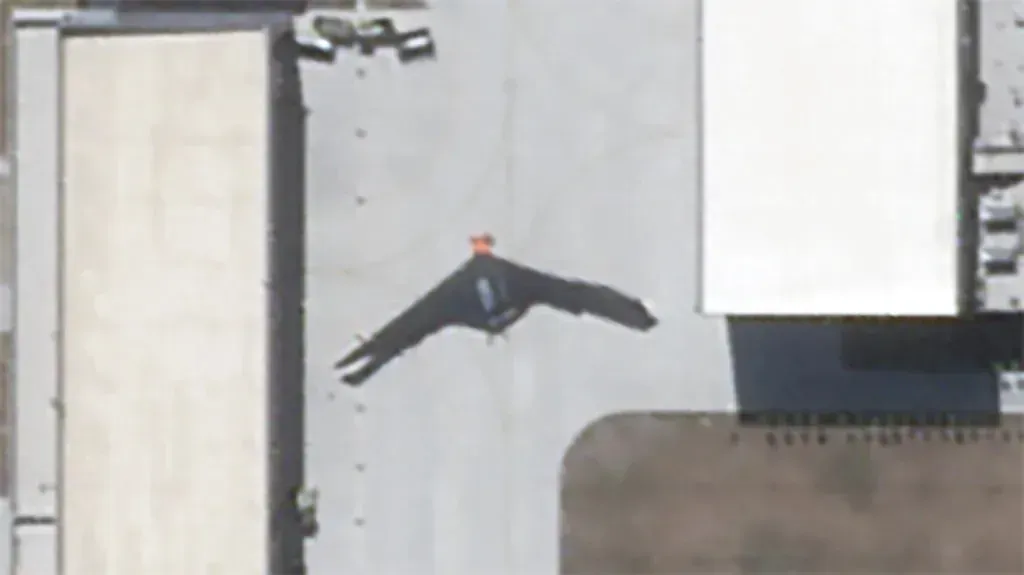
New imagery appearing out of China provides the best look yet at one of the country’s most enigmatic aircraft: the very large, low-observable, flying-wing drone widely referred to as the WZ-X. Seen previously primarily in satellite imagery, TWZ broke the story of the existence of this monster high-altitude, long-endurance drone. The new views that emerged today help clear up one of the most puzzling aspects of the aircraft’s appearance, namely the unusual shape of its enormous wings.
The aircraft was first identified in satellite imagery collected in May 2025 showing the People’s Liberation Army Air Force’s (PLAAF) sprawling test facility at Malan in Xinjiang. At the time, it was difficult to determine whether some of the apparent discontinuities in the wing planform were genuine features, visual countermeasures, or artifacts of the imagery.
The new photograph, seen at the top of the article and below, as well as a new satellite image, shows that the aircraft has a broader-chord inner wing section that transitions into a substantially narrower outer section. Rather than tapering continuously from the center section toward the tips, the wing effectively becomes much more slender over its outer portion in a ‘step down’-like fashion. The resulting planform gives the aircraft an exceptionally long, narrow outer wing. The wing arrangement differs from the B-2 and other stealthy flying wing designs because it has two outer wing sections, in addition to its diamond-like central fuselage, instead of just one.
We still can’t say for sure if this feature is just the way the aircraft’s wing was designed or if it also is due to some other exotic feature, such as wing folding or removable outboard sections. While a more novel explanation is possible, it is somewhat improbable at this point.
Seen from behind, the aircraft has a relatively shallow central fuselage section, with extremely long wings extending outward from it. The landing gear is extended, revealing large main undercarriage doors and substantial landing gear consistent with an aircraft of this size. Split rudders are visible toward the outer wing areas, broadly reminiscent of those used on the B-2.
An earlier view of the WZ-X. via Chinese internet
As in previous imagery, the rear of the center section of the aircraft may also reveal slot-like exhaust openings, supporting the assessment that it is twin-engined.
For an aircraft intended to spend long periods operating at high altitude, a very long overall span combined with a relatively narrow outer wing could be advantageous. Such an arrangement would increase effective aspect ratio and reduce induced drag during efficient cruise, potentially improving endurance and high-altitude performance.
It may also allow the designers to concentrate structural mass and internal volume closer to the center of the aircraft while still achieving a very large span.
There is a potential low-observable tradeoff, however. A significant change in chord introduces additional planform geometry and potential edge-alignment discontinuities that must be reconciled with the requirements of a stealth aircraft. The transition will influence radar reflections depending on its precise shape, orientation, and relationship to the aircraft’s other edges and surfaces. This will also be highly dependent on the aspect the radar is viewing the aircraft from. Modern very low observable designs try to minimize these exact types of features, with large continuous structures being the most advantageous to radar signature. This philosophy can be seen in the design of the B-21’s planform, which was also how the B-2 was supposed to look originally. You can read all about this here.
Regardless, the WZ-X does indeed have a semi-sawtooth trailing edge due to this intriguing feature.
New images of the so-called WZ-X stealthy flying-wing drone. via Chinese internet
The overall scale of the aircraft is also becoming increasingly apparent. Our initial analysis of satellite imagery put its wingspan at approximately 170 feet, roughly comparable to the 172-foot span of the B-2. That would make it considerably larger than other Chinese flying-wing drones identified to date.
Andreas Rupprecht, an analyst specializing in Chinese military aviation and TWZ contributor, assesses that the WZ-X is likely a twin-engined design similar in configuration to the supposed U.S. RQ-180, but considerably larger.
Rupprecht estimates a length of approximately 46 feet. He also assesses the aircraft as having a relatively spacious central fuselage and a dorsal satellite communications antenna. His estimates of a range exceeding 12,000 miles and a normal cruising altitude of somewhere between 59,000 and 66,000 feet remain unconfirmed.
The WZ-X is notably different from China’s smaller flying-wing designs. The CH-7, for example, has a deeper and more curved center section and is substantially smaller. The WZ-X’s broad, relatively flattened center body and enormous span instead appear particularly compatible with high-altitude endurance.
CH-7 stealthy flying-wing drone. via Chinese internet
Its apparent configuration also makes a long-duration surveillance mission plausible. The central body and inner wing section would provide substantial space for fuel, sensors, and communications systems, while the outer wing, combined with its lifting central body, could support highly efficient flight at high altitude.
A low-observable platform of this size could potentially conduct many types of wide-area surveillance and networking assistance while operating in or very near contested airspace where conventional high-altitude UAVs would face greater risks. A strike capability cannot be ruled out, particularly given China’s broader development of combat-capable flying-wing UCAVs, but the aircraft’s proportions appear especially well suited to persistence and reconnaissance.
While the location of the latest imagery is unconfirmed, Malan has developed into a massive center for Chinese drone testing, with satellite imagery showing extensive expansion of its infrastructure in recent years. The facility has been associated with multiple flying-wing designs, including the WZ-X and the similarly mysterious and also very large GJ-X. This substantially different flying-wing aircraft with a cranked-kite planform is also undergoing flight testing. That aircraft is estimated to have a wingspan of around 137 feet, underscoring the breadth of China’s experimentation with large low-observable uncrewed aircraft.
China is pursuing tailless/flying-wing designs across an increasingly wide range of sizes and missions, alongside larger crewed aircraft programs including the J-36 and J-XDS and, eventually, the H-20 stealth bomber.
The WZ-X appears to be part of a much broader effort to develop highly integrated, low-observable aircraft optimized for different combinations of range, endurance, payload, and survivability.
For now, its official designation, manufacturer, propulsion system, performance, and intended mission remain unknown.
However, its configuration appears well suited to the requirements of a very large high-altitude endurance aircraft, although the trade-off between its performance and its stealth characteristics remains equally mysterious.
Gov. George Deukmejian named on Monday Ventura County Superior Court Judge Kenneth R. Yegan to join the state 2nd District Court of Appeal, fulfilling the judge’s longtime dream of becoming an appeals court justice.
If a judicial review panel confirms Yegan’s nomination to the court’s 6th Division on Dec. 27, he will replace Justice Richard W. Abbe, who retired Nov. 28 after eight years on the three-member court.
“If I get confirmed on the 27th, I’ll take the oath right on the spot and hope to report to work the next day,” said Yegan, 43, of Westlake.
The review panel, composed of Supreme Court Justice Malcolm Lucas, Atty. Gen. John K. Van De Kamp and presiding 2nd District Court of Appeal Justice Lester Roth, is scheduled to meet next week in Los Angeles to discuss Yegan’s qualifications.
If confirmed, he will consider appeals cases from Ventura, Santa Barbara and San Luis Obispo counties with Justices Steven J. Stone and Arthur Gilbert, who have served on the 6th Division bench since it was established in 1982.
“Without even thinking about it, I’m really ecstatic about the appointment,” said Gilbert, who has reviewed Yegan’s Superior Court opinions on appeal and worked with him when Yegan served as a temporary appeals justice in the summer of 1986.
“I think he’s as good as you can get. He’s just first-rate,” Gilbert said. “He supports his point of view with well-reasoned statements of decision on the Superior Court, and he did the same thing when he was here.”
Stone said Yegan has a reputation for being able to handle all levels of appeals work, from doing legal research to writing the final draft of opinions.
“I have a lot of respect for Ken and I think that he will work very well with us,” Stone said. “I’m looking forward to it.”
Yegan said that Deukmejian called him Friday to offer him the seat. He said the governor swore him to secrecy until Monday, but gave him permission to tell his family.
“My wife was home with my oldest daughter and she was screaming, and my daughter was screaming,” Yegan said. “After they calmed down a little bit she asked me if I could pick up my youngest daughter from ballet and asked if I could go to the store and pick up some things. . . .and that’s when I knew things hadn’t changed.”
The focus of Judge Yegan’s work has not changed much from his first days in law. He said he has been fascinated by appeals work ever since law school.
“I took all the courses I could in law school in appellate practice,” Yegan said. “It’s intellectually challenging and it’s very stimulating to figure out where the facts meet the law and. . . .which is the better-reasoned opinion.”
Yegan graduated in 1972 from the University of the Pacific’s McGeorge School of Law in Sacramento and began work as a deputy in the Ventura County public defender’s office, handling trials and appellate cases.
Beginning in 1975 he worked as a senior attorney in the appeals court’s 5th Division in Los Angeles, researching cases and helping justices write opinions. In January, 1983, Gov. Edmund G. Brown Jr. appointed him to the Ventura County Municipal Court.
Deukmejian elevated him to the Superior Court in July 1986, where he tried criminal, civil and cases appealed from Municipal Court.
In recent months, Yegan said, letters urging his nomination have flowed into the governor’s office from County Dist. Atty. Michael D. Bradbury, Sheriff John V. Gillespie, three Supreme Court justices and a variety of appeals court justices, trial court judges and lawyers.
Abbe said of Yegan’s appointment: “His work when he was. . . .here was excellent. He was knowledgeable, he was able to evaluate cases quickly and accurately and make sensible decisions.”