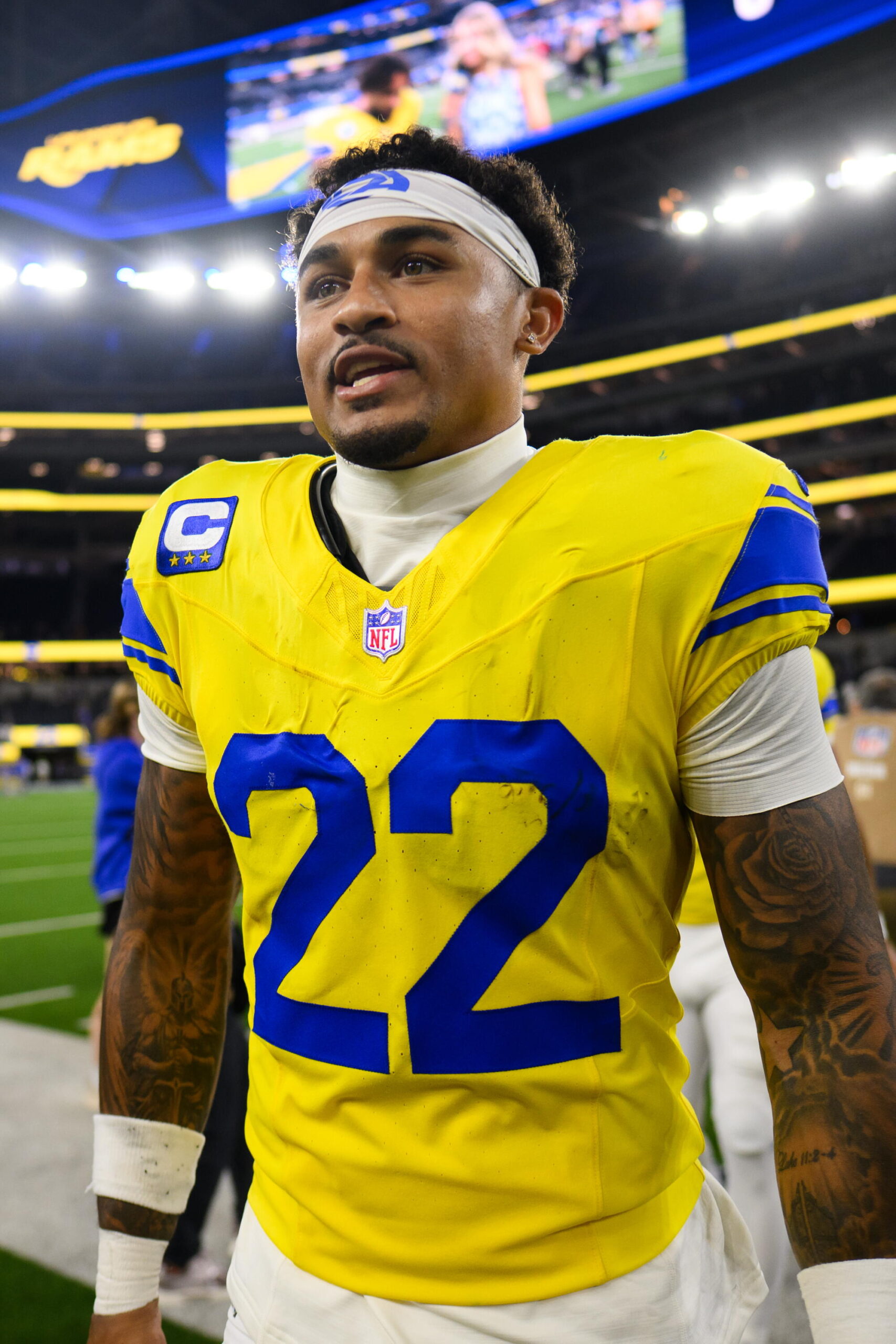
Trent McDuffie provides Rams with a calm, confident leader
Rams coaches and personnel executives call it “the moment of truth,” the split second when a defensive back, usually on the run in full stride next to a receiver, must decide how he is going to play a pass that is already in the air.
Top NFL cornerbacks remain calm. They do not panic.
“It’s those guys that just kind of — their blood pressure never rises,” defensive coordinator Chris Shula said.
Trent McDuffie is one of those guys.
The Rams traded for the All-Pro cornerback in March, sending the Kansas City Chiefs the 29th overall pick and three other draft picks for the four-year veteran. They quickly signed McDuffie to an extension that includes $100 million in guarantees.
Last Monday, McDuffie intercepted a pass in the Rams’ 28-6 victory over the New York Giants, a win that helped erase some of the sting from their embarrassing season-opening defeat by the San Francisco 49ers in Australia.
In McDuffie, a two-time Super Bowl winner, the Rams got even more than expected, coach Sean McVay said.
“He just has an amazing emotional intelligence of how to uplift and lead his teammates and challenge them in a way that’s authentic to his personality,” McVay said. “He loves the opportunity to be able to have some of the hard downs that a lot of corners sometimes don’t want, but this guy wants them.”
McDuffie, 26, is looking to make more plays Sunday night when the Rams play the Denver Broncos at Empower Field at Mile High.
With the Chiefs, McDuffie played against the Broncos six times, and he is still looking for his first interception against the former AFC West rival.
But mainly, he aims to help the Rams continue their momentum after giving up only two field goals against the Giants.
“It was one of those attitude games, where we didn’t have the greatest Week 1 performance,” McDuffie said. “So there was a little chip on our shoulder, a little attitude we brought.”
McDuffie began his rise to NFL stardom during a high school career that featured stops at Santa Ana Mater Dei, Anaheim Servite and Bellflower St. John Bosco, before playing in college at Washington.

Rams cornerback Trent McDuffie walks off the field after a win over the New York Giants on Sept. 21.
(Kyusung Gong / Associated Press)
The Chiefs selected him in the first round of the 2022 draft, and he helped them make three Super Bowl appearances, winning two.
McDuffie said he learned a tough but valuable lesson against the Philadelphia Eagles in Super Bowl LVII in Arizona in 2023.
With the ball at the Chiefs’ 45-yard line, the 5-foot-11 McDuffie lined up against 6-1, 225-pound receiver AJ Brown. As they ran downfield, McDuffie saw the ball in the air. But he did not know which way to turn his head. He did not know how he wanted to play the ball.
Brown caught the pass for a touchdown.
“Too much thinking in my head to where I didn’t make the play,” McDuffie said.
McDuffie turned the experience into a positive while developing into one of the NFL’s top players at his position.
“From then on, it was almost like, ‘All right, the ball’s in the air, it’s not so much a panic, it’s like you get an opportunity now,’” McDuffie said. “When you’re a DB in the NFL, there’s only so many times they’re going to throw the ball your way. There’s only so many times you’re in a position to make a play, so just kind of calming myself down.
“When the ball’s in the air, don’t panic — just become the receiver. Get back to the basics. You know how to play football. You know how to catch the ball. Just go make a play.
“And really, it’s the fear of failure that I don’t have anymore. Like if they make a play, they make a play. Let’s just line up and let’s keep attacking.”
The next season, despite not intercepting a pass, McDuffie earned All-Pro recognition. He forced five fumbles and had three sacks.
It did not take long for McDuffie to make an impression on his Rams teammates. During offseason workouts and training camp, he established himself as a leader and was voted a team captain.
His first interception for the Rams was the fourth of his career.
“I was in the right place at the right time to make the play,” said McDuffie, who also broke up three other passes, “but I think overall as a group we really took a step in the right direction, which looking back at the film was the most exciting part for me.”
Rams receiver Davante Adams raved about McDuffie during training camp. This week, he said McDuffie had been the “best-kept secret” in Kansas City.
“I’m just glad to see him making plays on guys that aren’t our receivers now,” Adams said. “Go out there and do his thing, show the world.”
Defensive lineman Aaron Donald did not see McDuffie up close until he came out of retirement to rejoin the Rams last month. McDuffie made an impression in Donald’s first game against the Giants.
“I usually don’t watch the DBs,” Donald said, “but he caught my eye. He’s something special.”
On Sunday, McDuffie won’t be the only elite cornerback on the field. “There’s a ton of great corners in the league,” McDuffie said, but he regards Patrick Surtain II of the Broncos, the 2024 NFL defensive player of the year, as the best.
“It’s always fun just being able to see him in person and work his craft,” McDuffie said.
McDuffie intends to showcase his own against a Broncos team that features quarterback Bo Nix operating coach Sean Payton’s offense.
The Rams are seeking another dominant performance.
“Now that we did it once,” he said, “now we have to prove it again.
“That’s kind of the standard.”