Venezuela: Arts Students Demand ‘Dignified’ Conditions, Authorities Promise Answers
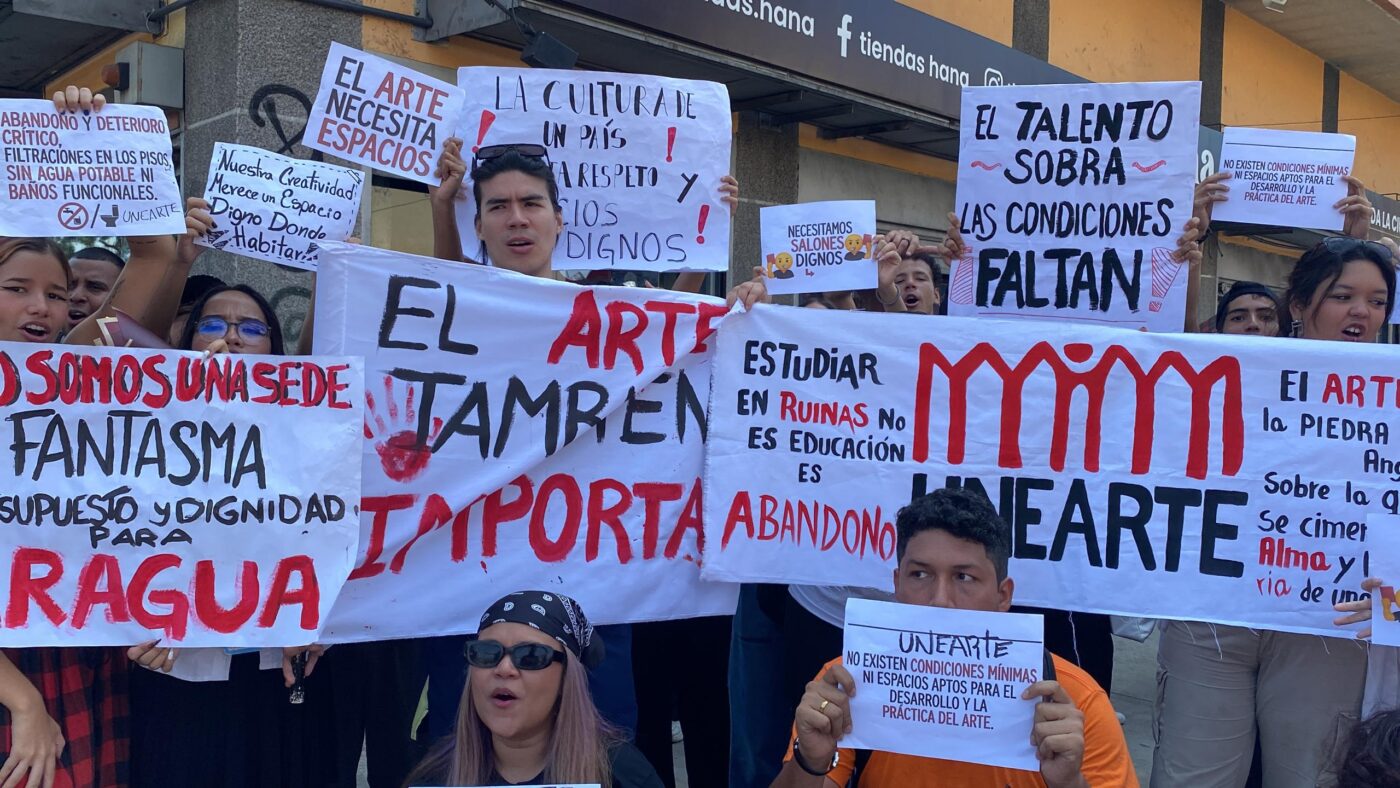
UNEARTE students have staged demonstrations in Maracay and Caracas. (El Siglo)
Caracas, October 22, 2026 (venezuelanalysis.com) – Students from the Venezuelan Experimental University of the Arts (UNEARTE) have staged multiple demonstrations in recent days to press for solutions to infrastructural and administrative issues.
Students from the UNEARTE branch in Maracay, Aragua State, blocked a major intersection on Tuesday to demand “dignified” studying conditions.
“We are staging a peaceful demonstration to demand improvements to our academic conditions,” student José Pérez told local reporters. “We do not have our own campus, and the facilities are inadequate for the artistic areas we are studying.”
Protesters held billboards and banners calling for a “dignified campus.” UNEARTE’s Maracay education programs function in different rented spaces, which students have complained are in deteriorating condition.
The Maracay demonstration followed a number of protests and sit-ins at UNEARTE’s main campus in Caracas. Students denounced that multiple university installations are shut down or in a state of disrepair. The Modest Bor center, which houses UNEARTE’s music program, has been partially closed for several years.
In addition, students decried that UNEARTE centers’ cafeterias have been shuttered for months, while many have additional grievances including inoperative bathrooms and software issues that left many students unable to properly register for classes.
In response to the protests, Venezuelan authorities vowed to address the concerns raised by students. UNEARTE Rector Ignacio Barreto approached students during a demonstration and promised that the registration process would start over.
The Ministry of Culture, which is responsible for UNEARTE alongside the Ministry of Higher Education, held an assembly with all university personnel and announced the creation of working groups with student representatives in several areas.
“This commission, apart from listening to the students and the authorities, should have a weekly plan that can be supervised,” Culture Minister Alejandro López told press. “Accountability before the students is key.”
López, Barreto and other officials were seen inspecting several university facilities last week. The minister pledged to address issues of running water, internet connectivity, and transportation in the near term.
UNEARTE was created by former President Hugo Chávez in 2008, bringing together several educational institutes dedicated to the arts with the aim of advancing a popular and anti-colonial pedagogical approach. It offers degrees in music, dance, film, theater, photography, and plastic arts.
The protests over UNEARTE’s disrepair and deficient conditions coincided with the Venezuelan government’s launch of the José Antonio Abreu Music University. Acting President Delcy Rodríguez headlined the inauguration ceremony earlier this month.
The new public university will have its state-of-the-art campus in the traditionally middle-class southwestern Caracas parish of El Paraíso, including three concert halls and a research center. It will also have 18 regional branches, with a maximum enrolment capacity of around 3,500 students.
Other Venezuelan universities have likewise seen student demonstrations in recent days. In the “Dr. Humberto Fernández-Morán” National Sciences University, students held a protest and an assembly on Monday over what they characterized as inadequate transportation.
The campus is located in Los Teques, some 25 kilometers outside Caracas, and was formally inaugurated in December 2024. Though the university promised to provide transportation, students have complained that the assigned buses are unreliable and have insufficient capacity.
Higher education trade unions have also been at the forefront of regular labor protests in recent months. Venezuelan working-class organizations have called for non-wage bonuses to be converted to salaries and for the restoration of collective bargaining agreements.
Edited by Lucas Koerner in Philadelphia, USA.