The homeless National Symphony finds shelter at the Hollywood Bowl
A wonderful Oval Office perk is what Thomas Jefferson dubbed “The President’s Own.” At the president’s beck and call is the United States Marine Band, created by an act of Congress in 1798.
But for an acquisitive current occupant of the White House, the oldest continuously active musical organization hasn’t seemed enough. In his appropriating the John F. Kennedy Center for the Performing Arts, also created and officially named by Congress, the president obtained the National Symphony Orchestra. Unlike its “President’s Own” sibling, which is supported by the Defense Department annual allotment of some $400 million for military bands, the NSO is administered, funded (between a third and half of its $35-million budget) and lately threatened by what are now the whims of the Kennedy Center.
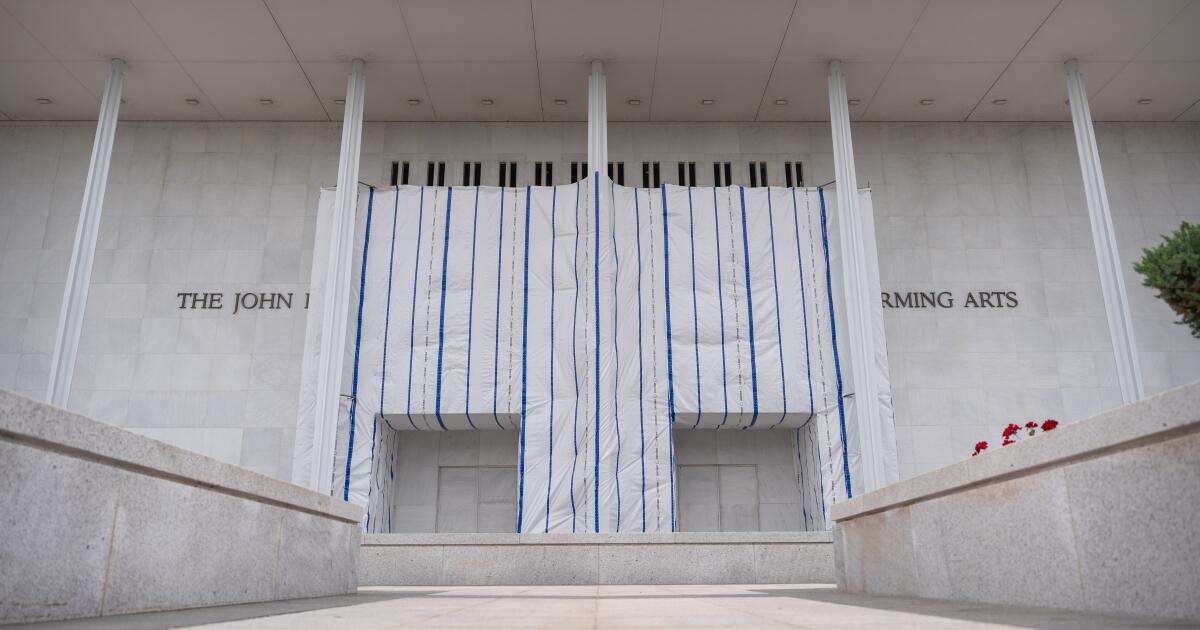
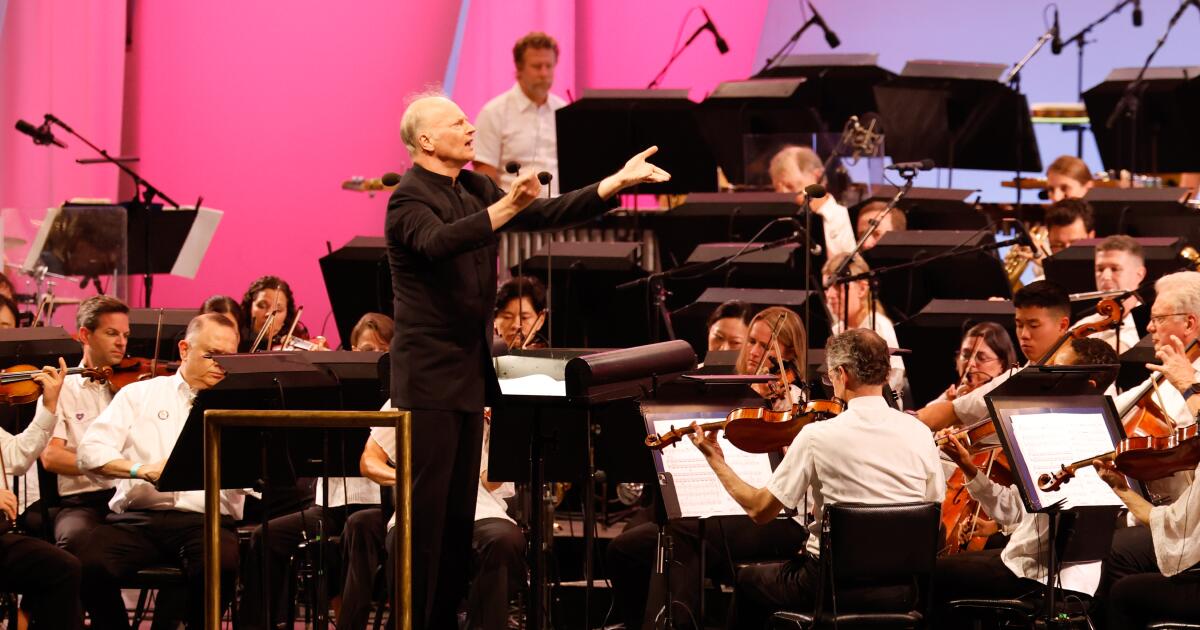
The NSO appeared at the Hollywood Bowl on Tuesday night, however, with a collective sigh of relief. A week earlier the Kennedy Center Board, without congressional input or legal approval, approved an imminent, two-year closure of the venue for repairs and remodeling, with little word about the homeless or economic future of its artist affiliate. By early August, no new NSO season, which would begin in September, had been announced.
But Tuesday morning, the NSO, in fact, did lay out a full and musically substantial season, the 10th for its music director, Gianandrea Noseda. Not taking a chance on the courts preventing a Kennedy Center closure, the NSO will become next season a peripatetic ensemble performing in various venues in and around D.C., as well undertake a national tour in the spring. Uncertainty remains, but for now all is as well as can be expected.
The NSO, however, offered little of what to expect. I can only find one program next season as unimaginative as Tuesday’s at the Bowl. The orchestra looks forward to several premieres of new works by lively composers and a variety of significant guest conductors, including the venturesome Teddy Abrams (who will lead the Los Angeles Philharmonic’s season-opening gala) and eclectic former NSO music director Leonard Slatkin (who is also the former L.A. Phil principal guest conductor for the Hollywood Bowl). Noseda’s only other bland program will be the one he brings on tour to The Soraya in April.
Hearing the NSO at the Bowl, moreover, is an act of guess work. With the new immersive sound system, orchestra impact becomes a matter of technology, giving individual instruments paranormal prominence and turning full orchestra glory into a sensual sound bath. Still, with its smooth strings, creamy brass, pungent winds and friendly percussion, Noseda’s NSO came across as a gracious orchestra meant to please, and, consequently, a seemingly marvelous anomaly in an otherwise divisive present-day D.C.
But that offered few favors for Leonard Bernstein’s Symphonic Dances from “West Side Story” or Gershwin’s “An American in Paris,” where the Bowl has regularly hosted far more idiomatic, swinging performances. Dvorak’s “New World Symphony” in the second half was, on the other hand, satisfyingly full-bodied. While Noseda sometimes practices likability to a fault, his sense of drama is ever sure, and it is hard to get enough of the lyrical sweetness he conveys. As an encore, Noseda led the overture to Bernstein’s “Candide” with real flair.
But why commonplace “Candide” and “West Side Story,” when Bernstein wrote “Slava! A Political Overture,” for the NSO as tribute in 1977 to its Russian music director, Mstislav Rostropovich? Might not the NSO make a point with “Three Mediations” from “MASS,” Bernstein’s multimedia masterpiece that controversially opened Kennedy Center in 1974. Bernstein also wrote a major late work for the NSO, “Songfest.” Bernstein, himself, conducted the Los Angeles Philharmonic in the West Coast premiere at the Bowl in 1983, which had special significance because his collaborator on “Songfest,” Tom Cothran, who happened to have grown up in Pasadena.
For his part, Noseda has done an exceptional job in championing major Black composers at home and on record. Carlos Simon has been the NSO’s composer in residence for the last five years, and Noseda has revived and recorded an essential album of works by George Walker. In October, Noseda and the NSO will release a recording of two symphonies by William Grant Still, who lived in L.A. Deeply evocative of a post-Dvorak new world, they are beautifully played on the new recording and would have been ideal for the Bowl.
The NSO has given up on the Kennedy Center, but must we? There are many questions that have not been considered. The current plan for infrastructure improvements and slapdash redecorating at the cost of $250 million. In fact, the facility’s playhouse, opera theater and concert hall are due for major renovations. But that requires significant planning, the hiring of a major architecture firm with concert hall experience, a first-rate acoustician and, ideally, four times the allotted budget.
This is clearly a long-term job for Congress and consultants who would do well to study the approach of the Salzburg Festival. It has been planning for several years to rehabilitate its large concert hall (which is of similar vintage to the Kennedy Center), which will require five years and a cost of around $600 million. It is also carefully examining alternate performance sites to be used during construction.
The Kennedy Center is a memorial, and before another new idea is allowed out, let the Kennedy Center board visit Lincoln Memorial Reflecting Pool for a moment of reflection on how and why to bring the NSO, America’s Own, back home. In the background, the U.S. Marine Band could offer its kin moral support by playing in the background Ives’ mysteriously transcendental “Unanswered Question.”