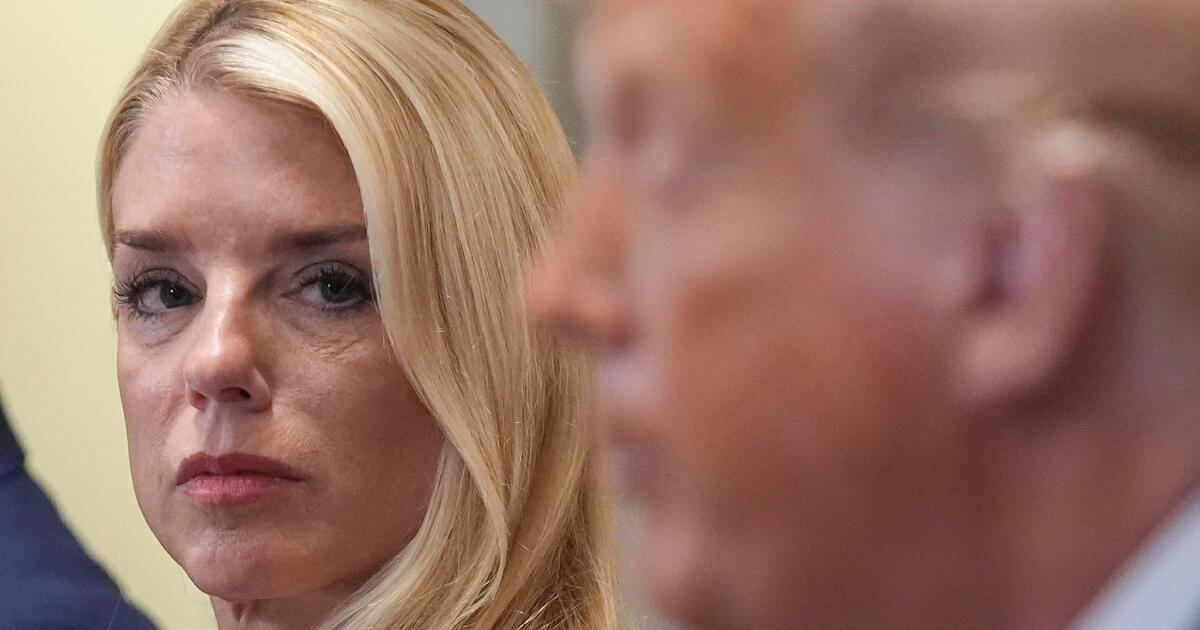
WASHINGTON — Pam Bondi is out of her job after failing to deliver criminal cases against President Trump’s political enemies.
But there’s no guarantee her successor will have any better success at placating the president.
Over the last year, Bondi’s Justice Department has encountered resistance from judges, grand jurors and its own workforce in trying to establish criminal conduct by one Trump foe after another. A new attorney general will confront not only Trump’s demand for political prosecutions — a constant dating back to his first term in the White House — but also the same skeptical court system, and factual and legal hurdles, that have impeded efforts to deliver the sought-after results.
“At the end of the day, it’s not like there were some magic steps that Pam Bondi could have taken to make bad cases look good to grand juries or judges,” Peter Keisler, a former acting attorney general in President George W. Bush’s administration, said in an email. “The problem is that the president is demanding that prosecutions be brought when there’s no evidence and no valid legal theory. A new Attorney General won’t change that.”
Bondi was just the latest Trump attorney general pressed to meet the president’s demands of loyalty and desire for retribution. Trump in his first term called for Jeff Sessions to investigate Democrat Hillary Clinton and ultimately pushed him out over his recusal from the Russia election interference investigation. He berated another attorney general, William Barr, over Barr’s refusal to back his false claims of election fraud in the 2020 contest. Barr resigned soon after.
Bondi arrived at the Justice Department 14 months ago seemingly determined to remain in Trump’s good graces unlike her predecessors had, heaping praise on him, offering unflinching support and embarking on investigations into Democrats and the president’s adversaries — even amid concerns from career prosecutors about the sufficiency of evidence.
Days after Trump implored Bondi via social media last September to prosecute former FBI Director James Comey and New York Atty. Gen. Letitia James, the Justice Department did just that, securing indictments in Virginia.
But the win was short-lived: a judge weeks later dismissed the cases after finding that the prosecutor who filed them, Lindsey Halligan, was illegally appointed. Grand juries have since refused to bring new mortgage fraud charges against James and the Comey case is mired in a thorny evidentiary dispute and statute of limitations concerns. Both Comey and James have vigorously denied any wrongdoing and called the cases against them politically motivated.
Since then, a federal grand jury in Washington refused to return an indictment against Democratic lawmakers in connection with a video in which they urged U.S. military members to resist “illegal orders.” And a federal judge has quashed Justice Department subpoenas issued to the Federal Reserve as part of an investigation into testimony last June by Chair Jerome Powell about a $2.5 billion building renovation.
The judge, James Boasberg, said that the government has “produced essentially zero evidence to suspect Chair Powell of a crime” and called its justifications for the subpoenas a “thin and unsubstantiated” pretext to force Powell to cut interest rates. A prosecutor on the case subsequently conceded in court that the investigation had not found evidence of a crime.
An additional investigation into a Trump enemy remains underway with prosecutors in Florida scrutinizing former CIA Director John Brennan over testimony to Congress related to Russian interference in the 2016 election. That investigation has been open for months, but has not produced charges and it’s not clear that it will. Brennan’s lawyers have similarly called the investigation baseless.
One high-profile Trump critic who could face trial in the years ahead is his former national security adviser, John Bolton, though the investigation that produced that indictment and examined Bolton’s handling of classified documents began before Trump took office.
For now, the Justice Department will be led by Deputy Atty. Gen. Todd Blanche, who has a longstanding relationship with Trump after having served as one of his personal lawyers. Several people familiar with the matter told the Associated Press on Thursday that Lee Zeldin, a Trump loyalist and head of the Environmental Protection Agency, has been privately mentioned by Trump as a possible pick.
Whoever holds the job in the long term will almost certainly be expected to carry out Trump’s retribution campaign with more success, said Jimmy Gurule, a former Justice Department official and law professor at Notre Dame. Blanche appeared to acknowledge as much in a Thursday evening interview with Fox News, saying “I think the president is frustrated, everybody is frustrated ” and that “what we saw happen for the past four years is unforgivable and can never happen again.”
“If she was fired because Trump did not think that she was moving quickly enough in bringing criminal cases against his political enemies, then you would expect that the person that would replace her would probably agree to escalate those efforts,” Gurule said.
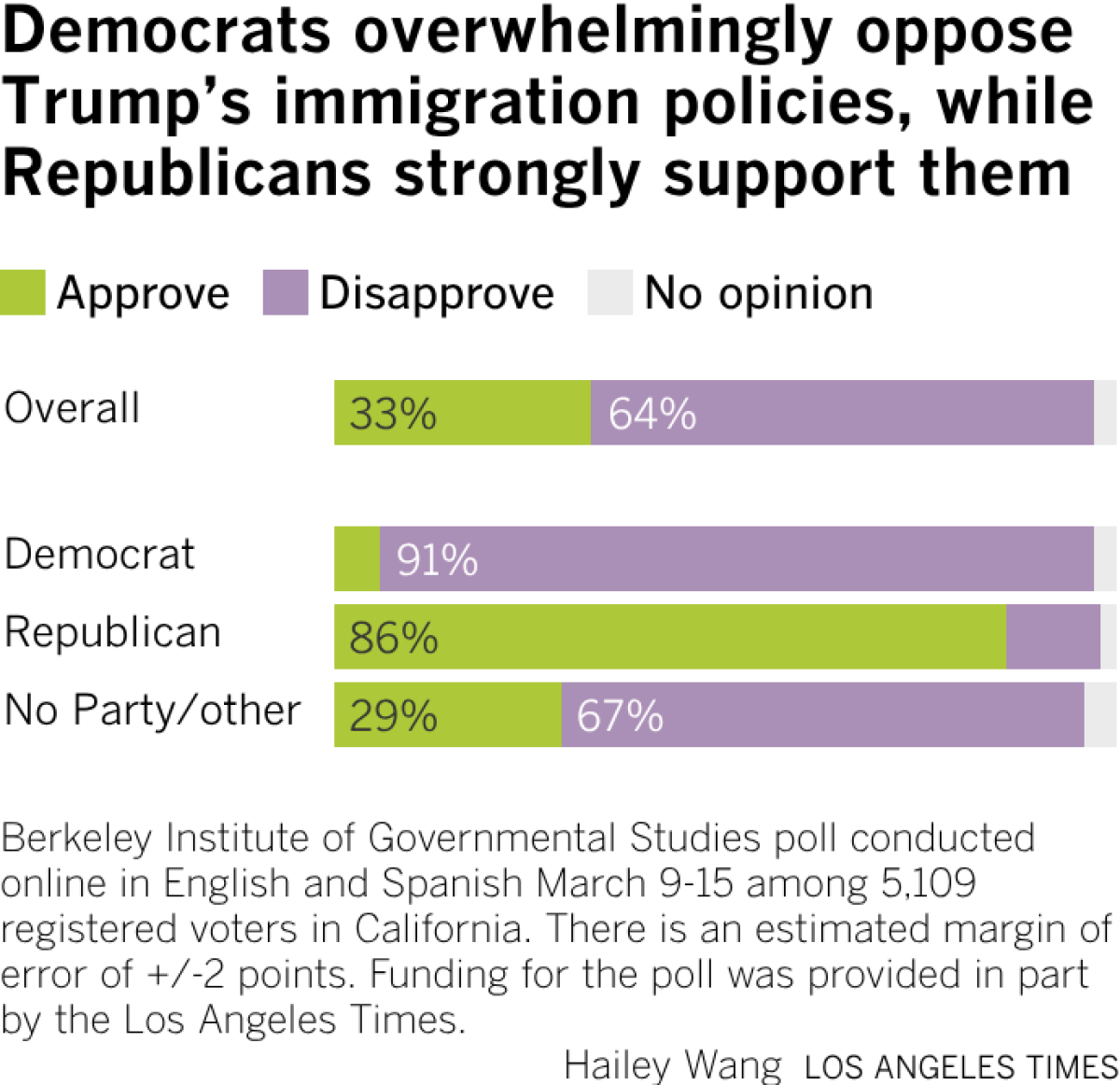
WASHINGTON — Two-thirds of California voters disapprove of President Trump’s immigration policies and a majority believe those policies are discriminating against Latinos, according to a new poll.
Nearly half of the voters said they were concerned that they, a family member or a close friend could be detained because of Trump’s immigration policies.
The findings of the UC Berkeley Institute of Governmental Studies poll, released Wednesday, show that most Californians haven’t budged on their thoughts about the president’s approach to immigration since he returned to office. A poll last August similarly showed strong disapproval of the Trump administration’s approach to immigration enforcement.
The poll, which was conducted for the Los Angeles Times, showed the usual division along party lines when voters were asked whether they trust the U.S. Border Patrol and Immigration and Customs Enforcement, whether agents should wear masks while on duty, and whether Latinos are being discriminated against.
“This suggests that a significant number of voters see ICE infringement on the individual rights of the undocumented as also potentially leading to broader infringements on citizens’ rights,” said G. Cristina Mora, co-director of the institute and a sociology professor at UC Berkeley who studies race and immigration.
“Latino voters also seem to particularly worry about the way that racism is motivating current immigration practices,” she said, which is likely tied to the Supreme Court’s approval of immigration agents detaining people on the basis of their perceived race, ethnicity, language or occupation.
The overall disapproval among voters of Trump’s immigration policies — 64% — was down a bit from the August poll, in which 69% of respondents said they disapproved of how immigration enforcement was being carried out in California.
Republicans appear to be more approving of immigration policies now, with 86% saying they approve of Trump’s immigration policies — up from 79% approval of enforcement in California last August.
Mora said the tilt among California Republicans toward the Trump administration could be due, in part, to the framing of the question, which asked about “President Trump’s immigration policies.”
Any time Trump’s name is included, Republicans are more likely to agree with him, she said. The same effect is seen when asking about other issues, such as the economy.
Another factor could be the timing, Mora said. Last summer, federal agents conducted widespread raids in Los Angeles before moving on to target other cities, such as Chicago and Minneapolis.
Now that the administration has shifted away from some tactics that resulted in escalations of violence, Republicans are “falling in line” again with the administration, she said.
“My hunch is it was shocking,” Mora said of the immigration raids last summer. “Things have normalized because the tension is somewhere else.”
Seeking to de-escalate after two protesters were shot and killed by federal agents in Minneapolis, the president tapped his border advisor Tom Homan to take control of the immigration enforcement operation there.
Republican strategist Ford O’Connell said that’s why voters are more supportive.
“Tom Homan being in charge and publicly taking a much lighter touch and appearing reasonable to the average voter is why you’re seeing this turnaround,” he said.
But Democratic strategist Maria Cardona said that that’s wishful thinking and that ICE’s approach hasn’t substantially changed.
“It only went down five points,” she said, referring to the disapproval of Trump’s policies. “That’s not the American people being on the side of the administration — it’s that they’re not seeing American citizens murdered on their screens every day.”
One question saw strong division among Republicans: Should immigration agents be allowed to enter the homes of suspected undocumented immigrants without a judge-approved search warrant?
Among California Republicans, 45% said no, 38% said yes, and 17% said they have no opinion.
O’Connell said that’s because Republicans strongly value civil liberties, especially around property.
Republicans were more strongly in favor of a different policy, allowing ICE agents to wear masks while on duty. While 91% of Democrats opposed the policy, 68% of Republicans favored it.
In the August poll, 45% of Republicans said federal agents should be required to show clear identification when carrying out their work. That desire for identification doesn’t appear to extend to being fully identifiable by face.
O’Connell said Republicans understand the concern over agents increasingly being doxxed.
“The administration wants to find a happy medium there, whether it’s a nameplate or a badge number,” he said. “There is wiggle room.”
Nearly 7 in 10 respondents said they want state and local authorities to intervene when they witness unlawful detentions or excessive use of force by federal immigration agents.
Voters were also asked about their level of concern that they, a family member or a close friend could be detained because of Trump’s immigration policies. While 85% of Republicans said they are not too concerned or not concerned at all, 63% of Democrats said they are somewhat or very concerned.
Overall, nearly half of the respondents, 45%, said they are somewhat or very concerned. Among racial and ethnic groups, 62% of Latino voters, 46% of Black voters and 43% of Asian or Pacific Islander voters said they are somewhat or very concerned.
“The Latino community has always wanted to think the best of this country and they still do,” Cardona said. “Our positivism, our optimism, our hope in a better future is second to none. I think that’s what you’re seeing in those numbers, even as our community feels totally attacked.”
Mora said the high concern among Black residents is notable because, while most Black Californians aren’t immigrants themselves, Los Angeles has one of the largest concentrations of Blaxicans — the children of one Black parent and one Latino parent.
Beyond intermarriages, Black residents in California are also likely to have immigrant friends or neighbors, she said.
O’Connell took a different view: “I don’t think we can glean anything from it other than how one party focuses more on identity politics than the other.”
The Institute of Governmental Studies poll was completed online in English and Spanish from March 9 to 15 by 5,109 registered voters in California.
Democratic lawmakers are demanding scrutiny into Paramount Skydance’s financial backers amid rising concerns about potential foreign influence of U.S. media properties.
In a letter this week to Federal Communications Commission Chairman Brendan Carr, seven U.S. senators criticized Carr’s suggestion that Paramount’s $111-billion bid for Warner Bros. Discovery, backed by billionaire Larry Ellison and his family, was on a fast track to receive FCC approval with scant oversight.
Such complicated mergers typically receive an intense government review. The proposed merger would combine two legendary film studios, dozens of cable channels, HBO, CBS and two major news organizations, CNN and CBS News.
Ellison and his son, David, who chairs Paramount, are friendly with President Trump, who has long agitated for changes at CNN, which is slated to be absorbed by Paramount.
The company has said it expects to complete the deal by the end of September.
The Democrats expressed concerns that the fix may be in. Trump’s Justice Department has been reviewing whether the merger would violate U.S. antitrust laws, but a key deadline passed last month without comment from the department’s antitrust regulators.
Late last year, Paramount disclosed that it had lined up $24 billion from wealth funds representing the royal families of Saudi Arabia, Qatar and Abu Dhabi, who would then become equity partners in the combined company.
Paramount has described the funds as largely passive investors, saying the royal families would not have input into corporate decision-making. They also would not control seats on the Paramount-Warner board.
Congressional Democrats previously have warned about potential national security concerns. The senators, led by Cory Booker (D-N.J.) and Chuck Schumer (D-N.Y.), remain concerned, particularly because the transaction will help shape the future of Hollywood production and the direction of key news outlets, including CNN, which maintains a strong presence around the world.
Members of the party have called on Carr to conduct “a full and independent” analysis of the foreign ownership interests before signing off on the merger. The FCC could play an important role, they said, because the tie-up includes Paramount-owned CBS, which holds FCC broadcast station licenses.
Paramount declined to comment. FCC officials did not respond to a request for comment.
Booker and Schumer pointed to Carr’s comments at an industry conference in Spain earlier this month. During an appearance at the Mobile World Congress, Carr suggested the Paramount-Warner deal could be swiftly approved because the foreign investment would warrant only a “very quick, almost pro forma review,” Carr reportedly said.
The FCC has a duty to examine foreign ownership, the lawmakers said, referencing the U.S. Communications Act, which forbids owners from outside the U.S. from holding more than 25% of the equity or voting interests in an entity that maintains an FCC license.
The lawmakers mentioned the FCC’s move earlier this year to tighten its foreign ownership framework to bolster transparency.
Paramount has not yet disclosed its final list of equity partners.
The company previously disclosed its proposed partners in Securities & Exchange Commission filings. However, last month, the composition of the Paramount-Warner deal changed when Larry Ellison agreed to fully guarantee the $45.7-billion in equity needed to finance the $31-a-share buyout of Warner investors.
Before Ellison stepped up, Warner board members had expressed concerns about Paramount’s financing. The tech billionaire’s increased involvement helped carry the Paramount deal over the finish line. Netflix bowed out Feb. 26, ceding the prize to Paramount.
Still, Paramount is expected to line up billions of dollars from outside investors.
It would be significant if Saudi Arabia’s Public Investment Fund, the Qatar Investment Authority and Abu Dhabi’s L’imad Holding Co., contributed $24 billion to the deal, the Democrats wrote.
“This is not incidental capital, it represents roughly one-fifth of the total transaction value,” Booker and the others wrote. “And it is not clear that this will be the only foreign investment.”
Initially, Paramount included Chinese technology company Tencent Holdings as a minority investor, but Paramount later removed Tencent from the investor pool due to concerns about its problematic status — it has been blacklisted by the U.S. Department of Defense.
“This constellation of foreign investment from China and from Gulf States, with complex and sometimes competing relationships with the United States, demands rigorous, not perfunctory review,” Booker and the others wrote.
The letter also was signed by Sens. Dick Durbin (D-Ill.), Elizabeth Warren (D-Mass.), Richard Blumenthal (D-Conn.), Sheldon Whitehouse (D-R.I.) and Mazie K. Hirono (D-Hawaii).
They keyed in on the role of Saudi Arabia’s sovereign wealth fund, saying it was controlled by Crown Prince Mohammed bin Salman “whom the U.S. intelligence community concluded ordered the murder of Washington Post journalist Jamal Khashoggi in 2018.”
The proposed $24-billion investment would give “these governments a significant financial stake in the future content, licensing, and strategic decisions of a combined entity that includes some of the most-watched news and entertainment networks in America.”
It is also unclear whether the current tensions in the Middle East over the Iran war will have an impact on Paramount’s investor syndicate.
Democratic legislative leaders on Monday called on voters to boycott USC’s upcoming gubernatorial debate if the university does not invite candidates who were excluded from participating.
The unsparing letter adds another layer of controversy to Tuesday’s forum, which as a result of the university’s selection criteria would not include any of the leading candidates of color.
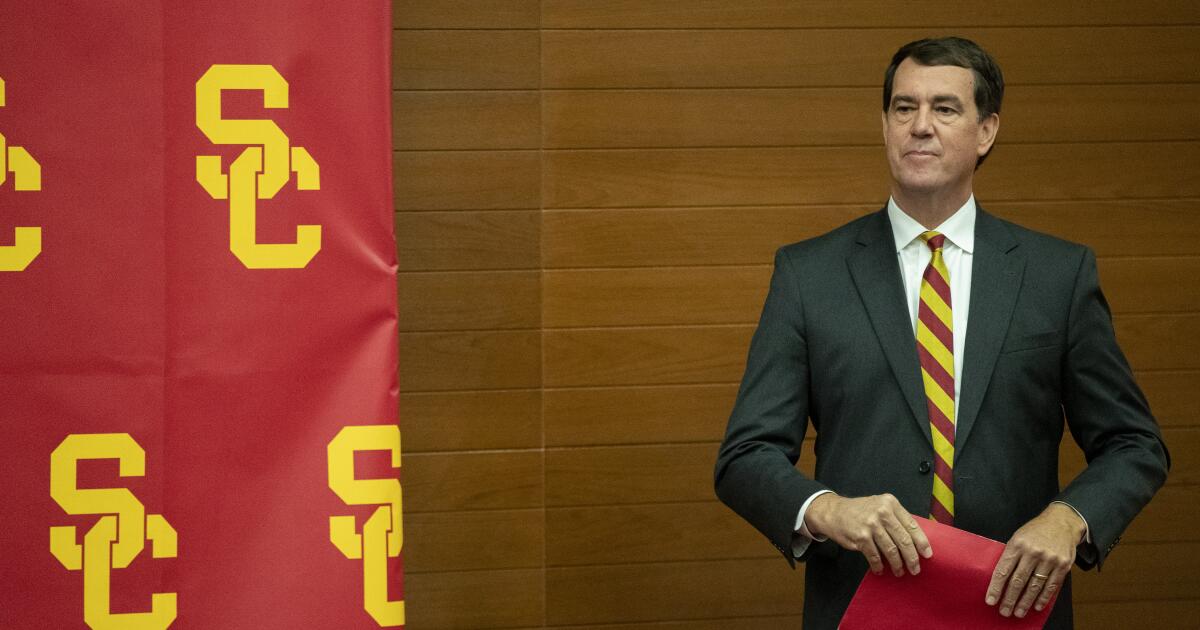
“We are writing to demand you open the March 24 gubernatorial debate to all leading candidates,” said the letter sent Monday evening to USC President Beong-Soo Kim by Assembly Speaker Robert Rivas (D-Hollister), Senate President Pro Tem Monique Limón (D-Goleta) and the leaders of the legislative Latino, Black, Asian and Pacific Islander, Native American, LGBTQ, Jewish and women’s caucuses. “The outcry over this debate is deafening and includes legal demands from the excluded candidates’ attorneys, public calls by elected leaders across the state, concerns from the included candidates’ own campaigns, and growing alarm from California voters. Instead of responding to these valid concerns by expanding the debate, USC has doubled down.”
USC officials did not immediately respond to a request for comment Monday. Tuesday’s debate is scheduled less than two months before ballots begin arriving in voters’ mailboxes.
The university has been embroiled in controversy over the criteria it used to select the candidates it invited to participate in Tuesday’s debate, which is co-sponsored by KABC-TV Los Angeles and Univision.
Specifically, critics have pointed out the methodology allowed San José Mayor Matt Mahan — a white candidate who recently entered the race and is polling poorly — to vault above former U.S. Health and Human Services Secretary Xavier Becerra, former Los Angeles Mayor Antonio Villaraigosa, state Supt. of Public Instruction Tony Thurmond and former state Controller Betty Yee.
“The university’s selection process — built on a formula never before used for a debate of this scale, has delivered a result that is biased,” the letter says. “When a methodology produces this outcome — one that elevates a candidate with notable ties to USC’s donor community and the co-director of the Dornsife Center for the Political Future — the burden falls on USC to explain itself, not on everyone else to accept it. If USC does not do the right thing, we call on California voters to boycott this debate.”
Mike Murphy, a co-director of the USC center hosting the debate, has been voluntarily advising an independent expenditure committee backing Mahan. The veteran GOP strategist previously said he had nothing to do with organizing the debate and that he has asked for unpaid leave at the university through the June 2 primary if he takes a paid role in the campaign.
USC has also received tens of millions of dollars in donations from billionaire real estate developer Rick Caruso and his wife. Caruso, a USC alumnus who served as a trustee for years, is also a Mahan supporter.
“I had no conversations with the debate hosts or organizers,” Caruso said in a statement to The Times on Monday. “This is the most important election for California in a generation, and I encourage everyone to be engaged, learn as much as possible about each candidate, then form an opinion who can move California forward in the most positive of ways. Watching debates is a part of that process. That is why I believe debates should include all the credible candidates.”
The debate sponsors released a joint statement on Friday defending their decision.
“We want to be clear that we categorically, unequivocally deny any allegations that the debate criteria was in any way biased in favor or against any candidate and want to clarify the facts,” said the statement by the USC Dornsife Center for the Political Future and its broadcast partners. “The methodology was based on well-established metrics consistent with formulas widely used to set debate participation nationwide — a combination of polling and fundraising — and developed without regard to any particular candidate.”
Hours later, the four prominent Democrats who were excluded from the debate called on their rivals to boycott the event, reiterating their concerns that the criteria used to determine who was invited to participate resulted in every prominent candidate of color being excluded from the forum.
The four Democrats who are participating in the debate — Rep. Eric Swalwell of Dublin, former Orange County Rep. Katie Porter, billionaire climate activist Tom Steyer and Mahan — all issued statements criticizing USC’s selection criteria, but did not pull out of the debate.
“It is a shame that USC has decided to elevate one candidate at the expense of others,” Swalwell wrote on X on Sunday. “USC, and every host of a gubernatorial debate, should employ fair, objective, and honest criteria for all candidates. I remain hopeful they will do so Tuesday night.”
Porter expressed similar thoughts.
“Criteria used to determine which candidates qualify to participate in a debate must be transparent, fair, and objective,” she wrote on X. “I’m disappointed by how USC handled the process for Tuesday’s debate. Candidates and Californians deserve answers.”
IMPERIAL — Whenever the weather changes suddenly, or the skyline becomes shrouded in a windy haze, Fernanda Camarillo braces herself for an asthma attack.
Her condition has become more manageable, but the 27-year-old said it’s still scary when her chest tightens and she starts to wheeze. It was one of her first thoughts when she heard about plans to develop a massive data center next to her home in Imperial County, a farming community near the border of Mexico that struggles with poor air quality.
“A lot of people in the county are asthmatic,” she said, explaining that she worries the new center would add more pollution. “I’ve been anxious — so many of us are voicing our concerns.”
Data centers have existed for decades but are rapidly changing and expanding due to the worldwide boom in artificial intelligence, or AI as it’s known. States and communities nationwide havestarted pushing back, citing concerns that the projects could strain power grids, increase utility bills and have negative health and environmental impacts.
In California, state legislators are debating how to protect residents and natural resources without creating so much red tape that developers go elsewhere, taking their jobs and taxable earnings with them.
No Data Center signs are posted in the front yard of a home that is right behind the proposed site.
“We can be supportive of innovation and a technology that is needed but also protect our communities and our health and our environment,” said state Sen. Steve Padilla (D-San Diego). “We can do both at the same time.”
The California Legislature is considering bills to prohibit the projects from being exempted from the state’s stringent environmental law and to impose new tariffs on new major energy users that strain power supplies. Lawmakers also have proposed restrictions on new data centers, requiring companies to provide verifiable estimates on expected water and energy usage before they can be granted a business permit.
Imperial resident Fernanda Camarillo, who is an asthmatic, holds some of her medications.
Members of Congress also expressed concerns. Rep. Ro Khanna, speaking at a town hall about AI last month at Stanford University, said legislators must ensure data centers serve the communities that power them.
“We live in a new gilded age,” said Khanna (D-Fremont). “What kind of future are we going to build?”
::
Eric Masanet, a professor at UC Santa Barbara specializing in sustainability science for emerging technologies, described the facilities as the “brains” of the internet. The sprawling centers are filled with banks of specialized computers that process online shopping orders, stream movies, host websites, encode Zoom and other videoconferencing apps, store data and serve as switching stations for the digital world that’s now woven into daily life.
Data centers, particularly those that power AI, use significant amounts of water and energy. The facilities accounted for about 4.4% of the nation’s total electricity consumption in 2023, up from 1.9% in 2018, according toa report provided to Congress from the Lawrence Berkeley National Laboratory. The researchers projected that figure will reach 6.7% to 12% by 2028.
Many companies, including big tech giants like Meta, Google and Amazon, are making major investments in AI.
“We are building a lot more data centers faster than we ever did — and a new AI data center is 10 to 20, maybe 30 times, the size of the largest data centers we had before,” Masanet said.
The proposed site of the 950,00-square-foot data center is on a dusty parcel that is next to the Victoria Ranch housing community and adjacent to farmland in Imperial, Calif.
It’s unclear how many data centers are in the state. A California Energy Commission spokesperson told the Los Angeles Times it does not track this information. Data Center Map, a nongovernmental website that tracks data centers across the world, lists 289 facilities in California, with more than 4,000 nationwide.
The federal government has, so far, largely left it to states or localities to regulate data centers.
The facilities can generate significant revenue for local governments due to sales and property taxes.
But some new proposals are sparking a backlash. More than 200 community and environmental organizations, including a dozen from California, sent an open letter to Congress in December calling for a national moratorium on new data centers.
Robert Gould, a pathologist with San Francisco Bay Physicians for Social Responsibility, one of the organizations that signed the letter, explained data centers are causing a shift away from renewable energy and back toward fossil fuels because the facilities need a reliable and constant stream of power.
Cornell Universityresearchers last year estimated that AI growth could add 24 to 44 million metric tons of carbon dioxide to the atmosphere annually by 2030, unless steps are taken to change course.
Gould said fossil fuel emissions are associated with various cancers, an increase in hospitalizations for older adults due to respiratory conditions, and asthma attacks or stunted lung growth in children. Particulate matter from fossil fuel emissions is also linked to cardiovascular events and negative effects on maternal fetal health.
Gould’s organization has noticed an alarming trend.
“These are generally placed in communities that are the least able to defend themselves,” he said.
Farmworkers toil in the noon heat to pick vegetables in Imperial. Agriculture is an important part of the Imperial Valley economy.
::
The debate over data centers is heating up in the Imperial Valley, a rural desert region in southeastern California where a proposed center faces fierce opposition from residents.
The county in 2025 granted the project an exemption for the California Environmental Quality Act, known as CEQA. The landmark 56-year-old state law has been credited with helping to preserve California’s natural beauty and protecting communities from hazardous impacts of construction projects — but also blamed for stymieing construction.
Imperial Valley Computer Manufacturing, a California-based limited liability company that started two years ago, plans to develop a 950,000-square-foot facility in the county that’s designed for advanced artificial intelligence and machine learning operations. The company says it will use reclaimed wastewater and EPA-certified natural gas generators, and create 2,500 to 3,500 construction jobs and 100 to 200 permanent positions.
“We are committed to Imperial County and to creating lasting economic opportunity,” the company website states. “The project will generate $28.75 million in annual property tax revenue for local schools, fire departments, libraries, and essential services.”
The Imperial County Board of Supervisors is moving toward finalizing the proposal.
Farmland spreads out in front of the Imperial Valley Fair near a proposed data center in Imperial.
Sebastian Rucci, an attorney and chief executive officer of Imperial Valley Computer Manufacturing, said he commissioned multiple studies assessing the proposed center’s potential effect on issues like traffic or the environment that found no or minimal harms. He threatened to pull his proposal if a CEQA review was required.
“CEQA leaves you in an unknown territory — some of the environmental groups have used it for extortion, they sue, they have no basis for the suit but they delay you, and then they can squeeze money out of you for settling the lawsuit,” said Rucci.
The exemption, however, has alarmed residents, who have spoken up at county board meetings and launched a community organization, Not in My Backyard Imperial, to protest the data center and demand a CEQA review.
“It feels like it’s us against the county,” said Camarillo, adding that many feel the board has dismissed their questions and concerns.
None of the Imperial County Board of Supervisors responded to requests for comment.
Resident Fernanda Camarillo’s home is right behind the proposed site of the data center in Imperial.
The center would be a neighbor to Camarillo’s house in Victoria Ranch, a family-friendly area with beige stucco homes topped with terracotta tile roofs. She worries about noise, pollution and spiking utility bills. Power companies that have to upgrade grids to meet data centers’ energy demands sometimes seek to recoup that cost by hiking up rates for all consumers.
Camarillo, a substitute teacher, is also scared for her students. The air quality in Imperial Valley is already so poor that schools use a system of color-coded flags to signal whether it’s safe for children to go outside during gym or recess, she said.
“I think they see [the valley] as easy pickings because we are a low-income community and we have such a large population of Latinos here,” Camarillo said.
A quick drive around the neighborhood shows others share her concerns. Signs protesting the data center pop up throughout the community, displayed on front lawns or nestled into rocky garden beds.
Victoria Ranch was quiet and peaceful on a sunny Sunday in late February. Francisco Leal, a resident and lead organizer for NIMBY Imperial, said that’s a major part of its appeal.
The colorful dusk sky hovers over a Little League baseball game at Freddie White Park in Imperial. The debate over data centers is heating up in the Imperial Valley, a rural desert region in southeastern California.
Leal wants answers about everything from potential health hazards and impacts on the local water supply to whether the fire department is equipped to handle a large-scale electrical blaze. But without a CEQA review, he says residents are left to trust assurances from the developer or privately hired consultants.
Leal plans to sell his property if the project goes forward, but the thought makes him emotional.
“It’s not just a house; it’s a home,” he said. “This is the only home my kids have ever known and all of our family memories are here.”
Gina Snow, another resident, isn’t necessarily against bringing a data center to the county. But she wants the proposal to undergo a CEQA review.
“Clearly we understand that there is economic development and the potential for that to be positive for the county, but at what cost?” she said.
Daniela Flores, executive director of Imperial Valley Equity and Justice, a nonprofit that works for social and environmental equality, stands on the site of the proposed data center.
::
Daniela Flores, executive director of Imperial Valley Equity and Justice, a nonprofit that works for social and environmental equality, said the community has good reason to be wary. Various industries have come into the region over the years and made grand promises that never panned out.
“We became a sacrifice zone,” she said, adding industries use the area’s resources while ultimately doing little to permanently improve the lives of most residents.
Flores said the community continues to struggle with a range of problems, including poor air quality, high poverty rates, weak worker protections and crumbling infrastructure. She believes a data center could add new and potentially dangerous challenges.
The valley has long, brutal summers with temperatures that swell to 120 degrees. If the data center strains the grid and causes a lengthy blackout, or low-income residents have their power shut off because they can’t afford the rising bills, Flores fears the situation could quickly turn deadly.
The city of Imperial also has concerns. The city hasfiled a lawsuit calling on the county to halt the project, arguing it should not have received a CEQA exemption.
The controversy has drawn attention from Padilla, whose district includes Imperial Valley. Padilla has echoed residents’ calls for more transparency from the county and introduced Senate Bill 887, which would ban data centers from receiving exemptions from CEQA.
“I am not anti-data center or anti-artificial intelligence,” Padilla said. But, he added, we need to “find a way to do this right and make sure there is adequate review and understanding.”
A dusty haze settles over the city of Imperial at dusk near the site of a proposed data center.
Another measure from Padilla, Senate Bill 886, would direct the Public Utilities Commission to create an electrical corporation tariff to cover the cost of data center-related grid upgrades.
Other related legislation this year includes Assembly Bill 2619 from Assemblymember Diane Papan (D-San Mateo) that would require data center owners to provide an estimate about expected water usage and sources before applying for a business license, and Assembly Bill 1577, by Assemblymember Rebecca Bauer-Kahan (D-Orinda), which would require data center owners to submit monthly information to a state commission about water and fuel consumption and energy efficiency.
While lawmakers weigh new policies at the statehouse, Camarillo said she hopes the priority will be protecting communities.
“Innovation is important, but innovation for the sake of innovation has never really been something that hasn’t had negative impacts,” she said. “Think about human lives.”
Should Paramount Skydance prevail in its $111-billion takeover of Warner Bros. Discovery, the Larry Ellison family would control two historic Hollywood film studios, dozens of cable channels, HBO and two legendary newsrooms, CBS News and CNN.
Concerns about the potential loss of more Hollywood jobs, and questions about newsroom independence dominated a hearing Friday to address Los Angeles’ crisis of shrinking film and TV production jobs.
Paramount wants to wrap up its Warner merger by September — a rapid timetable. The takeover deal, which was struck last month after Netflix bowed out, would put HBO and CNN under the control of Larry Ellison and his son David, the chairman of Paramount, which includes CBS.
Both Ellisons maintain friendly relations with President Trump. Those bonds, along with challenges to legacy media and changes at CBS News in recent months, sparked handwringing during the hearing called by Sen. Adam Schiff (D-Burbank) and Rep. Laura Friedman (D-Glendale).
“The questions surrounding this merger go beyond jobs, contracts and consumers,” Schiff said. “They also go to editorial independence of two of America’s most significant news organizations, CNN and CBS News.”
Trump has long agitated for changes at CNN, and members of his cabinet, including War Secretary Pete Hegseth, have openly cheered for an Ellison takeover of CNN.
To pave the way for the Ellisons’ purchase of Paramount, the company paid $16 million to Trump last summer to settle his lawsuit over edits to a “60 Minutes” interview with Kamala Harris in October 2024. Most 1st Amendment experts had deemed Trump’s suit “frivolous.”
Since the Ellisons took the helm, there has been a change in direction at CBS News and a reduction in its size and scope. Staff members at CNN are bracing for similar changes, including to the tone of its newscasts.
In addition to the long-term health of Los Angeles’ film economy, the merger’s fate could determine “whether we have state sponsored media … or whether we have journalists who can truly follow the story,” Friedman said.
Paramount Chairman David Ellison has vowed to “build a stronger Hollywood,” by increasing the creative output of the two legendary movie studios — Paramount and Warner Bros. — to 30 theatrical releases a year. Warner Bros., which owns such prominent franchises as “The Matrix,” Batman, Harry Potter, “The Big Bang Theory,” and “Friends,” has long been one of Hollywood’s most prolific studios.
But Paramount has suffered from years of under-investment and Ellison and his team have been working to boost the film pipeline.
“HBO will continue to operate independently under our ownership, enabling it to create more of the world-class content it is renowened for,” Ellison wrote in the Feb. 28 letter to Schiff and Friedman, responding to their concerns about consolidation.
During Friday’s hearing, the lawmakers turned to former CNN anchor Jim Acosta, who famously jousted with Trump during his first term, for his reflections. He was asked whether any “guardrails” could protect against potential merger harms.
“If this merger goes through, the guard-rails are gone,” Acosta said bluntly. “If we continue to go down this road it will be lights-out for the news industry… We need media options that are not controlled by the wealthiest and most powerful people in the country.”
The hearing occurred the same day that CBS News imposed another sweeping round of layoffs and disbanded its CBS News radio network. It also came the same week as Trump’s Federal Communications Commission approved a massive television station merger, which will allow Texas-based Nexstar Media Group to control more than 250 stations, despite a legal challenge from state attorneys general.
The proposed Paramount-Warner merger would prompt at least $6 billion in cost savings, according to Paramount. Industry veterans warn that billions more in cuts may be necessary to make the deal math work.
A combined Paramount-Warner would carry nearly $80 billion in debt, a legacy of the proposed leveraged buyout and the mergers that came before it.
The hearing at Burbank City Hall —“Lights, Camera, Competition”: Promoting American Film Production,” — was wide-ranging. Award-winning actor Noah Wyle, the star and a producer of Warner Bros.’ “The Pitt,” discussed the need to bring more productions back to Los Angeles where thousands of out-of-work film professionals have been suffering. “The Pitt” is filmed in Burbank.
“Over the last six years, the aggregate effect of projects leaving the state in search of tax credits, the pandemic and last year’s fires has been a near cratering of our once thriving industry,” Wyle said. “We lost 42,000 film and TV jobs between 2022 and 2024.”
The hearing unfolded down the road from the massive Warner Bros. studio complex, and was held to explore ways to boost the Hollywood economy, including the potential for a national tax credit under consideration in Congress. The campaign is intended to keep film jobs in the U.S. amid an increased migration to Britain, where Warner Bros. maintains an expansive studio complex in London, and other countries that offer generous subsidies.
“Work in the entertainment industry is precarious,” said Matthew D. Loeb, International President of the International Alliance of Theatrical Stage Employees (IATSE). “Past studio mergers have meant fewer jobs.”
USC has settled a lawsuit with a former high-ranking athletic department official who alleged the university allowed former athletic director Mike Bohn to racially harass and discriminate against her, then fired her when she voiced concerns about Bohn’s behavior.
Joyce Bell Limbrick was the highest-ranking Black and female official in USC’s athletic department when she was fired by the university in September 2023, four months after Bohn resigned amid an internal investigation into his conduct and the culture of the department. Bell Limbrick filed suit early last year, accusing USC of wrongful termination.
That dispute was settled out of court this week. Terms of the settlement were not disclosed.
When reached by The Times, Bell Limbrick declined to comment. Bohn has never publicly addressed the allegations.
While the lawsuit never made it to trial, it nonetheless offered the most detailed account yet of the conduct that led to Bohn’s resignation.
Bell Limbrick filed a Title IX complaint with the university against Bohn in October 2022, after an incident in which she says Bohn punched her on the arm at a USC volleyball match. That complaint ultimately compelled an investigation, during which, according to her complaint, Bell Limbrick told USC officials of “Bohn’s history and rumors of inappropriate and unwanted touching involving … other females at both Cincinnati and USC.”
The university hired an outside law firm that specializes in institutional responses to racial and sexual harassment and discrimination to investigate Bohn five months later. The Times learned of that investigation shortly thereafter, as well as a previous investigation into Bohn’s conduct at Cincinnati, and in May, asked both Bohn and USC about those concerns.
Bohn resigned a day later.
Soon after that, the university fired Bell Limbrick, citing “a pattern of poor performance.” She was the only member of an 11-member executive team to lose her job and, according to the complaint, had just been awarded a “merit increase” on account of her “overall job performance.”
Bell Limbrick worked at USC for nine years, initially as the director of athletic compliance, before Bohn was hired in 2019. Shortly after he became athletic director, Bohn promoted Bell Limbrick to senior woman administrator, one of the highest-ranking positions in the department. According to her complaint, she had been one of the few Black women to hold such a position at a major American university.
“Ms. Bell Limbrick had a thriving career at USC and she loved her work. Then, Mike Bohn arrived,” her attorney, J. Bernard Alexander, said in a statement in 2025.
”[Bohn’s] incessant, racially charged remarks made Joyce feel uncomfortable and undervalued, but more than that — he actively isolated her from the executive team and undermined her work. She already was vulnerable as the only Black woman on the team, and rather than support her, the university allowed Bohn to make her life hell.”
Her complaint detailed inappropriate comments made in front of USC donors and staff, as well as insensitive or discriminatory remarks made in her presence. At the time, The Times spoke with six people with knowledge of the department’s inner workings who largely corroborated her claims about Bohn’s conduct.
Bohn declined to respond to The Times’ questions about his conduct leading the athletic department, but he provided a statement to The Times on the day of his resignation in May 2023 stating he would “always be proud of leading the program out of the most tumultuous times in the history of the profession.”
“In moving on, it is important now that I focus on being present with my treasured family, addressing ongoing health challenges, and reflecting on how I can be impactful in the future,” Bohn said in the statement.
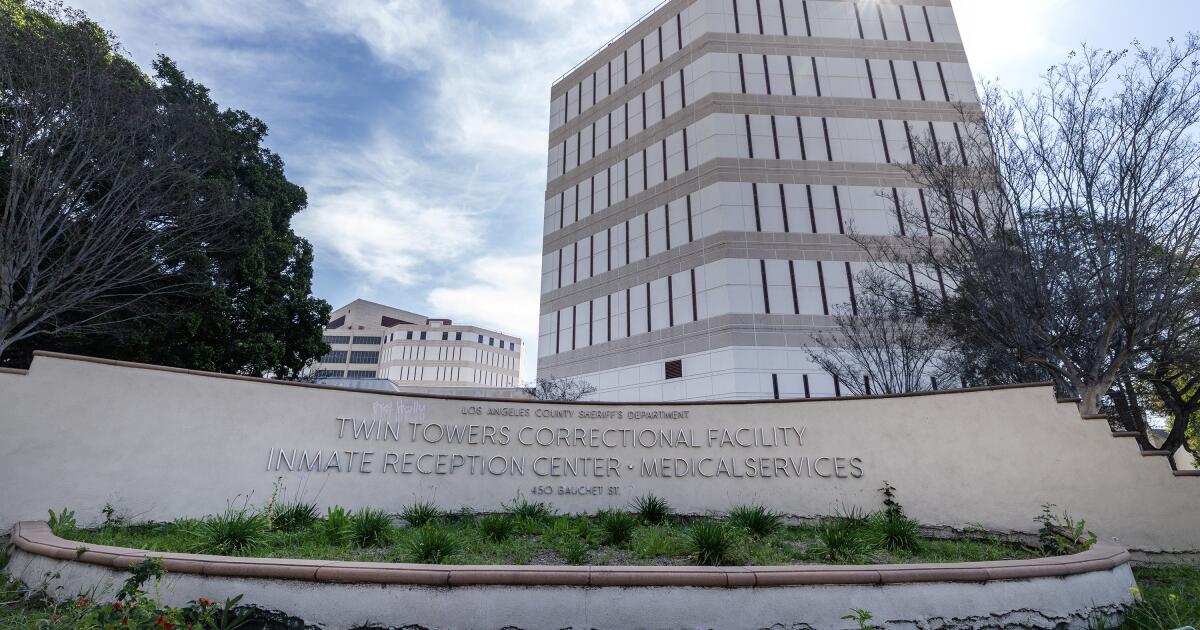
Sheriff Robert Luna has asked the National Institute of Corrections to examine conditions and practices at Los Angeles County jails, a request made after 10 inmates died in jail custody in less than three months.
The request comes amid growing concern over conditions inside county lockups. In September, California Atty. Gen. Rob Bonta sued the Sheriff’s Department over what he called “unsafe and unconstitutional conditions at county jails.”
Luna has also faced questions from the Sheriff Civilian Oversight Commission over health conditions, health access, drug use, and other factors that have led to in-custody deaths.
Now, the Sheriff’s Department is asking the National Institute of Corrections to conduct a comprehensive review of county jails in an effort to reduce the number of deaths, Luna told The Times.
“I want someone to come in and review from top to bottom,” Luna said.
Specifics on when the review would begin, and what it would entail, have not yet been set, but Luna said the aim is to get an outside, “unbiased view.”
Officials with the National Institute of Corrections referred questions to the federal Bureau of Prisons, its parent agency, which did not respond to a request for comment.
The National Institute of Corrections provides state, local and federal resources and guidance.
The agency, according to its site, provides “on site technical assistance” to jail administrators, and also helps to identify “gaps in policy and practice.”
The review, Luna said, would entail “everything we’re doing from policy, procedure, facilities, to make sure we’re not missing anything,” Luna said.
Inmate deaths have raised concerns among top sheriff officials and agencies charged with overseeing sheriff operations. The department saw 46 in-custody deaths in 2025, a steep increase from the 32 reported in 2024.
In-custody deaths are reviewed by the Office of Inspector General and the U.S. Department of Justice.
Bonta’s lawsuit against the Sheriff’s Department, filed in September 2025, alleged inmates were being “forced to live in filthy cells with broken and overflowing toilets, infestations of rats and roaches, and no clean water for drinking or bathing.”
In a statement, Bonta’s office alleged that a lack of access to healthcare in the jails, and conditions inside, contributed to a “shocking rate of preventable in-custody deaths, such as suicides.”
In a previous interview, Luna referred to the spate of death at the start of the year as a “kick in the groin.”
Efforts to reduce deaths are challenging partly because the inmate population inside the jails has been increasingly older, and ill, Luna said, with many of them suffering from drug addiction or long-term conditions.
About 82% of those in custody disclosed at least one medical or mental health issue when booked, officials said.
According to department data, half of the 46 inmate deaths recorded in 2025 were listed as natural. Autopsy results to determine the causes of death are still pending in this year’s cases.
Luna has pointed to changes that have already been made as efforts to improve conditions, including deploying body-worn cameras at the Inmate Reception Center, Men’s Central Jail and Twin Towers Correctional Facility.
The department has also opened a remodeled mental health assessment area at the Inmate Reception Center, the primary intake and release point for county inmates near Men’s Central Jail.
WASHINGTON — White House chief of staff Susie Wiles has been diagnosed with early stage breast cancer but will continue working during her treatment, President Donald Trump said in a social media post on Monday.
Trump said Wiles’ prognosis is “excellent” and described her as “one of the strongest people I know.” He said Wiles plans to begin treatment immediately but made no suggestion she was pulling back on her work as one of his closest advisers.
“During the treatment period, she will be spending virtually full time at the White House, which makes me, as President, very happy!” Trump said on his Truth Social platform. “She will soon be better than ever!”
It comes as the Republican president confronts mounting challenges on global and national fronts, from the war in Iran and soaring oil prices to this fall’s midterm elections and American’s concerns over affordability.
Wiles, 68, is a longtime Trump ally who rose from his campaign co-chair to his closest adviser and counsel. The first woman to become White House chief of staff, Wiles spent decades as a lobbyist and political operative in Florida and led Trump’s 2016 effort in the state.
Veteran presenter Eamonn Holmes appeared to fall asleep at his GB News desk during his morning segment, leading to viewers sharing their concerns for the star
22:32, 11 Mar 2026Updated 22:32, 11 Mar 2026
Viewers were concerned for Eamonn(Image: GB News)
Eamonn Holmes has sparked concern over his well-being after appearing to fall asleep during his morning slot on GB News. The Northern Irish presenter, 66, has had a tough few years when it comes to his health, and his latest appearance has led to fans being worried about the veteran.
Eamonn was presenting his morning show on the channel during an interview with Chief Secretary to the Prime Minister, Darren Jones MP. But he apeared to nod off momentarily during the conversation.
The host was seen fiddling his his microphone before seemingly zoning out and closing his eyes. A few seconds later, he lifted his head and focused back on his sound kit and mobile phone.
Co-host Ellie Costello continued with the chat, but Eamonn’s antics are said to have caused concern among staff. A source speaking to The Sun said: “It hasn’t gone unnoticed that Eamonn has been struggling a lot more lately
“Today he was falling asleep on air and slurring his words. There were lots of messages coming in about it.”
Ensure our latest headlines always appear at the top of your Google Search by making us a Preferred Source. Click here to activate or add us as your Preferred Source in your Google search settings.
Fans were quick to share their own concern online after the chat. One user wrote: “Please help Eamonn Holmes. He’s obviously struggling, falling asleep this morning. Slurring his words. The guy needs medical assistance!!”
Another said: “Why is Eamonn Holmes basically falling asleep on air? He looks either off his face or just so tired he can’t stay awake!” And a third added: ““Concerned Eamonn Holmes seems more slurry than usual.”
Eamonn’s health concerns have been well documented in recent years. He first shared his chronic pain diagnosis in 2021. The issue was initially caused when he dislocated his pelvis. He slipped three discs and then broke his shoulder during his recovery period.
Speaking on the Session 7 podcast, Eamonn previously explained: “I’m sick. I’m in a wheelchair. That’s been horrendous to deal with for two years.
“Certainly I don’t think TV wants to know you when, I mean there’s nothing you and I are talking and no one can there’s anything wrong but I can’t get up.”
He admitted that he required daily care. However, he insisted that once he is sat in his wheelchair, he is still able to “do everything”.
Eamonn went on to acknowledge that the wider world struggles to “deal with” people with disabilities, particularly in regards to providing the appropriate accommodations.
SINGER Anne-Marie has sparked concern after branding herself a “wreck” in a new social media message.
The star tweeted a lengthy message in which she also suggested people “wouldn’t care” about her “emotional” struggles.
Sign up for the Showbiz newsletter
Thank you!
Anne-Marie has sparked worry online after branding herself a “wreck” in a new social media postCredit: SplashThe performer insisted no one would ‘care’ about her emotional strugglesCredit: Instagram/annemarieThe concerning tweet sparked plenty of fan reactionCredit: X
The Ciao Adios singer penned: “Still figuring out how to be a good mum AND write the best album you’ve heard from me. It’s intense.
“I want to post, but I look and feel like a wreck most of the time.”
She added: “I know you don’t care about that though hahah.
“I miss you all so much and hope you are feeling as happy as you can be.”
Anne-Marie signed off her message by posting: “A cuddle is needed.”
The mum-of-two’s post sparked worry among her fans as many rushed to check in on the performer and insist they “do care” after her troubling words.
One said to her: “Anne marie you never ever need to apologise for being distant. You’re balancing being a mum, being human, and creating something beautiful for all of us that’s a lot for anyone.”
Another echoed: “We all care about you so much. You prioritise yourself, your health and your family.”
Another alarmed fan penned: “I’m proud of you. Speaking out is already so brave.”
Before a fourth went on to comment: “You didn’t have to force yourself, we care about it and care about you. Take care yourself and kids love u.”
The mum-of-two has faced personal struggles and career setbacks in recent yearsCredit: GettyShe is a mum-of-two with rapper husband SlowthaiCredit: Instagram @annemarieThe star hinted at intense mum guilt in her new messageCredit: Instagram
The famed Magic City adult entertainment club won’t be featured at next week’s Atlanta Hawks promotional night, the NBA announced on Monday.
NBA commissioner Adam Silver acknowledged concerns from others in the league on Monday, saying that his decision to cancel the collaboration is in the best interests of the “broader NBA community.”
“While we appreciate the team’s perspective and their desire to move forward,” he said in a statement, “we have heard significant concerns from a broad array of league stakeholders, including fans, partners and employees.”
The Hawks announced its “Magic City Monday” promotion in late February, featuring a halftime performance by Atlanta-based artist T.I., a collaborative hoodie and the offering of some of the club’s popular wings, including the lemon-pepper variety named after former Hawks player Lou Williams.
Hawks principal owner Jami Gertz was a producer on “Magic City: An American Fantasy,” a docuseries that aired on Starz. Still, the team’s decision to collaborate with the Atlanta strip club ruffled some feathers in the NBA.
San Antonio Spurs center Luke Kornet asked the Hawks to cancel the promotional night in a post on Medium last week, saying that it would “reflect poorly on us as an NBA community, specifically in being complicit in the potential objectification and mistreatment of women in our society.”
Others had argued that Magic City is a big part of Atlanta culture and should be celebrated as such.
The Hawks wrote in a statement on Monday that it was disappointed with the NBA’s decision but would respect it.
Rapper T.I. will still perform at halftime, but the live recording of the Hawks AF Podcast featuring Gertz, T.I. and Magic City founder Michael Barney was canceled. Fans who pre-ordered the collaboration hoodie will still receive one, but the sweatshirts won’t be available for purchase at the game, the Hawks wrote on X.
“As a franchise, we remain committed to celebrating the best of Atlanta — with authenticity — in ways that continue to unite and bring us all together,” the Hawks wrote.
Times staff writer Chuck Schilken contributed to this report