

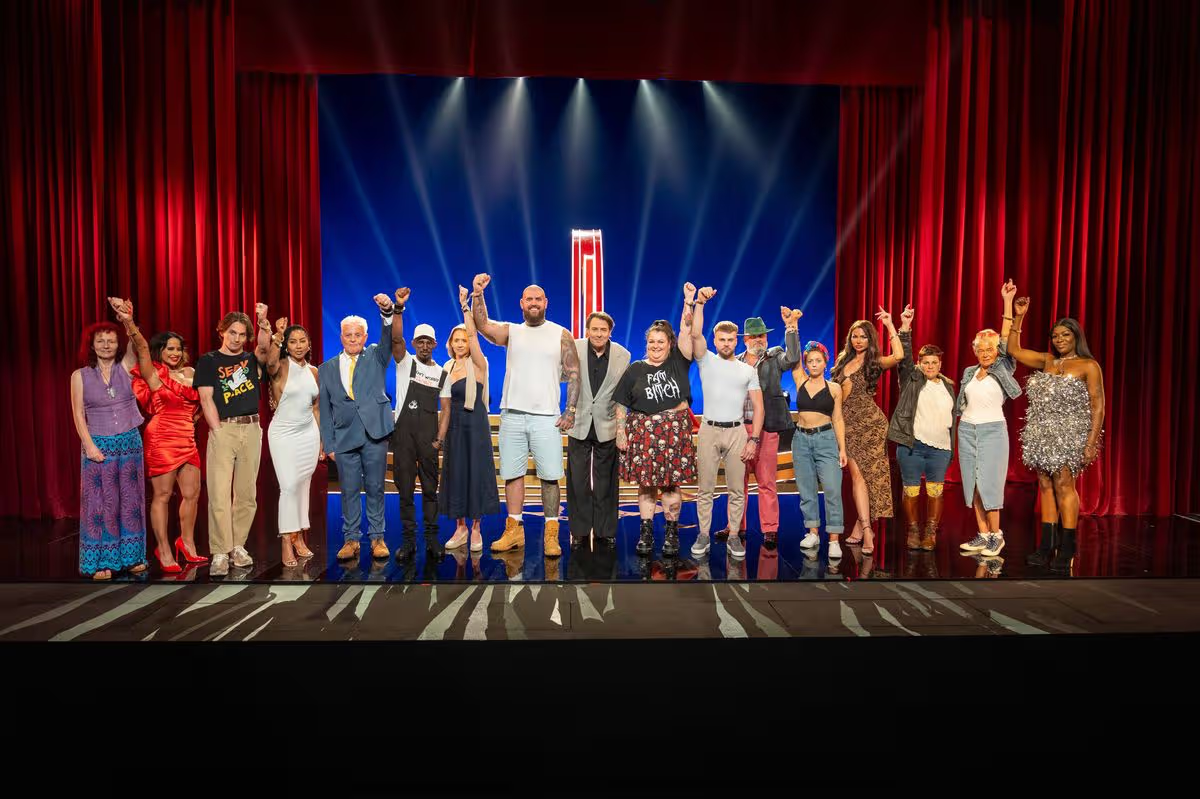
Jonathan Ross hosts Channel 4’s new social experiment Handcuffed, where 18 contestants are cuffed together as they compete to win a £100,000 prize

Handcuffed: Last Pair Standing contestants(Image: Channel 4)
Handcuffed: Last Pair Standing is the brand new social experiment from Channel 4.
Hosted by Jonathan Ross, the new series sees 18 contestants cuffed together as they compete to win £100,000.
A synopsis for the new Channel 4 series reads: “Could you survive being handcuffed to a total stranger? In a brand new social experiment, Jonathan Ross is challenging 18 brave Brits to do just that, as they compete to win a £100,000 prize.
“The nine pairs will have to cope with being chained to each other 24/7, doing everything – quite literally – just inches apart. If it gets too much, they can uncuff at any time, but if they do they’ll be out of the competition. The last pair standing takes all. Jonathan’s starting the competition as he knows best, in a TV studio with a live audience.
“The competitors represent a complete cross section of British society, and have never met each other before. As the cuffs are locked in position with the duos either side of a special screen, they’ll only discover who they’ve been chained to once the divide goes back.
“In a divided Britain, Jonathan’s hoping living in such close proximity will force these opposites to talk, listen, and maybe even learn from each other. As the pairs set off for each other’s houses, to walk a mile in their partner’s shoes, we focus in on three of the couples.”
Among the participants are Somerset contestants Sir Benjamin Slade, 79, the 7th Baronet of Maunsel, and bus driver Morag, 64. They’re joined by London-based model Bambi, 29, and Suffolk’s millionaire businessman Anthony, 60, reports Somerset Live.
Here’s the complete roster for Handcuffed: Last Pair Standing.
Jo, 39, Manchester
Jo, a plus-size fashion brand owner, describes herself as “loud, mindful and crazy.”
When asked about her biggest concern, Jo admitted: “I’m nervous about the proximity. I’m on the autistic spectrum and being in close proximity to a stranger is going to be quite a challenge for me.”
Reuben, 29, Portsmouth
Reuben, a property developer, characterises himself as “confident, cocky, and disciplined.”
Discussing the toughest part of the experience, Reuben revealed: “The hardest thing about the experience was definitely the speed of walking and the chafe of the cuff after several hours, having my partner slow and drag me down was tedious.”
Sir Benjamin Slade, 79, Somerset
Benjamin, the 7th Baronet of Maunsel, reflected on his experience: “I was surprised by having some challenging and honest conversations about class,” adding: “The hardest thing was having sleep apnoea which means I don’t get any sleep and having to pee 6 times a night.”
George, 60, London
Prison Officer George describes himself as “pragmatic, empathetic, and lively” and joined the show “purely for the spirit of adventure,” which has led him to experiences ranging from topless waitering to skydiving from 15,000ft, and even volunteering as the first Officer in Belmarsh for the High Secure Unit.
Claire, 48, Hampshire
Claire, an “eccentric, persistent, bubbly,” horse trainer from Hampshire, was surprised by her own patience. She admitted: “The level of patience I’ve got. I was surprised! I didn’t think I had it in me. Also, how much of a bubble I live in- I didn’t realise how different other people’s lives are to mine.”
Bambi, 29, London
Model and content creator Bambi described herself as “loud, chill…but also not chill- I’m a bit of a contradiction!” When asked about her biggest worry, Bambi confessed: “The actual intricacies of the day to day; showering, going to the toilet- the basics. Also, as much as I’m a social butterfly and love being around people I like my own space and I do take a lot of time to myself. I think my biggest concern is I’m not going to have that time to relax and unwind and I think that’s going to really get to me.”
Nina, 42, London
Hairdresser Nina characterises herself as “moody, loud and fun,” and found the most challenging aspect of being handcuffed was being paired with someone whose beliefs were “completely opposite” to her own.
Sara, 55, Northhamptonshire
Mum-of-seven Sara describes herself as being “bubbly, annoying and kind.”
Reflecting on the most challenging aspect of her experience, Sara said: “Being involved in something so intense then the sad feeling afterwards when life returns to normal. To be honest looking back it felt like an out-of-body experience.”
Lin, 38, London
Political commentator Lin characterises herself as “Charismatic, opinionated, and a leader.”
Regarding her biggest concern, Lin said: “Going to bed, I’m a really private person, the whole going to bed and showering, I’m apprehensive about how it’s going to work.”
Frank, 27, Derbyshire
Green Party Councillor Frank explained his motivation for joining the programme: “As a politician, I spend every day trying to get someone else to agree with me, but what most elected representatives forget is that genuine understanding comes from putting yourself into the shoes of another and taking the opportunity to truly question yourself. Participating in Handcuffed was the only way for me to grow personally and professionally.”
Bob, 70, Yorkshire
Retired soldier Bob, who describes himself as “well-travelled and a musician.”
spoke about the toughest element of the programme: “Not knowing what was coming next and the lack of privacy from always having a camera nearby meant it sometimes felt quite restrictive, and that I maybe wasn’t able to get to know my partner as well as I would have liked.”
Chris, 38, London
Youth worker Chris admits he’s most apprehensive about his “everyday life,” when it comes to taking part in the show. He confessed: “I’m quite particular and I like things a certain way. When I get home, I take off all my clothes put them in the wash basket and put on my house clothes because who just sits on their bed when you’ve just been on the tube? I’ve got a lot of insecurities that I’m still trying to work through: I suffer with lupus so there’s a part of me that’s not comfortable looking at my own self let alone being around another person- it’s very exposing.”
Charlie, 44, West Sussex
Practical Homemaker Charlie describes herself as “determined, kind and strong-minded.”
On what surprised her about her journey, Charlie revealed: “I think learning about my own levels of resilience, to always be open minded and not to judge a book by its cover.”
Rob, 32, Staffordshire
Rob is an adult content creator who characterises himself as “eccentric, straightforward, kind.”
On what surprised him the most about the experience, he shared: “That two people, living two completely different lives worlds apart can become great friends. We put our judgements aside and listened to our hearts.”
Morag, 64, Somerset
School bus driver Morag identifies herself as being “enthusiastic, vegan and hippie.”
On what surprised her the most, Morag admitted: “I was surprised to find myself so emotional, particularly in the first few days.”
Angie, 44, Stourport
Salon proprietor Angie describes herself as “direct, impulsive and wild.”
Reflecting on the most challenging aspect of the experience, Angie explained: “Not having control of what I was doing, where I was going, and that what was in store for us. I became very hyper vigilant, and I went through a process of unwrapping all these things that I didn’t know about myself. I don’t like being told what to do so this was an adjustment for me to hand over control. Being away from my husband was so hard, it’s the first time we have spent that much time apart with zero contact.”
Tilly, 37, North London
Barmaid Tilly is “loud, loving and kind”. She frankly revealed her motivation for joining Handcuffed: “I wanted to win the money… and for the experience, but mainly the money.”
Anthony, 60, Suffolk
Business proprietor Anthony, who characterises himself as “generous, genuine and happy,” shared that the toughest element of the experience was having to reveal so many “deep and repressed” aspects of himself to a complete stranger.