Historic change in South L.A. city council district no matter who wins
Estuardo Mazariegos and Jose Ugarte, running against each other for a city council seat representing part of South Los Angeles, are immigrants from Latin America who arrived undocumented as children.
Both 40 years old, they grew up in the area and established themselves as community organizers.
And no matter which of them wins election on Nov. 3, it will be a historic change for Council District 9, which has been represented by a Black council member since 1963, even as its demographics shifted to a Latino majority.
Mazariegos and Ugarte both said they are committed to representing all their constituents equally, including Black residents who have expressed concerns about the change.

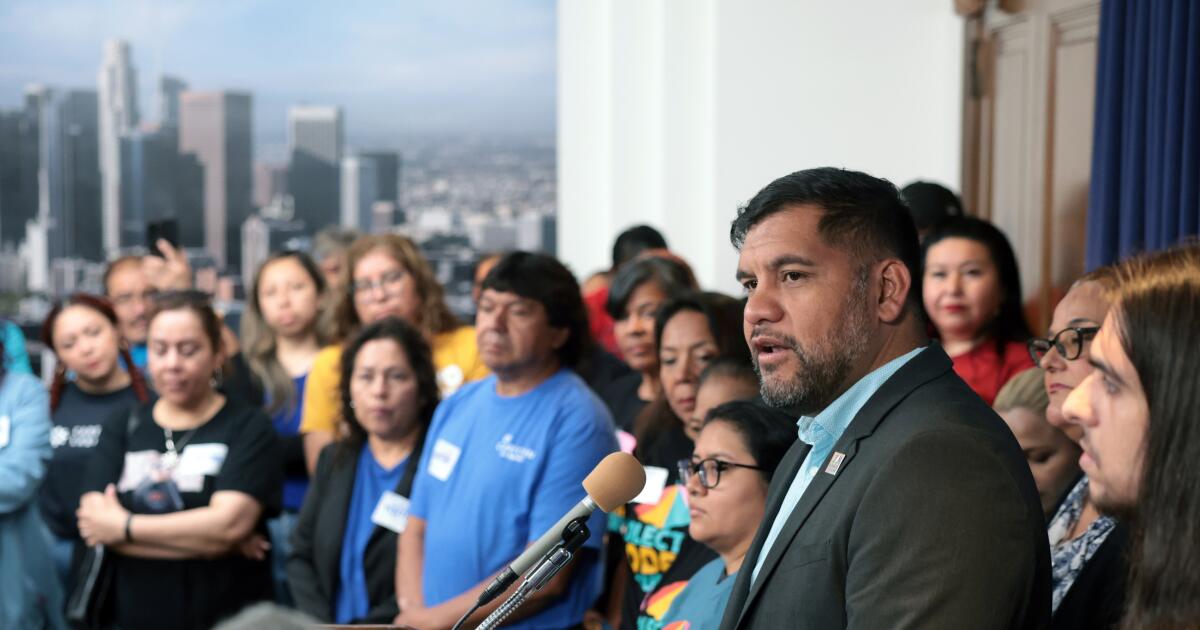
Jose Ugarte is the front-runner for City Council District 9 after getting 39% of the vote in the June primary.
(Genaro Molina / Los Angeles Times)
Ugarte, who was until recently a deputy chief of staff to the current council member, Curren Price, got about 39% of the vote in the June primary to 26% for Mazariegos, in a six-candidate field.
Ugarte was born in Oaxaca and is Mazateco — an Indigenous group native to the Mexican state. He has spent most of his life in South L.A., where he was embraced by his Black neighbors and schoolmates. He wants to model himself after Price, who he said is known in the community as the most “pro-Latino Black councilman.”
“I want to be a voice for Black residents in my district,” Ugarte said at his campaign headquarters on Avalon Boulevard. “I want to be called the most pro-Black Latino council member that the city really has.”
Last year, Ugarte agreed to pay a $17,500 fine to the city’s Ethics Commission, later increased to $25,000, for repeatedly failing to disclose outside income he made from his lobbying and consulting firm while also working as a council staffer. He said the issue stemmed from “an unintentional clerical reporting error on my part.”
Mazariegos is the L.A. co-director of the Alliance of Californians for Community Empowerment, a statewide nonprofit that organizes lower-income Black and brown communities for progressive change. Born in Guatemala and brought to the U.S. by his parents, he also was shaped by growing up in racially diverse parts of South L.A. He said he’s reaching out to different sectors of the community, including Black organizations and churches.
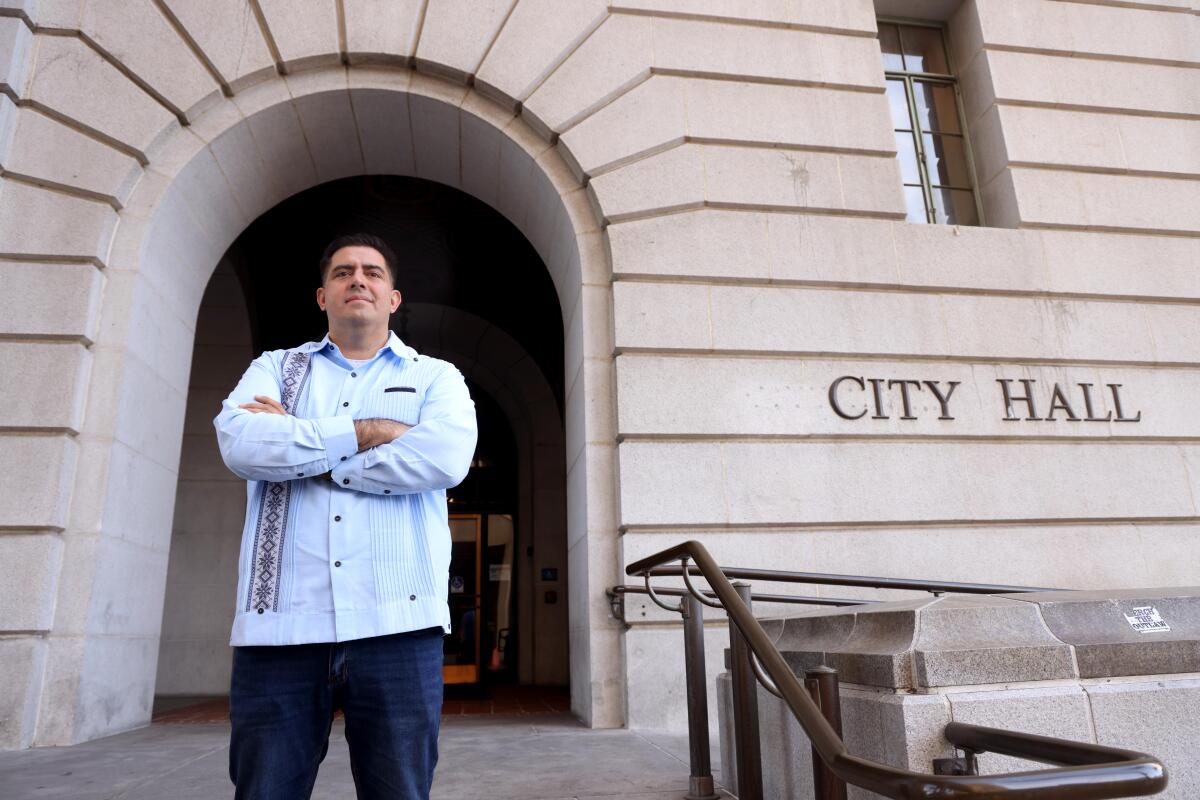
Organizing is about “always having open ears to the community,” Mazariegos said while sitting outside Mercado La Paloma, a food hall in the district. “It’s fighting for, honoring the Black legacy and fighting for a Black future, and you do that by building together.”
In his early 20s, Mazariegos pleaded guilty to a misdemeanor charge of carrying a concealed weapon in a vehicle. He said he was holding on to the gun for a friend and that the conviction makes him a better candidate because he can relate to people in the district who have had run-ins with law enforcement.
Council District 9 encompasses the Convention Center, USC and neighborhoods along the Harbor Freeway, including Vermont Square, South Park and Florence-Graham. In a district with the highest poverty rate in the city, residents are concerned about issues including illegal dumping, public safety, a dearth of grocery stores and a sense of being neglected by City Hall.
Price, who has represented the district since 2013, is terming out. He has been fighting corruption charges, with a judge deciding in January that there was enough evidence to move to trial on four counts of voting on matters in which Price had a conflict of interest, five counts of embezzlement and three counts of perjury.
Price said he never intended to do anything wrong and questioned the fairness of a prosecution over what he said was essentially a paperwork error.
The growth of the Latino population in a district that is now nearly 80% Latino has created political tensions for decades, said Manuel Pastor, a USC professor and author of “South Central Dreams: Finding Home and Building Community in South L.A.”
Four years ago, those tensions resurfaced after a recording emerged of a conversation among three Latino city council members and a labor leader that featured racist and disparaging remarks about Black people, Oaxacans and others. The revelations tested a fragile alliance of Black and Latino coalitions that organizers have sought to maintain.
More recently, some Black community leaders expressed concern that a proposal to allow noncitizens to vote in local elections would diminish Black political power. The City Council ended up sending the proposal to a committee for more study.
Pastor noted that Price made an effort to focus on Latino residents, who have grown up alongside Black residents and suffered the same disinvestment in their neighborhoods.
This election, Pastor said, will pit the strength of L.A.’s political establishment against the rising power of the Democratic Socialists of America.
Ugarte’s endorsements include Price and the L.A. County Democratic Party, while Mazariegos has been endorsed by Councilmember Eunisses Hernandez, City Controller Kenneth Mejia and the Democratic Socialists of America’s L.A. chapter, among others.
Through May 27, Ugarte had raised $510,000 in campaign contributions and Mazariegos had raised $254,000.
Ugarte has benefited from nearly $1 million in independent expenditures, which differ from campaign contributions, with Airbnb contributing $302,000 to support his candidacy and the California Apartment Assn. Housing Solutions Committee spending $230,000.
Mazariegos has received support from the political arms of United Teachers Los Angeles as well as his employer, the Alliance of Californians for Community Empowerment Action, which together spent about $118,000.

Jose Ugarte says, “I want to be called the most pro-Black Latino council member that the city really has.”
(Genaro Molina / Los Angeles Times)
On a recent Sunday morning, Ugarte stopped by services at two predominantly Black churches. At McCoy Memorial Baptist Church in South Park, he accepted a warm hug from longtime Pastor R.A. Williams Jr., who endorsed his candidacy. Ugarte then traveled a few blocks to Experience Christian Ministries, where Pastor Shep Crawford also has endorsed him.
“I met him years ago, boots on the ground, in the streets making changes,” Crawford told the congregation.
That same day, about three miles north at Audio Graph Beer Co., Mazariegos was cheering at a World Cup final watch party that doubled as a fundraiser. He posed for photos with supporters, who wore buttons declaring him “the people’s candidate.” He credited making the runoff election to his years in the community advocating for anti-displacement measures for tenants and lowering the rent cap.
Angie Gonzalez, 22, said Mazariegos earned her support because of his work advocating for tenant rights.
“I like how Estuardo is trying to empower us,” she said.
Odilia Romero, a resident of District 9 and executive director of CIELO, an advocacy group for Indigenous people, said she is not endorsing in the race. But she acknowledged the importance of an Indigenous candidate, four years after the audio leak scandal.
After The Times broke that story, Ugarte said, he secured permits for a march from L.A. Trade Tech to City Hall, where Oaxacans and others rallied.
Ugarte said if he is elected, he’d become the first Indigenous Oaxacan council member. He wants to show anyone critical of immigration — including the Trump administration — that “immigrants are here to build things to make the country better.”
“I want to be a council member that came from another country, that came as an immigrant, that came from an Indigenous state, and that made a name for himself, that [improved] his community,” he said.

Organizing is about “always having open ears to the community,” Estuardo Mazariegos says. “It’s fighting for, honoring the Black legacy and fighting for a Black future, and you do that by building together.”
(Arwen Clemans / Los Angeles Times)
Mazariegos said that while he may not be a political insider, he makes up for it as a “community insider.”
“There’s a lot of mistrust for the status quo right now,” he said. His goal is “making sure that the 9th district has representation that actually fights for it.”
These days, he said, campaigning has turned into an all-day affair, meeting people as he walks with his family around the district.
Mazariegos has in recent months appeared at City Hall to advocate for charter reform, including increasing police accountability, expanding the size of the City Council and advocating for noncitizen voting. None of those measures made the November ballot.
Organizers in the district said that no matter who wins, they intend to hold the new council member accountable.
“We hope that whoever wins this race keeps working-class people and their issues on the forefront,” said Ron Gochez, a longtime district resident and organizer with Union del Barrio, which advocates for immigrants. “We will pressure whoever wins to do the right thing.”