communist

A Communist magazine debates a DSA endorsement of Nithya Raman

Good morning, and welcome to L.A. on the Record — our City Hall newsletter. It’s David Zahniser, with an assist from Sandra McDonald and Noah Goldberg, giving you the latest on city and county government.

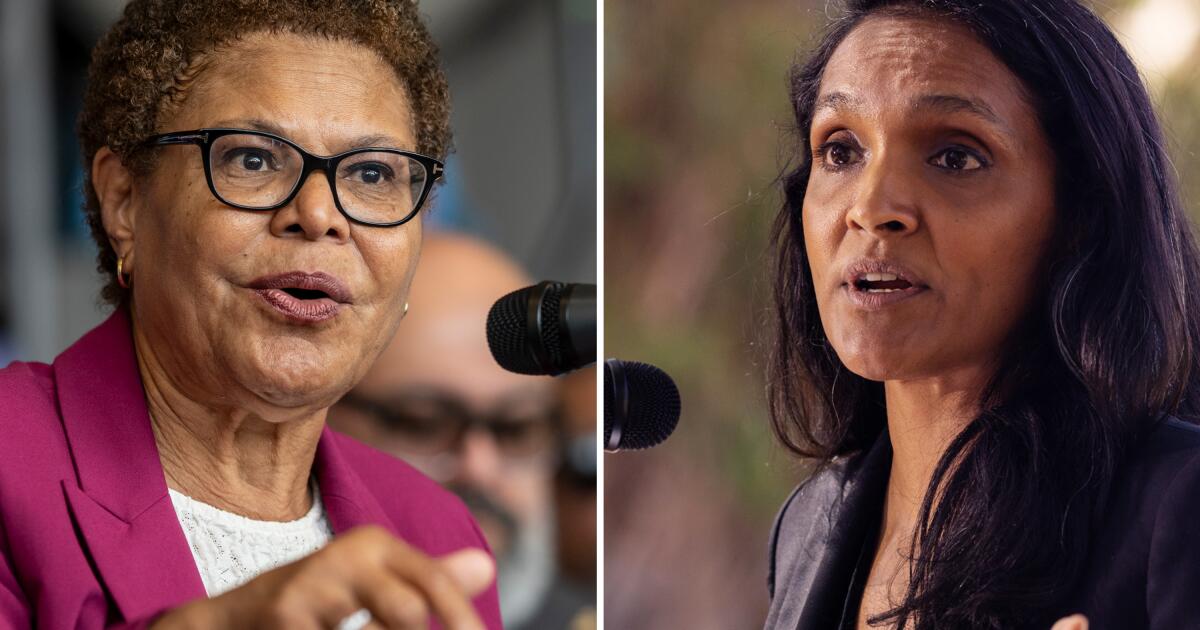
Los Angeles City Councilmember Nithya Raman is waiting to hear whether she has secured a prize coveted by many of the city’s left-of-center candidates: an endorsement from the Democratic Socialists of America.

Earlier this year, the DSA’s Los Angeles chapter took up the idea for the June 2 primary, only to decide against it. They made that decision after hours of debate, all under the watchful eyes of local reporters. The group later recommended Raman in its June 2 voter guide, but that didn’t give her access to the DSA’s vaunted get-out-the-vote apparatus, which goes only to endorsed candidates.

This time around, endorsement discussions for the Nov. 3 runoff were held behind closed doors, followed by an online vote now under way. But the debate has been playing out publicly on a somewhat obscure platform: Geese magazine, which bills itself as “a daily review of American Communism.”

Contributors to that online publication — which declares on its website “We answer to no one” — have been going back and forth for weeks over whether the DSA should endorse Raman, a DSA member herself, in her campaign to unseat Mayor Karen Bass.

Things got rolling on Aug. 11, when Geese posted a 4,400-word essay supporting a DSA endorsement of Raman, arguing that such a move could “open the floodgates for socialism in Los Angeles.”

The four writers, DSA-LA members themselves, conceded that Raman is “no Zohran” — a reference to New York City’s charismatic DSA mayor, Zohran Mamdami. They acknowledged that she’s had a sometimes turbulent relationship with the group, which endorsed her council campaigns in 2020 and 2024 but also censured her at one point, in part because she accepted an endorsement from a pro-Israel group.

Still, the essayists praised her work on homelessness and tenant protections. And they commended her for seeking greater cooperation with the organization in recent months, hiring DSA-LA members to lead her campaign.

“What this signals is that with a DSA-LA endorsement, we may anticipate more constructive collaboration with the Nithya campaign going forward,” the group wrote.

You’re reading the L.A. on the Record newsletter

Sign up to make sense of the often unexplained world of L.A. politics.

Not so fast, argued another group of Geese contributors. On Monday, those five writers — also DSA-LA members — panned the idea of an endorsement, saying Raman hasn’t earned it.

These writers assailed Raman for voting to confirm former Sheriff Jim McDonnell as Los Angeles police chief and for seeking a rewrite of Measure ULA, the so-called mansion tax, which she views as an impediment to housing production. The authors also portrayed her as woefully out of touch with the DSA on Israel’s war in Gaza.

“If we endorse Raman, a candidate who lacks the inspirational leadership and collaborative political relationship that forms the foundation of a strong DSA endorsement, we risk spending the next four years managing the consequences; explaining, defending, and organizing around the shortcomings of a mayor who was never meaningfully accountable to our democratic socialist movement in the first place,” the group wrote.

Two days later, third Geese essay showed up, arguing that Raman is “the nerd that can dig our city out of this crisis.” That piece sought to rebut some of the criticism contained in the previous essay, while conceding that Raman can be “overly fixated on details, slightly thin-skinned, obtuse, and argumentative.”

“But let’s not forget that Nithya also has a long list of positive attributes as well: she is an exceptional administrator — reducing homelessness in her district by 49% through careful service provision,” the group wrote, anointing her as “Our Pothole Populist.”

A fourth piece, also pro-Raman, posted Friday. Meanwhile, Bass has not emerged unscathed during the back-and-forth.

Geese’s contributors criticized Bass for refusing to let City Controller Kenneth Mejia audit her Inside Safe homelessness program, saying she showed a “disregard for democratic processes.” They assailed her over her handling of the Palisades fire, the Lineage fire, police spending and other issues.

The pro-Raman rebuttal piece had some of the harshest language, accusing Bass, who made many trips to Cuba earlier in her life, of being “puppeted by business interests, landlords, the more reactionary segment of labor, and a smattering of liberal NGOs.”

Bass has not sought the DSA’s backing, either in the primary or the runoff. But she does have endorsements from the council’s other three DSA members.

Raman needs to win 60% of the vote to secure the endorsement. More than 6,000 chapter members have received emails with online ballots.

Monday is the last day to vote.

Tracking Traci Park

City Councilmember Traci Park represents a Westside district that runs along the coast. But that didn’t stop her from heading to Sherman Oaks for the raucous Aug. 19 mayoral debate.

Her appearance in the audience immediately sparked questions. Was she trying to make a decision on whether to weigh in on the mayor’s race?

After all, Park is the only council member who has not publicly picked a horse. Thirteen of the council’s 15 members have come out for Bass. (Raman also endorsed Bass at one point, but then jumped into the race at the last minute.)

Park has made clear she is no political ally of Raman, diverging on such issues as the city’s anti-encampment law. Still, an endorsement of Bass could pose risks.

Park represents the Pacific Palisades, where residents have sharply criticized Bass over her handling of the Palisades fire, which destroyed thousands of homes and left 12 people dead.

On Friday, Park declined to say whether she plans to endorse, saying she simply wanted to “hear what both candidates have to say.”

“It was a mayoral debate. I’m a City Council member, taxpayer, and resident,” she said in a statement. “The progress we’ve made on the Westside is at stake.”

Back to school for Mazariegos

It’s supposed to be a little like traffic school — but instead of learning to drive more safely, you learn to run a by-the-book political campaign.

Community organizer Estuardo Mazariegos, who is running to replace City Councilmember Curren Price in a South Los Angeles district, is now enrolled. He agreed to take a seven module, roughly three-hour class on the state’s campaign finance laws to resolve a complaint filed with the Fair Political Practices Commission, said Jesse Alson-Milkman, a strategist for the campaign.

That complaint accused Mazariegos of failing to pay for community space during at least six “postcarding party” events held by his council campaign at Mercado La Paloma. The complaint was filed by Josh Rothstein, a member of the Mid City West Neighborhood Council, who says he submitted the paperwork in his own capacity.

Mazariegos is on leave as co-director of the Alliance of Californians for Community Empowerment, which hosts its corporate office at Mercado La Paloma. That facility charges for certain types of meeting space, yet Mazariegos’ spending report initially showed no payments or in-kind donations for such costs, Rothstein said.

Alson-Milkman said five of the postcarding events were held at the market’s public dining area, so no payment or in-kind donation was needed.

The campaign did have a sixth event where it rented a room for two and a half hours, Alson-Milkman said. But the invoice for $137.50 was lost, he said, delaying payment for months.

The FPPC concluded the violation can be remedied without an enforcement action or financial penalty by having Mazariegos take a Political Reform Education Program, or PREP class, Alson-Milkman said.

The class was created by the FPPC to help candidates who commit minor violations to avoid getting “a mark on their record” — or a financial penalty.

State of play

— CRUNCHING THE NUMBERS: We’ve told you in recent weeks about issues surrounding the Homeless Count: the failure to count a 600-bed homeless shelter in 2024 and 2025, which may have skewed this year’s numbers, and the wildly diverging numbers in Council President Marqueece Harris-Dawson’s South L.A. district. On Wednesday, the council instructed the Los Angeles Homeless Services Authority to report back on some of the discrepancies.

— VENDORS VEXED: Bass has ordered the LAPD to stop issuing criminal citations to street vendors and remove any that were erroneously issued. The mayor’s office took that step after learning that citations were being incorrectly handed to vendors in MacArthur Park, a situation reported by LA Public Press. The street vending issue has been a flashpoint in the mayor’s race in recent weeks.

— UNDER THE MICROSCOPE: With the mayor’s race heating up, Raman’s record on homelessness has come under fresh scrutiny, particularly her time overseeing the council’s housing and homelessness committee. Raman has touted her work in identifying less expensive strategies for tackling the crisis. Critics say her tenure as chair hasn’t adequately met the moment.

— AUDITING THE GAMES: Mejia, the city controller, called on LA28, the committee organizing the 2028 Summer Olympic Games, to turn over reports on its finances. Mejia said the private committee has fully complied with only two out of nine requirements of its contract with the city. The controller issued his statement on the same day that several lawmakers called on Trump to provide much-needed transportation funding for the event.

— NO IFS, AND OR PHENIBUTS: The City Council instructed the city attorney to regulate phenibut, a drug that’s available at gas stations and being abused as a nervous system depressant. The regulations would include warning labels, a prohibition on sales to people under 21 and a ban on sales near schools and daycare centers.

— WHISTLE BLOWER SPEAKS: The police officer who recorded his colleagues making racist remarks told The Times that the LAPD “ruined my life.” Council members had been planning to formally condemn Dist. Atty. Nathan Hochman over his filing of 16 felony counts against Officer Daniel Flores. But they shelved that plan on Tuesday after those charges were reduced to misdemeanors.

— PROGRAMMING NOTE: Our newsletter will be going dark for the Labor Day holiday weekend. We’ll see you again on Sept. 12.

QUICK HITS

  • Where is Inside Safe? The mayor’s signature homelessness program went to the Westside, focusing on an area around Venice Boulevard and Glendon Avenue, which is represented by Councilmember Katy Yaroslavsky.
  • On the docket next week: As we mentioned previously, the DSA will wrap up its endorsement vote in the mayor’s race.

Stay in touch

That’s it for this week! Send your questions, comments and gossip to LAontheRecord@latimes.com. Did a friend forward you this email? Sign up here to get it in your inbox every Saturday morning.

Source link

Column: Trump decries ‘communism’ while his government takes ownership of companies

As a student years ago, I dove deep into the history of the Red-hunting McCarthy era and became familiar with the actor who emerged second only to Wisconsin Sen. Joe McCarthy as the villain of that insidious time: his shameless, conniving young lawyer, Roy Cohn. Never would I have imagined that a future president would count Cohn as a mentor and role model.

Then came Donald Trump.

Now, in Cohn-inflected McCarthyesque style, President Trump is channeling his tutor yet again, baselessly labeling his political enemies — all Democrats — as communists as he looks ahead to the fall’s midterm elections. Once more Trump shows that his catchphrase “Make America great again” means regressing, this time to Trump’s formative 1950s and the McCarthy era that sadly helped define it.

In recent speeches, including on the Fourth of July, Trump’s utterances of “communist” or “communism” reached double digits each time. (As that implies, the president didn’t set aside his divisive rhetoric even for the nation’s 250th birthday.)

“Our warriors did not fight communism on battlefields across the world only to have that menace rear its ugly head right back here in America,” Trump said late on the Fourth on the National Mall.

Trump couples his commie-baiting with a dash of his trademark xenophobia. “There is now a resurgence of the communist menace in our land, including by newcomers to our country who embrace ideas totally opposed to our way of life and our great success,” he said at Mount Rushmore a day earlier. (He’s got it backward, of course: Immigrants come here for the American way of life and promise of success.)

Here’s the irony: Trump’s actions in his second term make him look more like the commie. He’s projecting again.

Now that Trump is exploiting a few victories lately by left-wing democratic socialists in Democratic primaries to paint the entire party as communists, it’s time to review the record — his record.

A hallmark of communism is government ownership of companies and control of the economy, at the expense of private property and free markets. In just over a year, Trump has used billions of taxpayers’ dollars to buy shares for the government in a growing list of private companies — U.S. Steel, Intel, Westinghouse and more — citing national security. The companies don’t always welcome their new stakeholder; at a minimum, they rightly fear it for the demands the government could make about prices and production.

“It’s what Putin did,” the estranged Republicans at the Lincoln Project posted online Monday. “Trump is the closest we’ve ever come to communism.”

“What began as a populist revolt against so-called elites has become a program of state ownership, price fixing and top-down industrial control,” free-market economist Veronique de Rugy wrote in The Times last October of Trump’s actions. “The power to ‘partner’ with business is the power to control it.”

Comrade Trump’s first big government grab, and a model for those to come, was in June last year, when he wrested a permanent “golden share” in U.S. Steel in return for approving its sale to Japan’s Nippon Steel. The company’s charter was revised to give the U.S. president extraordinary veto power over nearly a dozen corporate activities, including closing or relocating plants, supply-chain decisions, even pricing.

“We have a golden share, which I control,” Trump told reporters at the time, in words I never thought I’d hear from a president of the party once associated with free markets.

Just last week, Trump boasted to CNBC how he’d extracted a 10% stake in beleaguered chip giant Intel last August, after first demanding that its chief executive resign. “Intel came in. They had a problem. I said, ‘I can solve your problem, but I want 10% of the company.’ … Somebody said that’s not very American. I said, ‘No, I think it is very American, actually.’ And I’ve done that with other deals.”

And so he has.

The Pentagon is now the largest stockholder in struggling MP Materials, a large rare-earth mine in California, and guarantees a 10-year price floor for its output that stunned competitors. The administration has since taken shares in other rare-earth companies. The Commerce Department took an option for an 8% stake in Westinghouse, to spur construction of nuclear reactors, and has the right to 20% if the government decides the company should go public. The government takes a 15% cut of Nvidia’s and Advanced Micro Devices’ AI chip sales to China.

As much as anything he does, Trump’s direct intervention in private enterprise invites the question “What if Biden/Harris/Obama did that?” The answer, of course: Trump and Republicans would cry “Communist!”

Trump’s actions are the sort Americans generally have only seen during economic emergencies or major wars, and then rarely. I covered the frenzied and ultimately successful response to the near-collapse of the global financial system and the U.S. auto, insurance and housing industries. Behind the scenes in the Obama White House (and George W. Bush’s at the outset) was constant, angst-filled debate about any actions smacking of government takeovers and a determination that interventions be temporary, unlike Trump’s schemes. (For all the still-lingering unpopularity of the banking bailout, the Treasury — the taxpayers — got all the money back and then some, and exited the business.)

Trump’s economic big-footing isn’t the only way in which he resembles the commies Americans know best, and whom he so admires: Vladimir Putin, Xi Jinping, Kim Jung Un. There are also the images of himself everywhere, monuments planned, drearily long and self-adulating speeches and interference in the nation’s cultural, educational and legal spheres and — worst of all — in elections.

At Rushmore, Trump closed with a demand that Congress pass his so-called SAVE America Act to restrict voting. “We do that and we’re not going to lose an election for 100 years,” he said, speaking of course about Republicans.

One-party rule through central government election finagling? Now that’s a communist.

Bluesky: @jackiecalmes
Threads: @jkcalmes
X: @jackiekcalmes

Source link

Trump and Republicans return to communist attacks against Democrats ahead of the midterm elections

President Trump and his fellow Republicans are reviving a line of attack against Democrats heading into the midterm elections: They’re communists.

In just the past week, Trump has issued dark warnings that members of the Democratic Party’s ascendant left are communists who want to “completely destroy the traditional American way of life” and even engage in assassinations. Vice President JD Vance has similarly called out communism as a political shift that is “something we haven’t seen in the U.S.” House Speaker Mike Johnson has decried “radical candidates” who are “self-described, self-identifying Marxists.”

The GOP’s ideological focus conflates democratic socialism, which often centers on securing universal healthcare, higher taxes on the wealthy and stricter corporate regulation, with communism, under which private ownership is largely eliminated. It has been building since Zohran Mamdani, a democratic socialist, won the Democratic nomination for New York City mayor last year.

But it’s kicked into a higher gear recently after democratic socialists won several New York City congressional primaries last week. The primary victory on Tuesday by another democratic socialist, Melat Kiros, for a Denver congressional seat suggested the trend may extend beyond Manhattan liberalism.

“The Democrats are making this easy for us,” Rep. Richard Hudson, the North Carolina Republican who leads the House GOP’s strategy and fundraising arm, said in an interview. “They’re nominating extreme liberals, leftists who are out of touch even with mainstream Democrats.”

Republicans are holding onto slim majorities

The messaging effort comes as Republicans scramble to hold onto threadbare congressional majorities in the November midterms. It risks overlooking public frustration, particularly among younger voters, with unfettered capitalism at a time of growing income inequality and rising costs.

But it also gives Republicans a much-needed opportunity to shift the conversation back to territory that is more comfortable for them after their party has spent much of the year on defense over the fallout from Trump’s decision to launch a war against Iran, which contributed to widespread price spikes.

Ralph Reed, the longtime conservative activist who hosted Trump last week at a Faith and Freedom Coalition conference, acknowledged that Republicans are facing steep headwinds this year. But the recent string of wins by democratic socialists, he said, allows Republicans to present a contrast between “common sense and crazy.”

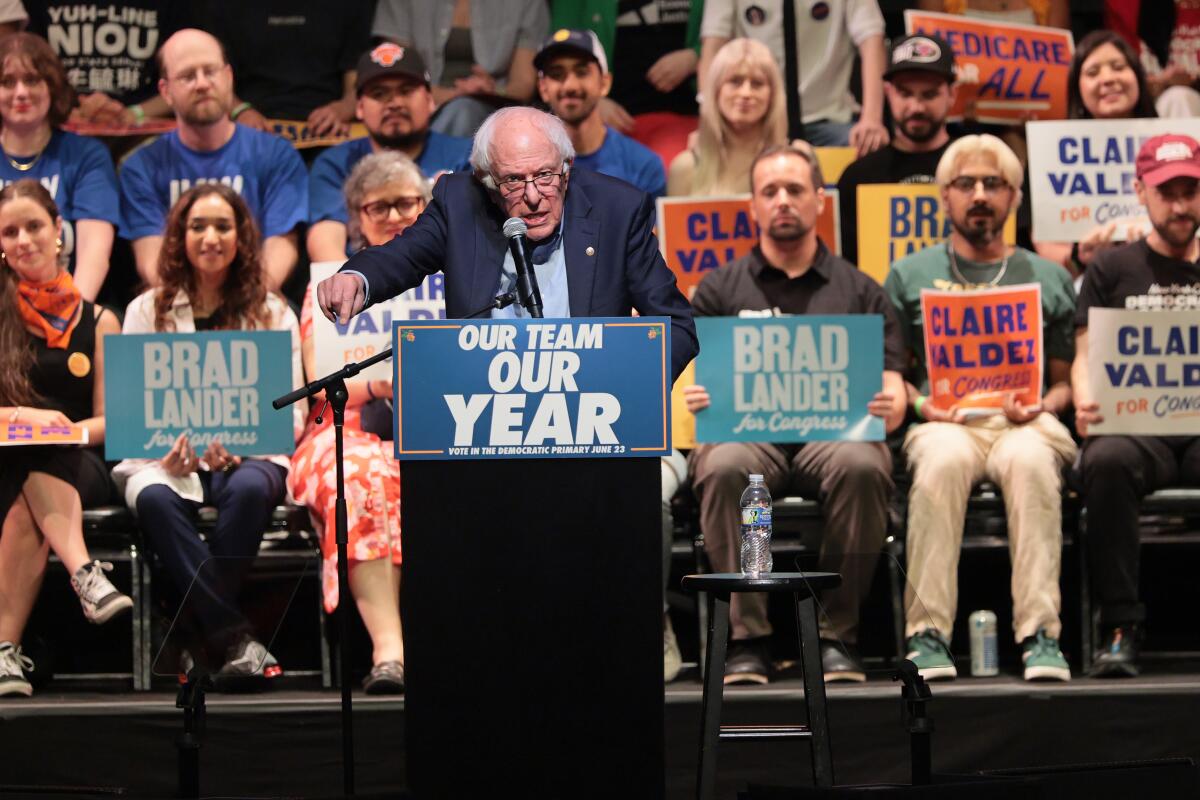
Sen. Bernie Sanders (I-VT) speaks during a Get Out the Vote (GOTV) rally

Sen. Bernie Sanders (I-VT) speaks during a Get Out the Vote (GOTV) rally at Kings Theater on June 18, 2026 in New York City. Sanders joined Mayor Zohran Mamdani ahead of next week’s primary, and the start of early voting on Saturday, as the pair campaigned for Brad Lander, Claire Valdez and Darializa Avila Chevalier, who are challenging incumbents in Democratic primary contests.

(Michael M. Santiago / Getty Images)

Democrats are uncertain over the party’s direction

The renewed push could tug at tensions among Democrats who are largely united in their loathing of Trump but are divided over the party’s direction. This year’s primaries are shaping up as a referendum between centrists who are eager to course correct from what they see as progressive overreach earlier in the decade and a left-wing pushing for even more sweeping change.

“A lot of this anger has been boiling under the surface,” said Joseph Geevarghese, executive director of Our Revolution, which was founded by U.S. Sen. Bernie Sanders, a Vermont independent who caucuses with Democrats. “It’s coming to the fore in this moment in a very powerful way.”

But Rep. Josh Gottheimer, a centrist New Jersey Democrat, called the victories in Colorado and New York “aberrations.”

“We’ve got to fight like hell to keep our party from being hijacked by socialists,” he said. “Most of them are bomb throwers, not problem solvers.”

Nevada Atty. Gen. Aaron Ford easily dispatched a more progressive rival earlier this year in his Democratic bid for governor in a state Trump carried in 2024. As he eyes a general election challenge to Republican Gov. Joe Lombardo, he insisted candidates like those who won in New York don’t represent all Democrats.

He said the Democratic Socialists of America “is not the face of our party.”

Rep. Suzan DelBene, a Washington Democrat who chairs the House Democratic campaign committee, said in a statement that Republicans were “resorting to desperate attacks that aren’t actually about the pocketbook issues.”

Trump risks overreaching with communism argument

Trump and fellow Republicans risk missing the mark when the public’s embrace of capitalism might not be as strong as it was decades ago.

About half of U.S. adults, 54%, have a positive view of capitalism, according to an August poll from Gallup, a slight decline from 61% in 2010. Democrats have driven some of the shift, but favorable opinions of capitalism have fallen among independents as well.

Only 42% of Democrats viewed capitalism favorably, while 66% had a positive view of socialism. The poll found that both younger and older Democrats have warmed slightly on socialism since 2010, but Democrats under age 50 are much less likely to view capitalism favorably. Democrats age 50 or older didn’t shift meaningfully.

“Young voters, who I would argue are driving a lot of the electoral energy that we’re seeing, came of age politically in a post-Soviet world,” Geevarghese said. “The attacks don’t land in the same way when Donald Trump was politically of age.”

Hudson, who is running the House GOP campaign committee, acknowledged the communism line might not resonate in the same way with all voters, particularly younger people. That’s why, he said, it’s important for Republicans to tailor their message to the needs of individual districts.

“I’ve never run cookie-cutter campaigns where we just say one thing over and over everywhere,” he said.

Still, the argument was high on Trump’s mind again on Wednesday as he visited the newly built Theodore Roosevelt Presidential Library in North Dakota. He called the former president a “ferocious opponent of a thing called communism.”

“It’s the biggest threat to our country, including World War I, World War II, Pearl Harbor, September 11,” he said. “It’s a bigger threat, potentially a bigger threat than that, because it’s like a cancer that spreads, and you better stop it fast.”

Beverly Gage, a history professor at Yale University who has written on the rise and fall of Sen. Joe McCarthy, said earlier eras of anti-communism politics took hold because there was a large and active Communist Party in the U.S. and the Soviet Union was the country’s primary foe. But she said Trump’s focus on the issue is notable given his ties to Roy Cohn, a onetime confidant of Trump who earlier worked for McCarthy.

“It’s not very many steps to get from McCarthy to Roy Cohn to Donald Trump,” she said.

California Gov. Gavin Newsom, a potential Democratic presidential candidate, shrugged off Trump’s communism focus as “bunk.” In an interview, he said the direction of the party isn’t all that different from the dynamics he’s navigated for decades in California politics.

“I governed in an environment where the DSA was otherwise known as progressives,” he said. “This dialectic is so deeply familiar to me, and I don’t over read any of it.”

Sloan writes for the Associated Press. AP writer Michelle L. Price contributed to this report.

Source link