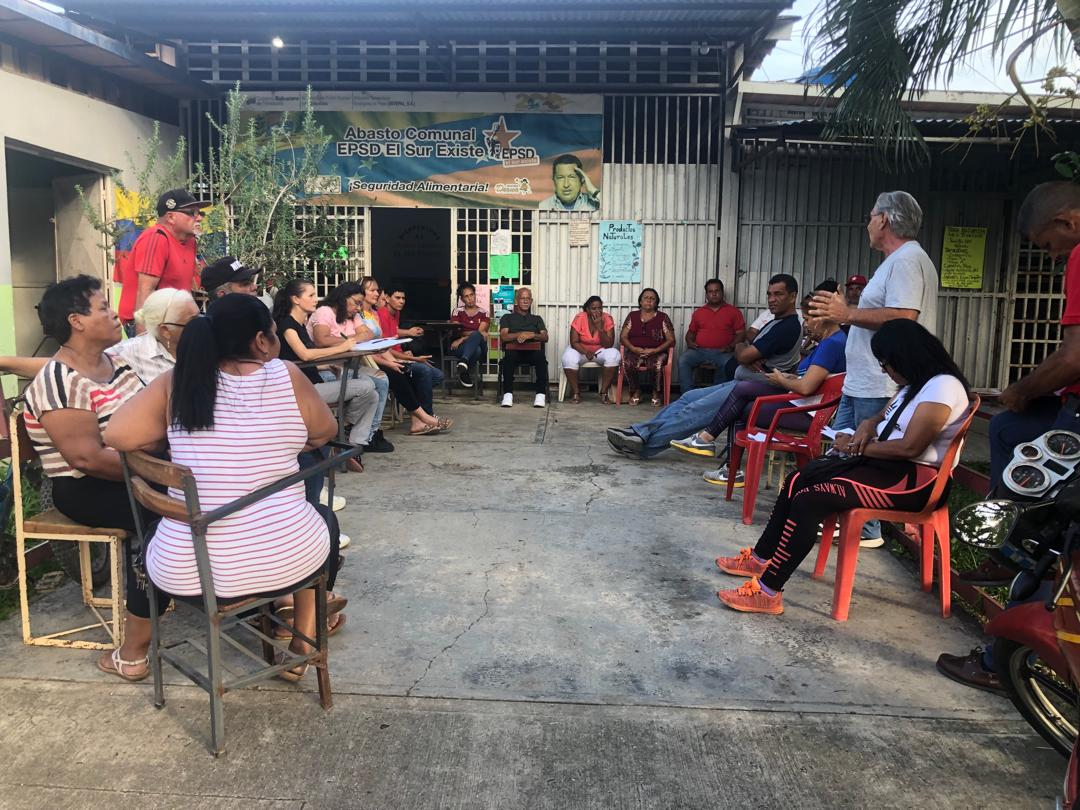
Communes

Juan Contreras: ‘The Venezuelan People Are Armed with Consciousness’

Contreras called for a unified Latin American response against ramped-up US aggression. (Tiempo)

Following the US attack on January 3, Venezuela was left in a state of turmoil and uncertainty that does not rule out further military actions. In recent days, there was “a joint operation between Venezuelan and US security agencies in the southeast of Bolívar state, in which organized crime networks were dismantled,” according to a statement from the Venezuelan government. Days earlier, the Coordinadora Simón Bolívar, a historic Chavista organization, had denounced DEA involvement in planning a repressive offensive with the aim of “decapitating” the popular movement in the iconic 23 de Enero neighborhood, which Juan Contreras describes as “the most important in Caracas.”

A community leader, social work graduate, and president of the Coordinadora, Contreras is a longtime Chavista activist and staunch defender of the Bolivarian Revolution. Today he believes there are “shameful situations that must be denounced,” but he holds the US government – ”our enemy” – responsible. Contreras was born and raised in the densely populated and combative 23 de Enero neighborhood, where he still lives and where he welcomed us to analyze the complex situation facing Venezuela, and in particular the social movements.

How are Venezuelan social organizations responding to what has been happening in the country since the US military attack on January 3?

What happened was an act of aggression, an act of war. They [the US] sought and continue to seek to break our people, but we in the social movements have kept up our efforts because we still believe in the revolutionary process. Our enemy is the US government, which must have realized that the problem wasn’t Chávez, because Chávez died and the revolution continued. President Maduro has been kidnapped, and here we are. What we’re experiencing today is unique in history; I don’t think anything like what’s happening in Venezuela has ever happened anywhere else in the world – the closest thing was in 1989 in Panama, when they kidnapped Noriega. But here, their narrative has fallen apart: it has not been proven that Venezuela is a drug trafficking country, that its government is linked to drug trafficking, or that President Nicolás Maduro was one of the biggest drug lords, as they claimed. On the contrary, today all those narratives have been debunked, and what is clear is that they are coming after our energy reserves. The Venezuelan people are well aware of this.

Is identifying a state of war and an enemy the context for the denunciation you issued about the danger of a DEA-orchestrated attack on 23 de Enero?

This is information we’ve received from a reliable source indicating that a large-scale operation is being planned against 23 de Enero, which is not far-fetched. 23 de Enero, as a barrio, has historical significance dating back to the Fourth Republic, between 1958 after the fall of Pérez Jiménez and the advent of democracy. That threat is very real. I believe that at the time, there was an underestimation of the threats posed by the US empire: the fact that our coasts were blockaded, the fact that our airspace was blockaded… Now, what we’re denouncing here has all the hallmarks of becoming a reality. It’s not just me saying this, nor the source that gave us this information, which is a reliable one. It’s that all the propaganda out there points in that direction, starting with the journalists who now live in Miami and are waging a full-scale campaign against the colectivos. “What’s going on with the colectivos? Why aren’t they attacking the colectivos? Why don’t they disarm the colectivos?” Marco Rubio himself has said it, and just recently one of the top military leaders said it: they’re coming for the “armed groups.” The problem is that, in their narrative, they label social movements as armed groups, accusing them of being armed in order to justify their aggression. Well, today our people are armed with consciousness; today, after 27 years, our people are more Bolivarian than ever. These are the people who placed their trust in Comandante Chávez, who committed to refounding the Bolivarian Republic of Venezuela. That is why we can understand all this cognitive warfare being waged against Venezuela.

There are no guerrillas here; what we have here is a people with a consciousness, a mobilized people, a people who, through culture, through popular education, have managed to advance in building the Bolivarian embryo from the barrio level, with the communal councils and the communes. So, the US seeks to dismantle that organization by employing the tactic of decapitation. They want to destroy the collectives, those who raise their voices against the empire, those who today denounce what is happening in our country, those of us who disagree with what is happening today, and who have maintained a principled and firm stance in the face of that aggression and invasion by the US empire.

Based on the information you have, how would the DEA carry out an attack of that kind on Venezuelan territory?

They have been operating by applying pressure. In all our countries, we have a repressive police force. Perhaps there is a segment of the police ranks – among their core leadership – that understands human rights issues, but there are other segments that are easily co-opted. We have 27 years of experience in which generals, colonels, and captains have turned their backs on us and served the empire’s policies. So, it’s not far-fetched to say that the United States is working with certain police forces, or with specific officials who might be willing to carry out an operation against the most important symbol in Caracas, which is the 23 de Enero parish. From 1958 to 1998, approximately 160 martyrs were killed there by the police. In other words, this is not crazy: it is serious, and as the pressure on our government to move toward an electoral process intensifies, the plan of aggression may also accelerate.

So, of course, it’s entirely possible that they’ll move forward with an action like this to eliminate what they consider “the Bolivarian resistance,” represented by social movements organized into communes, communal councils, and long-standing social organizations such as the Coordinadora Simón Bolívar, which is an expression of the popular power.

Did you receive any show of solidarity from the government?

Someone with influence within the government called us, reached out, we talked, and they agreed to investigate and look into the matter. What they recommended was caution: to steer clear of any provocation. And well, we’re waiting to see if what was discussed will be carried out, that a thorough investigation is conducted into what we’re denouncing. Because up until now, we thought [the US] would never invade, but they did; we underestimated them, and they invaded. And today they have the audacity to sell our oil, manage our finances, provoke us, and say they’re going to turn us into their 51st state. And on top of that, they’ve placed us under tutelage as if they were the owners of our country. This is, of course, shameful, and we must denounce it.

That is why we, as part of the popular movement, remain mobilized and continue to denounce what happened on January 3 and the consequences we are enduring in Bolívar’s homeland.

This situation has not yet had any international repercussions. What message do you have for the social and political forces in Latin America?

It has been 200 years since the Amphictyonic Congress, that call made by the Liberator to build a confederation of nations and defend ourselves against the US empire, which was already showing its claws. What better time to call for a continentalization of the struggle of our social organizations? It is not just Venezuela that is at risk: it is all of Latin America. They are coming for their backyard. Today, brazenly and in an interventionist manner, they are meddling in Colombia’s elections and declaring which candidate they want to win. They did the same in Honduras. 

So, in light of these events, the call to expand the struggle across the continent must be a reality today. Latin America’s only chance to escape the aggression of Donald Trump’s administration is through the coordination of the popular and revolutionary movement across the region. We must unite, we must denounce this situation, and we must move forward, because they’re coming for everything. The only way forward is to make the struggle a continental one. This is something that, at one point, was not only stated by Bolívar but also attempted by Comandante Ernesto Guevara. I believe that is where we should focus our efforts: on uniting the popular and revolutionary forces of Latin America and the Caribbean.

Source: Tiempo Argentino

Source link

Venezuelan Gov’t Backs Communes to Boost Coffee Production, Increase Exports

Communes Minister Ángel Prado oversaw the transfer of a coffee-roasting plant to a network of communes. (MinComunas)

Mérida, June 2, 2026 (venezuelanalysis.com) – The Venezuelan government launched the First National Meeting of the 2026 Communal Coffee Plan on Saturday, May 30, as part of efforts to deepen popular control and increase coffee production for export. 

The central event took place in the Ospino municipality of Portuguesa state, where authorities inaugurated the El Cafetal social property company (EPSDC), a coffee-processing plant transferred to collective communal management.

According to officials, the infrastructure will serve nearly 80 coffee-producing communes from the central-western states of Portuguesa, Lara, Yaracuy, and Trujillo. The facility, previously ran by the state-owned Venezuelan Coffee Corporation, was transferred to a network of several communes.

Acting President Delcy Rodríguez opened the event, emphasizing the role of grassroots production in the sector. 

“Coffee is one of the most important items where the communal economy already has the entire production chain organized,” she stated during a tour of the relaunched plant.

Rodríguez hailed output growth to nearly 4 million quintals in the 2025-2026 cycle, with 1.8 million quintals destined for national consumption and 2.1 million for export. According to official figures, production increased by around 25 percent over the past five years.

In her address, Venezuela’s acting president emphasized the importance of increasing exports to international markets while maintaining accessible prices domestically. “This is the path of a country that builds a sovereign future,” Rodríguez concluded.

Communes Minister Ángel Prado, who led an assembly with thousands of coffee producers and communards on Saturday, echoed the target of boosting non-oil exports from communal organizations. “You can count on the communal economy, President,” he said in his speech.

Agriculture Minister Vladimir Padrino López, who previously served as defense minister, also attended the event and called for joint efforts between his ministry and communal structures to support coffee producers. 

“We have to merge, work with a special synergy because in the end, where is the campesino? Where is the coffee grower? He is in a communal circuit, he is in a commune,” Padrino expressed. 

For their part, grassroots producers hailed the transfer of the processing plant as a long-awaited conquest. Yamileth Ortiz, a spokeswoman from El Cafetal Commune in Portuguesa state and a worker at the plant since 2008, emphasized the project’s potential to elevate coffee production in the Caribbean nation.

“There is an expectation to receive crops from at least 10 states and strengthen the national links between coffee-producing communes,” she told reporters.

The Venezuelan government has facilitated fuel supplies, seeds, and technical guidance to support producers taking part in the El Cafetal project. In recent years, Venezuelan coffee growers have highlighted fuel shortages, overpriced inputs, and a lack of access to credit as obstacles to maintaining production levels. Rural organizations have likewise denounced the influence of agribusinesses in establishing crop prices.

Edited by Ricardo Vaz in Caracas.

Source link

Venezuelan Gov’t Announces New Popular Consultation, ‘Productive Pilgrimage’

Delcy Rodríguez kicks off the new “pilgrimage” stage at the Cabelum company in Bolívar State. (Presidential Press)

Mérida, May 21, 2026 (venezuelanalysis.com) – Venezuelan Acting President Delcy Rodríguez announced that on 12 July the country will conduct its second popular consultation of the year to fund local projects. 

The Venezuelan leader made the announcement during the inauguration of the “City of Entrepreneurship” at the Giant Cacique Tiuna commune in Caracas on Monday, an event with local small-scale entrepreneurs. The upcoming vote follows the first consultation of 2026, which took place on March 8 in 5,336 communal circuits.

“I am pleased to announce that the second popular consultation will take place on July 12. So, everyone should prepare for this national consultation,” Rodríguez stated. “It will be open to projects in any of the Seven Transformations,” she added, referring to the government’s development plan across different areas.

A significant development for the upcoming vote is the incorporation of new types of organizations into the process. The acting president announced that the consultation will include 120,000 condominium boards and 15,000 neighbor associations, emphasizing the importance of consolidating a “common effort” alongside traditional communal projects. Following the March 8 consultation, Rodríguez pledged to expand the process to traditionally middle-class areas where there is no grassroots organization.

Popular consultations have become the main mechanism of government policy to transfer funds to grassroots organizations. Prior to the vote, communities hold assemblies to identify the local priorities, traditionally focusing on infrastructure, public services, or supplying healthcare facilities.

The most-voted initiative receives the equivalent of US $10,000, with the local organizations charged with executing the projects and rendering accounts. According to official figures, the Venezuelan government supported 33,743 initiatives in 2025. On some occasions, state, regional, and municipal offices have funded the second-place projects in several communes.

The upcoming July vote will be the seventh national consultation since the mechanism was consolidated, following two rounds in 2024 and three in 2025.

Venezuelan authorities have yet to specify whether the condominium boards and neighbor associations will access similar funding and if all will be eligible to participate. Their jurisdiction and ability to access state funds have yet to be defined. The move to expand the consultation to organizations in traditionally middle-class apartment complexes and residential areas bypasses the communal instances envisioned by former President Hugo Chávez as “unit cells” for the construction of socialism.

New Phase of ‘National Pilgrimage’

The announcement of the July consultation coincided with the launch of a second phase of the “Great National Pilgrimage” to defend peace and oppose sanctions. The pilgrimage, a large-scale political mobilization strategy, began the new stage on 19 May with a special emphasis on dialogue with the productive sectors of the economy.

According to Interior Minister Diosdado Cabello, this new phase differs from the first stage, which concluded on April 30, by expanding its reach to non-metropolitan areas and focusing on specific regional economic activities such as fishing, agriculture, and the oil industry.

During a rally in the western state of Zulia on Tuesday, Cabello explained that the objective is to establish direct engagement with the population, independent of political affiliation, and to channel proposals on public services, security, and financing to the Rodríguez administration.

At the same time, the Caribbean nation’s acting president held meetings in Bolívar state with the aluminum conductor company Cabelum. She stated that the pilgrimage aimed to go “to the heart of productive Venezuela” to identify structural obstacles and promote productivity. In recent months, the Venezuelan National Assembly has approved several pro-business reforms with the stated purpose of attracting private sector investment, both national and foreign.

Rodríguez explicitly linked the pilgrimage’s goals to the need for diplomatic dialogue with the Trump administration to request a removal of unilateral coercive measures, which she lamented have imposed a “very high cost” on the Venezuelan population.

The pilgrimage, which also includes mass assemblies and the collection of proposals for public management, is expected to run alongside the preparations for the upcoming July consultation. Venezuelan authorities have defended the initiative as an effort to reach out to other political factions under common national goals.

Edited by Ricardo Vaz in Caracas.

Source link

Heyerde López: ‘Our Challenge Is Staying True as a Left-Wing Organization’

López explained the role played by the arts in building a popular identity. (Venezuelanalysis)

Heyerde “Seko” López is a Venezuelan artist and activist with experience in plastic arts, screen printing, photography, graphic design, and audiovisual production. For 13 years he has been a member of Fundación Nativa Crea, a grassroots organization from Guarenas, on the outskirts of Caracas, dedicated to social work and advancing popular power.

What is Fundación Nativa Crea and what does it do?

Fundación Nativa Crea is a sociocultural organization dedicated to bringing together communes, social movements, and individuals in the town of Guarenas. We organize a variety of activities in our territory, ranging from rescuing abandoned spaces and painting murals to offering free workshops on screen printing, music, theater, and circus in local communities and schools.

Nativa is also dedicated to grassroots communication through social media. We’re always doing digital and graphic design and recording in the community to make visible what people are doing. We work to forge the identity of our barrio, our working-class areas, and our communities, so that people can be the protagonists of the revolution we’re building and the path we’re traveling together.

We’re located in Plaza Bolívar in Guarenas, right next to City Hall, because we had the chance to speak with President Chávez and decided to occupy that space, which was a Corpoelec [state electricity company] substation that had been abandoned for 15 years. At the time, we identified 37 abandoned spaces in Guarenas, but that one stood out as the most visible and strategic. We surveyed the area, and the project was born.

How is Nativa’s work organized in practice, and how does it integrate with the local community and the people’s power organizations?

There are six of us now, but we coordinate with other people in the territory and in other parts of the country. We have a set of goals and an action plan. Each person takes on tasks based on their strengths. We have six production units, two of which are currently operational: the auto repair shop, where we fix cars and motorcycles, and the screen printing and communications workshop, where we make T-shirts. We have a brand called “Contestatarixs” to market prints of iconic figures and world-renowned fighters. The other four units are a cultural café that we will soon reopen, a community bakery, a recording studio, and a greenhouse. In fact, we plan to establish a greenhouse in every community council.

In total, there are 15 community councils in our territory, which make up the General José Félix Ribas Commune. Our organization belongs to the Pueblo Arriba Communal Council. In our sector, we’re going to start with a medicinal garden, as well as tomato and onion seeds, and coffee and cacao seedlings, to later coordinate with local farmers. We’re also considering a partnership to grow barley in the nearby campesino settlements and produce craft beer. Why not have a Venezuelan communal beer?

López at a Palestine solidarity rally. (Archive)

You mentioned the bakery and the café that closed down. What obstacles did they face?

The bakery and the café closed down due to the economic difficulties resulting from the US sanctions. For example, when wheat imports were restricted, it became very difficult for us to acquire the raw materials. Previously, it had been subsidized. Although we were part of a bakery coalition with other grassroots organizations, and we held numerous meetings and coordinated efforts with the government to defend community bakeries, it was not possible to maintain our operations. In Venezuela, wheat is controlled by the owners of the silos. We fought a tough battle between 2014 and 2017, but that coalition practically fell apart, and now only the large, capitalist bakeries remain. But we are creating the conditions to revive this productive unit. We want to build a communal economy. We are going to start creating the conditions, now with more criteria and the lessons learned over these years. After all these battles, I believe we have the necessary experience.

What are the main challenges Nativa has faced over the years?

The main challenge is staying true to our identity as a left-wing organization in the face of the imperialist blockade. Nativa Crea started out as a clothing brand and is now a social organization running a headquarters of 542 square meters. But the hardest part is sustaining ourselves over time. It’s one thing to have an idea, to design a project, and quite another to sustain it –to preserve the ideology, retain the members, and create conditions so that it’s a space where people aren’t exploited and can have free time to organize alongside the pueblo

We also knew that, as we asserted ourselves, we would deal some blows to the bourgeois state. Not all mayors, governors, or institutional leaders will want to relinquish their share of power and accept the consolidation of popular power or the communal state. In practice, we have seen that things are not as beautiful as they are in theory. Rather, they are riddled with contradictions. But we have the spirit to fight and move forward. Today, what we do is join forces with different organizations, communal councils, etc., to keep the project moving forward and to help them identify with it. Nativa has always been a space where people can meet, hold workshops, organize politically, and so on.

Murals by Nativa Crea. (@nativacrea)

What would you highlight as Nativa’s main achievements over the years?

Our main achievement has been bringing together different people, from different communes, and ensuring that everyone understands we’re all fighting for the same cause: building the communal state. 

I believe our task is to demonstrate that popular power is the way forward. For example, eight years ago, using the surplus generated by the bakery, we were able to build a sports court. So, we showed that economic activity can take place under decent working conditions, serve the community, and generate a surplus to contribute to the territory where we live. Therefore, if we have productive units –which is what we insist on in the commune –we will be able to achieve autonomy, we will be able to make decisions in the territory, and we will be able to develop what the barrio needs.

Nativa, and you in particular, place a lot of emphasis on the cultural front, especially on graphic design. What is the vision behind this?

Through graphic arts, we shape our identity. Ever since we started creating prints, painting murals, taking photographs, and producing audiovisual works, we’ve always sought to reclaim Venezuelan identity. Not the identity sold to us about barrios in mainstream culture –the glorification of crime or the idea that people dress and speak a certain way. Every town has its identity, every city has its identity, every territory has its identity. So, through the arts, we try to capture that, what we experience, and in this way, people begin to recognize themselves, know where they come from, and also to appreciate things that are nationally, locally, and indigenously produced. It gives new value to their experiences, to what they consume, read, and so on.

Screen printing at the Nativa headquarters in Guarenas. (Heyerde López)

You recently hosted an international brigade from Brazil’s Landless Workers’ Movement (MST). What was that exchange like, and how can that feedback help strengthen grassroots organizing?

The MST brought a large group that split into seven brigades spread across different parts of the country. We were assigned one as the representative from the central capital region. This experience has been very important, because we see that our brothers and sisters in Brazil are fighting for the same cause as us: against capitalism and imperialism, and for the unity of the Latin American peoples.

The Landless Workers’ Movement has been raising that banner of struggle –the fight for land and the construction of campesino settlements –for over 40 years. They have very advanced methods, and they are masters of organization and planning. In fact, they are advising us on the various productive units. They believe that we, Venezuelans, need to focus more on planning, sticking to schedules, fulfilling responsibilities, etc. The exchange has helped our communards hear the perspective of comrades from outside, with their experience and organizational skills. They have shared their insights with 10 communes here in Guarenas and are also getting to know the local projects that have been approved through popular consultations.

As someone with many years of experience in grassroots organizing, how do you view the relationship between constituted power (institutions) and constituent power? What is working, and what needs to change?

Chávez, and also our professor Manuel Sulbarán, always told us that we, the working-class people, are the only ones capable of bringing about change and progress in our own country through popular power. So, popular power must continue to develop these methods and strengthen our communes, making them active and productive, and demanding that the state or institutions transfer the responsibilities we can assume and the resources we need. 

For example, in the General José Félix Ribas Commune, the project that won last year’s consultation was focused on the youth to build a soccer field. There was a group pushing for it, but the US $10,000 allocated for the project wasn’t enough. That caused a lot of discontent and led some to think that popular consultations were useless. These are the issues we need to debate and politicize. We explained to them in an assembly that this is a megaproject that cannot be done with just $10,000, so it must be conceived in several phases. We have to keep our spirits up and continue participating.

The soccer field has been a good topic for debate and reflection, because it is also true that the commune has many priorities that are more important than a soccer field. Everything is needed, and sports play a fundamental role, but for example, if the sewer system is damaged, the community will likely prioritize fixing that. That’s why we need to plan and see which projects are proposed through which channels. If we do a better job of categorizing projects by scale and setting timelines, we’ll be able to strengthen our commune. 

But, to answer the question, institutions need to work with us, the pueblo, and understand the priorities of each territory. Perhaps it’s not best for the commune to choose building a sports field because that should be the responsibility of the Ministry of Sports. This ends up giving the commune a responsibility that it should not have to assume, or that it is not in a position to take on. Nor should we be taking on the project of repairing a school when we have a Ministry of Education and a Ministry of Public Works. Obviously, our communards will dedicate themselves to anything that improves the community’s life, but why should the commune burn its only chance to access funding for popular power on unfeasible projects that should, moreover, be the responsibility of the institutions? So we must also demand that those holding constituted power –the government and institutions –fulfill their responsibilities, so that we, as an organized people, can move forward with ours. Another challenge we face is that some people confuse the tasks of the party [PSUV] with the exercise of popular power, and as a result, they sometimes end up dragging the commune into areas that are not its responsibility.

Local activity with the MST brigade. (Heyerde López)

Finally, how does Nativa interpret the current political situation, and what role should the organized people play?

January 3 was a grave moment, a call for reflection, just as the 2002 coup had been, when the people took to the streets to make history. The lesson is the same: the people must understand that only popular power will allow us to overcome this onslaught by the capitalist economic system and imperialist attacks.

Today we must organize ourselves once again, win over all those people who were fighting, or who are fighting out there but scattered. We have to unify the struggles, as President Chávez said at the time: it is very important that we know who we are, what we want to build, in order to move forward in consolidating the Bolivarian Revolution. And beyond Venezuela, we must understand ourselves as a bloc with our neighboring countries. 

For the youth, it is important not to abandon the banners of anti-imperialist and anti-capitalist struggle and to create our own methods. The past centuries’ revolutionary struggles of Germany and France will not apply here. It is not enough for us to simply “follow the ideas of Lenin, Mao, Che, or Fidel,” although we must certainly read and study them. Chávez put it very clearly: we are going to give birth to the 21st-century revolution; we are going to create it. We’ve only been at this for 20 years, developing different theoretical and political aspects, with different participants sometimes on different wavelengths. But we all know that we have a right to an anti-imperialist revolution that defends life on the planet.

Source link