Comet

Is This Secretive Air Force 737 About To Become NASA’s Next ‘Vomit Comet’?

NASA is moving to hire a contractor to assess whether or not a Boeing 737-73W can meet its needs for a new reduced-gravity testbed aircraft. The use of planes modified for this role is now new, and they are often called “Vomit Comets” because of the extreme maneuvers they perform to simulate zero-G environments and the physical side effects this often induces. However, there’s an unusual twist here with the specific plane that NASA is now eyeing: it currently belongs to the U.S. Air Force and is part of a “classified military program.” There is a strong possibility that the aircraft in question is a mysterious 737 that the service acquired in 2020, and that has been the subject of much speculation as to its purpose ever since.

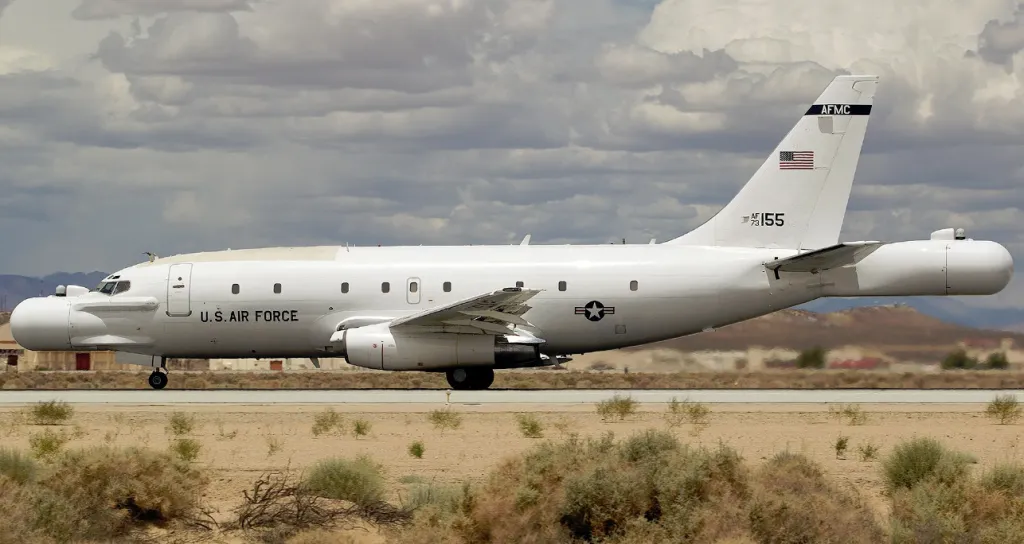
NASA’s Armstrong Flight Research Center posted a contracting notice yesterday justifying a planned sole-source contract to Denmar Technical Services, Inc. in relation to “Reduced Gravity Modification” of the 737-73W aircraft. Earlier this year, signs had already emerged that NASA might be in line to get a heavily modified and highly secretive 737 from the Air Force, designated the NT-43A and commonly referred to by the callsign RAT55. However, yesterday’s notice does not appear to refer to the NT-43A, long used as an airborne signature measurement platform and described in the past as the world’s most secretive 737, which is based on a much older 200-series airframe. We will come back to this later on.

A stock picture of the NT-43A Radar Test Bed aircraft, also commonly known by the callsign RAT55. Phodocu

What NASA wants now

“NASA requires Denmar Technical Services, Inc. to conduct a feasibility assessment to determine the Boeing 737-73W’s suitability to perform the NASA reduced gravity mission; modify the aircraft cabin, if required, to support reduced gravity operations; perform overdue maintenance and inspections, perform airworthiness restoration tasks, and paint the aircraft exterior with NASA identifiers,” the contracting notice NASA released yesterday explains.

The notice adds that the aircraft, if modified, would be used, at least most immediately, “for the Reduced Gravity Test Bed Project in support of the agency [sic] need for performing validation testing on Space Suits in support of the Artemis program.”

Artemis is NASA’s current effort to return U.S. astronauts to the lunar surface. The Artemis II mission, conducted in April, involved the first fly-by of the Moon by a crewed spacecraft since the end of the Apollo program in the early 1970s. However, the spacecraft did not touch down on the surface. The goal now is for a crewed lunar landing to come in 2028. RAT55 was notably used to support the launch of the Artemis II mission and the subsequent recovery of the capsule after its return to Earth.

Back in January, NASA had put out a separate contracting notice calling for information about new options to provide “parabolic flight services” to simulate “reduced gravity environments, including microgravity” for testing and scientific research purposes. The Florida-based Zero-G corporation is currently the primary provider of these services to NASA, using a retrofitted Boeing 727-200 dubbed ‘G-Force One.’ You can read more about NASA’s general use of Vomit Comets in the context of that notice here.

Total Weightless! What Happened on my Zero Gravity Flight? thumbnail

Total Weightless! What Happened on my Zero Gravity Flight?


The Boeing 737-73W under consideration to be turned into a Vomit Comet “is owned by the United States Air Force (USAF). Denmar Technical Services, Inc. has specialized knowledge of this Boeing 737-73W aircraft as they are currently contracted by the USAF to modify the aircraft under a classified military program,” the contracting notice NASA released yesterday adds. “NASA does not have a ‘need to know’ regarding the details of the current modifications being made under the USAF contract and therefore is unable to provide modification details to another contractor or provide another contractor with access to the aircraft. The USAF will transfer ownership of the aircraft to NASA upon completion of the closeout tasks.”

“Denmar Technical Services, Inc. is uniquely positioned to close out work under their existing obligations while performing the feasibility assessment, maintenance, and any modifications required under this action,” the notice continues. “Additionally, due to the constrained timeline for the NASA Extravehicular Activity and Human Surface Mobility Program’s space suit testing for Artemis, NASA requires the assessment and overdue maintenance to be performed immediately upon contract award and any subsequent aircraft modifications to be complete no later than October 1, 2026. The timeline can only be supported if this requirement is fulfilled concurrently with the USAF closeout tasks.”

Denmar is a small aviation firm headquartered in Reno, Nevada. At the time of writing, its website lists a wide array of specialized design, modification, flight testing, and other work among its portfolios. This includes “advanced customized mission system development” that “encompasses the design of unique airborne operator interfaces, specialized emitters and sensors, system integration, and post-mission analytics and processing.” The company also describes itself as the “Nation’s leading experts on IR [infrared] and RF [radiofrequency] survivability, signature modeling, [and] agile software development for analysis and real-world operational assessments.”

In line with all this, Denmar is understood to have been the prime contractor behind the extensive modifications to RAT55. In April, the Air Force confirmed to TWZ that the NT-43A was “being transitioned to start the next phase of its career,” as reflected by its involvement in the Artemis II mission, “after decades of flights supporting the Air Force in various roles.” The aircraft, which is understood to have long called the secretive and remote Tonopah Test Range Airport (TTR) in Nevada home, has been seen much more publicly since then.

However, as NASA’s recent contracting notice makes clear, the 737 it is now looking at as a potential Vomit Comet is a much newer 700-series model. TWZ has reached out to the Air Force and NASA for more information.

The curious case of N712JM

As mentioned, it is very possible, if not highly probable, that the 737 NASA is now considering turning into a Vomit Comet is one that the Air Force acquired in 2020, which TWZ explored in-depth at the time. That aircraft, which is a -73W model, is still officially on the U.S. civil register, with the registration code N712JM. Federal Aviation Administration (FAA) records show that the preceding owner of this aircraft was Denmar, which acquired it in 2019. The plane’s history before that is murky, with Boeing delivering it in 2013 to East West Bank via a trusteeship with Wells Fargo Bank, per the FAA’s records.

N712JM had drawn particular attention in 2020 not just because of its transfer to the Air Force, but also because it emerged at that time wearing a green protective coating and otherwise looking like it had just rolled off the production line. It also had some unusual external features that raised questions about its role, as we explored at the time.

N712JM as it was seen in 2020. Reader submission

In 2020, Jon Ostrower, long-time aviation journalist and editor-in-chief of The Air Current, told TWZ the following:

“This is definitely an airplane that never made it to a formal finish you’d expect from a commercial airplane. The green finish is a protective coating applied to fuselages during manufacturing to protect from scratches and other damage. It is dissolved during painting. You can also still see the manufacturing (line) number as well. That’s from its original trip down the assembly line. There’s also quite a bit of instrumentation visible with sensor wiring leading into the cabin through the passenger windows. This type of arrangement points to a flight test setup of some kind.”

In 2020, N712JM conducted many test flights in U.S. military ranges off the coast of Southern California, flying various flight profiles, some of them quite unusual. The aircraft flew those sorties from Santa Maria Airport in California, and used the callsign STING 38.

What the Air Force has been using N712JM for to date is unknown. Per FAA, the aircraft has been and continues to be registered to an address at Bolling Air Force Base (technically now part of Joint Base Anacostia-Bolling) in Washington, D.C., which looks to belong to the Air Force’s Rapid Capabilities Office (RCO). The RCO has headed up multiple cutting-edge, high-priority programs over the years, including the development of the B-21 Raider stealth bomber and the X-37B reusable spaceplane. A 737-based platform could be configured to support an array of different research and development and test evaluation activities that would fall under the purview of RCO, as well as other stakeholders that this office might engage with.

A screen capture of the entry for N712JM in the FAA’s online database at the time of writing. FAA capture

There has also been some speculation over the years that N712JM might have transformed into an Air Force 737 with the serial number 21-0024, but this appears to still be unconfirmed. The 21-0024 serial has more recently become associated with other shadowy 737s tied to the U.S. military, which have civilian-style paint schemes and may also be on the U.S. civil register. One of them was notably spotted in 2025 at a U.S. forward operating location in El Salvador, sitting directly alongside an Air Force AC-130J Ghostrider gunship and a U.S. Navy P-8A Poseidon maritime patrol plane. This, in turn, raised questions about its involvement in the ongoing U.S. campaign of strikes on alleged drug smuggling boats in the Caribbean and the Eastern Pacific Ocean, as TWZ previously explored in detail.

Sightings and flight tracking data have also pointed to N712JM being a resident at the Sierra Nevada Corporation’s (SNC) facility at Colorado Springs Airport, in the Colorado city of the same name, over the years. SNC is well known for highly specialized and unique aircraft modification work, especially for the U.S. military, but its exact connection to this 737 is unclear.

Interestingly, there have been several online flight tracking data ‘pings’ suggesting new activity related to N712JM at Colorado Springs Airport since at least February of this year. However, there do not appear to be any confirmed flights by the aircraft from there in that same timeframe. This airport notably sits adjacent to Peterson Space Force Base.

There is still a possibility that NASA could be looking at a different Air Force 737-73W for possible conversion into a Vomit Comet. As the contracting notice makes clear, the aircraft in question is currently in the classified realm. At the same time, this seems far less likely to be the case given everything that is known (and still unknown) about N712JM.

A separate question does exist now as to what effort the Air Force might be in the process of closing out that would allow it to transfer any classified 737 to NASA. TWZ has previously raised tangential questions about how the Air Force might fill the resulting gaps left by the highly-specialized RAT55 moving on to the next stage of its career. It is certainly interesting in its own right that NASA seems to be focused heavily at the moment on leveraging some of the most secretive 737s in existence today to support its much less sensitive needs.

More details may emerge if Denmar deems the “classified” Air Force 737 to be a suitable starting place to create a new Vomit Comet to support NASA’s reduced gravity training needs and the Artemis program.

Update: 3:45 PM EST –

In immediate response to our queries, NASA has directed us to an additional notice about the award of the sole-source contract, valued at $8.4 million, to Denmar Technical Services back on June 1.

“The contractor will modify a Boeing 737-700 aircraft to perform lunar-gravity parabolic flights to test NASA space equipment. Once modifications are complete, NASA Armstrong will own the aircraft and oversee aircraft operations out of NASA Johnson,” the notice says. “The aircraft will be used to validate astronaut lunar suits and associated crew systems required to support Artemis mission objectives. This can be done with the modified 737 aircraft in an operationally relevant, reduced-gravity environment prior to lunar mission execution.”

No mention is made here about the sourcing of the aircraft from the Air Force or its classified mission work, as outlined in the sole-source justification that was released yesterday.

Contact the author: joe@twz.com

Joseph has been a member of The War Zone team since early 2017. Prior to that, he was an Associate Editor at War Is Boring, and his byline has appeared in other publications, including Small Arms Review, Small Arms Defense Journal, Reuters, We Are the Mighty, and Task & Purpose.


Source link

Secrets of BA’s history from paper dresses and grouse for dinner to contraband

EXCLUSIVE: A new book charts the extraordinary history of British Airways, inclduing its unusual first passenger flight, its unique link to Marmite, royal fans, and some questionable fashion

British Airways has been flying for 107 years, connecting Britain to the world across more than a century of aviation history.

From a single biplane lifting off from a grass field in west London to a fleet serving destinations across the globe, the story of the world’s favourite airline is told in a new history by Captain Al Bridger – taking the story of BA in 100 objects, which encompass everything from Neville Chamberlain to Marmite.

British Airways traces its roots to 1919, when Aircraft Transport and Travel (AT&T) launched the world’s first international scheduled passenger service from Hounslow Heath to Paris.

This pioneering line later fed into Imperial Airways, which became BOAC in 1939 for long-haul routes, while BEA was formed in 1946 for European services; the two finally merged in 1974 to create modern British Airways.

But it began on August 25 1919 when a modest biplane was prepared on the grass at Hounslow Heath, a few miles from what is now Heathrow Airport. Captain Al said: “The world’s first international scheduled passenger was piloted by Lieutenant Bill Lawford.

“It carried one passenger, some newspapers, fresh grouse bound for the British Ambassador to France and Devonshire clotted cream. In challenging weather, Lawford skilfully completed the trip in 2 hours and 30 minutes.”

Five years later, in March 1924, the British government formed Imperial Airways, at the futuristic Croydon Airport. The art deco structure had a first-class restaurant, canteen for staff and a viewing gallery. The network expanded and flights could reach Delhi in seven-and-a-half days.

The Argosy aircraft, which first flew a passenger service on July 16 1926, gave early travellers a taste of luxury that would define the airline’s ambitions for decades to come. Captain Al said: “A white-coated steward served twenty passengers incredible four-course meals with drinks, providing true luxury for those lucky enough to afford it.

“The aircraft were also used for very popular weekend ‘Tea Flights’, offering afternoon tea while enjoying fabulous views over the capital.”

Among the collection’s most striking objects is a signed photograph of Prime Minister Neville Chamberlain, stepping from a British Airways Lockheed 10A after his famous Munich meetings and the declaration of “peace in our time”.

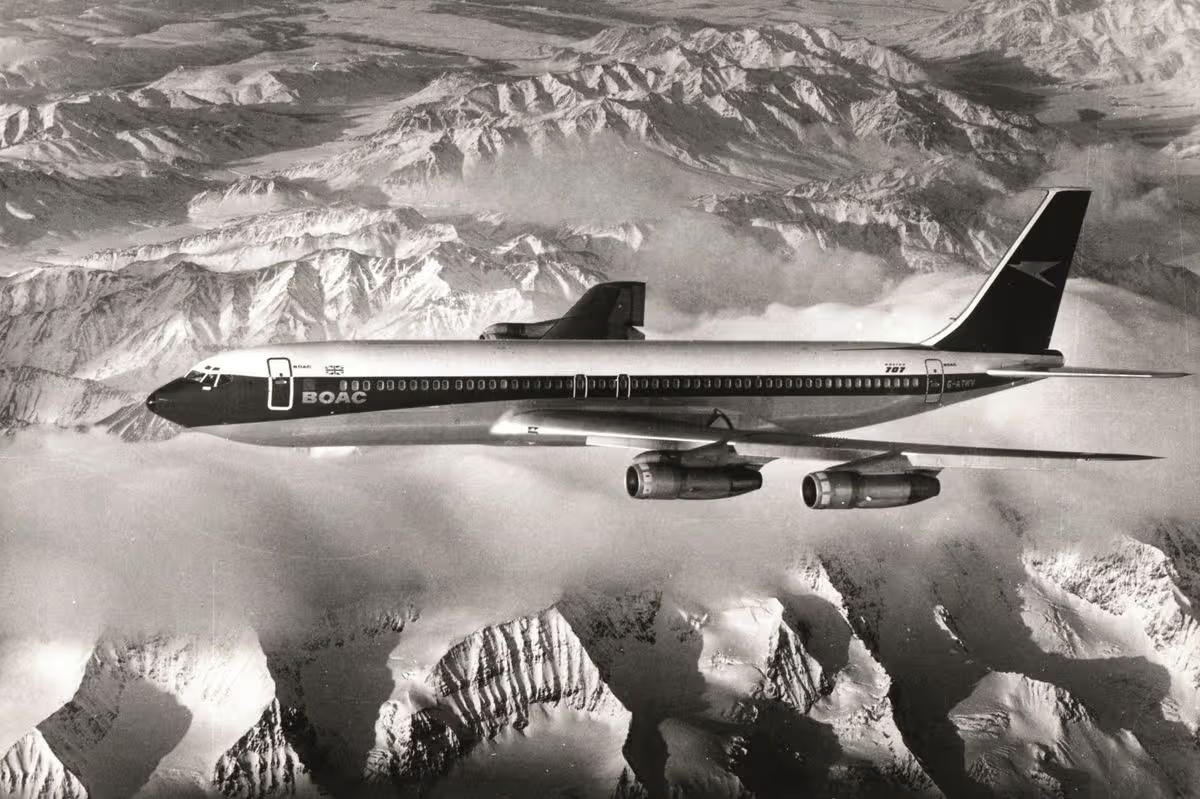
The 1950s brought a fresh start. “The Jet Age was officially launched with the introduction of the Comet in 1952, placing the UK at the very forefront of aviation,” said Captain Al, “The Rolls-Royce-powered Boeing 707 was a truly iconic symbol of the 1960s, and Sydney in Australia was now within reach in just 33 hours with four stops on the way. A true symbol of the iconic 1960s, the Boeing 707 was a triumph, shrinking the world overnight.”

The collection’s menu cards speak to a more glamorous age of flying. A BEA Silver Wing menu signed by Sir Winston Churchill on 26 April 1955 sits alongside one signed by Muhammad Ali on 10 May 1979

The 1960s brought experimentation of a more flamboyant kind. BOAC introduced cabin crew uniforms that became one of aviation’s most memorable fashion footnotes.

“While famously described as paper dresses, they were in fact sensibly made of a fireproof fabric that resembled paper and could be cut to the required length,” said Captain Al. “Incredibly, they were discarded after each flight.” They lasted a year.

The airline was also reaching out to its youngest passengers. On 26 March 1957, BOAC launched the Junior Jet Club, and Captain Al said: “The club was a huge success and had over 2 million members in its twenty-seven years of existence. Cabin crew would hand young travellers an envelope containing a registration form, a logbook and a Junior Jet Club badge.”

No history of British Airways would be complete without Concorde. The aircraft first flew on 2 March 1969 and entered service with British Airways on 21 January 1976. Captain Al said: “Concorde was to become the flagship of the fleet, bringing supersonic travel to everyone for the first time. Able to carry 100 customers in total luxury at speeds in excess of Mach 2 (more than 1,300 mph) the aircraft could cross the Atlantic in under 3 hours, with the record set on 7 February 1996 at 2 hours and 52 minutes.” The aircraft operated its last service on 24 October 2003.

While Concorde was redefining long-haul travel, the airline was also transforming life on board for ordinary passengers. A BOAC packing checklist pamphlet from the 1960s shows the formality of travel at the time. “For gentlemen, the list mentions the necessity of a dinner jacket, shirt collars and hair tonic,” said Captain Al. “For ladies, a bed jacket, hat and stole were essentials when travelling abroad.”

A photograph of the Beatles from the same era shows the Fab Four carrying BEA travel bags. Captain Al said: “Note how the Beatles are carrying BEA(TLES) travel bags, much like the more common BOAC bags. Clearly the band were travelling light.”

The 1980s brought fresh challenges and fresh ambition. In 1995, as part of a £500 million investment, the airline introduced the world’s first fully flat bed seat in First Class. Captain Al said: “Scientifically proven to give a much better night of sleep, it represented a huge leap forward in airline comfort.”

The airline’s inflight magazine, High Life, had been charting the journey since 1973. Captain Al said: “It truly is BA’s wingman. Through the years there have been some amazing contributors, from Jilly Cooper to Morecambe and Wise.”

Smoking had been part of airline life since the very beginning, but by March 1998 it was over. “When BEA was formed in 1946 over half of the British public smoked, with two-thirds of adult males recorded as smokers,” said Captain Al. “It wasn’t until 1998 that British Airways introduced a complete smoking ban on all flights.”

The modern era brought its own landmark moments. On 18 May 2012, a gold-liveried Airbus A319 named Firefly carried the Olympic flame into Culdrose Naval Airbase in Cornwall. Captain Al said: “Safely contained in four miner’s lamps, the flame was taken from the aircraft by Anne, the Princess Royal, accompanied by Lord Coe, the chairman of the London Olympics Organising Committee and football superstar David Beckham.”

The airline’s centenary in 2019 produced one of the collection’s most unlikely objects. “To celebrate the airline’s centenary, British Airways and Marmite teamed up and created a limited-edition jar that could be purchased on board,” said Captain Al.

“Apparently Marmite is the most confiscated brand at airport security, so the centenary jar was made to be just 70 grams, conveniently sized to fit within the liquid allowance to get it safely through airport security.”

Few objects in the collection carry more weight than the Royal Flights book, its pages bearing the signatures of those who have trusted the airline across the decades. The first entry dates from November 1983.

Captain Al said: “The book was beautifully inscribed with superb calligraphy and the signatures of Her Late Majesty Queen Elizabeth II and His Late Royal Highness The Duke of Edinburgh. Fittingly, the final signature is again that of Her Late Majesty after her visit to the British Airways Headquarters on 23 May 2019 to celebrate the airline’s centenary year.”

From a grass field in Hounslow to the signature of a queen, British Airways has carried the nation and the world for 107 years.

As Captain Al writes of the airline he has served and loves: “It has seen great highs and led the world through some very challenging times, and I know it will continue to give the best it can in the coming years, generating many more wonderful objects along the way.”

British Airways in 100 Objects by Al Bridger is published by Amberley, £17.99

BA in numbers

46.3 million passengers carried in 2025.

Fleet of 254 aircraft serving 215 destinations across six continents.

40,000 employees worldwide.

Revenue of £14.6 billion in 2024.

Source link