A road trip to Carrizo Plain, which blooms with spring colors
In summer, it’s too hot. And in rain, the muddy dirt roads threaten to swallow your car.
But if you can hit Carrizo Plain National Monument on a spring day when the hills and grasslands are green and a few wildflowers remain in the meadows — well, you’re winning. And you’ll be seeing a lonely, raw corner of California that few people ever find.
The monument is about 38 miles long and 17 miles wide — hard to miss, you’d think. But it lies along the San Andreas fault in the usually dry hills between Bakersfield and Santa Maria, far from Interstate 5 or U.S. 101, about 170 driving miles northwest of Los Angeles.

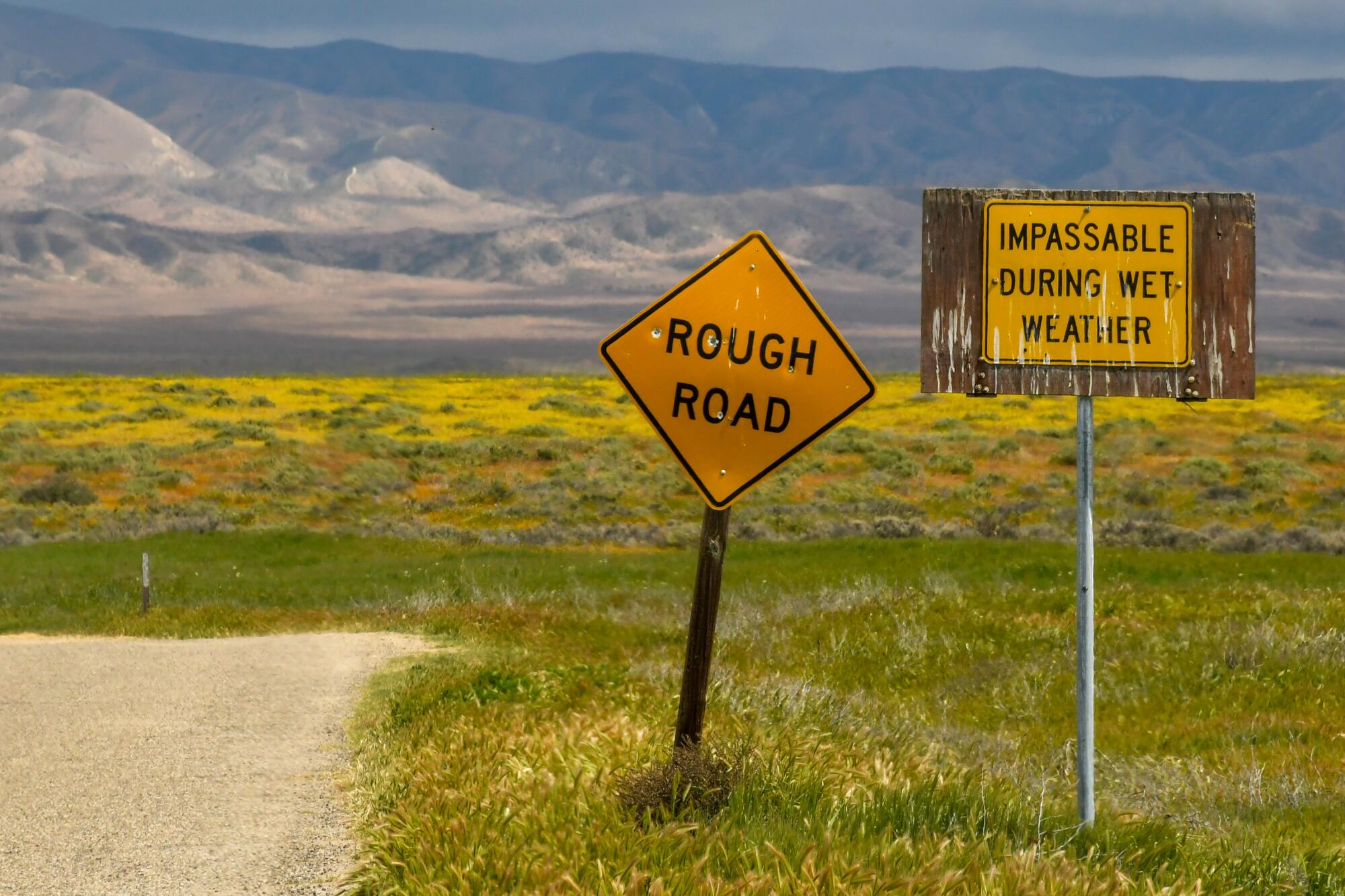
Signs warn motorists what’s ahead in Carrizo Plain National Monument in San Luis Obispo County.
(Christopher Reynolds/Los Angeles Times)
Within the monument, most of the roads are gravel or dirt, and there is no drinkable water, no food, no gas and spotty cellphone coverage. The education center and two semi-primitive campgrounds feature vault toilets.
It’s almost perfect, in other words, for repelling crowds. Yet it’s pretty good as the centerpiece of an overnight road trip probing small towns and back roads of the western San Joaquin Valley and eastern San Luis Obispo County.
If you happen to arrive Friday, Carrizo staffers and volunteers will be celebrating the 25th anniversary of the monument, which was created from former ranch land under President Clinton. (Free tours and refreshments will be offered at the event, which takes place from 10 a.m. to 1 p.m. at the Guy L. Goodwin Education Center.) But next week might be greener, because rain on the plain is probable Saturday and Sunday.
For many visitors, Carrizo’s big draw is wildflowers. The grasslands and hillsides act as a vast, uncluttered canvas for their colors, which typically bloom in March and last through April. But every year is different, especially in this era of climate change. This year, after unusually heavy rains in February, Carrizo Plain erupted in a dramatic bloom in March, attracting several hundred visitors per day.

In Carrizo Plain National Monument on a spring day, the hills and grasslands were green and a few wildflowers remained in the meadows.
(Christopher Reynolds/Los Angeles Times)
By the time my wife and I arrived in the first days of April, the flowers were past their peak, but the hills were still green and many meadows popped with yellow, purple and blue. If I’m reading my wildflowers handbook right, these were tidy tips, Goldfields, Owl’s Clover, thistle sage, Valley Larkspur, coreopsis, phacelia and hillside daisies.
Meanwhile, the 3,000-acre Soda Lake, which lies dusty, crusty, dry and white in summer, still had some water in it. Imagine the salty lake beds of Mono Lake, the Salton Sea or Death Valley’s Badwater, but surrounded by green hills. It was startling — the opposite of an oasis in the desert.
To get there, we drove north on I-5 into the San Joaquin Valley, then veered west by way of State Routes 166, 33 and 58, pausing for gas at Maricopa (population: 984).
Within the monument, we rambled along Soda Lake Road, admiring windmills, an old ranch house now reserved for bats, and a few hills dotted with lazy cows. (The monument is run by the Bureau of Land Management, which allows grazing.)
Looking a little bit more closely, you realize that the monument is all but torn in two by the San Andreas fault. On Elkhorn Road, you remember that those mountains to the east (the Temblor Range) are slowly lurching to the southeast. Meanwhile the Caliente Range — those mountains just to the west — are lurching the opposite way. The “offset” is growing by about 1.5 inches per year — at least, until the next big quake.

A lone visitor stands at the edge of Soda Lake in Carrizo Plain National Monument.
(Christopher Reynolds/Los Angeles Times)
Slowly rolling through this scene, we spotted two critters scurrying along the roadside — fist-size creatures hopping on their back legs. These were probably giant kangaroo rats, a native species whose numbers have been growing since their listing as an endangered species in 1987.
We didn’t spot any blunt-nosed leopard lizards or San Joaquin Valley kit foxes (which eat giant kangaroo rats) but those species, too, are endangered and native to the area. Pronghorn antelope and Tule elk are out there, too, the experts say, along with California condors soaring overhead. We just saw crows, loitering on fence posts.
The Goodwin Education Center, the monument’s main gathering spot, is open Thursdays through Sundays, December through May. We looked at maps, got advice on where to go next and ate our sack lunches at a picnic table, marveling at those green slopes.

A San Joaquin kit fox is displayed at the Goodwin Education Center within Carrizo Plain National Monument.
(Christopher Reynolds/Los Angeles Times)
In this long valley, scientists have found signs of Native campsites up to 10,000 years old — a hint of how much wetter this area once was. Not far from the education center is a short hike to Painted Rock, a protected site that includes Native pictographs on a horseshoe-shaped sandstone formation. The red, black and white images go back 100-4,000 years. (We didn’t see them. From March through May, visitors can see the pictographs only on Saturday guided tours. From July 16 through February, visitors can book self-guided tours.)
After lunch we nosed around nearby Soda Lake, exited the north end of the monument, joined State Route 58 and headed west over a series of whoop-de-doos — those rises and falls in the road that will help you defy gravity, if you take them fast enough.
One of them, I realize now, was the San Andreas fault itself.
Through all of this, we saw no more than 15 or 20 people, cars included. Continuing from State Route 58, we joined State Route 41, watched oak trees and vineyards pop up and multiply, continued into Paso Robles and spent the night.
On the return trip we lingered for an hour or two in Santa Margarita (population: 1,149), checking out the Porch Cafe, the Barn (antiques) and the Giddy Up vintage goods and gift shop, which operates in a blue Quonset structure known as the Rainbow Hut.

Holli Rae owns and runs the Giddy Up vintage goods and gift shop on El Camino Real in Santa Margarita.
(Christopher Reynolds/Los Angeles Times)
“It’s just a sweet little town. So quiet,” said Holli Rae, a filmmaker and former Angeleno who opened the Giddy Up about two years ago. She moved north, she said, for “the nature, the animals, the deer, the birds. The creatures!”
Thanks to U.S. 101, we were home and grateful within three and a half hours.
Soon, we knew, summer will come and fry the Carrizo Plain until everything green is brown. Beginning June 1, in fact, the Goodwin Education Center will close for six months.
For a few more weeks, Angelenos, your window of opportunity is open.
If you go
Where to explore:
Check out the Carrizo Plain National Monument website or call the visitor center at (661) 391-6191. The recorded information line is (661) 391-6193. Also check the weather; most roads in the monument are dirt or gravel and can become impassable in rain.
Where to sleep:
Adelaide Inn, 1215 Ysabel Ave., Paso Robles; (805) 238-2770. This hotel, located near 24th Street and U.S. 101, includes a pool and children’s play area. Rates start at about $100.
River Lodge, 1955 Theatre Drive, Paso Robles; (805) 221-7377. This hotel, born as a motel in 1947, was reborn as a boutique property in 2024. It has 28 rooms, a patio restaurant (Ciao Papi) and an adult-only pool. It stands alongside U.S. 101, about 3 miles south of downtown Paso. Midweek rates often start at $149, often doubling on weekends.
Melody Ranch Motel, 939 Spring St., Paso Robles; (805) 238-3911. This is a throwback 1950s motel with a swimming pool, open May through September. From the start, it has had 19 rooms and a prime spot on Spring Street, the main artery of Paso Robles. Rates start at about $100. Most reservations are taken by phone, in person or through Expedia.
Where to eat:
Joe’s Place, 205 Spring St., Paso Robles; (805) 238-5637. Since 1995, this breakfast-and-lunch spot has been a local favorite for casual family meals.
The Porch Cafe, 22322 El Camino Real, Santa Margarita; (805) 438-3376. This all-day cafe (with beer and wine) stands along the main drag in sleepy little Santa Margarita.