How water became a top election issue this year in Arizona
Ahead of the November elections, candidates in Arizona seized on one issue like never before: water.
Democratic Gov. Katie Hobbs ran ads touting her record, saying: “Those before me didn’t protect our water, so I tackled the problem.” She handily won reelection.

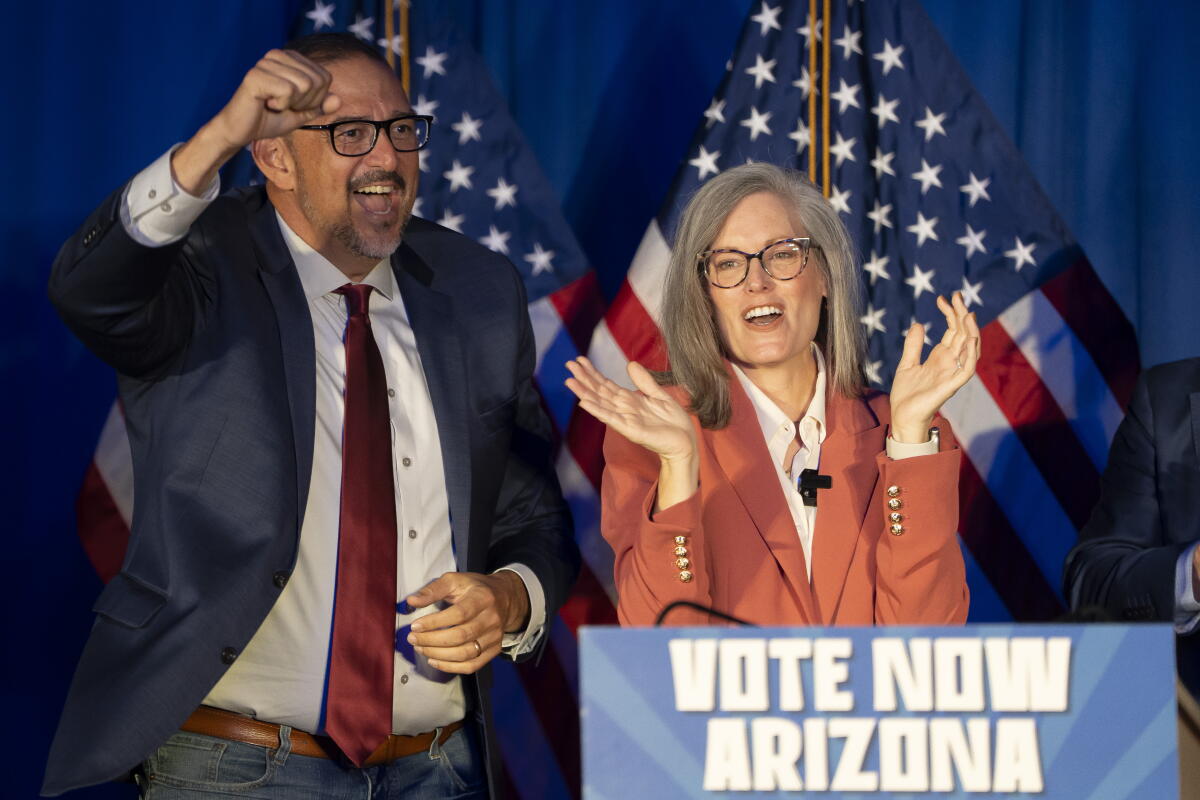
Arizona Secretary of State Adrian Fontes and Arizona Gov. Katie Hobbs share the stage during a Democratic rally in Phoenix.
(Rebecca Noble / Getty Images)
Atty. Gen. Kris Mayes also made water a central issue, saying in a campaign ad: “If it’s Arizona’s water, I’ll always fight to protect it.” She similarly trounced her Republican challenger.
The surge in water-focused campaigning reflects growing concerns among voters about the shrinking Colorado River and chronic overpumping of groundwater.
“Water is now among the very top issues,” said Christopher Kuzdas, the Environmental Defense Fund’s water program director in Arizona. “People increasingly relate water to their ability to make choices about their future — the opportunity to stay in a place and build a life.”
The subject has become top-of-mind for many as the desert state braces for more cuts to its allotment of Colorado River water. Arizona recently joined a lawsuit by Nevada against the Trump administration to challenge its plan for mandatory cutbacks, arguing it would harm the state’s economy.
In California, in contrast, water was less prominent in most political campaigns.
One exception was Republican gubernatorial contender Steve Hilton, who sought to woo voters with his calls for delivering more water to farms and cities. In the Central Valley, some of his campaign signs declared: “For Water & Jobs.”
But ultimately Hilton’s calls seemed to gain little traction. Democrat Xavier Becerra won by a large margin.
Some Arizona voters have become alarmed about how out-of-state companies and investors have set up large farms in the desert where they can pump unlimited groundwater from wells, with some exporting alfalfa overseas.
Both Hobbs and Mayes have targeted a giant Saudi-owned hay farm in western Arizona, and campaigned on their efforts to rein in its heavy water use.
The governor terminated the company’s leases of state land, a deal that had included below-market rates. And Mayes is suing the company, arguing it’s causing harm by pulling up excessive amounts of water on its remaining farmland.

An irrigation system sprays an alfalfa field in December 2025 near Vicksburg, Ariz. The Saudi-owned company Fondomonte Arizona LLC has been growing alfalfa on desert farmland.
(Kayla Bartkowski / Los Angeles Times)
“It takes about 12 gallons of water to grow just one alfalfa plant. But there’s a Saudi-owned mega-farm in Arizona growing millions of them,” the attorney general said in one commercial. “That’s why I sued, just like I’ve sued other companies abusing Arizona’s water supply.”
The company, Fondomonte, also owns land in California. It recently said it is “committed to progressive, efficient agricultural practices,” and has invested in “the latest technology to conserve water” on its farms.
A survey earlier this year by the Center for the Future of Arizona confirmed that water has risen to the top of voters’ concerns, and that 69% do not believe the state will have enough over the long term to support people, agriculture and economic growth. The survey also found 78% want stronger protections for groundwater in rural areas — which Hobbs’ administration has begun to adopt.
Over the last four years, state officials have established three new regulated areas to limit pumping by farms where groundwater levels are dropping. Hobbs has tailored her message to indicate she isn’t anti-farming but will prioritize solutions where large farms are taking too much groundwater. In one ad, farmer Ed Curry endorsed Hobbs as a leader who is helping to address his area’s water problem.
In a post on the Environmental Defense Fund’s website, Kuzdas wrote that concerns about water have gone “from obscurity to the mainstream,” thanks in part to extensive journalism examining the subject. (He credited a 2019 Arizona Republic investigation that I wrote with then-colleague Rob O’Dell for helping to put the groundwater crisis on the agenda.)
He also credited residents who have organized and spoken out to demand change in areas where wells have run dry.
At the same time, the constant news coverage of the Colorado River’s low reservoirs over the last year has more people concerned about the state’s water future as climate change intensifies drought. By this summer, Kuzdas said he was seeing political ads on water almost every day.
He said unlike issues such as the economy or education, water tends to be a nonpartisan issue, and that makes him hopeful the state’s leaders can take bigger, more creative steps toward solutions.
“I do think that water has some traction and legs for a while as a top electoral issue,” he said, “because the challenges we face are so significant.”

A 2014 aerial view of the valley where the proposed Sites Reservoir is slated to be built near Maxwell, Calif.
(Risa Johnson / California Department of Water Resources)
More water news
California water regulators have cleared the way for construction of Sites Reservoir, the state’s first large reservoir in decades. I reported for The Times on the decision by the State Water Resources Control Board after a heated debate. Gov. Gavin Newsom and leaders of water agencies say the reservoir is vital to a modern California water system. Tribes say it will destroy sacred sites, and others argue the $7-billion project is too costly and will harm fish and the environment.
The decision followed another vote by the same board approving controversial changes to how the state controls water pumping in the Sacramento-San Joaquin River Delta, the heart of the state water system.
My L.A. Times colleague Susanne Rust wrote about alarming new research on plastic pollution. A scientist skied into remote wilderness areas of the Sierra Nevada to take samples of freshly fallen snow. Everywhere she looked, she found microplastics.

A deckhand holds a dorado aboard the sportfishing boat Dana Pride in September.
(Gary Coronado / For The Times)
More climate and environment news
The extremely warm ocean waters along the California coast, fueled by climate change and the strong El Niño, continue to set records and drive extraordinary shifts in fish and other marine life. Joshua Partlow writes in the Atlantic that El Niño, which has pushed the ocean temperature to 11 degrees higher than average, has brought entire tropical ecosystems north, including whale sharks, giant manta rays and reef fish.
The superheated ocean waters have been bringing dramatic transformations for months. Fedor Zarkhin reported for The Times that anglers on sportfishing boats have been catching tuna, mahi-mahi and wahoo, which aren’t usually found off Southern California. Last week, my colleague Corinne Purtill covered the news when a third olive ridley sea turtle laid its eggs in Southern California. The shifts in the ocean are also leaving victims, as thousands of emaciated seabirds have washed up dead on beaches.
Sen. Alan Armstrong of Oklahoma pushed for a provision in a permitting reform bill that would limit states’ power to block gas pipelines. As Nicholas Kusnetz and Lauren Dalban report for Inside Climate News, Armstrong could stand to gain financially.
As U.N. climate talks began in Turkey this week, Secretary-General António Guterres said in an interview with AP reporter Seth Borenstein that as global warming brings worsening heat waves, storms, floods and droughts, it’s time fossil fuel companies start paying taxes on their windfall profits to support countries grappling with the most severe effects.
“This is a moment of truths,” Guterres said. “We can no longer wait. … Everybody must do more, everybody must do more now.”
This is the latest edition of Boiling Point, a newsletter about climate change and the environment in California and the West. Sign up here to get it in your inbox.
And catch the latest episode of the Boiling Point Podcast: This week hear film director Richard Ladkani talk about the documentary he has produced with Indigenous leader Juma Xipaia about her years of struggle to protect the forests and rivers of the Amazon.
For more news on water issues and climate change, follow Ian James @ianjames.bsky.social on Bluesky and @ByIanJames on X.