Colombia

Trump’s threats of intervention jolt allies and foes alike

Venezuela risks “a second strike” if its interim government doesn’t acquiesce to U.S. demands. Cuba is “ready to fall,” and Colombia is “very sick, too.”

Iran may get “hit very hard” if its government cracks down on protesters. And Denmark risks U.S. intervention, as well, because “we need Greenland,” President Trump said.

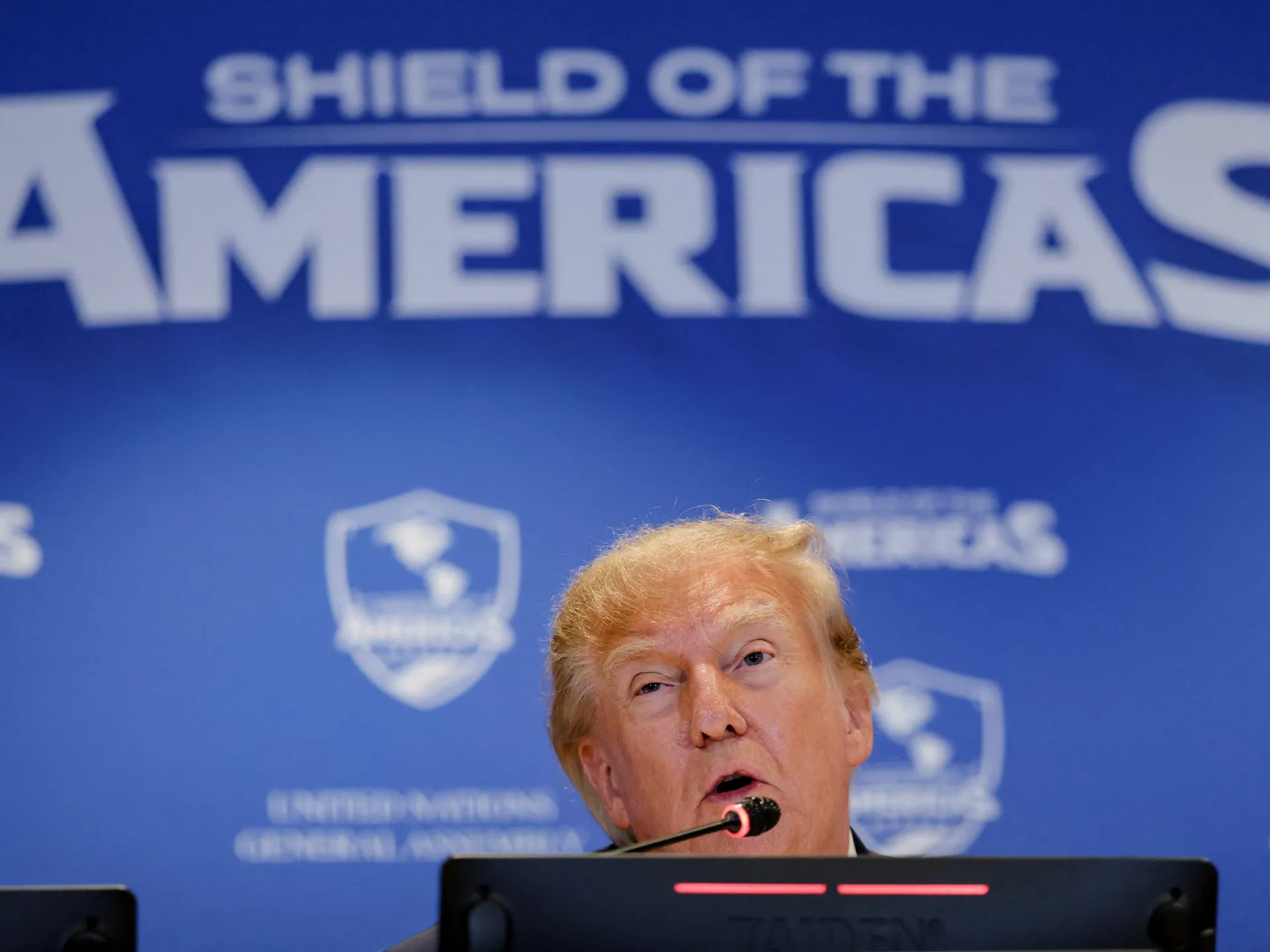
In just 37 minutes while speaking with reporters Sunday aboard Air Force One, Trump threatened to attack five countries, both allies and adversaries, with the might of the U.S. military — an extraordinary turn for a president who built his political career rejecting traditional conservative views on the exercise of American power and vowing to put America first.

The president’s threats come as a third of the U.S. naval fleet remains stationed in the Caribbean, after Trump launched a daring attack on Venezuela that seized its president, Nicolás Maduro, and his wife over the weekend.

The goal, U.S. officials said, was to show the Venezuelan government and the wider world what the American military is capable of — and to compel partners and foes alike to adhere to Trump’s demands through intimidation, rather than commit the U.S. military to more complex, conventional, long-term engagements.

It is the deployment of overwhelming and spectacular force in surgical military operations — Maduro’s capture, last year’s strikes against Iranian nuclear facilities, assassinations of Islamic State leadership and Iran’s top general in Iraq — that demonstrate Trump as a brazen leader willing to risk war, thereby effectively avoiding it, one Trump administration official said, explaining the president’s strategic thinking.

Yet experts and former Trump aides warn the president’s approach risks miscalculation, alienating vital allies and emboldening U.S. competitors.

At a Security Council meeting Monday at the United Nations in New York — called by Colombia, a long-standing and major non-North Atlantic Treaty Oranization ally to the United States — Trump’s moves were widely condemned. “Violations of the U.N. Charter,” a French diplomat told the council, “chips away at the very foundation of international order.”

Even the envoy from Russia, which has cultivated historically strong ties with the Trump administration, said the White House operation was an act of “banditry,” marking “a return to the era of illegality and American dominance through force, chaos and lawlessness.”

Trump’s threats to annex Greenland, an autonomous territory of the Kingdom of Denmark with vast natural resources, drew particular concern across Europe on Monday, with leaders across the continent warning the United States against an attack that would violate the sovereignty of a NATO ally and European Union member state.

“That’s enough now,” Greenland’s prime minister, Jens-Frederik Nielsen, said after Trump told reporters that his attention would turn to the world’s largest island in a matter of weeks.

“If the United States decides to militarily attack another NATO country, then everything would stop,” Denmark’s prime minister, Mette Frederiksen, told local press. “That includes NATO, and therefore, post-World War II security.”

Trump also threatened to strike Iran, where anti-government protests have spread throughout the country in recent days. Trump had previously said the U.S. military was “locked and loaded” if Iranian security forces begin firing on protesters, “which is their custom.”

“The United States of America will come to their rescue,” Trump wrote on social media on Jan. 2, hours before launching the Venezuela mission. “We are locked and loaded and ready to go. Thank you for your attention to this matter!”

In Colombia, there was widespread outrage after Trump threatened military action against leftist President Gustavo Petro, whom Trump accused, without evidence, of running “cocaine mills and cocaine factories.”

Petro is a frequent critic of the American president and has slammed as illegal a series of lethal U.S. airstrikes against alleged drug boats in the Caribbean and the eastern Pacific.

“Stop slandering me,” Petro wrote on X, warning that any U.S. attempts against his presidency “will unleash the people’s fury.”

Petro, a former leftist guerrilla, said he would go to war to defend Colombia.

“I swore not to touch a weapon again,” he said. “But for the homeland, I will take up arms.”

Trump’s threats have strained relations with Colombia, a devoted U.S. ally. For decades, the countries have shared military intelligence, a robust trade relationship and a multibillion-dollar fight against drug trafficking.

Even some of Petro’s domestic critics have comes to his defense. Presidential candidate Juan Manuel Galán, who opposes Petro’s rule, said Colombia’s sovereignty “must be defended.”

“Colombia is not Venezuela,” Galán wrote on X. “It is not a failed state, and we will not allow it to be treated as such. Here we have institutions, democracy and sovereignty that must be defended.”

The president of Mexico, another longtime U.S. ally and its largest trading partner, has also spoken out forcefully against the American operation in Caracas, and said the Trump administration’s aggressive foreign policy in Latin America threatens the stability of the region.

“We categorically reject intervention in the internal affairs of other countries,” President Claudia Sheinbaum said in her daily news conference Monday. “The history of Latin America is clear and compelling: Intervention has never brought democracy, has never generated well-being or lasting stability.”

She addressed Trump’s comments over the weekend that drugs were “pouring” through Mexico, and that the United States was “going to have to do something.”

Trump has been threatening action against cartels for months, with some members of his administration suggesting that the United States may soon carry out drone strikes on drug laboratories and other targets inside Mexican territory. Sheinbaum has repeatedly said such strikes would be a clear violation of Mexican sovereignty.

“Sovereignty and the self-determination of peoples are non-negotiable,” she said. “They are fundamental principles of international law and must always be respected without exception.”

Cuba also rejected Trump’s threat of a military intervention there, after Trump’s secretary of State, Marco Rubio, himself the descendant of Cuban immigrants, suggested that Havana may be next in Washington’s crosshairs.

“We call on the international community to stop this dangerous, aggressive escalation and to preserve peace,” Cuban President Miguel Díaz-Canel posted on social media.

The U.S. attacks on Venezuela, and Trump’s threats of additional military ventures, have caused deep unease in a relatively peaceful region that has seen fewer interstate wars in recent decades than Europe, Asia or Africa.

It also caused unease among some Trump supporters, who remembered his pledge to get the United States out of “endless” military conflicts for good.

“I was the first president in modern times,” Trump said, accepting the Republican presidential nomination in 2024, “to start no new wars.”

Wilner reported from Washington and Linthicum from Mexico City.

Source link

Colombia can be “part of solution” for Venezuela transition | US-Venezuela Tensions

Former Colombian President Ivan Duque Marquez, discusses how Colombia’s could play a supporting role in Venezuela transition after the abduction of Nicolas Maduro. US President Donald Trump has threatened military action against Colombia, accusing its government of making and selling cocaine to the United States.

Source link

Venezuelans divided after US attack and Maduro’s abduction | US-Venezuela Tensions

NewsFeed

Venezuelan officials say US air strikes killed at least 40 people, destroyed parts of the capital and violated their national sovereignty with the abduction of President Nicolas Maduro. Venezuelans are divided between fear of ongoing US intervention and celebrating his removal.

Source link

Trump just sent a very dangerous message to Latin America | Nicolas Maduro

Within hours of a massive operation of regime change in Venezuela, United States President Donald Trump revelled in his “success”. He posted a photo of Venezuelan President Nicolas Maduro in handcuffs and then addressed the American public.

He praised the military for launching “one of the most stunning, effective and powerful displays of American military might” in US history, allegedly rendering Venezuelan forces “powerless”. He announced that Maduro and his wife would be indicted in New York for “narcoterrorism” and claimed – without evidence – that US operations have reduced maritime drug trafficking by 97 percent.

Trump went further, declaring that the US would “run the country” until an unspecified transition could be arranged, while openly threatening a “second and much larger attack”. Crucially, he framed these claims within a broader assertion of US “domination over the Western Hemisphere”, explicitly invoking the 1823 Monroe Doctrine.

The US military intervention in Venezuela represents something far more dangerous than a single act of aggression. It is the latest manifestation of a centuries-old pattern of US interference that has left Latin America scarred. The regime change operation in Caracas is a clear sign the Trump administration is embracing this old policy of interventionism with renewed fervour. And that bodes ill for the region.

That this attack targeted Maduro’s repressive and corrupt government, which was responsible for the immense suffering of many Venezuelans, makes the situation no less catastrophic. Washington’s long history of supporting brutal dictatorships across the region strips away any pretence of moral authority. Trump himself can hardly claim any moral high ground given that he is himself embroiled in a major political scandal due to his close ties with convicted paedophile Jeffrey Epstein and has maintained unconditional support for Israel’s genocide in Gaza.

The Trump administration’s attack on Venezuela solidifies a catastrophic pattern of violations of international law. If the US can unilaterally launch military strikes against sovereign nations at a whim, then the entire framework of international law becomes meaningless. This tells every nation that might and power trump legality and sovereignty.

For Latin America specifically, the implications are chilling. To understand why this attack reverberates so painfully across the region, one must take a quick look at its history. The US has orchestrated or supported coups and military dictatorships throughout the region with disturbing regularity.

In Guatemala in 1954, the CIA overthrew the democratically elected government of Jacobo Arbenz. In Chile in 1973, the US backed the coup that brought Augusto Pinochet to power and ushered in an era of unchecked political violence. In 1983, the US invaded and occupied the island of Grenada to overthrow its socialist government. In Argentina, Brazil, Uruguay, and throughout Central America, Washington provided training, funding and political cover for military regimes that tortured dissidents and murdered civilians.

The new question now is, if the US carried out regime change in Venezuela so easily, who is next? Colombia’s President Gustavo Petro, who has been at odds with the Trump administration, was quick to react – and is right to be concerned, as in December, Trump threatened an intervention, saying “he’ll be next“. Others in the region are also nervous.

Beyond the looming threat of US intervention, Latin America now also faces the potential regional instability that a regime change in Caracas is likely to create. The political crisis under Maduro had already spilled beyond its borders into neighbouring Colombia and Brazil, where Venezuelans fled poverty and repression. One can only imagine the ripple effect the US-enacted regime change will have.

There are probably many Venezuelans who are celebrating Maduro’s ouster. However, the US intervention directly undermines the political opposition in Venezuela. It would allow the regime, which appears to retain power, to paint all opposition as foreign agents, eroding its legitimacy.

The Venezuelan people deserve democracy, but they have to achieve it themselves with international support, not to have it imposed at gunpoint by a foreign power with a documented history of caring more about resources and geopolitical dominance than human rights.

Latin Americans deserve better than to choose between homegrown authoritarianism and imported violence. What they need is not American bombs but genuine respect for self-determination.

The US has no moral authority to attack Venezuela, regardless of Maduro’s authoritarian nature. Both can be true: Maduro is a dictator who caused immense harm to his people, and US military intervention is an illegal act of aggression that will not resolve the crisis of democracy in Venezuela.

The region’s future must be determined by people themselves, free from the shadow of empire.

The views expressed in this article are the author’s own and do not necessarily reflect Al Jazeera’s editorial stance.

Source link

Colombia braces with alarm after Maduro’s removal in Venezuela by US | Nicolas Maduro News

Medellin, Colombia – The shock removal of Venezuelan leader Nicolas Maduro by the United States military has triggered alarm in bordering Colombia, where analysts warn of the possibility of far-reaching repercussions.

The Colombian government condemned Washington’s early Saturday morning attacks on Venezuela – which included strikes on military targets and Maduro’s capture – and announced plans to fortify its 2,219-kilometre (1,378-mile) eastern land border, a historic hotbed of rebellion and cocaine production.

Recommended Stories

list of 3 itemsend of list

Security analysts also say Maduro’s deposition could aggravate an already deteriorating security situation in Colombia, while refugee advocacy groups warn the country would bear the brunt of possible migration waves triggered by the fallout from the intervention.

The Colombian government held an emergency national security meeting at 3am (09:00GMT), according to President Gustavo Petro.

“The Colombian government condemns the attack on the sovereignty of Venezuela and Latin America,” wrote the president in an X post, announcing the mobilisation of state forces to secure the border.

The ELN factor

The National Liberation Army (ELN), a left-wing group and the largest remaining rebel force in the country, have been vocal as recently as December in its preparations to defend the country against “imperialist intervention”.

Security analysts say the primary national security risk to Colombia following the attacks stems from ELN, which controls nearly the entire border with Venezuela.

“I think there is a high risk now that the ELN will consider retaliation, including here in Colombia, against Western targets,” said Elizabeth Dickinson, deputy director for Latin America at Crisis Group International.

The rebel group is heavily involved in cocaine trafficking and operates on both sides of the border; it has benefited from ties with the Maduro government, and US intervention threatens the group’s transnational operations, according to analysts.

The ELN, which positions itself as a bastion against US imperialism in the region, had already stepped up violence in response to the White House’s threats against Colombia and Venezuela. In December, it ordered Colombians to stay home and bombed state installations across the country, an action it described as a response to US aggression.

The Colombian government has ramped up security measures in anticipation of possible retaliatory action by the ELN following Maduro’s removal.

“All capabilities of the security forces have been activated to protect the population, strategic assets, embassies, military and police units, among others, as well as to prevent any attempted terrorist action by transnational criminal organisations, such as the ELN cartel,” read a statement on Saturday morning issued by Colombia’s Ministry of Defence.

‘Mass influx of refugees’

In addition to fears of increased violence, Colombia also stands to bear the brunt of any migration crisis initiated by a conflict in Venezuela.

In an X post on Saturday morning, Petro said the government had bolstered humanitarian provisions on its eastern border, writing, “all the assistance resources at our disposal have been deployed in case of a mass influx of refugees.”

To date, Colombia has received the highest number of Venezuelan refugees worldwide, with nearly 3 million of the approximately 8 million people who have left the country settling in Colombia.

The previous wave of mass migration in 2019 – which followed opposition leader Juan Guaido’s failed attempt to overthrow Maduro – required a massive humanitarian operation to house, feed, and provide medical attention to refugees.

Such an operation is likely to prove even more challenging now, with Colombia losing roughly 70 percent of all humanitarian funds after the Trump administration shuttered its USAID programmes in the country last year.

“There is a real possibility of short-term population movement, both precautionary and forced, especially if instability, reprisals, or power vacuums emerge,” said Juan Carlos Viloria, a leader of the Venezuelan diaspora in Colombia.

“Colombia must prepare proactively by activating protection mechanisms, humanitarian corridors, and asylum systems, not only to respond to potential arrivals, but to prevent chaos and human rights violations at the border,” added Viloria.

A further collapse in US-Colombia relations

Analysts say Maduro’s removal raises difficult questions for Petro, who has been engaged in a war of words with Trump since the US president assumed office last year.

The Colombian leader drew Trump’s ire in recent months when he condemned Washington’s military buildup in the Caribbean and alleged a Colombian fisherman had been killed in territorial waters. In response, the White House sanctioned Petro, with Trump calling him a “thug” and “an illegal drug dealer”.

“Petro is irascible at the moment because he sees Trump and his threats no longer as empty, but as real possibilities,” said Sergio Guzman, Director at Colombia Risk Analysis, a Bogota-based security consultancy.

Indeed, Trump has on multiple occasions floated military strikes against drug production sites in Colombia. However, experts say it is unlikely the White House would take unilateral action given their historic cooperation with Colombian security forces.

Despite Petro condemning Washington’s intervention in Venezuela, he previously called Maduro a “dictator” and joined the US and other nations in refusing to recognise the strongman’s fraudulent re-election as president in 2024.

Rather than supporting Maduro, the Colombian leader has positioned himself as a defender of national sovereignty and international law.

On Saturday, Petro called for an emergency meeting of the United Nations Security Council, which Colombia joined as a temporary member just days ago.

“Colombia reaffirms its unconditional commitment to the principles enshrined in the Charter of the United Nations,” wrote the president in an X post.

This story has been published in conjunction with Latin America Reports.

Source link