colom

Black voters view Scott Colom’s historic US Senate win through lens of Mississippi’s racial legacy

It’s been nearly 150 years since a Black man has represented Deep South and deep red Mississippi in the U.S. Senate.

That changed Wednesday evening as Democrat Scott Colom was declared the winner over Republican incumbent Cindy Hyde-Smith, who had been endorsed by President Donald Trump. For many in the state and for Black Americans across the nation, Colom’s victory reflects the ambitions that were thwarted by generations of systemic oppression and violence.

Janice Johnson, who lives in Greenville in the Mississippi Delta, says having a Black senator has been a long time coming. “In the last few years we have seen great strides,” she said.

Out of all the southern states, Mississippi has a special place in the struggle over Black Americans’ exclusion from the nation’s promises of freedom and justice. There’s Ida B. Wells-Barnett, the Mississippi-born journalist who investigated 19th century lynching across the South, and Emmett Till, the 14-year-old whose 1955 kidnapping and murder by white men in Mississippi reinvigorated the Civil Rights Movement.

There’s Medgar Evers, the NAACP’s first Mississippi field secretary who fought at Normandy in World War II and organized Black voter registration until his 1963 assassination. And Fannie Lou Hamer, the civil rights leader who challenged Mississippi’s all-white delegation at the 1964 Democratic National Convention.

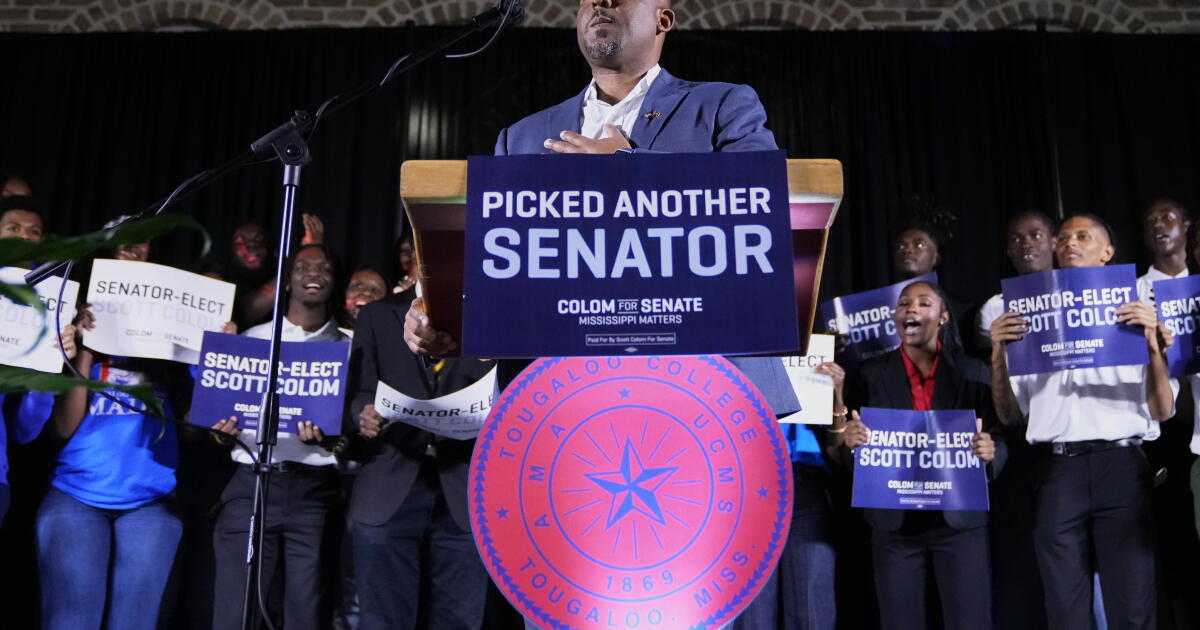
Rep. Bennie Thompson, who represents Mississippi’s 2nd District, was a student organizer for Hamer while studying at Tougaloo College, where Colom’s victory celebration was held Wednesday night. And now, Thompson is watching his mentee, Sen.-elect Colom, fill a more than 145-year gap of Black leadership in statewide office.

“From my perspective, I now have a partner in Washington,” Thompson said before introducing Colom.

“I can’t help but think about Medgar Evers on Veterans Day,” Colom said during a victory speech. “A moment like this, where he served his country and came home to Mississippi, when they wouldn’t let him vote. But he had the faith that Mississippi could make progress. … He had faith that a day like this was possible.”

He added, “All I did was have the courage to imagine a night like this.”

Johnson, who watched part of Colom’s victory speech from home, says she understands that Black voters, alone, aren’t responsible for Colom’s win. White voters, too, had to be fed up with the state’s economy, school systems and crumbling health care infrastructure for the poor — Black and white — under Republican rule.

“The most important part is we’ve got to have faith that Mississippi is ready to do the right thing,” an elated Johnson told The Associated Press on Thursday. “We as a people — and Mississippi as whole — are ready to show the nation. We have to work together, and that was his message. He wants to help pull us together.”

Jerome Dunn, a barber in Jackson, echoed Johnson’s sentiment.

“It takes everybody to vote, not one single race,” said Dunn, 59, who is Black and also voted for Colom. “I think people are looking for him to work for everybody. People are tired of Republicans and what they believe.”

Two came before Colom

Blanche K. Bruce, a Republican, was the second Black man in the Senate from Mississippi after that state’s legislature elected him to a six-year term. He served from 1875 to 1881. Hiram Revels, another Republican, was the first after the Senate voted to seat him in 1870 to fill a vacancy left empty since the start of the Civil War. Revels’ term expired about a year later.

Bruce and Revels were among 16 Black men from southern states who served in Congress during the period of Reconstruction, which aimed to address the inequities experienced by Black people during enslavement, while preparing reentry for the 11 Southern states that seceded from the union at the start of the U.S. Civil War.

Once Reconstruction ended and federal troops were withdrawn, freed slaves in the South lost many of the freedoms gained following the war as Southern states enforced racial segregation through Jim Crow-era laws.

White conservatives have dominated Mississippi’s Statehouse and congressional delegation ever since. Nearly all were white Democrats as laws restricted where Black people could live, work and go to school. That weight carried on through the Civil Rights era, but during the late 1960s white elected leaders in Mississippi switched political parties and became Republicans.

Colom’s win represents “a pretty significant change in Mississippi politics,” said Brian Shoup, head of political science and public administration at Mississippi State University.

“We haven’t seen a Democrat win the Senate since the 1980s and even then that was a traditional kind of more southern conservative Democrat,” the professor said. “We haven’t had an African American senator since the era of Reconstruction, so this is obviously a very significant and important election in Mississippi history.”

Mississippi has been burdened by its racial legacy

Black voters in Mississippi and across the South were faced with the reality of redistricting efforts designed to reduce Black representation in elected positions, set off in late April by a Supreme Court decision that gutted the landmark Voting Rights Act of 1965. The ruling helped fuel increased voter turnout.

But it’s difficult for many to ignore Mississippi’s troubling past involving race relations, from the lynching of Black people by the Ku Klux Klan and other mobs to the killings of Evers and Till.

In his 1963 “I Have a Dream” speech, civil rights icon the Rev. Martin Luther King Jr. referred to Mississippi as a state “sweltering with the heat of injustice, sweltering with the heat of oppression.”

Colom’s election is historic and means things are changing in parts of the South, said Elnora Fisher, 68, of Greenville, who was born and raised in Mississippi where she remembers that simply living often didn’t seem fair to Black people.

“As I understood, my grandparents always tried to save up to vote,” Fisher said. “They had to pay a tax to vote.”

As a child during the 1960s, Fisher said her mother took her to an NAACP meeting. “While we were there the white police stopped the meeting and made us leave,” she said.

Black people in Mississippi should be ecstatic with Colom as a U.S. senator, Fisher added.

“Here in Mississippi, so much has been taken from the poor people and given to the rich people,” she said. “I hope Colom will give back to the people who helped get him where he is.”

Good may come of it all with so many eyes on the results of the contest between Colom and Hyde-Smith, said Shoup, the professor. Mississippians, along with the rest of the nation, may be ready to begin healing from the past.

“This race, the fact that it has been so close, and it has activated so much turnout, might portend the prospects of maybe being able to talk about these things in a more civil and open fashion,” he said.

Williams writes for the Associated Press. Sophie Bates in Jackson, Miss., and Aaron Morrison in New York contributed to this report.
Source link

Democrat Scott Colom elected as Mississippi’s first Black senator since Reconstruction

Democratic nominee Scott Colom has defeated Republican Sen. Cindy Hyde-Smith in Mississippi’s closely contested U.S. Senate race after a prolonged ballot counting process, giving the state its first Black U.S. senator since post-Civil War Reconstruction.

Colom’s narrow victory is a seismic shift in Mississippi, which has been controlled mostly by white conservatives for generations, and it will echo through the country as well. The outcome adds to a decisive midterm rebuke of President Trump, whose party suffered defeats in several Republican-controlled states, and it will bolster some Democrats’ argument that their future runs through the American South.

The Associated Press called the contest Wednesday in Colom’s favor after local elections officials spent several days processing absentee and provisional ballots, called affidavit ballots in Mississippi.

The last time Mississippi chose a new Democratic senator was 1947, and the winner then was a staunch segregationist. Colom, a 43-year-old local prosecutor, capitalized on the state’s large Black population, discontent with the economy and Hyde-Smith’s missteps as she sought a second full term.

“They actually deserve a senator that will listen to them, that actually cares about what they think, actually cares about what they’re going through,” Colom said in the campaign’s closing stretch.

Colom said during the campaign that he could represent all of Mississippi, a state where racial divisions have long defined its politics and society.

“It’s got to be about having a party that represents rural America again, suburban America, urban America — a party that makes sure we actually deliver for voters in ways that make their lives better, and we don’t come up with excuses as to why we can’t do it,” he said.

A race Washington once viewed as a longshot

The contest was a latecomer to the national spotlight, drawing attention from Democrats who belatedly infused cash into Colom’s candidacy. The son of a onetime Republican who worked for President Reagan, Colom garnered attention for his aggressive campaign as Democrats widened the Senate battleground map and Hyde-Smith’s vulnerabilities crystallized.

Colom attracted particular notice for some of the year’s most widely circulated ads. After Hyde-Smith, 67, seemed to brush off high beef prices by saying consumers could choose other proteins, Colom cut a 30-second spot depicting incredulous voters saying they’d “pick another senator instead.”

When Trump went to Corinth, Miss., in late October for a rally with Hyde-Smith, Colom walked the line of Trump supporters as they waited outside the gates. He introduced himself, asked about their concerns and explained his priorities.

Later that evening, when Trump called Hyde-Smith to the stage, she said nine words in six seconds: “Is this not the best president in our lifetime?”

Then she stepped away.

“I love that,” Trump replied when he continued his 80-plus minutes at the microphone. “Sometimes they get up and they talk for 10 minutes.”

The appearance tracked Colom’s tactic of criticizing Trump’s policies — especially the Iran war and tariffs that he said were especially hard on Mississippi farmers — without taking personal jabs at the president or people who voted for him.

Instead, he consistently put the onus on Hyde-Smith, framing her as a non-entity in Washington — a critique that resonated in a state that has been accustomed to long-serving senators like Thad Cochran, Trent Lott and John Stennis, who all rose to powerful posts and routed federal money back to Mississippi.

There is some irony to Hyde-Smith finding herself flat-footed against Colom. In 2022, then-President Biden nominated Colom to be a U.S. District Court judge in the Northern District of Mississippi. Mississippi’s senior Republican Sen. Roger Wicker and former Gov. Haley Barbour, who is also a former national Republican chairman, backed the nomination.

Hyde-Smith, however, blocked Colom’s confirmation under the Senate tradition that members can spike a president’s choices for federal judicial positions in their home state.

Colom said his Senate bid was never about getting even with Hyde-Smith.

Colom called on Mississippi’s history

The senator-elect concluded his campaign with an ad that featured him at the Jackson home of Medgar Evers, the civil rights leader who, in 1963, was gunned down in his driveway by a white supremacist and died in front of his family.

“In Mississippi, no one is above the law, and no one should be outside its protection,” Colom said, telling the story of Evers’ military service at Normandy in World War II, his voter registration efforts in Mississippi, his assassination and the three decades it took to win a conviction.

“He was killed for helping Mississippians vote,” Colom said. “On Tuesday, use your vote and honor everyone who died for that right.”

Black Democrats, including Maryland Sen. Angela Alsobrooks and Georgia Sen. Raphael Warnock, highlighted Colom’s bid early. Senate Majority Leader Chuck Schumer helped Colom raise money, and he drew financial support from other outside players, including Illinois Gov. JB Pritzker, a billionaire and potential presidential candidate.

Former President Clinton and former Vice President Kamala Harris campaigned on Colom’s behalf in the campaign’s closing weeks.

Despite Republicans’ domination, the path was always there

With the largest share of Black voters of any state, Mississippi’s general elections have been closer for years than its immediate Southern neighbors. Trump won by double digits in each of his three presidential contests, but in 2023, Republican Gov. Tate Reeves managed to win reelection by a margin of just 3 percentage points.

Colom and other Black party leaders and strategists insisted throughout 2026 that he could narrow the gap with strong Black turnout, Republican voter discontent and an uptick in Democrats’ usual share of the white vote in Mississippi.

Results showed strong turnout in the Mississippi Delta and its concentration of majority Black counties. But nearly all of the state moved leftward from the 2024 election, when Trump carried Mississippi by nearly 23 points.

Then-Gov. Phil Bryant first appointed Hyde-Smith, who was state agriculture commissioner, to the Senate in 2018 when Cochran resigned. She won a special election runoff in 2018 and a full term in 2020. Both times she defeated Democrat Mike Espy, a former U.S. agriculture secretary who’d also been Mississippi’s first Black congressman since Reconstruction.

During the extended vote count, Colom acknowledged the historic nature of doing what Espy could not. But he said he sees his place more in terms of other Mississippians, especially its youngest residents, than his individual story.

“My job is to do well enough as the next United States senator that the next time some young black boy or girl has the work ethic, the vision, and the values,” he said, “and they want to be United States senator, that nobody says because of anything I’ve done that they shouldn’t get a chance.”

Barrow and Bates write for the Associated Press.

Source link

Democrat Scott Colom wins closely watched US Senate race in Mississippi | US Midterm Elections 2026 News

BREAKING,

The historic victory delivers an eighth US Senate seat to Democrats after last week’s pivotal midterm election.

Democrat Scott Colom has won Mississippi’s closely watched United States Senate race, giving his party a rare, historic victory in a Republican stronghold that has eluded them for decades.

Colom, a prosecutor who will become the state’s first Black senator in more than 140 years, garnered a narrow victory on Wednesday over incumbent Republican Senator Cindy Hyde-Smith in one of the US midterms’ biggest upsets.

Recommended Stories

list of 3 itemsend of list

The win builds on Democrats’ success after the party delivered an electoral drubbing last Tuesday, winning at least eight US Senate seats that are currently held by Republicans. A US Senate race in Alaska remains uncalled.

For more than a week, the Mississippi contest has remained too close to call as election officials worked to count more than 100,000 mail-in ballots. Thousands of other residents, who could not confirm their registration at voting sites, cast provisional ballots that required confirmation of their eligibility.

US Senator Cindy Hyde-Smith appears with President Donald Trump at a rally in Biloxi, Mississippi
US Senator Cindy Hyde-Smith appears with President Donald Trump at a rally in Biloxi, Mississippi [File: Rogelio V. Solis/AP Photo]

Colom and Hyde-Smith took markedly different approaches as remaining ballots were counted.

Hyde-Smith, who was not seen publicly until she returned to Washington this week as the Senate returned to session, had expressed confidence she would win after “every legally cast vote is fully and accurately counted”. But after the election, Colom continued to hold a series of public events where he castigated his opponent.

“Ultimately, at some point, the senator needs to speak out. Where is Cindy Hyde-Smith?” Colom told reporters on Friday in Jackson, Mississippi. “We want to hear from her. She needs to answer questions. What is her path to victory? She doesn’t have one”.

The US Senate race also was not the first time the two had crossed political paths.

Hyde-Smith, citing concerns about Colom’s position on transgender athletes, previously blocked him from serving as a federal judge in 2023 after he was nominated by former US President Joe Biden. The position had required Senate approval.

Colom’s win defies political gravity in a state that US President Donald Trump won by just over 22 points in the 2024 presidential election.

The last Democrat to win a US Senate race in Mississippi was 1982, when John Stennis claimed victory over Republican challenger Haley Barbour, who later became governor of the state.

Colom, who has been a proponent of raising the minimum wage, increasing protections for rural hospitals and ending the US war in Iran, will be sworn in next January. He will be the chamber’s seventh Black lawmaker.

Source link

Scott Colom and Black Mississippians on cusp of history as vote count continues

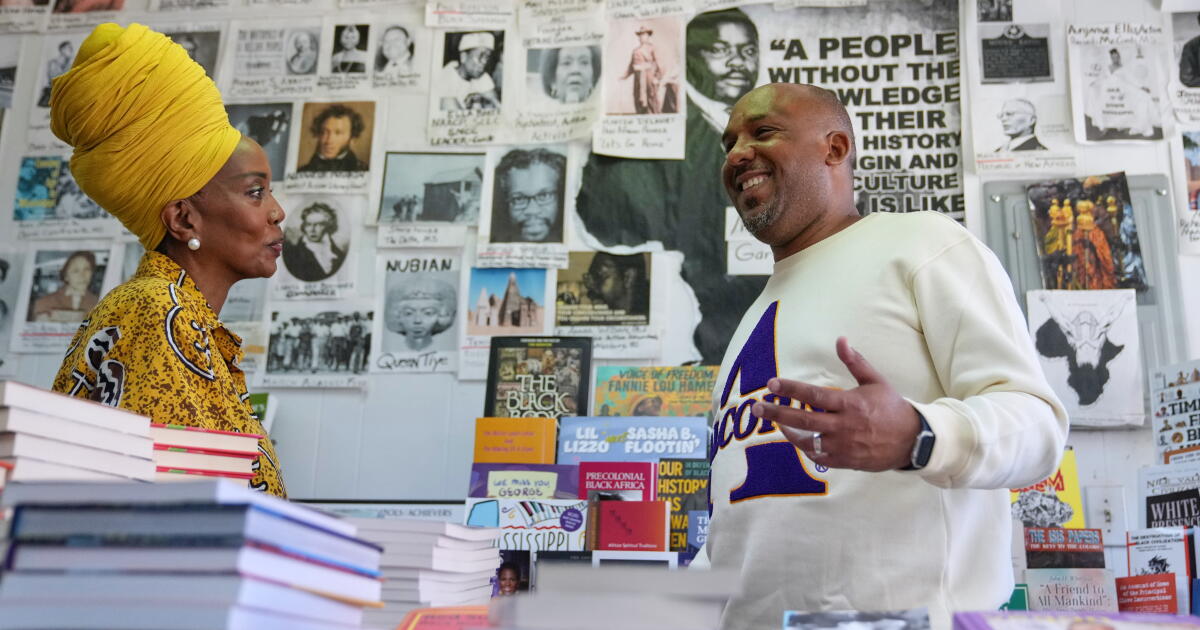
Democrat Scott Colom hasn’t won Mississippi’s U.S. Senate race, but the local prosecutor was welcomed as a historic figure Friday as he strolled through the Farish Street business district where civil rights leaders once organized.

“It’s so wonderful! It’s so wonderful to have Scott Colom as our representative,” said Maati Jone Primm, who owns Marshall’s Music and Book Store in Jackson.

The state is still tallying ballots that could make Colom the first Black senator from this Deep South state since Reconstruction. The possibility of Colom defeating Republican Sen. Cindy Hyde-Smith puts many Black voters somewhere between cautious optimism and outright celebration in a state where nearly 40% of the population is Black but the top representation for generations has been white.

“I’m so glad we are at the point where we are,” said Sorie Tarawally, a 76-year-old attorney who has long known Colom’s father. He called the 43-year-old candidate “the man, our messiah, our savior.”

The contest remains too early for the Associated Press to call, and Colom’s historic bid will hinge on a tedious process playing out in elections offices across Mississippi’s 82 counties. Local officials are receiving and examining absentee and provisional ballots, called affidavit ballots, before deadlines next week. Volunteers and lawyers representing each campaign look on in anticipation of potential litigation.

“We’re going to make sure everything is followed according to the law, and I have confidence in those local officials,” Colom said. “They’re doing their jobs. Got to be patient with them.”

Hyde-Smith has not appeared publicly since election night, when she essentially declared victory despite her razor-thin lead at the time with ballots still uncounted. Ballots tallied since have leaned in Colom’s favor.

Colom chided Hyde-Smith for not explaining her strategy going forward.

“She’s still our senator. Where is she? Why is she not doing any interviews?” he asked. “Why can’t she explain what her pathway to success is?”

In a social media post on Friday, Hyde-Smith wrote, “We are not backing down. This election is not over. Our team is working across Mississippi to monitor the remaining ballots and protect the integrity of the process. We will see this through to the very end!”

Uncertain number of outstanding ballots

The pool of outstanding ballots includes absentee ballots, which can be counted in Mississippi as long as they are received by Tuesday, five business days after the election. The rest are affidavit ballots, which are cast at the polls when there’s a glitch: Perhaps the person’s name was not on the rolls or the person did not have proper identification, or a poll worker determined the person’s identification did not precisely match the name on the list.

Citizens who had identification issues have until Tuesday to address those matters in person at their local elections office. For people who were not on a precinct’s rolls, local officials can verify a person’s status using previous records and information on the affidavit that person filed when filling out a ballot. That person typically has no responsibility to come to a local elections office; ballot status can be found on the Mississippi secretary of state’s office website.

Counties have until Friday to certify complete results to the secretary of state.

Mississippi law has no provision for a statewide recount. Campaigns could seek court orders, usually county by county, seeking to examine ballots.

A potentially seismic effect in state

Democrats already have won control of the Senate, so the result in Mississippi would not change the balance of power in Washington.

But it would mark a seismic shift in the state, where white conservatives have dominated the Statehouse and congressional delegation for nearly 150 years. Through Jim Crow segregation and the civil rights era, those leaders were nearly all Democrats. In the decades since, as the Democratic Party rid itself of white nationalists, Republicans have taken over the leadership. For Black Mississippians, the result was the same: a lack of proportional representation at the top levels of state government and in Washington.

Colom was initially viewed as a long shot, and it wasn’t until late October that Senate Democrats’ top campaign group started spending on advertising to support him. But the midterms revealed a broad backlash against redistricting efforts in the South that were aimed at boosting Republicans and, by extension, reducing Black representation.

Primm’s bookstore, where Colom visited Friday, opened in the 1930s and is recognized as the oldest Black-owned bookstore in the U.S.

She said the Farish Street neighborhood still represents Black Mississippians’ “first migration, from the plantation to the city.” Having Colom there as a potential senator “makes us so proud, and it gives us someone to aspire to. Our youth need to see the possibilities for their lives, and we do when we see our next senator from Mississippi.”

As he campaigned, Colom emphasized that he can represent all Mississippians, and he said President Trump’s policies — the war with Iran and tariffs, especially — cut across all demographic lines. He celebrated the extended ballot counting process as a benefit to the state’s 2.95 million residents.

“I’m so glad the national press is getting to see the beauty of our state,” he said.

But Colom and his Black supporters also have never ignored the significance of his candidacy.

“We are motivated by the gross inequalities we have seen in society and how only one side seems to benefit,” said Tarawally, who was born in Sierra Leone and arrived in the Deep South to attend law school at the University of Mississippi. “So, we want a person who speaks to our benefit.”

Colom ended his campaign with an ad set at the Jackson home of Medgar Evers, the civil rights leader who was gunned down in 1963 in his own driveway, dying in front of his wife and children.

“It’s a powerful reminder of the sacrifice to gain the ballot, and nobody sacrificed more than Medgar Evers and his family,” Colom said Friday.

“What was important to me about that ad is we didn’t ask people to vote for me. We just talked about the sacrifice, talked about the story,” he continued. “We just wanted that to be the closing ad because I wanted that to be the last message that the people of Mississippi heard.”

Barrow and Bates write for the Associated Press.

Source link