college player

Angels top 2025 draft pick Tyler Bremner endures amid heartache

“It just means more” is a fine slogan. When it comes to the baseball draft, however, the Southeastern Conference can take a back seat to our oceanfront pitching factory.

First pitcher selected in last year’s draft: Tyler Bremner, UC Santa Barbara, taken second overall by the Angels.

First pitcher selected in this year’s draft: Jackson Flora, UC Santa Barbara, taken fourth overall by the San Francisco Giants.

Bremner followed the first round of Saturday’s draft from an airplane, watching from the screen on the back of the seat in front of him.

“It was cool to see someone I knew get picked that high,” Bremner said. “He’s stoked.”

Under former general manager Perry Minasian, college players would be stoked to be drafted by the Angels, who did not hesitate to promote top prospects to the major leagues after the briefest of stints in the minor leagues.

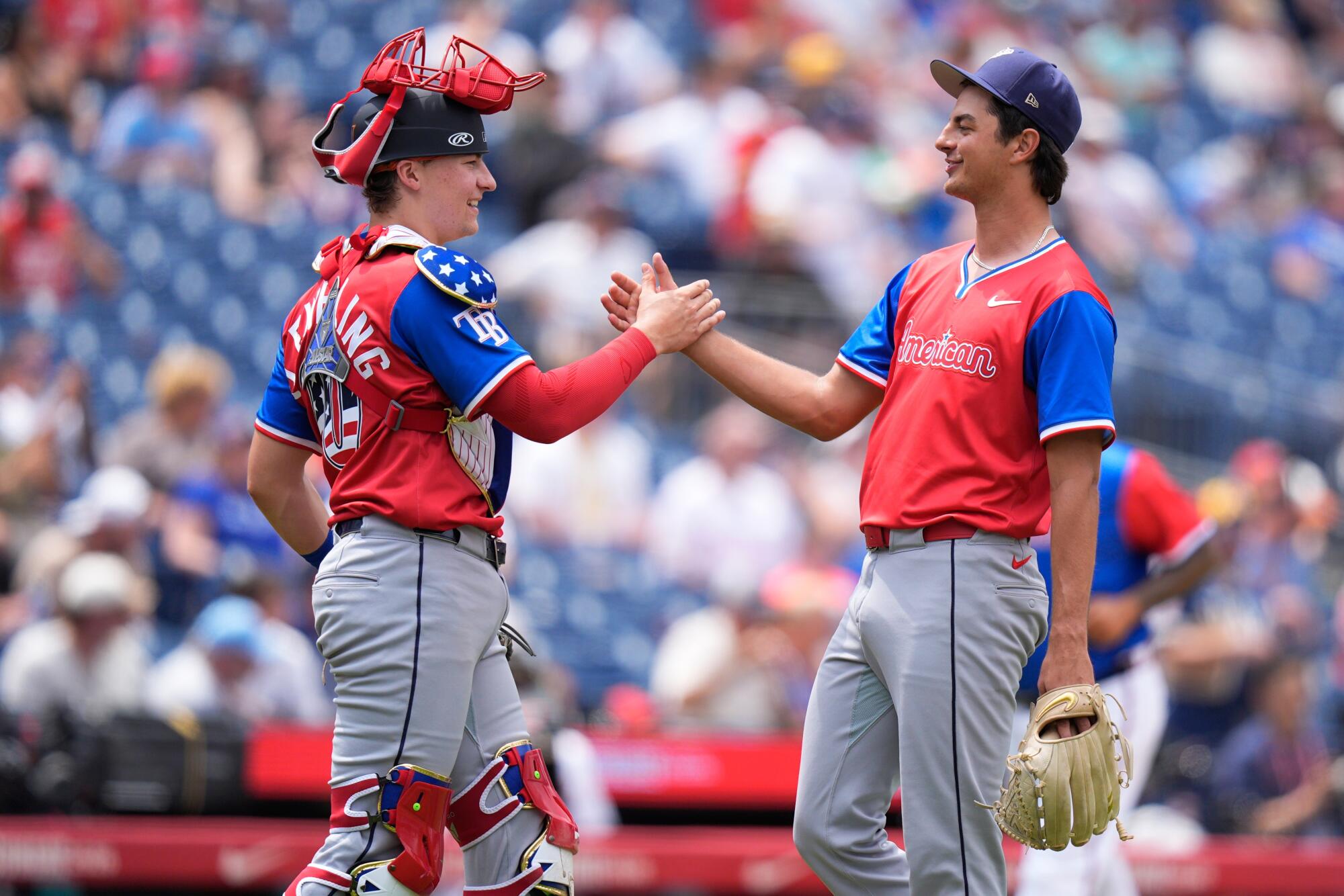
American League catcher Nathan Flewelling greets pitcher Tyler Bremner during the MLB All-Star Futures game.

American League catcher Nathan Flewelling greets American League pitcher Tyler Bremner, left, during the MLB All-Star Futures game on Sunday in Philadelphia.

(Chris Szagola / Associated Press)

Bremner has yet to rise above Class A, but he did participate in Sunday’s Futures Game. He retired the only batter he faced.

The pitchers the Angels might well have taken in place of him, Kade Anderson and Seth Hernandez, each pitched a scoreless inning in the Futures Game.

After the Angels drafted Bremner with the second pick, the Seattle Mariners selected Anderson, an LSU product considered the most polished pitcher available. Anderson is 8-1 with a 1.36 ERA at double-A, likely the next man up should the Mariners’ rotation need one.

The Mariners had alerted him after the first pick — infielder Eli Willits, by the Washington Nationals — that they would take him with the third, he said.

“I got to watch the Angels make their pick, and then it was my turn,” Anderson said. “I never talked to them.”

Anderson signed for $8.8 million, Bremner for $7.7 million. Under Minasian, the Angels chose to spend less on the first-round pick and spread the savings among players drafted in lower rounds.

The first high school pitcher selected last year, Seth Hernandez, played at Corona High, about 20 miles from Angel Stadium. Hernandez is 6-foot-1 with a 2.61 ERA at Class A for the Pittsburgh Pirates, with 111 strikeouts in 69 innings.

He said he had talked with the Angels but did not expect them to select him because he “knew what direction they were going.” (Translation: trying to save money in the first round.)

“It would have been cool to go there,” Hernandez said, “but I’m happy with where I’m at with the Pirates.”

Whatever success the Angels might have in developing players drafted in the lower rounds, their 2025 draft will be remembered for this: They had their choice of any pitcher in America, and they chose Bremner.

Today, the league website ranks Anderson and Hernandez as the game’s top pitching prospects, and among the top six overall. Bremner ranks 44th overall, the only Angels prospect among the top 100.

His season started well, with a 1.08 ERA over five starts. He then missed a month because of illness and arm fatigue. Since his return, he has a 5.63 ERA over six starts.

The 48 strikeouts over 34 total innings is good news. The 34 innings to this point means his season grade can only be marked as incomplete.

“I’m just trying to stay on the field the rest of the year,” Bremner said. “That’s the main goal.

“I think it all comes down to how I perform and how I execute. They gave me all the opportunity in the world this year.”

In addition to adjusting to the first season of his professional career, Bremner is playing his first full season without his mother, who died from breast cancer last June.

“I feel like I am still dealing with that a good amount,” he said.

“It’s not something that gets brought up too much. I don’t want to say people move on, but it has been a year, and people start looking toward the next thing. That’s just how life moves.

“It’s still on my mind a lot. I’m trying to focus on what I need to be focusing on, and that’s being present and competing and having success in the sport. It’s my job right now. It’s not easy, but I’m getting through it.”

Same, really, for his pitching.

In a year in which three of the starters in the Angels’ opening rotation have been (a) injured; (b) demoted; or c) demoted and recalled, it’s hard not to imagine that a healthy and productive Bremner might have made the majors by now.

“I think about it sometimes,” he said, “but I’m content: not really contentment with where I’m at, but content going day to day and figuring out the process as I go through it.

“You can’t really think about getting to the big leagues before going through the other steps. Just kind of enjoying where I’m at right now, and realizing I need to have success here to make it there.

“You can’t just expect it to be handed to you. That’s something they made clear to me: It’s not going to be handed to me. It needs to be earned. I think I have a little ways to go, but I’m confident I can get there.”

He is confident, too, that Santa Barbara was an optimal launching pad toward getting him there.

“They develop pitchers well,” he said. “It’s a good location. It’s a fun school. I can’t say enough about my time there.

“Playing a lot of guys who have played in those big stadiums and in those big settings — Omaha, whatever — you do realize it’s the same game once you get here. It’s an even playing field. I feel like I fit in just fine.”

He should. The number of Cy Young winners this decade from the SEC is the same as the number from UCSB: one.
Source link

Would you trust former Dodger Ross Stripling to manage your money?

For Ross Stripling, baseball was something of an accidental career.

He walked onto the team at Texas A&M, majoring in business finance, planning to stick around campus long enough to earn a master’s degree. After his junior year, he turned down a six-figure bonus offered by the Colorado Rockies. After his senior year, he accepted a six-figure bonus to sign with the Dodgers, only to blow out his elbow after one season in the minor leagues.

He was 24. He was at peace. He called home.

“I think the right thing to do is to say I did this baseball thing and go start my life,” he told his father.

If you’re a Dodgers fan, you know the rest of his baseball story: In his major league debut, Stripling was five outs from a no-hitter when Dodgers manager Dave Roberts yanked him. In his nine years in the major leagues, including five with the Dodgers, he pitched in the All-Star Game and the World Series, and he once pitched with his “Chicken Strip” nickname on the back of his game jersey.

His father knew best. Instead of giving up on baseball when he needed Tommy John surgery, his father encouraged Stripling to use the yearlong rehabilitation process as a way to explore what a future without baseball might look like. His grandfather set him up with an internship at an investment firm.

Five years ago, Stripling and his mentor from that firm founded their own financial services company, called Skyward Financial. Now, 21 months after Stripling threw his last pitch in the major leagues, he is throwing a new one: Hey, young athletes coming into a lot of money, I’ve lived in that world, and I’ll show you how to protect your money and build toward generational wealth.

“It’s not me trying to become the next Wolf of Wall Street,” Stripling said. “This is genuine. I want to help kids and their families out in a space that has gotten out of hand in a hurry.”

Matthew Houston, the mentor, said Stripling blew away the brokers when he interviewed for that internship.

“He brings with him, like, a two-inch folder stuffed with handwritten stock reports he had written on minor league bus trips,” Houston said. “He handed us a couple of them, and they were legit Wall Street reports, him doing analysis of stocks. We were falling out of our chair.”

Stripling soon earned his broker’s license. Over the past decade, Houston estimated, he and Stripling might have traded messages about markets and clients “25 to 50 times a day.” One night, Houston watched Stripling pitch on television. Not long after the game ended, he heard the ping of a text message.

“I had just seen him on TV, and it’s like, ‘What do you think about Celgene and Gilead in the biotech sector?’” Houston said. “My mind was blown.”

You don’t need to have played in the major leagues to realize how much money athletes make. Major brokerages want a piece of that money. Some even use former athletes to recruit current ones.

Marc Isenberg, the former director of financial education for Morgan Stanley’s sports and entertainment group and author of the “Money Players” guide for young athletes, wished Stripling well but said he would face significant competition from firms with bigger names and greater resources.

“It’s oversaturated,” Isenberg said. “Almost every single Wall Street firm, to compete for athletes and entertainers, has a sports and entertainment group.”

And it’s not just the behemoths. Stripling checked with a basketball agent, who said he represents 24 college players that each have a different money manager.

There is nothing revolutionary about Stripling’s message: limit the flashy spending now in favor of prudent savings and investment, so you can grow your money through and beyond your career.

Stripling believes he can win by concentrating on young athletes, the ones suddenly showered in six- or seven-figure payments from draft bonuses, college revenue sharing payments, and name, image and likeness deals.

“I’ve seen the first-rounders come in and blow money on cars and houses and gambling,” Stripling said, “and I’ve seen the first-rounders like (former Dodgers shortstop Corey) Seager, who probably hasn’t spent a dime of his signing bonus.”

In a presentation for young athletes — and for the pro teams and college athletic departments that might invite him to speak — Stripling’s firm uses his story of a baseball prospect that got a $900,000 up-front payment and spent the $500,000 after taxes on a red Lamborghini. If the prospect had invested that $500,000 over 30 years into a fund that tracked the S&P 500, he would have made $8.6 million.

“That was the dumbest decision I’ve ever seen anyone make,” Stripling said.

“I have these stories from being in the locker room. I hope that, as a player, my story resonates more than a guy from Goldman Sachs saying, ‘Yeah, we’ve got a couple good ETFs.’”

Stripling would love the chance to speak at one of the Dodgers’ morning meetings in spring training, where players hear briefings about everything from safety and security to social media.

“I’d like to learn more about it, but I’d be open to putting him in front of the guys,” Roberts said. “I definitely trust him.”

In the meantime, Stripling has a federal record. All brokers do. One form requires brokers to list their employers and job descriptions over the last 10 years. Among all the wealth strategists and financial advisors and registered representatives, Stripling’s form is the one with the job history that starts with this line: “LA Dodgers, Pitcher.”

Source link