Collaborative

Northrop Grumman’s Talon Blue Collaborative Combat Aircraft Has Flown

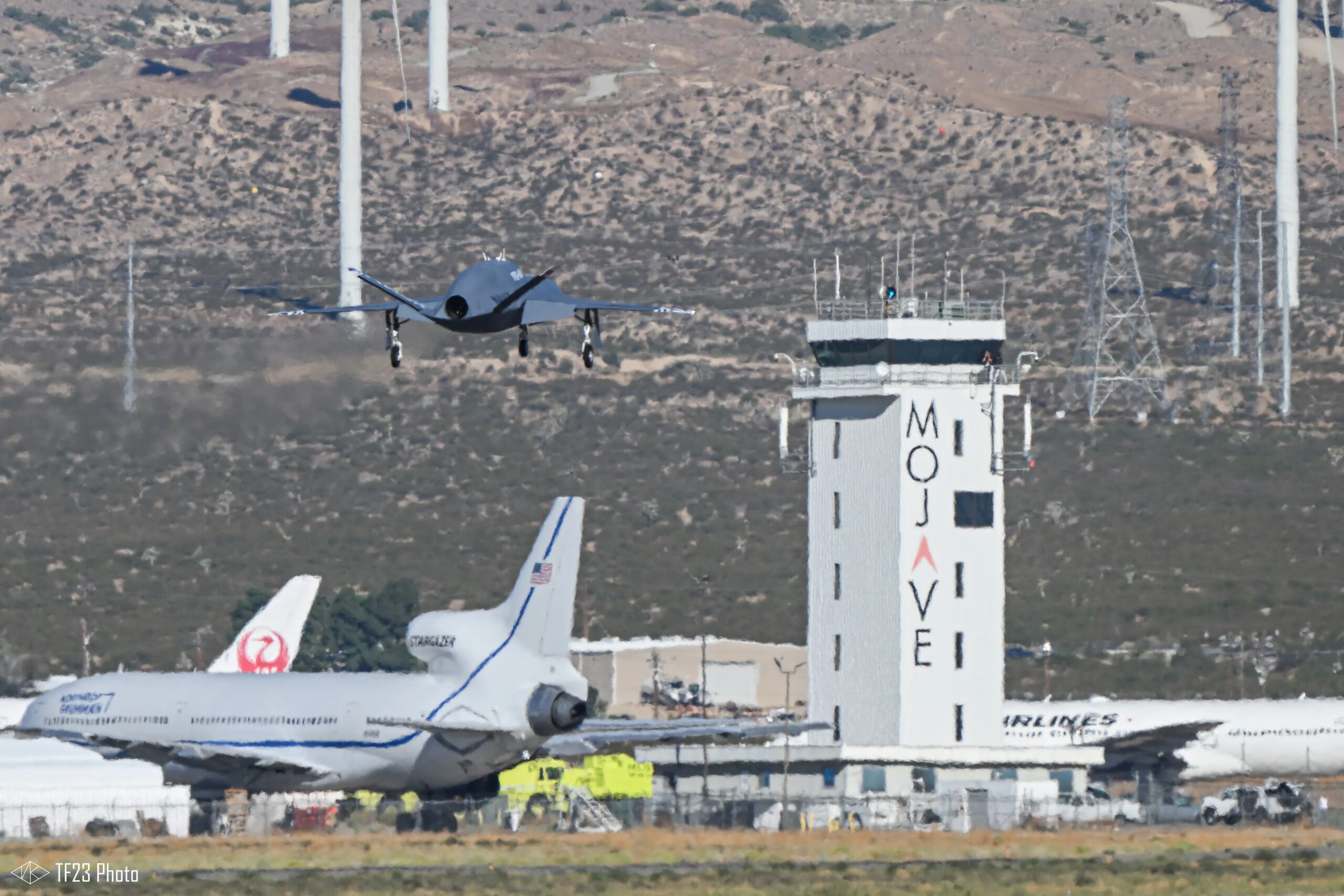
We have a significant update on the fast-moving world of Collaborative Combat Aircraft (CCA) out of Mojave, California today. Northrop Grumman’s Talon Blue, which now has the official designation YFQ-48A, has taken to the skies for the first time. The existence of Talon Blue was first officially disclosed in December of 2025 at a media event in Mojave that we attended.

Talon Blue flying out of Mojave Air and Space Port for the first time. (@Task_Force23) TASK_FORCE23

The uncrewed aircraft took to the skies over Mojave Air and Space Port, home of famed ‘bleeding0edge’ airframer and Northrop Grumman subsidiary Scaled Composites, which built the aircraft. A release from Northrop Grumman reads:

“MOJAVE, Calif. – Oct. 3, 2026 – Northrop Grumman’s (NYSE: NOC) YFQ-48A Talon Blue completed its first fully autonomous flight, including taxi, takeoff, in-flight maneuvers, and landing. Developed through company investment, Talon Blue combines modular design and advanced manufacturing to lower cost and support faster production without compromising mission capability. The flight builds on Northrop Grumman’s seven decades of autonomy experience and more than 500,000 autonomous flight hours, with lessons from Talon Blue informing future autonomous systems. 

Details on YFQ-48A Talon Blue:  

  • Talon Blue is part of Northrop Grumman’s internally-funded Project Talon portfolio focused on accelerating the development of mission-ready autonomous airpower capabilities.  
  • Manufacturing and design innovations cut part count and overall weight, lowering cost and enabling faster production to meet growing demand for autonomous systems.  
  • Designed with flexible operational concepts in mind, Talon Blue’s high air intake, wide wheelbase and integrated weapons bay support a wide variety of mission needs for U.S. and allied partners.

Craig Woolston, vice president and general manager, research and advanced design, Northrop Grumman: “Our customers made it clear they need autonomous systems that can be fielded faster and more affordably without sacrificing mission effectiveness. We listened. Talon Blue’s first flight is one step toward a new generation of autonomous capabilities. Every flight and lesson strengthens our broader autonomy work and sharpens what comes next.” 

Talon Blue flying above the Mojave Desert in California. (Northrop Grumman)

While the Talon Blue aircraft draws most of the attention, Northrop Grumman has put great emphasis on its back-end autonomy development ecosystem, which includes its purpose-built Model 437 demonstrator aircraft, now under the Talon IQ badge (formerly Beacon).

Talon Blue is entering a growing field of CCA offerings, with extremely intense competition, that are primarily aimed at equipping the USAF with its next CCA acquisition of hundreds of aircraft known as Increment 2, for which the requirements remain undefined. Currently, the USAF has moved its YFQ-44 from Anduril and its YFQ-42 from General Atomics, both of which are deep in flight testing, into production. Boeing’s MQ-28 Ghost Bat is another serious CCA contender and perhaps the most mature of all, while Lockheed Martin has its tailless Vectis, and on the lower end, Kratos’ FQ-58 Valkyrie continues to evolve and rack-up flight hours. Many more types are on the horizon, including those from new players and globally from foreign manufacturers.

(@Task_Force23) TASK_FORCE23

With the loss of the F/A-XX next-generation naval fighter program to Boeing, Northrop Grumman winning a contract from the U.S. services for Talon Blue has become more important. Doing so would get the company back into the Pentagon’s tactical air combat portfolio. As we have discussed for years, advanced uncrewed tactical systems are set to be less risky and potentially more lucrative than traditional fighter programs as air combat rotates to predominantly uncrewed capabilities and mass production of them. Beyond U.S. needs, the demand for CCAs is likely to explode internationally in the coming years, so programs like Talon Blue could find success elsewhere if the Pentagon goes another direction, but getting the U.S. armed services’ stamp of approval and the scale of production that comes with it would surely help there too.

Author’s note: A big thanks to our friend @Task_Force23 for providing us with great photos for this story.

Contact the author: Tyler@twz.com

Tyler’s passion is the study of military technology, strategy, as well as foreign policy, and he has fostered a dominant voice on those topics in the defense and national security space. Tyler was the creator of the hugely popular defense site Foxtrot Alpha before developing TWZ, which he continues to lead as the Editor-In-Chief to this day.


Source link

How The USAF Is Preparing For European Allies To Join The Collaborative Combat Aircraft Club

Senior U.S. Air Force leaders in Europe say NATO allies are increasingly looking to participate in the development and employment of collaborative combat aircraft (CCAs), even as several of those same countries pursue their own indigenous fighter and drone programs. American commanders say they are looking forward to CCAs expanding the alliance’s overall capacity, and are already pushing for such systems to work together from the outset.

Speaking yesterday at the Air & Space Forces Air, Space and Cyber Symposium that TWZ is attending, Lt. Gen. Jason T. Hinds, commander of U.S. Air Forces in Europe, U.S. Air Forces Africa, and NATO’s Allied Air Command, and Chief Master Sgt. Joshua J. Wiener, USAFE-AFAFRICA’s command chief, discussed how the command is preparing for an eventual European role in the U.S. Air Force’s planned fleet of hundreds of CCAs.

RAMSTEIN AIR BASE, Germany – U.S. Air Force Lt. Gen. Jason T. Hinds, U.S. Air Forces in Europe – Air Forces Africa commander, and U.S. Air Force Chief Master Sgt. Joshua J. Wiener, USAFE-AFAFRICA command chief, pose for a group photo with the Association of African Air Forces representatives from Kenya, Nigeria and Tunisia during the AAAF planning conference at Ramstein Air Base, Germany, Sept. 3, 2026. The weeklong conference strengthened multinational partnerships and advanced planning for future AAAF initiatives, including AAAFEX27 in Kenya.
U.S. Air Force Lt. Gen. Jason T. Hinds, U.S. Air Forces in Europe – Air Forces Africa commander (far left), and U.S. Air Force Chief Master Sgt. Joshua J. Wiener, USAFE-AFAFRICA command chief (second from left), pose for a group photo with the Association of African Air Forces representatives from Kenya, Nigeria, and Tunisia at Ramstein Air Base, Germany, earlier this month.

The issue is particularly significant for USAFE, which operates a fraction of the fighter force it maintained in Europe during the Cold War, even as many of its NATO allies contend with shrinking fleets of crewed combat aircraft. This comes against a backdrop of deepening tensions with Russia and the emergence of new kinds of threats. Autonomous aircraft that can augment crewed fighters could provide the alliance with additional combat mass without requiring a corresponding increase in the number of crewed aircraft and personnel permanently based in Europe.

“I’m excited about what CCAs have in store for the Air Force,” Hinds said, pointing to recent comments from the Secretary of the Air Force Troy Meink, including the aim of having at least 500 CCAs in service by 2032.

He added that European interest in these kinds of platforms is already growing.

“I think you’re going to see a lot more interest from other nations inside Europe about what is America doing with CCAs and how they can join this party, if you will,” Hinds said.

Germany is “heavily involved,” he said, while Scandinavian countries and the Netherlands are also showing interest.

In the case of Germany, we have previously explored how that country is looking to procure CCAs by 2029. Sweden, too, recently unveiled a concept for a high-end, stealthy CCA-type drone, while the Dutch are looking to become more closely alligned with U.S. Air Force CCA efforts.

Saab has produced a full-scale concept model of a future uncrewed combat air system, known as aircraft A3. Saab

USAFE is currently using two broad operational scenarios to explain to allies how CCAs could fit into NATO’s force structure.

The first is defensive. A CCA could operate as part of an integrated air and missile defense network, potentially engaging one-way attack drones or cruise missiles without the need for expensive crewed fighters.

The second is offensive. In that scenario, autonomous aircraft could help suppress or destroy integrated air defense systems and potentially attack fielded forces during an effort to repel a hostile incursion into NATO territory.

Allies are interested in both missions, Hinds said, and want the ability to incorporate CCAs into their own force designs. Interestingly, only yesterday, Anduril shared photos of its YFQ-44A Fury configured with air-to-ground weapons, underscoring the fact that the CCA could take on an air-to-ground role in the future in addition to its current air-to-air focus.

A YFQ-44A carrying pods for 2.75-inch rockets and 500-pound Joint Direct Attack Munitions (JDAM) under the wings. Anduril

That kind of interest has already prompted work at the NATO level. Hinds pointed to a study by the Joint Air Power Competence Center, the alliance’s airpower think tank based in Kalkar, Germany, examining how NATO members could employ CCAs in a modular fashion, including issues such as sustainment, training, and exercises.

“It was a pretty long paper, but the nations wanted it,” Hinds said.

Initial experimentation is expected to take place in the United States, but European experimentation could follow, including by Sweden and potentially other NATO members.

At the same time, European countries are not simply waiting for an American CCA to arrive.

The United Kingdom has launched its own Storm Fighter CCA program. Germany is pursuing a separate loyal-wingman effort, while the United Kingdom, Italy, and Japan are meanwhile jointly embarked on the Global Combat Air Program, or GCAP, which is intended to produce the Tempest next-generation crewed fighter and associated uncrewed systems.

A rendering of a CCA concept released at the launch of the U.K. Royal Air Force Storm Fighter program, earlier this year. BAE Systems

The proliferation of national programs raises an obvious question: How does NATO prevent a growing fleet of autonomous aircraft from becoming a collection of incompatible national systems?

Hinds said the answer starts with commonality.

“The first and foremost thing is we want to strive for commonality,” he said. “Commonality means we don’t even have to worry about interoperability.”

Where common equipment is not possible, however, USAFE wants interoperability built into national systems from the beginning.

“Interoperability by design” is the preferred approach, Hinds said, with NATO data standards and other requirements incorporated before a system enters service rather than retrofitted later.

The good news for USAFE is that NATO already has extensive experience establishing common standards for interoperability, covering everything from tactics and procedures to communications, datalinks, weapons employment, and other technologies. That existing framework gives the alliance a foundation for integrating increasingly diverse national systems without requiring every member to field identical equipment.

F-35A Lightning II aircraft from the U.S. Air Force’s 48th Fighter Wing and the Royal Norwegian Air Force fly tandem after a formation flight near Lofoten, Norway, March 10, 2026. The formation flight symbolized the partnership and degree of interoperability displayed between participating NATO militaries during exercise Cold Response 26. A key component of NATO's enhanced vigilance activity Arctic Sentry, exercise Cold Response 26 is a Norwegian-led winter military exercise designed to enhance collective defense capabilities and ensure U.S. readiness to rapidly deploy and seamlessly operate alongside NATO Allies in challenging arctic conditions. (U.S. Marine Corps photo by Cpl. Mya Seymour)
F-35A from the U.S. Air Force’s 48th Fighter Wing and the Royal Norwegian Air Force fly tandem after a formation flight near Lofoten, Norway, March 10, 2026. The formation flight was intended to symbolize the partnership and degree of interoperability displayed between participating NATO militaries during Exercise Cold Response 26. U.S. Marine Corps photo by Cpl. Mya Seymour Cpl. Mya Seymour

Hinds did warn that some countries have previously acquired equipment that was not compatible with NATO systems, leaving them with the choice of paying to modify their own equipment or forcing the alliance to adapt its systems around it.

That problem becomes particularly important as autonomous aircraft are connected to increasingly complex sensor and weapons networks. Even more important is the requirement for a baseline command-and-control network for CCAs themselves, allowing different platforms to manage them seamlessly.

The ability to share and control CCAs across a complex battlespace is already emerging as both a major opportunity and a significant integration challenge. The U.S. Air Force and Navy, for example, have made clear that their respective CCAs are being developed with the ability to be controlled seamlessly across services, pointing toward a future in which autonomous aircraft need not remain tied to the service or platform that launched them.

Hinds described a potential kill chain in which an F-35 detects a target, passes the information to another node in the network, and a ground-based system operated by another NATO country ultimately launches the weapon.

In such an architecture, the aircraft, sensor, command-and-control network, and weapon do not necessarily have to belong to the same country.

As an example, Dutch F-35s, operating in Europe, have used a data-exchange system to transmit targeting coordinates to Israeli-made PULS (Precise and Universal Launch System) rocket artillery. The system, developed by Lockheed Martin is known as Keystone, and you can read more about it here.

A Dutch F-35A brandishing its AIM-120 AMRAAM missiles during a NATO air policing drill. Bartek Bera

USAFE is making “significant advances” in areas including cross-servicing, cross-loading, and cross-flying allied aircraft, Hinds said, all of which are intended to make multinational operations more seamless.

U.S. Air Force A1C Dylan Montgomery, 493rd Fighter Generation Squadron crew chief, conducts post-flight operations/checks with Lt Col Dustin Merritt, 493rd Fighter Squadron commander at Pirkkala Air Base, Finland, June 3, 2026. As Allied Air Command's premier tactical exercise, Ramstein Flag 26 tests the ability of U.S. and NATO forces to respond to emerging threats with immediate, decisive airpower. (U.S. Air Force photo by 2nd Lt. Sarah Hedgman)
A U.S. Air Force F-35 crew chief conducts post-flight checks at Pirkkala Air Base, Finland, during the tactical exercise, Ramstein Flag 26. U.S. Air Force photo by 2nd Lt. Sarah Hedgman

The same philosophy applies to weapons.

“We want to have all the fires, right? Whether it’s U.S. built or built inside European nations,” Hinds said.

That could prove increasingly important as European countries expand domestic production of missiles, drones, and other weapons alongside their aircraft programs.

The growth of GCAP and other European defense programs comes amid broader debate over how much Europe should depend on U.S. military equipment.

But Hinds rejected the idea that allies developing indigenous aircraft and autonomous systems necessarily signals a move away from American equipment.

“No, I don’t,” he said when asked whether allies were moving away from U.S. systems.

Instead, Hinds characterized the trend as an expansion of the transatlantic defense-industrial base.

Sweden was one example he cited. The country, which recently joined NATO, continues to produce new military equipment, including Gripen fighters, while those aircraft are already being operated by NATO members.

Swedish Gripens are currently leased to Hungary, and other countries are considering the aircraft, Hinds said.

A Hungarian Air Force JAS 39 Gripen participating in NATO exercise Ramstein Flag 24 flies over the west coast of Greece, Oct. 4, 2024. Over 130 fighter and enabler aircraft from Greece, Canada, France, Hungary, Italy, Poland, Portugal, Romania, Spain, Sweden, United Kingdom and United States are training side by side to improve tactics and foster more robust integration, demonstrating NATO’s resolve, commitment and ability to deter potential adversaries and defend the Alliance. (U.S. Air Force photo by Tech. Sgt. Emili Koonce)
A Hungarian Air Force JAS 39C Gripen participating in NATO Exercise Ramstein Flag 24 flies over the west coast of Greece, in 2024. U.S. Air Force photo by Tech. Sgt. Emili Koonce

The broader trend toward co-manufacturing and co-production is also something he welcomed.

“I’m seeing a lot of discussions about co-manufacturing and co-production, and I welcome those discussions as well,” Hinds said.

That approach could become increasingly important as NATO tries to expand its available combat power without relying exclusively on additional U.S.-built platforms.

For USAFE, the objective is to ensure that whatever aircraft NATO countries develop or purchase can plug into a common architecture, sharing data, receiving targeting information, drawing on common logistics networks, and contributing weapons effects across national boundaries.

For a U.S. Air Force command that has spent decades trying to cover Europe with far fewer fighters than it once had, hundreds of autonomous wingmen, whether American-built or allied, could provide a significant way to generate additional combat mass.

Senior U.S. Air Force officials are now working to ensure that the networking, weapons integration, logistics, and command-and-control architecture will be in place once those aircraft start to come online.

Contact the author: thomas@thewarzone.com

Thomas Newdick is a staff writer at TWZ, where he covers military aviation, defense technology, weapons systems, and international security. Based in Berlin, Germany, he reports on conflicts, military modernization efforts, and emerging aerospace technologies around the world, with a particular interest in airpower and its role in contemporary warfare. His reporting is informed by deep expertise in modern and historical airpower, particularly in Europe, with a focus on military aviation, air campaigns, and aerospace developments across the continent and beyond.


Source link