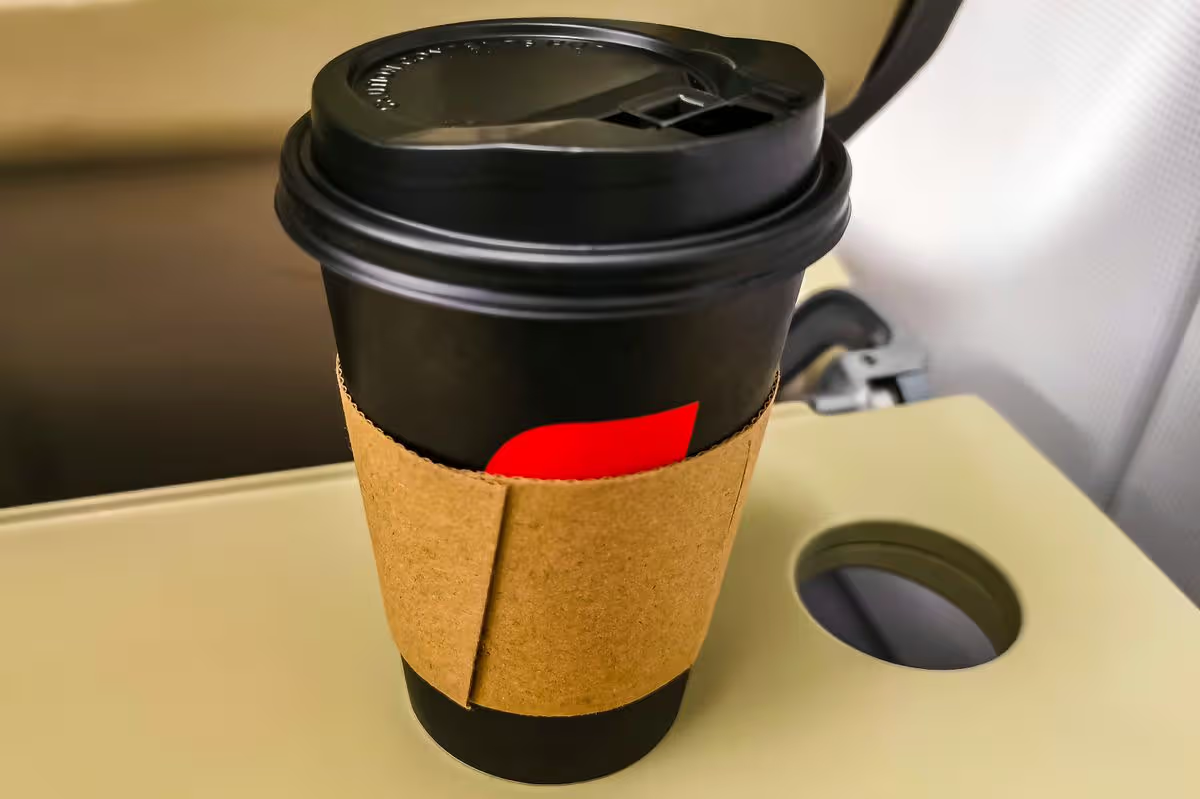
If you’re planning to take a hot beverage on your next flight, make sure you know your airline’s policy around food and drink. Some airlines are pickier than others about what you can bring into the cabin
14:47, 09 Apr 2026Updated 16:59, 09 Apr 2026
This article contains affiliate links, we will receive a commission on any sales we generate from it. Learn more
A strong coffee is essential for those early morning flights(Image: Getty Images)
When you’re rushing to the airport for a budget airline flight at some ungodly hour, you’ll no doubt be dreaming of your first cup of coffee of the day. Once through security, many of us make a beeline for the nearest café to get us through to our destination.
However, when it comes to boarding your flight, not all airlines are happy for you to bring your venti cup onboard. While some airlines are fine with hot drinks as long as the lid is well-secured, others will make you bin your freshly-roasted drinks and you may end up waiting for the trolley to come round to get your caffeine fix.
It’s important to check the rules with your airline – otherwise you may end up wasting money on a coffee you then need to chuck before you get on your flight.
Here’s what some of the UK’s most popular airlines say about bringing hot drinks onboard in their policies.
EasyJet
If you’ve booked a flight with easyJet you can bring your own food and drink, although the airline does of course sell its own range onboard. When it comes to your morning cuppa or coffee, the easyJet website states: “You can bring hot drinks on board if you’ve bought them at the airport and they have a lid on.”
When you buy your takeaway drink, make sure you keep hold of the lid, or even better buy a reusable cup with a tight seal such as the Byron 2.0 SNAPSEAL™ Travel Mug and get it filled with your favourite drink at the airport before you board.
Jet2
Unfortunately for Jet2 passengers, the airline doesn’t allow you to bring a cup of coffee onboard, even if bought at the airport. Its website states: “No, you can’t bring hot food or hot drinks onboard our planes for safety reasons. However, we offer a great selection of meal deals and hot and cold sandwiches that can be pre-purchased in Manage My Booking.”
The Jet2 website also has a link to its online menu, which shows it sells a range of Costa coffees including cappuccinos, lattes, Americanos, and decaf options. Its menu also includes Yorkshire Tea and Cadbury’s hot chocolate.
Ryanair
While Ryanair does allow passengers to bring their own cold food and drink onboard, its general terms and conditions of carriage clearly state: “You must not take hot drinks on the plane, or drink your own alcohol when on the plane.”
Ryanair has an app that allows passengers to order food and drink before the trolley comes round and in-between drink service. You can therefore order a coffee or tea as soon as you’re in the air and the crew will deliver it when safe to do so. While its hot drink selection is quite limited at just coffee, tea, hot chocolate, or cappuccino, the airline does offer some meal deals that include a sandwich and panini, snack, and either hot or cold drink which can work out cheaper.
TUI
TUI don’t specify whether you can bring your cup of coffee onboard. Under an FAQ saying “Can I take my own food for the flight?” the airline has responded: “Yes. However, we can’t provide heating facilities on board – although for infants, we are able to warm bottles of milk in hot water.
“Therefore, we would advise low-risk food such as pre-made sandwiches and snacks that can be eaten cold.”
It’s likely to be at the discretion of flight attendants whether they let you bring your coffee cup onboard, so you may be better off waiting for the trolley. TUI’s inflight café menu for short-haul flights includes cappuccinos, Americanos, and decaf options for coffee, as well as teas including herbal tea, and Cadbury’s hot chocolate.
British Airways
British Airways (BA) also don’t explicitly ban hot drinks from being brought onboard. It simply states that food and drink needs to pass security checks and adhere to customs regulations, so again, it’s likely to be at the crew’s discretion.
BA offer the High Life Café aboard most short-haul routes meaning travellers get a better choice of hot drinks than most airlines. From a flat white to a pumpkin spice latte, you’ll find the kind of coffees you usually order in high street chains. It also offers a wide range of Birchall teas and hot chocolate.
Have a story you want to share? Email us at webtravel@reachplc.com
I’m looking for something that’s open early on the weekends (9 a.m.?) where we can take our 2-year-old daughter. We don’t want it to be an indoor play place or something that is solely designed for kids. Ideally, it would be something that adults enjoy too. Maybe something outdoors or with a restaurant/cafe where we can give ourselves a little treat. We are in Manhattan Beach and have to be back home by 12:30 p.m. for nap time. We’ve been able to make drives to Pasadena and Orange County and make it back in time (bonus of leaving on a Saturday or Sunday because there’s no traffic!) — Brittany Newell
Here’s what we suggest:
Finding places that will keep both you and your toddler entertained can be tricky. But don’t fret, Brittany! I’ve enlisted the help of some of my colleagues who are also parents that understand the need to flee the house before nap time. I’ve compiled a list of fun mini adventures that you can start early-ish.
For an activity close to home, Michelle Woo, The Times’ West Coast experiences editor, suggests renting a toddler bike trailer or bike seat from one of the local shops and taking a ride along the Strand from Manhattan to Redondo and back to Hermosa for a stop at Good Stuff, a beachside restaurant where you can enjoy a refreshing smoothie, mimosa or Woo’s go-to order, “the Good Stuff Breakfast with a pork sausage patty — simple yet comforting.” Then let your daughter play in the sand for a while. And if you haven’t been to the Roundhouse Aquarium before, it’s definitely worth a visit. The free, donation-based marine educational center is home to swell sharks, sea urchins, jellyfish and more that will leave visitors of any age in awe.
About 12 miles up the coast in Venice Beach is the newly renovated Windward Plaza Playground, a nautical-themed fun zone equipped with slides, swings, climbers and more. The best part is that it’s located on the sand at the beach just steps away from the famous boardwalk. Before you get to the park, my colleague Amy King suggests stopping by Breakaway Cafe for yummy breakfast burritos or Menotti’s for coffee.
For an early morning adventure, Times entertainment and features editor Brittany Levine Beckman recommends visiting the Riverside bike path in Frogtown, which opens at 6 a.m., so you can start as early as you’d like. She and her husband usually take turns pushing their 18-month-old daughter in a tricycle along the pathway and get their steps in. Afterward, she suggests going to Lingua Franca, a restaurant situated along the river. “We’ve arrived a few times as soon as the restaurant opens at 10 a.m. on the weekend and been the only early-bird brunchers,” she tells me. “We grab a table outside in the back and our daughter meanders without us feeling annoying.” The restaurant also serves a toddler-approved Dutch baby and a parent-approved bloody Mary, she adds. If you prefer to just grab a coffee, go to Tadaa.Coffee, which has a sand pit that your daughter can play in.
Another fun option is the Natural History Museum in Exposition Park, where you can wander through the awe-inspiring Dinosaur Hall, learn about the evolution of mammals, roam through the enchanting nature gardens and admire more than 2,000 gems and minerals from across the globe. The museum opens at 9:30 a.m., but there’s still plenty of time to explore before nap time. Levine Beckman also enjoys taking her daughter to the museum. “Our toddler loves the animal dioramas,” she tells me. “She likes staring up at the dinosaur bones too (and can say “roar” now), but the big stuffed animals are her favorite.” For food, my colleague Sophia Kercher recommends South LA Cafe, which is located at the museum.
Now for some rapid-fire ideas: Kercher suggests the Stoneview Nature Center, which is a plant-filled city sanctuary nestled in Culver City’s Blair Hills. Here you can chase hummingbirds, roam through the never-crowded garden and “visit Stoneview’s resident quails, which have their own fenced-in compound called, ‘Quallywood,’” she says. Times contributor Rachel Kraus, who recently wrote about the rise of mall parks in Southern California (and why parents are loving them), suggests the Proud Bird near LAX, which she calls “a one stop shop parent and kid utopia.” She adds, “You can order food and drinks (including from a full bar) and let your kids run around on the outdoor play structure, kick a ball on the turf or explore the vintage airplanes.” Also, be sure to check out our list of L.A. playgrounds that are close to coffee shops where you can get a jolt of energy if needed.
I hope these suggestions are helpful with planning your next morning adventure with your toddler and that you are able to create some fun new memories together. Happy exploring!
Many years ago, I swapped languages with a young woman from Trieste. It was during one of our half-English, half-Italian practice hours that she introduced the idea of Trieste, on a map, as possessing the shape of a stomach. She described her city (which is also a province) as being suspended: pressed by the sea on one side, enveloped by Slovenia and the Karst hills on the other, with a short oesophagus attaching it to the body of Italy. She also suggested I read la Conscienza di Zeno – Zeno’s Conscience –Italo Svevo’s devilishly funny hymn to procrastination, self-delusion and walking around in search of a suitable cafe, and warned me about the ruffian wind.
It would be almost two decades before I finally visited Trieste, bringing with me enough anticipation to tempt disappointment (unfounded) and the itinerary of a food writer. I carried the image of a stomach too, fitting in so many ways for this remarkable food city, not least for making its geography vivid, which in turn explains so much about its history. Once a coastal fishing village, colonised by the Romans, raided by the Venetians, entrusted to the Habsburg monarchy in Vienna (for four centuries, which included a prolonged heyday), appended to the newly united Kingdom of Italy, fought over, briefly independent, handed back to Italy in 1954, from which point it developed into what is today one of the most outward looking and dynamic cities in Italy. Trieste, it seems, has digested and assimilated, meaning its complex history is reflected in the architecture, dialect, music, literature, sports, civic nature and multifaceted food culture: surely one of the most intriguing and rewarding in Italy.
True to Austro-Hungarian traditions: La pasticceria Pirona.Lunch is served at Clai.
Take the coffee culture, for example, the foundations of which were laid in 1719 when Charles VI declared Trieste a free port (and in effect the port of Vienna) and a customs-free zone. One of the goods that arrived was coffee beans, in particular from Ethiopia and Yemen, which in turn saw the creation of aromatic roasting and processing facilities – and the emergence of cafes themselves, many of them designed in the spirit of a Viennese Kaffeehaus. Later, when the railway connected Vienna with Trieste in 1850, these same cafes and pastry shops would serve the cosmopolitan population of a culturally magnetic city that many wanted to be part of. Several of the historic cafes still thrive, their literary connections intact – Svevo, Saba (Trieste poet in excelsis) Joyce, Mann, Rilke – comforting customers with coffee, strudel and no sense of rush, alongside them the economic and social powerhouse that is the Illy brand and a welcome wave of speciality coffee. The port of Trieste still handles 50% of beans entering Italy: it was and remains a city that tastes of salt and smells of coffee.
Buffet Clai, Trieste.
Another wonderful habit that robustly survives is femo un rebechin, which comes from the verb ribeccare, a typical espressione Triestina meaning to take another peck or bite: that is, to have a snack. The seaport had a burgeoning workforce whose need for a substantial mid-morning snack was met by boisterous and functional “buffets”serving il bollito misto: boiled pork served with potatoes, kraut, mustard and – a totem of Trieste – freshly grated horseradish; or stuffed in a bread roll, alongside soups, stews, goulash, cheeses and cured meats. Heaven! Buffets still punctuate the city and the habit of rebechin is like water, filling every gap and need, be that a prosciutto roll and a beer at 10am, or a glass of Friulian, Slovenian, Croatian or Austrian wine and tasty things on toast at 6.30pm. Trieste has a polyglot profusion of bars, bakeries, takeaways and restaurant-trattoria, some of which focus on the fish caught daily in the gulf, many on dishes whose roots trace back to middle European traditions, others on the superb produce that arrives from the mountainous region of Carnia, the larger Friuli Venezia-Giulia region, Slovenia … the world – Trieste is, after all, a gateway. After dinner, a chance to wander, to find another cafe, or the water’s edge, to look beyond the stomach, and out to sea.
Caffe Stella Polare, Trieste: ‘Literary ghosts contribute to the place’s popularity’.
A cherry wood bar, with white panels and a black granite top, runs the entire length of this old coffee shop. First opened in 1865, the cafe was designed, then redesigned, in the spirit of a Viennese kaffeehaus and decorated with gilded mirrors and Viennese stucco – some of which remains, with a line of tables and curveback chairs arranged opposite the bar. There is also an internal tea room for reading, meeting and gazing in the spirit of past patrons such as the writers Italo Svevo, Umberto Saba, James Joyce and Franz Kafka, whose literary ghosts contribute to the place’s popularity – as does its location on the corner between Via Dante and Piazza Sant’Antonio. I found the service best when standing at the busy, efficient bar, and their gocciato, an espresso with a generous drop of creamy foamed milk, an ideal way to start the day. Via Dante Alighieri, 14
For the smell of coffee and bread the address is Via Giusto Muratti 4d. Originally from Belgrade, Pedja Kostic spent three decades in Boston before opening the contemporary bakery Pagna, in 2022. Previously an Austro-Hungarian warehouse, the lofty space is now divided by a deep counter, the larger back section accommodating the mill, lab and ovens where the long-fermented breads are baked, the front section filled with tables for breakfast pastries, bread with honey or quince jam, filled focaccia, or cheese and wine in the early evening (the wine list is impressive, and largely natural). Pagna is also the place for speciality coffee, with blends from local roasters, such as Bianca Maria Maschio’s Bianca Tosta, and international roasters, including Drop in Stockholm. Via Giusto Muratti, 4/D
Antica trattoria Menarosti Established in 1903, Menarosti has been run by the Benussi family since 1974. The room, with its lace-edged white cloths, white chairs and white-cream tiles, has something of an elegant conservatory about it, while the paintings, ornaments and drinks cabinets give the space an idiosyncratic parlour-feel, but one in which everything has a purpose: of comfort and practised hospitality. The menu is a paean to the daily catch from the gulf of Trieste and the well-established habits of a great, unfussy kitchen. The menu changes daily but often includes granzievola (spider crab) cooked, shredded and returned to its fluted shell, a warm salad of molluschi, steamed mantis shrimps, a delicate three-fish risotto alla marinara, spaghetti with vongole lupino, gnocchi with cuttlefish ragù, a lightly battered fritto misto of calamari and anchovies, baked fish of the day, apple strudel, honey and amaretti semifreddo. There is an excellent wine list and a large selection of grappa. Via del Toro, 12
Da Pepi: ‘The oldest, and best known of the buffets in Trieste.’
The caldaia – the huge pan in which the various cuts of pork are boiled – takes pride of place on the counter at Pepi, the oldest and best known of the buffets in Trieste. When I asked a friend from Trieste if it was more popular with locals or tourists he looked annoyed, telling me Pepi, like all buffets, are a public service for anyone who is hungry. Established by Pepi Klajnsic in 1887, the buffet was originally known as Pepi S’Ciavo, for his nickname, Pepi the Slovenian, and has passed through various hands (of family and staff) since, each age leaving its mark on the wood-panelled decor. Pepi does a swift trade in takeaways, most commonly a roll stuffed with whatever cut of pork is desired – ribs, loin, ham, sausage, snout, tongue – plus a smear of mustard or a good amount of fresh horseradish. Cheese or hard boiled eggs are an alternative. The same cuts can be enjoyed sitting at one of the tile-topped tables: the ultimate pork platter, along with sauerkraut, potatoes, mustard (mixed with a dash of beer), and freshly grated cren (horseradish), or jota, bean and sauerkraut soup. Savings Bank Street, 3
L’Approdo The excellent and always bustling L’ Approdo, not far from the covered market, highlights another function of the buffet counter. That is the things on bread or toast – baccala mantecato (whipped saltcod), liptauer (an Austrian-style cheese and herb spread), sweet and sour sardines, the fried meatball and dough balls – in short a great number of tasty things with which to “Femo un rebechin” – have a snack – with a glass of wine at any hour you please, either at one of the tables, or standing outside. Via Carducci, 34
Get rare regional products at SET – an acronym for Sapori Eccellenti del Territorio.
If the weather allows, it is a good idea to get a table outside SET deli, and to order the orologio di formaggio. This tasting plate of cheeses could well include pastorut, a full-fat, soft, blue-veined cheese; pecorino with pear; goat’s cheese; or a compact and creamy mountain cheese called frant, with either a glass of Brežanka (an aromatic white originating from the Breg area) or a beer from a Dimont brewery, in the Carnia Valley. SET is an acronym for Sapori Eccellenti del Territorio, and the counter and shelves are filled with exactly that, with particular attention to traditional products at risk of disappearing in the Friuli Venezia Giulia region; look out for ricotta (which arrives daily from the Carnia valley), speck, horseradish, kraut, pesto with lard and herbs called varhackara, and cheese and potato cake, helpfully vacuum-packed, called frico. Via di Cavana, 13A
La pasticceria Pirona: ‘A cake and pastry shop from another time.’ Pirona, Trieste, Italy.
Not far from the magnificent ship-like covered market on largo Barriera Vecchia, La pasticceria Pirona is a cake and pastry shop from another time. Founded by Alberto Pirona in 1900, the shop has changed hands several times, but the art deco front with gold lettering on black lacquer and the cherry-wood fittings remain as they were when James Joyce (who lived a few doors down) called by for a bun. The cakes, pastries, sweets and preserves also remain true to Austro-Hungarian traditions: expect exceptional presnitz (a stuffed pastry ring filled with dried fruit, nuts and spices), an enriched Easter bread called pinza triestina, putizza (a ring of rolled, paper-thin dough layered with nuts and spices), apple or cherry strudel, Sachertorte, marzipan and – to bring home – finger biscuits embossed with the name Pirona. Via Largo Barriera Vecchia, 12
Caffe degli Specchi – designed by architect Antonio Buttazzoni, and a coffee house since 1839, this popular cafe has caught the attention of the Accidentally Wes Anderson brigade. Piazza Unità d’Italia, 7
Illy have several branches in Trieste (Illy CEO Riccardo is also the mayor) but the flagship cafe is on the seafront on via Gioacchino Rossini, 2 while the shop Incantalia (which also sells coffee accessories and food) is on via Luigi Einaudi, 2/A
La Bomboniera is a typical Austro-Hungarian patisserie dating back to 1836, in art nouveau style. Bring back a presnitz, a sturdy pastry ring filled with dried fruit. via Trenta Ottobre 3
La Bomboniera patisserie: go for the preznitz.
Antica Trattoria Saban – a trattoria whose menu celebrates the multicultural nature of Triestini cuisine – goulash sauverkataut, goose, pancakes … Via E. Comici 2
Ditta Emilio Cesca Casalinghi is a fabulous, ordinary, great-value houseware shop full of practical kitchen utensils. Grab yourself a cake tin, a horseradish grater and coffee cups. via Roma 10
VUD – for the most beautiful wooden bread and cheese boards. Via Diaz 15/a
Mercato Coperto, the historic Covered fruit and vegetable market – it looks like a steam ship from outside. Shop for a root of horseradish at via Giosuè Carducci, 36
La Bottiglia Volante – a relaxed wine bar (including, but not exclusively, natural wine). via Paganini 2c
Villanovich – another great speciality store with products from the mountains, paprika, and jars of horseradish and mustard. Via delle Torri, 1b
Salumeria Villanovich: regional products galore.
Melograno – for a good selection of gluten-free and vegan dishes, especially the pizza and cakes. Via di Cavana, 14
How to order coffee
For an espresso, ask for un nero, or un nero in b, if you want it served in a glass (bicchiere) rather than a cup. A decaffeinated espresso is un deca, or un deca in b. If you want a macchiato (an espresso with a little foamy milk), order un capo, or un capo in b, or a un capo deca, or un capo deca in b if you want decaf. If you do happen to order a macchiato, you will most likely receive an espresso with cold milk on the side. Meanwhile, what is considered cappuccino throughout Italy is practically nonexistent in Trieste, except in the ersatz form of caffe latte (which comes without foam) which is also known as latte macchiato. More typical, reliable and well-proportioned is a gocciato, an espresso with a generous drop of creamy, foamed milk.
Travelling to Trieste – and what to do when you’re not eating
Ryanair flies direct to Trieste daily from Stansted from £32 return in April (two hours and five minutes). Lufthansa flies from Heathrow via Frankfurt, from £184 return (shortest flight time four hours and 15 minutes). Train travel from London via Paris and Turin takes at least 14 hours 44 minutes, from £430 return. Or there are overnight ferries from Harwich to Hook of Holland (Stena Line, from £246 each way for car and two passengers), Hull to Rotterdam (poferries.com, from £454) or Newcastle to Amsterdam (DFDS, from £581), then a drive of about 14 hours.
Where to stay
In an 18th-century building five minutes from Piazza Unita d’Italia, hotel L’Albero Nascosto has spacious, art-filled rooms and one-bed apartments from £166 in April, including an excellent breakfast. Near Trieste’s ‘Grand Canal’, Residenza le 6A, is an elegant B&B with six doubles from €80 and a Vespa guests can borrow. (James Joyce lived nearby for more than a decade from 1904: check out his statue on the Ponte Rosso.)
The stunning centre of city life is Piazza Unità d’Italia, Europe’s largest sea-facing square, with neoclassical palazzi on three sides and the fourth open to the Adriatic. The stone jetty to its right is Molo Audace: looking like a low pier – but with no railings or amusements – it’s where Triestini go for sea breezes, sunsets or to hang with friends on summer nights.
The square links two Triestes: to your right the Borgo Teresiano, the commercial quarter built under the Habsburgs, looking like a slice of MittelEuropa; to your left the older town of seafarers and fishers. Once-dodgy Via di Cavana is today pedestrianised and busy with pavement cafes and little restaurants.
The Revoltella Museum art gallery (€4.50, closed Tuesdays) is a short walk from Piazza Unità. I love its 20th-century works by Giorgio Morandi, postwar abstract pioneer Alberto Burri and Georgio de Chirico.
Barcoleta: boats sail past the Vittoria Lighthouse. Photograph: Stefano Rellandini/AFP/Getty Images
The world’s biggest sailing regatta comes to Trieste every October. The Barcolana sees the Gulf of Trieste filled with 2,500 sailing boats – a spectacle to watch from Piazza Unità or San Giusto Hill.
At VUD, on Via Daz by the sea, architect turned carpenter Filippo Mastinu makes sensuous chopping boards, toys and furniture in ash, acacia and oak. Up the street at Carta Straccia Lab, Alessandra Cuttone and Francesca Tonsi have been making quirky toys and decorations from papier mache since 2016. And round the corner at L’Angolo del Cuoio, shoppers can watch leather experts Anna Alberi and partner Valerio Saini making gorgeous belts, wallets and bags. On a parallel street is Knulp, a bookshop/cafe that has become a cultural hub, hosting painting and photography exhibitions and live music.
Things to do
You may have spotted the icing-sugar turrets of Miramare Castle (€12, grounds free) from the train. This was built for Austrian archduke Ferdinand Maximilian and his wife, Charlotte of Belgium, in 1854 and boasts a shocking pink throne room, impressive imperial kitchens and, in the grounds, a mini castle and the duke’s own bathing hut on the rocky shore.
A unique tram, built in 1902, links Trieste’s Piazza Oberdan to the town of Opicina, 330 metres above in the karst hinterland. Closed for years, it reopened to great fanfare in February 2025. (It is closed now but should reopen later in 2026.) Get off at Francesco I d’Austria Obelisk for great views and access to the 5km Strada Napoleonica walking trail to Prosecco (yes, where the wine came from, though most is now made in the hills near Treviso), with panoramic views over the Gulf of Trieste.
Grotta Gigante (guided tour €15), once the world’s largest visitable cave, is close by, with stalagmites that look like piles of plates. On a hot day it’s a welcome 11C inside.
Excursions run by Trieste Green include a farm-to-table tour with half-Australian, half-Triestina Alice – food you gather and cook varies by season, but May is good for wild asparagus. Another tour features a day with shepherd Antonič, walking in the hills, watching the milking and tasting his pecorino cheese.