clubhouse

The Dodgers have one job this winter: Sign Tarik Skubal

Don’t you dare say the Dodgers don’t need him.

The Dodgers desperately need him.

Don’t you dare believe the Dodgers’ starting rotation is deep enough to withstand his loss.

It’s not as deep as you think.

And don’t you dare give the Dodgers a pass because their owner Mark Walter might have money troubles and there may be a lockout and how can they afford to spend more than $350 million on such an uncertain future?

Excuses, excuses, excuses.

Sign Skubal.

If the Dodgers are serious about keeping their swiftly closing championship window open, they will sign Tarik Skubal.

If the Dodgers are going to keep investing in their fans, they will re-invest in the best pitcher in baseball, buying the asset that was so successful as a rental, christening their new ace.

Sign Skubal.

You may have heard that Skubal, who went 5-2 with a 2.61 ERA in 10 starts for the Dodgers after being acquired at the trade deadline, is now a free agent.

You may have heard he’s seeking at least a $350-million deal, one that could be offered by several different teams, notably deep-pocketed Steve Cohen’s New York Mets.

You may have also heard that the Dodgers only have lukewarm interest in adding this big contract to their already bloated payroll, that they love their all-world rotation and wouldn’t be crushed if the new guy goes elsewhere.

They should be crushed. They should be furious. They need to do this.

Sign Skubal.

As it currently stands, Yoshinobu Yamamoto is their only starter who is a consistent reliable force. As the window closes on this aging superstar-filled lineup’s championship hopes, one stud starter is not enough, particularly in October.

Last month, in two postseason starts, Skubal had a 2.45 ERA and Yamamoto had a 3.72 ERA. The other two guys? Ugly.

Blake Snell, who turns 34 next month and has the physical makeup of someone twice that age, made only nine starts in the regular season before falling apart in October, racking up a 4.66 ERA with three homers allowed in 9 ⅔ innings.

Tyler Glasnow, who will be 34 next August and only made 13 regular-season starts, also blew up in the playoffs, with 5.00 ERA in two starts and seven walks in nine innings.

Then there’s the starters who didn’t start in the postseason, and there’s not a totally reliable arm among them.

Shohei Ohtani was 8-2 with a 1.79 ERA in 14 regular-season starts, but his pitching led to injuries that severely damaged his hitting, and this space maintains the belief that he should never pitch again.

Emmet Sheehan, Roki Sasaki and Justin Wrobleski all made more than 20 starts, and each pitched well in stretches, but all three combined would not be reason to forsake Skubal.

Check out the numbers, examine the resumes, and it’s painfully clear that the Dodgers should bring back the pitcher who belonged here the moment he arrived.

Sign Skubal.

He wasn’t a cheap rental like Manny Machado, who showed up in 2018, dogged it to first base a few times, and skipped town for San Diego.

He wasn’t an unsightly rental like Max Scherzer, who showed up in 2021, tapped out of a playoff start, and skipped town for New York.

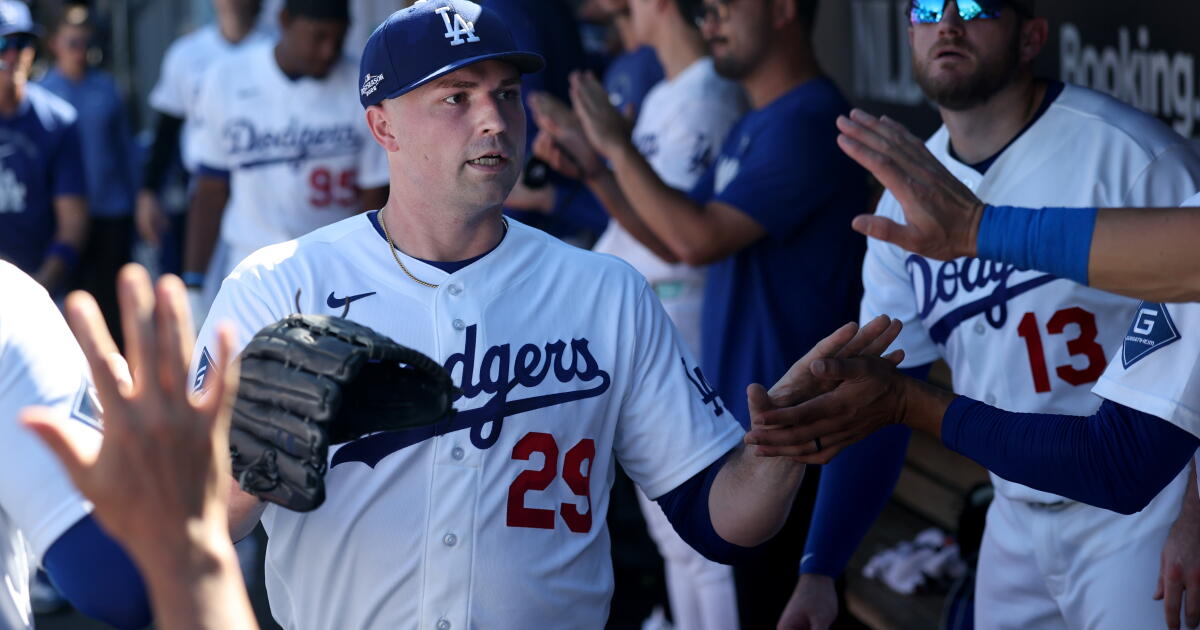
Skubal was that rare rental that shined, hurrying into his Dodger uniform less than 24 hours after the trade, immediately cheering on his new teammates from a strange dugout while commanding respect in the clubhouse like he’s been here for years.

“The group of guys, the clubhouse, the culture they have here — it’s real,” he told reporters after the Dodgers final playoff loss. “I was honored to be part of it.”

The Dodgers were honored to have him, and they knew it.

“It’s not easy for a guy to get traded in the middle of a season to come to a new city, new clubhouse, you have set routines and you have to make those adjustments, it’s not easy,” said Andrew Friedman, president of baseball operation, in his postseason presser. “The way he was able to seamlessly transition, not just in terms of on the field, but in the clubhouse, I can’t say enough good things about the impact that he made in such a short period of time. We have a tremendous amount of respect for him on and off the field.”

So what’s the problem?

“I think a lot of it is continuing to see what this all looks like,” said Brandon Gomes, general manager, to reporters at last week’s general managers’ meetings, later adding, “Obviously, we know what kind of pitcher he is. So for us, it’s understanding what this all looks like, as far as what does our team need? What does the contract look like? Where does he end up? I don’t know. We know we love the player, we love the human, and you kind of have to let things play out to understand what that looks like, and if it’s something that we’re gonna ultimately execute.”

Don’t know what it looks like? Here’s what it looks like.

With Skubal: Championship favorites

Without Skubal: Just another contender.

At this point you might be saying, wait a minute, they finished only second in the National League with Skubal, they can do that much without him.

Please, don’t blame the Brewers’ sweep on him. The culprits were the batters, who were seemingly smothered underneath the empty uniform that was Ohtani.

They get their first offseason rest in three years, they add a couple of bats, Ohtani gets healthy, Will Smith gets refreshed, Kyle Tucker rebounds, the offense will recover enough to chase another championship.

But it is doubtful they will catch it without Tarik Skubal.

He reportedly plans to sign before the current Collective Bargaining Agreement ends on Dec. 1, after which the owners are expected to lock the players out in hopes of imposing a salary cap.

That gives the Dodgers, what, two weeks? They should do this in two minutes.

Sign Skubal.
Source link

After NLCS exit, Dodgers face big questions about their aging lineup and future

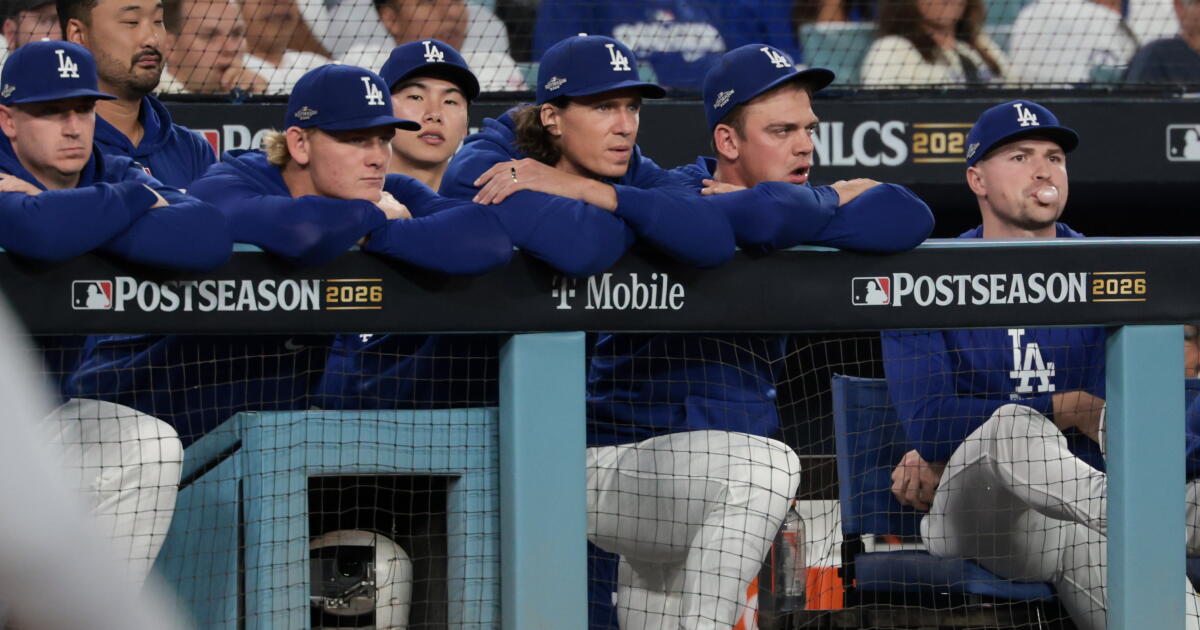
Dodger Stadium was eerily quiet on Wednesday, as a light rain fell over the already-yellowing grass. A crow perched on an empty seat. Scattered lights flickered in mostly-dark hallways.

Before the World Series had begun, the stadium was closed down for the season, hosting just one last event before officially wrapping up the 2026 slate.

In the interview room, tucked away at the entrance to the clubhouse, president of baseball operations Andrew Friedman and general manager Brandon Gomes took their seats at the podium for their end-of-season press conference.

There was the usual end-of-season checklist. Are you expecting any changes to the coaching staff or front office? “I expect status quo,” Friedman said. Is Shohei Ohtani going to undergo offseason surgery? “That’s not on the table,” Friedman said.

But from that emerged a persistent throughline.

The Dodgers had fallen short of their goal of a three-peat. But considering the age of the position-player core, the scrutiny owner Mark Walter is under, and MLB owners’ insistence on a salary cap in their early CBA proposals, was the Dodgers’ dynasty over?

“I welcome it,” Friedman said of such claims. “For us, and we’ve talked about this a lot, even after successes and we winning a World Series and then winning back to back, everything we do is for our fans. And there’s a lot of noise around us in general. We don’t really pay much attention to it. It’s a partnership we feel with our fans, and so people saying that we’re done and we’re on the downside of this run — it’s just more noise to us because everything for us is about the motivation we have to have a parade in the streets of Los Angeles next November.”

Friedman also didn’t seem to anticipate any trickle down from Walter’s outside ventures — Walter’s insurance companies are under federal investigation and face several lawsuits — affecting the Dodgers’ offseason budget.

“It’s been business as usual for us,” Friedman said. “We talked to Mark after we lost, and he was obviously really disappointed. But so much of his focus was on, ‘OK, what can we do? What are our plans? What are our thoughts for the off season?’ And our brains weren’t quite there yet, but so much of his focus was how do we put ourselves in the best position to win in ‘27?”

How will the Dodgers go about picking themselves up from their NLCS exit?

The Dodgers’ 2026 season wasn’t exactly a failure. They won 100 games in the regular season and lost in the playoffs to the only team that won more than that — the Brewers. But the Dodgers, with their star power and payroll, aren’t in the business of accepting moral victories.

Though plenty went wrong in the postseason, from Ohtani’s struggles following hisinjured list stint, to stalwart Yoshinobu Yamamoto’s surprising short start in Game 2 of the NLCS, the overarching theme in the Dodgers’ four straight losses to the Brewers was a lack of offensive execution, especially with runners in scoring position.

“Obviously throughout the latter part of the year, it was stuff we were talking about and trying to put our finger on,” Friedman said of the offense. “And in a lot of ways, it’s a little bit of a game of whack-a-mole, where it can be one thing for some period of time, and then it’s something else, and then it’s something else. Sometimes it’s noise, and sometimes it’s real. And what’s important for us is to be able to sift out the noise and isolate what’s real and what things we can improve upon. We’ll spend a lot of time really focusing on that in the off season.”

Asked if the age of the lineup could be a contributing factor, Friedman pointed to the strong finishes of some of the more veteran players on the roster.

“I don’t think it’s as easy as to paint it with that broad of a stroke,” he said.

Friedman, in an effort to continue to extend the Dodgers’ run of success, has kept in mind the cliff that successful veteran teams can fall off of, if the roster isn’t properly backfilled.

“This isn’t something that we just woke up and were like, ‘Oh wow, the age of our position player group,’” Friedman said. “We knew what things were going to look like in ‘26, ‘27, but also how talented these guys are, the way they prepare. And so much of our long-term contract bats are betting on the human — betting on the person, betting on the work ethic, betting on them doing everything they can to keep themselves in the best position to have success. But when you couple the core talent that we have at the major league level with the position-player strengths that we have in our farm system, that’s what makes us excited, is the art of how to onboard some of these young, talented minor league players.”

The Dodgers had the No. 1 ranked farm system as of mid-August, according to MLB Pipeline. But many of those prospects, including the three outfielders who the Dodgers’ Top 3 (Josue De Paula, Eduardo Quintero and Mike Sirota), are blocked by veteran players.

“For us, it’s just about having as many many talented players as we can, and things tend to sort themselves out,” Friedman said.

This offseason, the Dodgers will also have to figure out what to do about their soon-to-be free agents, a group headlined by left-hander Tarik Skubal. The two-time Cy Young winner was not only the best pitcher available on the trade market when the Dodgers acquired him from the Tigers at the trade deadline, but he’s in line to be the best pitcher available this offseason as well.

“It’s not easy for a guy to get traded in the middle of a season to come to a new city, new clubhouse,” Friedman said. “You have set routines, and you have to make those adjustments. It’s not easy. The way he was able to seamlessly transition, not just in terms of on the field, but in the clubhouse, I can’t say enough good things about the impact that he made in such a short period of time.

“We have a tremendous amount of respect for him on and off the field. … He’s put himself in this position to go out and be a free agent. And for us, it’s, continue to talk to [his agent, Scott Boras]. But he and his family have to make a choice over where they want to spend the next X number of years, and obviously we wish him nothing but the best.”

When asked about negotiations, however, Friedman spoke generally, saying the Dodgers were still “wrapping [their] arms around” their offseason strategy.

The impending lockout, which is expected to go into effect on Dec. 1 as soon as the current CBA expires, and uncertainty over changes in the next CBA, will certainly affect the free agent and trade markets this offseason. And though MLB navigated a lockout just five years ago, the owners’ push for a salary cap has many around the industry bracing for a longer work stoppage and murkier landscape on the other side.

“I never have any feel for how a market’s going to play out,” Friedman said. “We’ve kidded ourselves in the past that, like, ‘Hey, we think this is going to happen,’ and it just takes on its own life form. So for us, it’s just about being as prepared as we possibly can be, and pouncing on opportunities.”

Source link