clothing

Flight attendant tells travellers to stop wearing 1 item of clothing on planes

A flight attendant has told travellers to stop wearing a common item of clothing to travel on planes. According to Cher Dallas, a certain garment should always be avoided

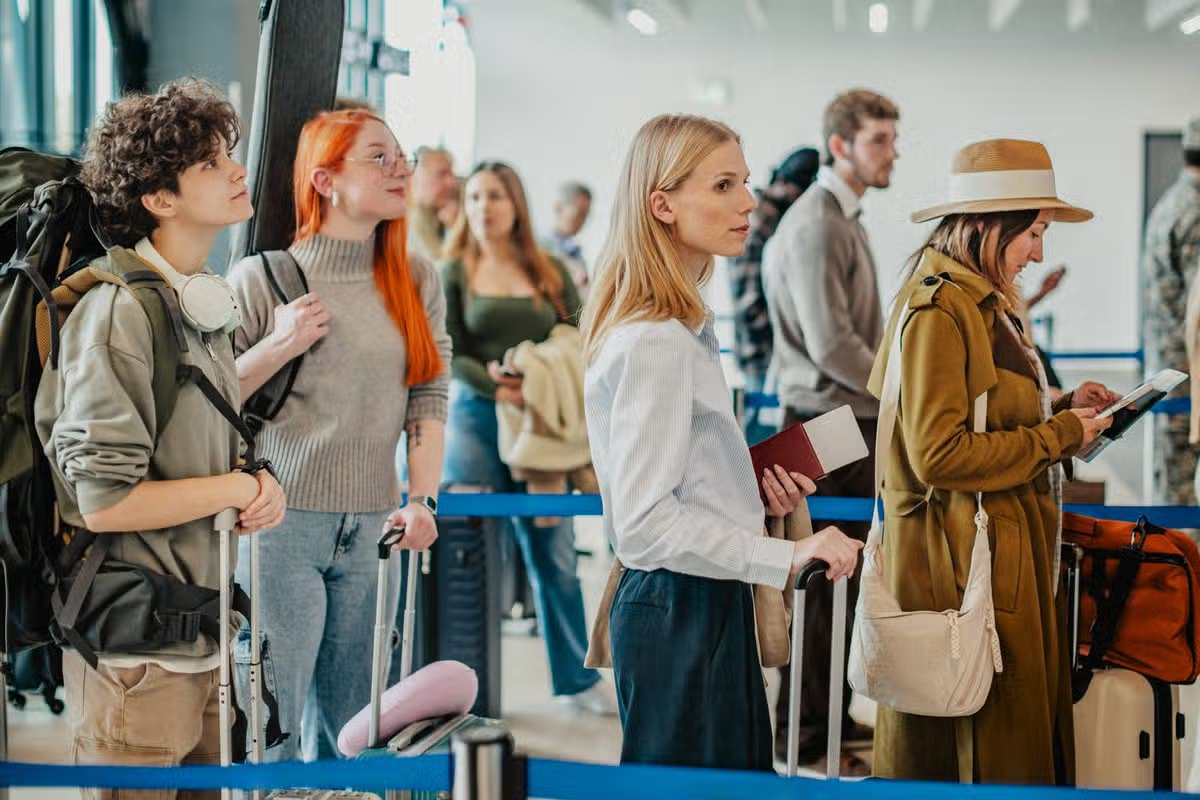
When people travel, a lot of thought can go into their outfits, but there’s some items of clothing you may actually want to avoid wearing on planes. According to flight attendant, Cher Dallas, there’s a certain item that people should stop wearing as soon as possible when jetting off abroad.

Cher, who shares travel tips and stories on TikTok, said there’s one item she never wears to travel on a plane, and there’s good reason why too. It’s one piece of air travel advice you may want to follow from now on when you jet off on adventures around the world.

It’s not the first piece of advice of its kind to be shared either. Previously, another flight attendant cautioned travellers about wearing certain clothes on planes too.

What is her advice?

In a candid clip discussing the clothing, Cher said: “Since everyone gets fuming mad at me when I say don’t wear shorts when you travel, coming from a flight attendant, guess how many diapers got changed on the seats yesterday on my one flight? Four.

“Guess how many announcements we made for people to not do that? Three. People don’t care.

“Guess how many of those diapers were poopy? All four.

“They change them on the seats, and you want to rub your skin on there? You do.

“You want to. You’re dying to. Enjoy your staph infection. Just don’t say I didn’t warn you.”

Why should it be avoided?

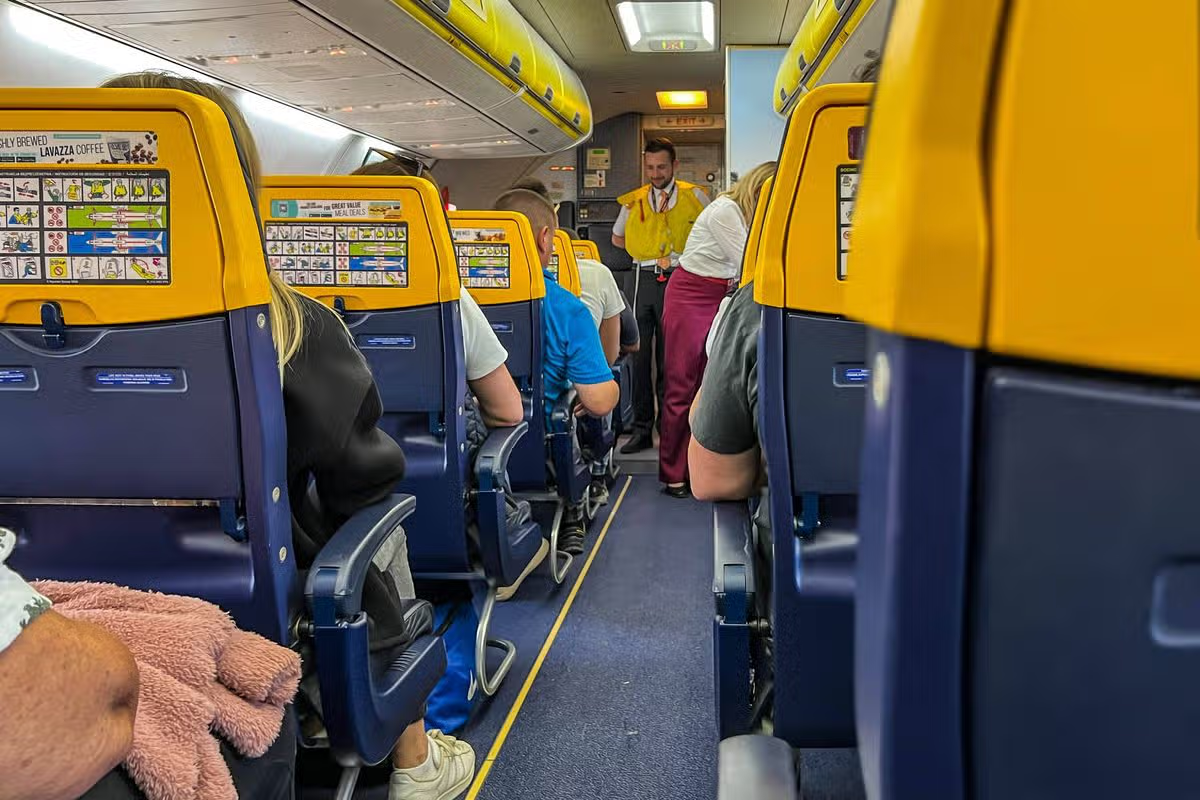
There are a few reasons why it’s best to avoid wearing shorts on planes. Many flight attendants note that airplane seats are rarely deep-cleaned between quick turnaround flights and can harbour bacteria, body fluids or spills from previous passengers.

Wearing long trousers creates a physical barrier so your skin does not touch the upholstery directly. It’s much better to keep your legs covered.

Content cannot be displayed without consent

As well as this, plane cabins often get very chilly during flights, and shorts leave you exposed to cold drafts. If surfaces are sticky, bare legs could also stick to chairs.

It’s also considered wise to cover your legs in case of an emergency. In a rare emergency evacuation, where evacuation slides are deployed, bare legs can suffer painful friction burns or scrapes as you slide down.

Therefore, there are various reasons why shorts should be avoided. As well as exposing you to germs, they can actually be problematic in other ways too.

This is why it’s best to avoid wearing them any time you board a plane. You’ll be glad you did it later down the line.

Source link

Canada strikes back at U.S. with retaliatory tariffs as trade war escalates

Canada struck back at the United States on Tuesday with retaliatory tariffs on about $20 billion worth of American goods, including steel, dairy products, appliances and farm equipment, as the trade war between the once-friendly neighbors escalated sharply.

The tension threatened one of the world’s largest trading relationships. The new tariffs extended well beyond industrial goods, hitting everyday purchases such as seafood, cheese, clothing, cosmetics and toilet paper, with some facing duties as high as 50%.

“We did not choose this conflict, but when our economic integration is used as a weapon rather than the foundation for a win-win partnership, we need to stand up,” Finance Minister François-Philippe Champagne said in French, calling the situation “an unprecedented challenge imposed on Canada.”

Canada’s retaliation came after the Trump administration imposed 50% tariffs over the weekend on Canadian goods following the collapse of trade negotiations. Canadian Prime Minister Mark Carney accused Washington of trying to subordinate Canada and said U.S. demands during the failed talks showed that Americans wanted to “destroy our major industries.”

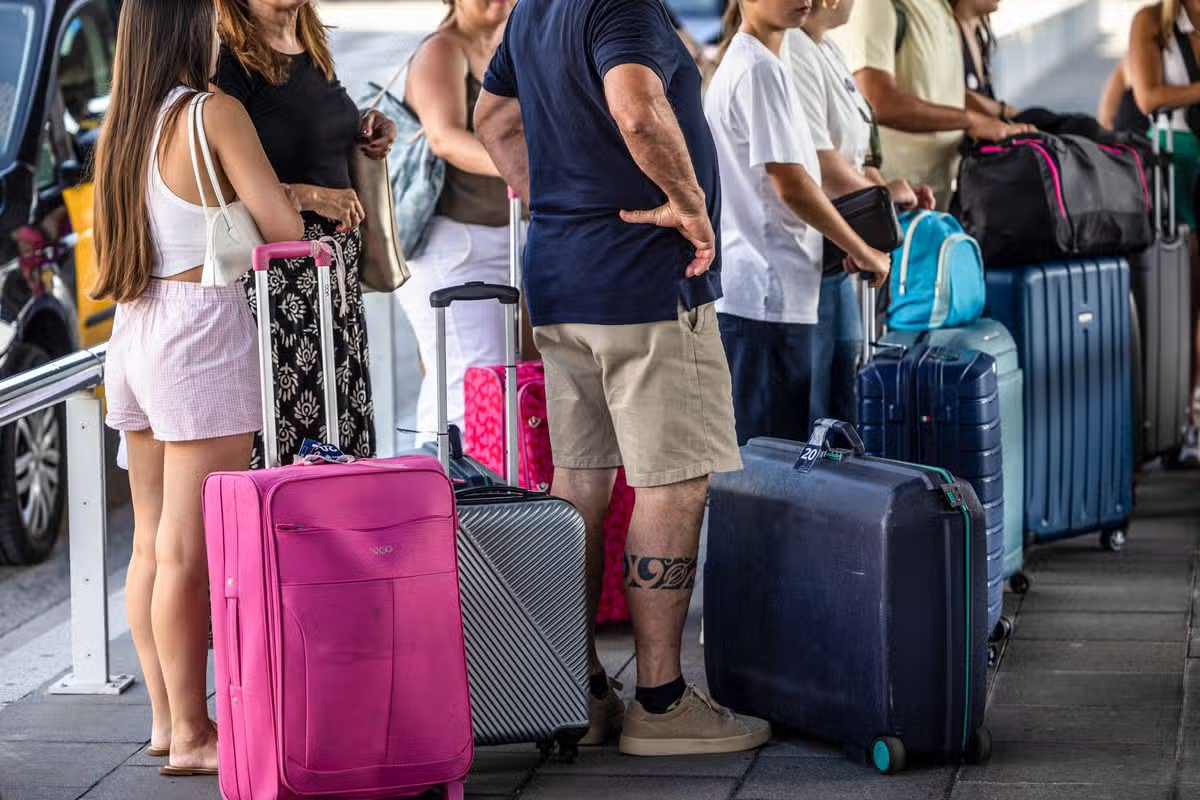
President Trump intensified the confrontation Monday, telling Canadian leaders to “fall in line” or face consequences “far WORSE” than existing tariffs and threatening new 50% tariffs on Canadian vehicles, auto parts and steel.

Trump added another provocation Tuesday, saying the United States was giving “serious consideration” to renaming Lake Ontario “Lake America” in a feud with Ontario Premier Doug Ford. Such a change would be reminiscent of the Republican president’s unilateral action last year by executive order to rename the Gulf of Mexico to the Gulf of America.

The tariffs will take effect Sept. 8 at rates of 15%, 25% and 50%, with Canada matching the corresponding U.S. tariff rate on more than 700 products such as pulp and paper and electronics. The tariffs on many American products would double from 25% to 50%, with the largest share of the new measures affecting steel and aluminum.

Canadian officials said the goal is not to raise revenue but to protect Canadian companies and reduce U.S. imports.

U.S. steel imports, for example, have already fallen 30% since Canada imposed a 25% tariff, and the new 50% rate is expected to cut them further, Canadian officials said.

Goods facing 50% tariffs include some steel and aluminum products, furniture and clothing. Appliances, dairy products including cheese, fish and seafood, and certain steel and aluminum derivatives will face 25% tariffs. Existing Canadian countertariffs on U.S. autos will remain in place.

Canada also announced a support package for workers and businesses affected by the dispute worth $7.5 billion in Canadian dollars ($5.4 billion in U.S. dollars).

Canadian officials acknowledged the counter tariffs will raise costs for some businesses and consumers but said they expect the overall economic effects to be moderate.

They said the government has provided more than $30 billion Canadian dollars (US$21.7 billion) in tariff-related support since the beginning of 2025 — far more than it has collected in retaliatory duties — as it tries to cushion the blow from the trade fight.

Canada and the United States have deeply integrated supply chains across autos, energy, agriculture and manufacturing, making a prolonged trade fight potentially costly for businesses and workers on both sides of the border.

Businesses and consumers are caught in the middle, facing uncertainty about how much prices may increase.

Michael Howard II, owner of a furniture business in Warren, Michigan, outside Detroit, said the tariffs will hamper the “ability for us to put food on the table for our family” and affect “the ability for us to give back to our community.”

Howard and his wife started their business a decade ago. They make and sell everything from dining room tables to bookcases.

“To say that we don’t need Canada is just disingenuous,” he said. “It’s dishonest. And it’s just absolutely not truthful. We need our neighbor, but also they need us.”

Carney said Monday that Canada may need to move away from matching U.S. tariffs dollar for dollar and instead use more targeted retaliation aimed at protecting Canadian workers and businesses.

“An attitude at the negotiation table that Canada is a subsidiary of the United States” is “not something we’re going to accept,” Carney said.

Carney was even more blunt in French.

“We learned during the negotiations that the Americans want to destroy our major industries, including autos, steel and aluminum,” Carney said. “That was one of the main reasons we said no. It was a bad deal.”

On Monday, Carney said U.S. negotiators had raised the discoverability of French-language content on streaming platforms, along with French-language labeling rules, as trade irritants. He rejected the idea that those protections were negotiable, saying in French: “For the Americans, questions about the French language, Quebec culture, francophone culture and Canadian culture are irritants. Here in Quebec, here in Canada, they are rights.”

In a social media post early Tuesday, Trump wrote: “I would never interfere with Canadians speaking French! In fact, I have never even thought of doing such a stupid thing. This lie was made up by a weak and ineffective Prime Minister in an attempt to gain political support, which he has totally lost, from the people of Quebec. I love French Canadians!”

Gillies writes for the Associated Press. AP writers Seung Min Kim in Washington and Mike Householder in Warren, Mich., contributed to this report.
Source link

‘I’m a pilot’s wife and all passengers must stop wearing common clothing item on planes’

A pilot’s wife has shared her top travel clothing tips, including what people should avoid dressing in. She said there’s a common item travellers need to stop wearing on flights

It’s that time of the year where many of us will be heading abroad. When travelling in summer, parents are constantly warned to check their children’s passports ahead of any trips.

Taking advice is best from an expert and who knows travel more than a pilot? Now travel guru Laurie is renowned for her helpful travel tips on her YouTube channel Travel Tips by Laurie. Recently she revealed some essential advice about what to avoid wearing on a flight. While it’s tempting to disembark the aircraft looking incredibly fashionable, Laurie maintains that comfort and practicality should come before style when selecting your in-flight attire, and she urges travellers to pay attention to her guidance, which she disclosed in a recent video.

This isn’t the only travel tip doing the rounds of late. Previously, people were also warned about wearing other outfits while flying.

Travel Expert Warns Flight Passengers Against Wearing White Clothes and Jumpsuits

In her online video, Laurie kicks off by explaining the kinds of clothing to steer clear of while flying. She suggests: “In the airplane, I recommend not to wear white.

“I did twice in my 23 years as a pilot’s wife at the beginning, and I got smudges on my jeans from bringing my luggage down from the overhead bins and pizza stains inside the airport that some other passenger had eaten and dripped some on the boarding gate seats.

“Do not wear complicated jumpsuits. Why? Because they’re complicated. They’re going to add stress to you, especially inside a tight, cramped lavatory inside the airplane.

“My travel tip is to pack that outfit and avoid wearing it in the airplane. Do not wear stiff leather or stiff denim, because it restricts your blood flow.

“While I sometimes wear trendy pieces, this video is going to focus on cosy, stretchy and versatile garments you should be wearing and a few to avoid. All that is so we maximise your comfort from boarding to baggage claim.”

While it may appear to be obvious advice to steer clear of jumpsuits, avoiding stiff fabrics is genuinely important. Although denim is generally considered acceptable for flying, experts actually warn against it due to potential discomfort problems.

The cabin pressure on flights causes abdominal bloating, and unforgiving materials can restrict movement while increasing the risk of deep vein thrombosis (DVT). For both comfort and health reasons, loose-fitting clothing or athleisure wear are your safest options.

Health and Safety Risks of Wearing Tight Denim Jeans on Long Flights

There are several reasons why denim is a poor choice for air travel. First and foremost, tight waistbands can become uncomfortably restrictive as your body swells owing to reduced cabin pressure.

Beyond simple discomfort, constricting clothing can restrict blood circulation, raising the risk of DVT. What’s more, heavy denim and belts regularly cause hold-ups at airport security checkpoints.

In short, this material poses numerous drawbacks for air passengers. If you absolutely must wear denim, make sure you opt for high-stretch varieties only.

While pulling on a pair of jeans might appear to be a savvy way to save on luggage space, the downsides frequently outweigh the advantages. The general consensus points towards choosing more comfortable options such as joggers or leggings instead.

As we head further into 2026, this handy piece of advice sits at the top of Laurie’s travel tips. It’s definitely worth keeping in mind before you set off on your next trip abroad.

Source link

Ryanair says wearing 1 clothing item on the plane is ‘worse’ than jeans

Irish airline Ryanair has reiterated its controversial stance on what passengers should not wear on their planes – after one passenger attempted to bend the ‘rule’

There’s nothing worse than feeling uncomfortable on a flight, knowing there’s nothing you can do about it. Wearing jeans is often regarded as an air travel faux pas as the tightness of the material can cause problems when the body swells slightly during low cabin pressure.

Ryanair has frequently warned against wearing denim on board, saying that tight waistbands and stiff leg material squeezes your body, which can cut off good blood flow if you are sitting still for hours. Recent passenger Pam Booth recently sought advice over her choice of outfit, which prompted a damning response from the Irish airline.

“What you got to say about this Ryanair?” Pam asked on Twitter alongside a snap of her attire. “Technically they aren’t jeans.”

Ryanair simply declared in reply: “They’re worse.” Pam’s photo revealed she had opted for denim shorts for her journey, cut just above the knee.

If you’re wearing shorts then your bare thighs and calves could be pressed against the seat fabric for hours. And aircraft seats are turned around fast – while they are cleaned, they’re not deep-sanitised between every passenger, so you’re increasing exposure to sweat, skin cells, crumbs and microbes left behind.

Content cannot be displayed without consent

Last month, Ryanair shared an “important” message to those wearing jeans, having previously threatened to introduce a “denim fee” for travellers not adhering to this guidance.

“Important Travel Announcement,” the company posted, accompanied by three images of a Ryanair aircraft in the sky, zoomed in to reveal various details. The first two showed a Ryanair plane soaring through the air, with a brilliant blue sky visible in the background. However, the third image displayed a banner trailing from the rear of the aircraft.

The message was short and sweet. It simply read: “Stop travelling in jeans.”

Ryanair also took to TikTok in July to share a similar message. The airline shared a video of a plane with the Ryanair logo descending over turquoise waters before landing at what appears to be Corfu airport.

Celebratory music is heard playing over the clip, followed by a voice saying the classic phrase many passengers will have heard before: “Thank you for flying Ryanair. It’s 2026, let’s stop travelling in jeans please.”

The recommendation is shared by AAA Club Alliance, who state online: “A stiff denim waistband isn’t ideal when you’ll be sitting in a small, cramped seat for hours.

“Jeans can quickly get uncomfortable, which can put a damper on your entire travel experience. Plus, wearing tight jeans can actually increase your risk of deep vein thrombus (DVT) which are blood clots in the leg, so stiff, tight pants should be avoided.”

The advice continues: “Instead of jeans, opt for a stretchy pant. While sweatpants and leggings can be a great option, if you want to up your game, try trousers with drawstring or an elastic waist.

“Styles in light fabrics, like cotton, or that curl up in a jogger style, are great for a long-haul flight. Or, if you love your jeans, try a relaxed boyfriend cut or other style with decent stretch.”

Source link