PROFESSOR Green’s flagship takeaway restaurant has been abruptly shut – just two months after opening.
The branch had marked the rapper’s second fast-food location in the UK.
The site opened just two months ago following the first Glasgow locationSource: Instagram – pgfastfoodThe website currently displays this statmentSource: pgfastfood.com
Located in Soho, London, Proper Good launched on September 14 with a build-your-own-meal concept – offering salad boxes topped with an array of protein, dips and sides.
The fast-casual restaurant followed the opening of the rapper‘s first branch – PG Fast Food – in Glasgow earlier this year, which has since been closed.
Sign up for the Showbiz newsletter
Thank you!
According to the Glasgow Times, a representative at the time had said: “As part of the next phase of our growth, we have taken the decision to close the restaurant for refurbishment as we evolve the brand and customer experience.”
Now, Professor Green’s newest venue appears to have also been shuttered, with a notice on its website reading: “Proper Good has closed its doors. For now.”
It is unclear whether the site has permanently shut or is part of a wider refurbishment programme.
The menu featured four base meal options, which could be dressed-up with the addition of Asian and American-inspired toppings and dips including miso salmon, pot roast beef and yogurt ranch.
Commenting online, users expressed hope that workers would not be impacted ahead of the festive period, with one saying: “Hope they are all ok and find jobs soon.”
Another said: “West End is the graveyard for most businesses sadly.”
Prior to its closure, the takeaway had brought in mixed reviews, with some “loving the veggie options” and commenting that the “food looked great”.
Meanwhile, another said: “No surprise, food was bad and also the customer service.”
Abivax (ABVX) closed Friday down ~9% following a short report from Scorpion Research, which attacked the clinical development of the company’s ulcerative colitis candidate obefazimod.
Scorpion revealed it has a short position in Abivax. The firm claims that the asset exhibits “
GUANGZHOU, China — Behind the scenes, Treasury Secretary Scott Bessent spent months pushing for action that would signal resolve within the Trump administration against China’s pursuit of the most powerful American computer chips, a flashpoint in their race for superiority in artificial intelligence, multiple sources said.
But Trump’s courtship of Xi Jinping, seeking to alleviate tensions among the world’s greatest powers, and a contingent of advisors skeptical of commercial warfare against Beijing slowed the process down — giving China months of opportunity to gain access to U.S. semiconductors through the back door.
Ultimately, just hours before departing for Asia alongside President Trump, Bessent got his way, bolstering his position ahead of talks with Chinese officials in Shenzhen this week on the risks posed by frontier systems.
A new rule tightening loopholes in U.S. export controls sends a dual message to Beijing ahead of Thursday’s summit, that Washington is serious about curbing Chinese circumvention — and that China hawks within the administration may be gaining the upper hand.
Trump has repeatedly sidestepped confrontation with Xi over the intensifying AI race in their two previous meetings this year, in Beijing and Washington, wary of upsetting a carefully managed détente and reluctant to jeopardize a technology boom increasingly central to the U.S. economy.
But the administration, from the president down, is acutely aware of China’s ambitions to dominate an industry that could reshape the global balance of power. That competitive drive was underscored this month by a scandal involving a Chinese espionage campaign targeting Jensen Huang, co-founder of Nvidia, the world’s leading AI chip maker.
Before resigning from the company in disgrace over the weekend, Huang admitted to having an affair with a suspected Chinese spy — a woman who worked at a Singaporean firm accused by American authorities of helping to divert restricted Nvidia chips to China, in violation of U.S. export controls.
The national security scandal has roiled the markets — and in so doing, commanded Trump’s attention — inflicting a significant devaluation on Nvidia and reverberating well beyond it, wiping nearly $1 trillion from the combined market value of major technology companies in a single trading session on Monday.
Trump, who counts Huang a friend and ally, indicated he would be open to his return as Nvidia’s chief executive. Bessent suggested otherwise, expressing confidence its board could find competent new leadership and urging a full investigation.
Trump is not expected to raise the Nvidia matter directly with Xi. But Bessent plans to do so in his own meetings, one official said.
The Treasury secretary has thus taken on the role of an enforcer, pursuing a tougher line than Trump is willing to take himself in his highly personalized relationship with the Chinese leader.
Bessent is scheduled to meet with Chinese Vice Premier He Lifeng on the sidelines of the summitry in Shenzhen to discuss potential collaboration on AI safety protocols, standards for testing of advanced models, and a direct communications channel for AI emergencies.
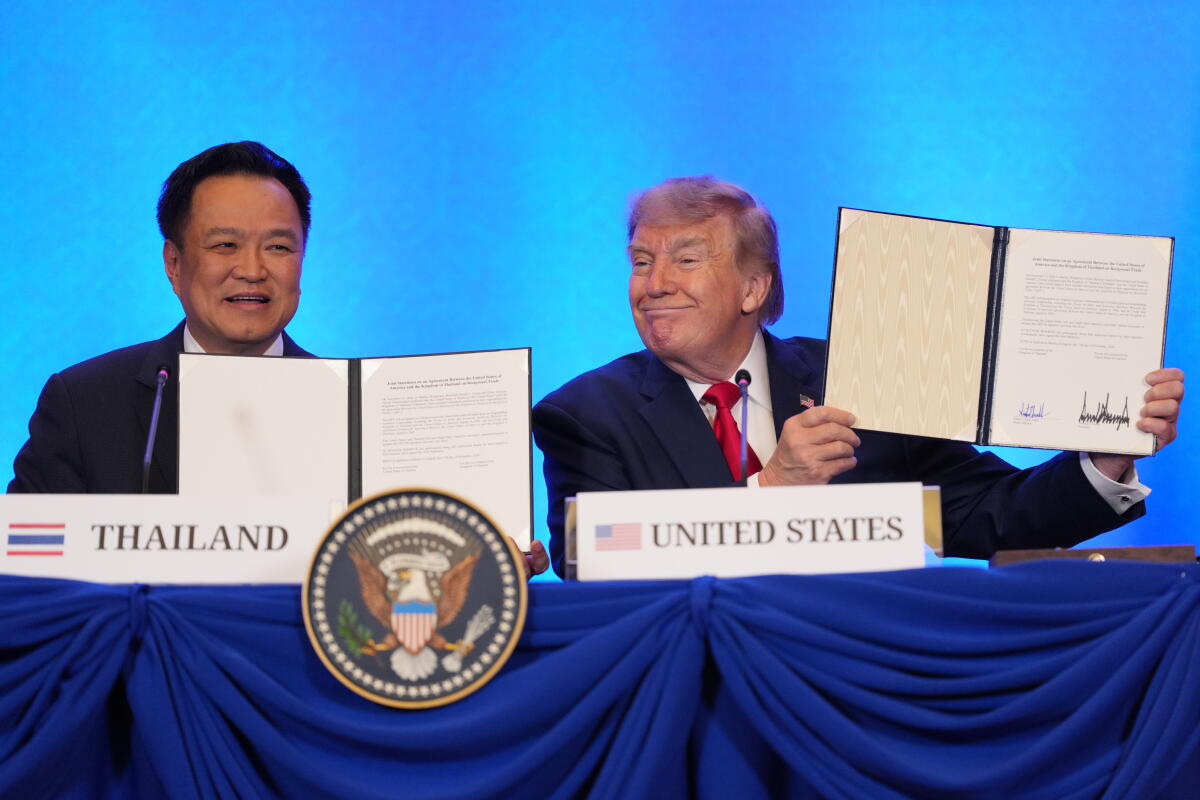
President Trump and Thailand’s Prime Minister Anutin Charnvirakul shows documents during a signing ceremony in Manila.
(Mark Schiefelbein / Associated Press)
The two men have met before to discuss AI, most recently in New York, where they agreed in principle to coordinate. But the talks have yet to produce much in the way of tangible results.
“Bessent is signaling that, while he sees working with Beijing to mitigate AI risks as a priority, it won’t come at the expense of actions that he sees as necessary to protect U.S. national security, like limiting AI chip exports to China,” said Daniel Remler, a senior fellow with the Technology and National Security Program at the Center for a New American Security.
The administration’s latest action marks a policy defeat for Howard Lutnick, secretary of the Commerce Department, who oversees chip policy and had advocated for a less restrictive approach than Bessent, Secretary of State Marco Rubio and Jamieson Greer, the U.S. trade representative.
The feud began spilling into public view ahead of the president’s travel, and in light of the Nvidia scandal, after Bessent said in a television interview that the Commerce Department “has the pen” to act, implying a split within the team.
“Look, there’re two different views,” Trump told reporters on Monday, answering questions on the matter. “One view is you don’t want to insult China. We have a very good relationship with China, and you don’t want to insult them.”
“The other view is just go, you know, down and dirty and do what you have to do,” Trump continued. “You can’t say either is wrong or right. We’ll let you know.”
Beyond the diplomatic niceties, Trump has been explicit and consistent since resuming office that the United States must “win” the race for AI superiority, calling the alternative “not acceptable.”
“Whoever wins AI,” Trump said at the UN General Assembly in September, “whoever wins superintelligence, wins.”
Trump will arrive in China on Wednesday after meeting with world leaders in Manila, including those from the Quad — an alliance of Japan, India, Australia and the United States — which discussed AI at their own summit Tuesday evening.
Describing “superintelligence” — Trump’s preferred term for AI — as “the greatest opportunity for economic growth since the industrial revolution,” Trump announced a Quad effort to accelerate adoption of the technology, including an investment of more than $85 million to enhance AI ecosystems throughout the region.
“We want to be careful with it,” Trump said, “but it’s amazing, the things that have come out, in terms of science and in terms of medical breakthroughs. No one can believe what we’re finding. And we’re finding it fast.”
“We want to be very careful, but we want to cherish it,” he added. “The United States as you know is leading in that capacity, by quite a bit.”
The new U.S. rule requires overseas data centers serving customers in China, Russia, Iran and Cuba to identify their end users before gaining access to chips. It also imposes additional licensing requirements on chip sales to Indonesia, Malaysia, Singapore, Thailand and Brazil, which the Commerce Department identifies as posing a “higher-than-normal risk of diversion” to unauthorized destinations.
U.S. officials say that export controls are not up for negotiation in talks with the Chinese. But Beijing sees them as yet another historic example of Washington trying to contain its rise — a posture that has repeatedly stifled diplomatic progress between the two superpowers.
“While administration officials say export controls aren’t up for negotiation, Chinese officials will certainly bring them up,” Remler said. “These restrictions are the key obstacle to China’s AI progress, which is increasingly important to the Chinese economy and to Xi’s strategic goals.”
Protesters in Manila take part in a demonstration Tuesday against President Trump visit to the Philippines for the ASEAN summit.
(Ezra Acayan / Getty Images)
China claims it does not seek an all-powerful, generalized “superintelligence,” but rather specialized AI systems embedded across industries to boost productivity and improve quality of life.
In Beijing’s telling, it is the United States — pursuing generalized AI through a private sector largely unchecked by the federal government — that poses an existential threat to the global order.
Sheila Jasanoff, a professor of science and technology studies at the Harvard Kennedy School, said China “has a much clearer vision of what it is seeking to accomplish in the so-called AI arms race, as well as the capacity to benefit from Nvidia’s chips.”
“I doubt that China will be interested in launching a discussion that calls attention to its spying operations, or jeopardizes any supply networks it has built over the years,” Jasanoff added, “by innocent or nefarious means.”
Pressed by The Times, Chinese officials would not say whether they expected progress in the AI talks — before the announcement of the new rule on export controls.
And “what the U.S. president chooses to bring up,” Jasanoff added, “is anyone’s guess.”
REVELLERS travelling to a famous Bonfire Night event this weekend will be forced to change their plans ahead of a train station closure.
Those heading to the Sussex town of Rye on Saturday (November 14) for the bonfire celebrations will have to make alternative travel plans because the station will close at 3pm.
The Rye bonfire celebrations are always popular with locals and out-of-townersSource: Alamy
The decision has been taken to shut the station early to prevent ‘trouble-causing youths’ who in previous years have travelled in from other areas to make mischief.
Those coming in by train will need to arrive before 3pm, as services after that will run straight through Rye to the next station without stopping.
Sign up for the Travel newsletter
Thank you!
Southern Rail area manager Paul Wyborn explained: “As with previous years, Rye railway station will be closed for reasons of public safety, from 3pm on the day of the town bonfire celebrations.
“Community organisers and members of the local multi-agency Safety Advisory Group have helped us reach this decision.”
He added: “Trains will run through Rye without stopping until the normal start of service next day, Sunday 15 November, and online journey planners such as nationalrail.co.uk have been updated with this revised timetable.
“Please consider your alternatives if you’re planning to travel that day.”
James Foster, chair of Rye Bonfire Society, echoed his comments.
“We support Southern’s decision. The closure of Rye station limits the numbers coming from out of town and prevents an influx of youths who, in the past, have caused trouble,” he revealed.
Parents have been warned not to push their children to the front because of the loud bangs and flaming torchesSource: Alamy
“It has a noticeable positive impact on crowd behaviour, and this is clearly demonstrated by the reduction in police incidents.”
Other towns with proud bonfire traditions, like Lewes in East Sussex, have brought in similar measures to control crowd flow and reduce the risk of violence.
Lewes, which each year hosts a massive event for all of the local bonfire societies, closed its station from 5pm on Thursday, November 5.
Chief Inspector Sarah Taylor of Sussex Police added: “To ensure public safety, a decision has been made to close Rye Station during the bonfire event.
“Police officers will be working closely with partners to maintain order, prevent crime, and respond swiftly to any incidents.”
Rye’s bonfire celebrations will kick off with a pagaent procession starting out from Mason Road on the Tilling Green Estate at 7pm.
The procession route will go down Ferry Road to the Crown Inn then turn left into Cinque Ports Street.
It will then head down Tower Street, through Landgate Arch to Hilders Cliff, then into High Street down to The Mint, where it will turn right into Wish Ward.
The final part of the route is back on to Cinque Ports Street, down Tower Street, left down Landgate, right into Bedford Place and then on to the bonfire site, where ‘Rye Fawkes’ will light the fire at 8pm.
The grand finale will be the dazzling fireworks display starting at 8.15pm on the same site.
Those thinking of driving in to Rye on the day have been warned that all streets on the processional route will be closed to traffic from 5.30pm until around 10pm, and there is to be no parking on the route from 4pm.
Any vehicles parked on the route are likely to be removed by tow trucks, the organisers said.
And dogs should be left at home in case they are spooked by the loud bangs of firecrackers, drums and fireworks.
“This is a traditional custom, not a carnival or ordinary fireworks display, it can be loud and frightening, there will be fire and very loud bangs,” the organisers added.
“Keep children with you and do not push them to the front. If you are nervous, worried, or have a medical condition, we respectfully suggest you keep away.”
“It’s great when fairytales come true,” England boss Roy Hodgson said after 21-year-old Tottenham striker Harry Kane scored 79 seconds into his international debut back in 2015.
“Let’s hope it’s the start of a good and long England career for him.”
Eleven years on, Kane will make his 126th appearance for his country and become the most-capped men’s player in Three Lions history when England play Croatia in the Nations League at Wembley on Thursday (19:45 GMT).
Peter Shilton, who served England as a goalkeeper, won 125 caps between 1970 and 1990.
“It’s not about me – it’s about the team,” said Kane, scorer of 91 goals in 125 appearances for his country, about his landmark moment.
“I love coming to every England camp, I love playing every game and representing the country in the best way possible.”
Kane, 33, has gone through every emotion playing for his country.
He fought back tears after missing a penalty in the World Cup quarter-final defeat by France in 2022, and sang Wonderwall with fans following the win over Croatia at this summer’s World Cup – which he labelled one of his “favourite ever moments” in a Three Lions shirt.
London-born Kane is the boy who grew up in Chingford to captain his country, become England’s record goalscorer and win the 2026 Ballon d’Or.
Now the Bayern Munich striker stands on the brink of making more appearances than any other man in England’s football history.
“He wins the Ballon d’Or, and deservedly so, and in the next game for England he gets the all-time record with 126 matches,” England boss Thomas Tuchel said about Kane when announcing his squad last week.
“Thursday is a deserved occasion to celebrate an extraordinary player.”
In the last few days, in marked contrast to an election campaign defined by its bitterness and the closeness of its personal attacks, Israel’s current prime minister Benjamin Netanyahu has spoken of national unity and coming together with the opposition bloc that edged out his ruling coalition in October’s election.
On Saturday, the same day that Israeli President Isaac Herzog tasked former Chief of Staff Gadi Eisenkot with forming a government capable of commanding the Knesset, Netanyahu published a video on his social media account claiming Israel to be facing the genuine risk of civil war if a government were established with the support of Arab parties which he accused of wanting to “eliminate the State of Israel”.
Recommended Stories
list of 4 itemsend of list
Two days later, Netanyahu returned to the theme of existential threat in a further video, calling upon the leaders of the more successful bloc to recognise the “needs of the hour” and join, under his leadership, a single unified government that would also include the ultra-Orthodox parties, at least one of which is understood to be in talks with Eisenkot, as well as the prime minister’s controversial allies on the far right, Bezalel Smotrich and Itamar Ben-Gvir.
“It’s all a game at the moment. It’s leverage, it’s one-upmanship, it’s psyops, it’s spin, it’s counter-spin,” former Israeli government adviser Daniel Levy said of the invariably long and complex negotiations that take place ahead of establishing a government,
Currently, with the new Knesset being sworn in on Tuesday, speculation is focussing on the role of the Ultra Orthodox, or haredim, parties, which have traditionally offered support to Netanyahu in return for measures shielding their young male yeshiva students from the military draft in defiance off a Super Court ruling of June 2024.
Strategy
Nevertheless, irrespective of the past political cover offered to their members by Netanyahu, there are suggestions that one of the Ultra Orthodox parties United Torah Judaism (UTJ) – which refused to endorse Netanyahu’s selection to build a government by the President – is preparing to throw in behind Eisenkot, with the objections of one of the opposition’s principal figures Avigdor Lieberman said to be quieted in the face of either partnering with one of the Arab parties or the continued rule of Lieberman’s nemesis, Netanyahu and the prospect of further elections.
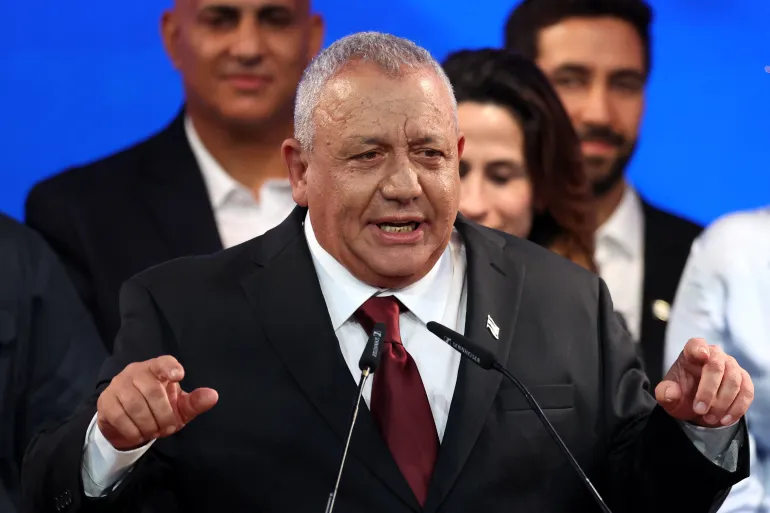
Yashar party leader Gadi Eisenkot has been tasked with attempting to form a government that will succeed the right wing coalition led by incumbent prime minister Benjamin Netanyahu [AFP]
“‘It’s political strategy, that’s all,” Netanyahu’s former aide, Israeli pollster Mitchell Barak said from Jerusalem. ‘But he’s negotiating from a weakened position. With the UTJ, Eisenkot’s got 67 seats,’ he said of the numbers needed to gain a working majority in the 120 seat Knesset, “so, of course, Netanyahu’s going to do all he can to reinforce his bloc; Barak said of negotiations regarded by many as critical to Netanyahu’s personal future.
Netanyahu faces a number of challenges that speak directly to both his political legacy and personal freedom that he will lose all influence over should Eisenkot succeed him.
Foremost are like to be the multiple corruption charges that is is presently on trial for and, despite his claims of innocence that he has already preemptively petitioned the country’s President and his former political rival, Isaac Herzog for. Secondly, and more pressingly is the question of his and his government’s culpability for the alleged failings ahead of the October 7 Hamas led attack that triggered the genocide unleashed upon Gaza by Israel and the multiple strikes and attacks launched by Israel non regional neighbors in the years since.
New Knesset, new danger
Many of the new MKs being sworn in on Tuesday, including bereaved family members, reservists, advocates for the 250 or so Israelis taken captive that day and Eisenkot himself, who lost a son and two nephews in the genocide that followed, are all tied directly to October 7 and the wars that followed together creating a chamber where feelings over the October 7 attack and where culpability for its lies are said to run close to the surface.
In particular, attention is likely to focus sharply on Netanyahu himself, whose supposed miscalculations ahead of the attack, stories of numerous missed warnings and who was subsequently accused of dragging out the war, or sacrificing the welfare off the captives for his own political ends. Key among the opposition’s aims for the first day of parliamentary business is set to be the installation of Matan Kahana, a member of Eisenkot’s Yashar (“straight”) party and a keen advocate of a state inquiry into Netanyahu and the government’s failings ahead of the Hamas led attack.
“Having so many people connected so directly to October 7 is going to increase the temperature, but it’s become so politicized that a win for one side automatically becomes a loss for the other, so the bereaved family on the right can say we need to increase our militarism in honor of my son, and the bereaved family in the center says we need to enlist more people.
“Netanyahu can try to influence that but for the first time in a long time, he seems a bit lost,” Israeli political analyst Nimrod Flaschenberg said.
However, how lost Netanyahu may be, or how grounded his claims of pending civil war or destruction at the hands of regional adversaries may be, ultimately, his political and potentially personal fate now lies with an opposition that outstrips his own numerically and a volatile Knesset eager to comb over the mistakes of the past.
“There’s no appetite on the other side to go in with Netanyahu for a unity government,” Levy said,
“The only real circumstances under which that happen is if he can create a security emergency,” he said following a weekend where the UK press had reported daily phone calls from Netanyahu to the Trump administration urging renewed war on Iran.
Fox Corporation has completed its $22 billion acquisition of Roku, transforming the Murdoch family’s company into a major player in the streaming video business.
The deal closed Friday, months ahead of the companies’ original target of the first half of 2027.
The deal combines Fox’s news, sports and broadcast channels with the San Jose-based streaming platform, which reaches 100 million households globally. The $22 billion valuation includes debt.
Roku, founded in 2002, provides Fox with a direct line to consumer households at a time when the traditional pay-TV universe continues its slow decline as viewers move away from cable and satellite services to video streaming. Fox already owns the free ad-supported streaming service Tubi, which turned profitable last year.
Fox Corp. expects to see around $400 million in cost reductions within two years of the Roku acquisition.
While Roku provides Fox with an opportunity to be more aggressive in marketing its channels, Fox has pledged that the platform will remain open to distributing content from competitors.
“Beginning today, our top priority for the combined company is to continue to relentlessly serve audiences and partners, while reinforcing the openness and choice that is the essence of the Roku platform,” Fox Executive Chair and Chief Executive Lachlan Murdoch said in a statement. “Our shared entrepreneurial passion and clear conviction toward building the future together with our new Roku colleagues gives us great confidence in the opportunities ahead of us.”
Roku founder Anthony Wood will join the Fox board of directors. He will also serve as co-chair of Fox Digital Platforms, the newly formed division that includes Roku, Tubi, the direct-to-consumer streaming service Fox One and Red Seat Ventures, which provides sales and technical support to podcasters. Paul Cheesbrough, who oversaw Tubi for Fox, will become co-chair and chief executive of the division.
Under the terms of the merger agreement, Roku stockholders are entitled to receive $95.30 in cash and 0.9799 shares of Fox Class A common stock for each share of Roku Class A and Roku Class B common stock they owned immediately prior to closing. As a result of the transaction, Fox stockholders own around 74% of the outstanding shares of Fox common stock and former Roku stockholders own approximately 26%.