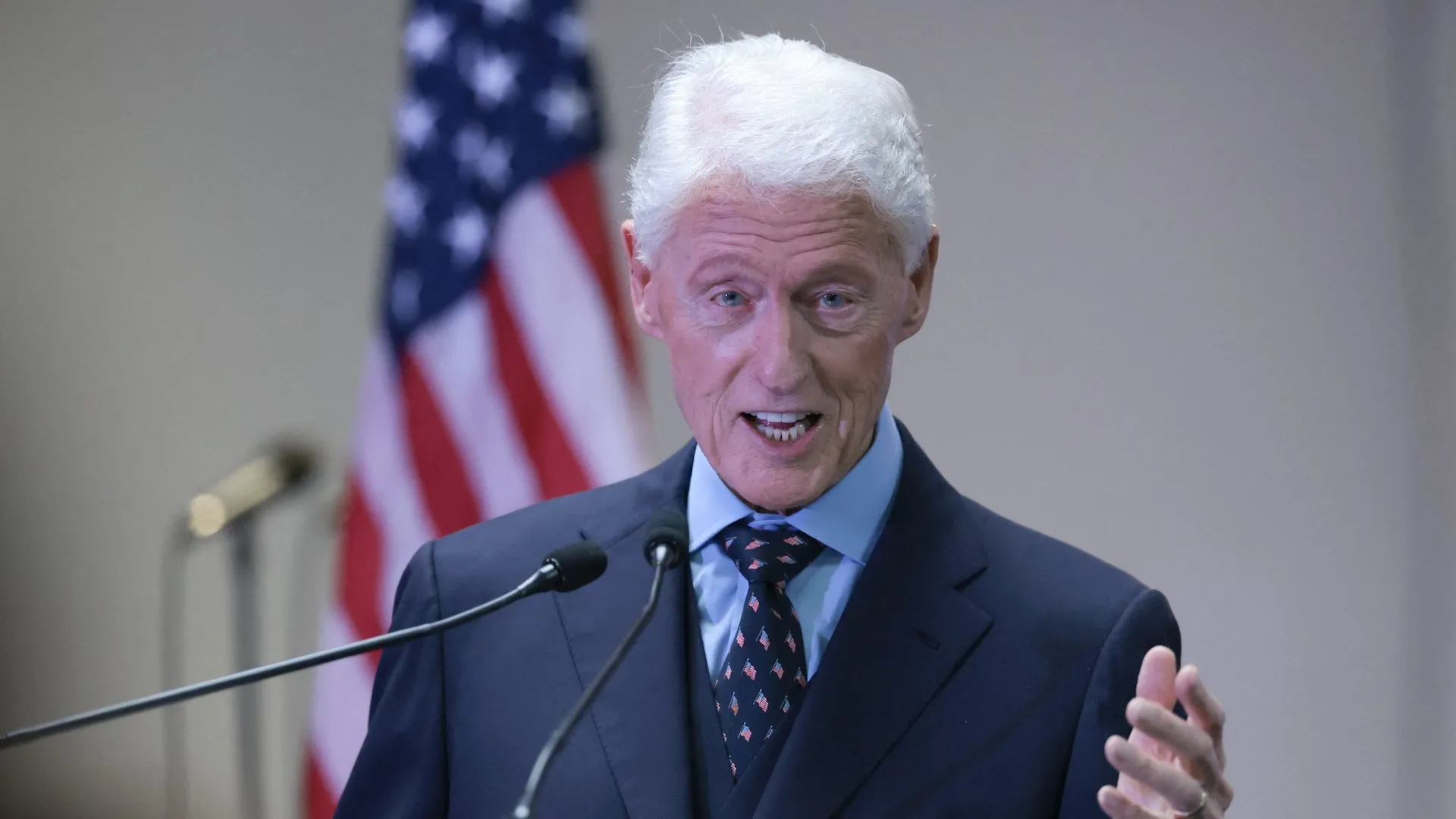
Clinton

Bush Family’s Feud Heats Up With Clinton

George W. Bush and his campaign have enjoyed remarkable success synchronizing the message from everyone at the Republican National Convention this week.

Except his parents.

After maintaining a low profile all year, former President Bush and former First Lady Barbara Bush have been drawn into a pointed war of words with President Clinton–the man who ousted the elder Bush from the White House in 1992.

The confrontation, which escalated when Barbara Bush criticized Vice President Al Gore on Wednesday, worries many Republicans, who fear it will both distract from the convention’s velvet-glove feel and reinforce questions about whether the younger Bush would be this close to the presidency if his name was Smith.

“It plays into [the Democrats’] hands,” complained one Bush campaign insider about the feud. “It’s what they want: a distraction from a perfect convention.”

Indeed, Democrats have welcomed the controversy. “It reminds everybody . . . that Bush thinks the presidency is an office you can inherit,” said Democratic National Committee Chairman Joe Andrew on Wednesday.

Karl Rove, Bush’s chief strategist, rejected the notion that the Bush family-Clinton tiff was interfering with the convention’s carefully scripted message of moderation and civility. “I think what’s more important . . . is that the vice president is such a weak candidate that he’s forced to rely upon a constant barrage of attacks launched by President Clinton,” Rove said. “I think people see it as inappropriate and it paints a picture of Al Gore as a weak candidate and a weak leader.”

She’s Skeptical Gore Can Restore Respect

Barbara Bush added fuel to the flap when, with her husband Wednesday on ABC-TV’s “Good Morning America,” she first inferred that Clinton had brought disrespect to the presidency, then said she was skeptical Gore could return respect to the office. “It would be very difficult, I think, with some of the things he’s done,” she said.

She did not elaborate.

The multi-generational battle–which before Barbara Bush’s comments had seen Clinton criticize the younger Bush and both the younger and elder Bush criticize Clinton–underscores the unique circumstance of this campaign. Only once before in American history has a president’s son also won the office. And that man, John Quincy Adams, ran 24 years after the term of his father, John Adams, had ended, long enough for the passions of his presidency to cool.

In contrast, the younger Bush is running at a time when the wounds of his father’s defeat are still open, especially among Republican activists who viewed Clinton as morally unfit for the office even before the Monica S. Lewinsky scandal.

But in both public and private, George W. Bush has always emphatically rejected suggestions that he has sought the White House to avenge his father’s defeat. And for most of the campaign, the younger Bush has been extremely sensitive to avoid the impression his presidency would amount to a restoration of his father’s.

Bush, for instance, hasn’t campaigned with his father since the former president referred to him at a New Hampshire rally as “this boy . . . of ours.”

Media Stir Debate on Father’s Influence

That arms-length relationship began to break down last week, when Bush selected Dick Cheney as his running mate. As Defense secretary, Cheney had been an architect of the Persian Gulf War that marked the greatest triumph of the elder Bush’s presidency. And President Bush’s apparent backstage support for Cheney inspired a new wave of media discussion about his influence on his son’s campaign.

Clinton stirred the pot Friday at a Democratic fund-raiser in Rhode Island, where he suggested that Bush was running for president on minimal qualifications. Speaking as if he were Bush, Clinton said derisively, “I mean, how bad could I be? I’ve been governor of Texas; my daddy was president; I own a baseball team.”

Democratic insiders say Clinton may have turned on Bush in response to Bush’s own barbed comments that day on his inaugural campaign swing with Cheney. Bush described his running mate as “a solid man . . . a man who understands what the definition of ‘is’ is.” That was a reference to an often-ridiculed answer from Clinton during his 1998 grand jury testimony in the Lewinsky scandal.

Whatever the cause, Clinton’s comments drew sharp retorts from both the younger and elder Bush. The former president told NBC earlier this week: “I’ll tell you what I’m going to do. I’m going to wait a month. And then, you give a call. . . . And if he continues that, then I’m going to tell the nation what I think about him as a human being and a person.”

Since then, the elder Bush has studiously avoided further comments; he told Fox News on Wednesday that his son “probably wished I kept my mouth shut, but I haven’t heard from him yet.”

Some Bush campaign officials say the former president’s high personal popularity–recent polls found about two-thirds of Americans now have a favorable opinion of him–means there’s little risk in his increased visibility over the last few weeks. In any case, one senior Bush aide said that after this week, the parents will quickly recede into the background again.

Source link

Clinton Tells of Marijuana Use in ’60s : Democrats: He says he tried the drug one or two times while a student in England. He had not been directly asked about it before and does not believe episode will hurt his candidacy, he adds.

Arkansas Gov. Bill Clinton acknowledged Sunday that he had experimented with marijuana while a 22-year-old student in England in the late 1960s, an admission that could raise doubts about his past candor in answering questions about his personal conduct.

For five years, the 45-year-old Clinton has answered questions about whether he had ever used drugs by saying he had never broken a U.S. law. During a televised debate here with Democratic presidential rival Edmund G. (Jerry) Brown Jr., a questioner for the first time asked Clinton explicitly whether he had ever broken either a state, federal or a foreign drug law.

“When I was in England I experimented with marijuana a time or two,” he answered on the WCBS-TV broadcast, “and I didn’t like it. I didn’t inhale and never tried it again.”

Asked the same series of questions, Brown answered bluntly: “No.”

Clinton’s disclosure, which overshadowed one of the most substantive exchanges of the political season between the two rivals, is hardly unusual for a person of Clinton’s generation. Two of the Democratic presidential candidates in 1988 acknowledged similar behavior. And nothing Clinton said about his use of marijuana contradicted what he had said before.

But his decision until now to fend off drug-use queries with a narrow response, which could mislead voters into thinking he had never used drugs of any kind, was likely to add to concerns of those who regard him as less than straightforward.

Clinton said he did not believe the episode would hurt his candidacy, noting that other politicians had admitted to using marijuana and had suffered no apparent electoral consequences. He defended his previous denials by saying he had seen no need to volunteer a reply to something he had not been directly asked.

“Nobody’s ever asked me that question point blank,” he said, adding: “I said I’ve never broken the drug laws of my country, and that’s the absolute truth.”

It was the second time in a week that Clinton found it necessary to clarify previous statements on drugs.

On Thursday, a Clinton campaign aide, Betsey Wright, volunteered to the Los Angeles Times that the governor had never used cocaine or knowingly been around it.

The Times had contacted Wright to ask about a state police drug investigation in the mid-1980s of Clinton’s half-brother and a political contributor. After answering the questions, Wright said: “I assume from the questions that you were implying guilt by association in a state where everybody is associated. For that reason, when I verified with Gov. Clinton the answers to some of the questions, I asked him the following questions:

“ ‘Bill, have you ever used cocaine?’

“He replied, ‘No.’

“I said, ‘Bill, have you ever been in a room where you were aware there was cocaine?’

“He replied, ‘No.’ ”

When asked Friday why she had posed questions never asked by The Times, Wright said she had heard “rumors” that reporters were trying to place Clinton at parties where cocaine had been used. “I decided it was best to go ahead and put the issue on the table,” she said. (Interviews by The Times with some people said to have been in attendance at those parties have produced no evidence linking Clinton to the drug.)

Later Friday, Clinton called The Times to say that the campaign had not intended to provoke a story quoting him as denying cocaine use. Senior Clinton campaign officials said they feared such a story might be seen by the public as raising yet another question about his personal life.

Clinton’s Sunday acknowledgement of marijuana use while a Rhodes Scholar at Oxford came only three days after Clinton was asked by a member of the editorial board of the New York Daily News whether he had been asked previously about his drug use.

Clinton said that he had been asked such questions, and that his answer had always been that he had never violated a U.S. law.

Clinton campaign officials later described the new admission as an “elaboration” of Clinton’s previous comments and suggested that it and the earlier, narrow denials were merely two ways of looking at the same issue.

“Bill Clinton told the truth at every step of the way,” his chief strategist, James Carville, said. “It’s like the old saying about the guy who’s being sworn into office and he’s asked, ‘Do you swear to tell the truth, the whole truth, and nothing but the truth?’ and he answers, ‘Which one do you want?’ ”

Carville and other senior Clinton aides nevertheless expressed concern that the issue would be given undue prominence and further tar their candidate at a time when polls show that a large number of Democratic voters still harbor questions about Clinton’s personal record.

For his part, however, Brown chose not to make an immediate issue either of Clinton’s marijuana use or his handling of questions about it.

After denying that he had violated any drug laws, Brown demanded of a questioner: “Why don’t you lay off this stuff? What you did 10 or 20 years ago is not really relevant.”

But Brown himself was forced during the debate to respond to a new suggestion of impropriety in a Washington Post story detailing his ties to a company that paid a $400,000 settlement to the federal government after being accused of making exaggerated claims about a product said to help treat AIDS.

Brown, who served on the board of directors of a subsidiary to the company, Costa Mesa-based ICN Pharmaceuticals Inc., until he began his presidential campaign, said he had had “nothing to do” with the episode. He said his position gave him “no responsibility and no contact” with the parent firm.

Clinton did not press the issue during the debate, saying his own experience made him wary of “piling on.” But he suggested later in the day that justice was being done as he told a Bronx audience that “the press is finally starting to look at” a rival he believes has been treated too gently.

Clinton framed his response to the drug question during an era when the issue rose to political prominence.

In 1987, Supreme Court nominee Douglas H. Ginsburg was forced to withdraw his name from nomination after it was learned that he had used marijuana when he was a law-school professor.

But other politicians, including Sen. Albert Gore Jr. of Tennessee and Gov. Bruce Babbitt of Arizona, both 1988 Democratic presidential candidates, acknowledged using marijuana while in college and suffered no apparent political consequences.

Supreme Court Justice Clarence Thomas has also admitted to having used marijuana, but the issue was given only passing attention during his confirmation hearings.

Clinton, by contrast, has steadfastly refused to answer “have you ever” questions about drug use, adultery or other matters of personal conduct on grounds that they are not legitimate subjects of inquiry.

He has said it is legitimate, however, for an officeholder or a candidate to be questioned about violations of law, and has always responded to questions about his drug use by stating that he had adhered to U.S. drug laws.

Earlier in the morning, Clinton delivered what amounted to an impassioned political sermon to the enthusiastic congregation of an African Methodist church in a mostly black neighborhood in Queens.

But faced with continued criticism of his periodic use of an all-white country club to play golf–conduct that Clinton has said was a mistake–his message Sunday was in part a plea for redemption from a black community from which he has so far drawn deep support.

“I have seen myself turned into a cartoon character of an old Southern deal-maker by the tabloids and television in a total denial of my life’s work,” he said.

He told the congregation he had made “a foolish mistake.” And as he cited Scripture later, the congregation joined him in a sympathetic chorus to murmur “those who are without sin should cast the first stone.”

The hourlong debate here between Clinton and Brown, who participated via satellite from Wisconsin, was one of the better illuminations of the differences between the Arkansas moderate and the California populist-liberal.

Again and again, the two candidates clashed on issues ranging from economic policy to capital punishment to labor issues to Middle East strategy.

On economic issues, Brown advanced his proposal to overhaul the current tax systems and replace them with a 13% flat-tax as a “progressive tax” whose simplicity would “jump-start the economy.”

But Clinton, who favors a more conventional middle-class tax cut and an increase on taxes for the wealthy, again derided Brown’s idea as a plan that would benefit only the wealthy and would “triple taxes on the poor and raise taxes on the middle class.”

In answer to a question, Clinton said he favored capital punishment as well as a proposal to accelerate what is now the time-consuming process under which a death-row inmate may appeal his sentence.

But Brown described Clinton’s decision earlier this year to order the execution of a man whose lawyer claimed he was retarded as a “moral abomination.” He contended that the proposal to limit death-penalty appeals was part of a “systematic erosion of civil liberties” and said: “I would oppose it with every ounce that I have.”

Brown said he would favor a five-year moratorium on the manufacture of handguns. But Clinton, while describing himself as an advocate of gun control, said he was unsure whether he could embrace such an approach.

On Israel, Clinton defended what he described as a longstanding U.S. willingness to “wink” at Israeli settlements on the occupied West Bank and criticized the Bush Administration’s recent get-tough policy. But Brown bluntly said he regarded the settlements as “a problem.”

Asked about an issue important to labor unions, the two candidates made clear that their allegiance pulled them in different directions.

Clinton said he would favor placing young people in jobs of all kinds as part of a civilian corps to give them training for the future.

But Brown warned that the low wages paid to such employees would undermine working people and suggested that any such corps be limited to outdoor conservation efforts.

Source link

Support for Clinton Is Up in Iowa Poll

A new poll found support for Arkansas Gov. Bill Clinton among Iowa Democrats on the upswing as the state’s residents prepare for their presidential caucuses Monday night.

Clinton was backed by 16% of the likely Democratic caucus-goers surveyed by the Des Moines Register. That is more than triple the support he received in the newspaper’s last survey in December.

The poll, published Saturday, also found support for native-son Sen. Tom Harkin dropping to 54%–down 14 percentage points since December.

Clinton was second in the new poll, ahead of Nebraska Sen. Bob Kerrey, who dropped two points to 8%. Former California Gov. Edmund G. (Jerry) Brown Jr. and former Massachusetts Sen. Paul E. Tsongas both had 5%.

“We’re amazed,” said Craig Smith, Clinton’s deputy campaign manager. “If the result from Iowa is different from the conventional wisdom, it will have an impact on the race.”

Despite the large margin Harkin maintained in the poll against his rivals, his Iowa race is more against high expectations than other candidates. His own campaign had said he would exceed Jimmy Carter’s record score of 59% in 1980.

Except for Harkin, who launched a three-day campaign blitz in Iowa on Saturday, the other candidates have ignored the state because of his native-son candidacy.

Source link