Claudio

Claudio Fermín: ‘Hay que generar conciencia contra la recolonización de Venezuela’ 

Claudio Fermín. (Venezuelanalysis)

Claudio Fermín es un profesor universitario y dirigente político de larga trayectoria en Venezuela. Como militante de Acción Democrática, fue el primer alcalde electo en Caracas (1990-93). Integró la Asamblea Constituyente de 1999 y fue candidato presidencial en múltiples ocasiones. En la oposición venezolana se ha caracterizado por defender el diálogo y la participación política.

En esta entrevista exclusiva, Fermín ofrece un balance de su rol en la oposición venezolana, las consecuencias del bloqueo contra la nación caribeña, el “robo” de los recursos naturales por parte de Estados Unidos después del ataque del 3 de enero, y el reto de recuperar la soberanía.

Volviendo más de dos décadas atrás, ¿cómo fue su relación con el Comandante Chávez?

Chávez tenía una lengua afilada, de la que no se salvaba nadie. Sin embargo, cuando se refería a mí, siempre lo hizo con respeto, con cariño. Le agradezco su generosidad.

En los primeros años, el chavismo no solamente fue un amplísimo movimiento popular, sino casi una religión. Siendo que el presidente Chávez se expresaba de mí con tanta consideración, creo que eso también permeó hacia las bases, y el chavismo de base conmigo siempre ha sido muy afectuoso. Yo en mi vida no he dejado de ir a ningún lugar, ni a la Esquina Caliente. Chavistas o adecos, los saludo igual. He tenido esa fortuna.

Mi relación con Chávez fue siempre de respeto, de consideración. Yo, siendo un conciliador, lo que llaman moderado, que no se lleva por los extremos, siempre he reclamado respeto hacia el presidente Chávez y siempre he valorado las cosas positivas que hizo su gobierno. A veces los periodistas se sorprenden y me piden un ejemplo. Yo hablo de la Misión Vivienda, de la gente que vive mucho mejor ahí que en el rancho donde estaba. Y como es ejemplo pueden poner 30 otros que defiendo de la obra chavista, como puedo poner otros tantos de cosas que protesto.

El chavismo sabe que mis críticas son honestas, sinceras. Hemos tenido una buena relación. Lamento mucho que sea, a mi modo de ver, un movimiento muy impermeable. Más allá de la obra de gobierno, desde el punto de vista político yo haría la observación de la falta de autocrítica.

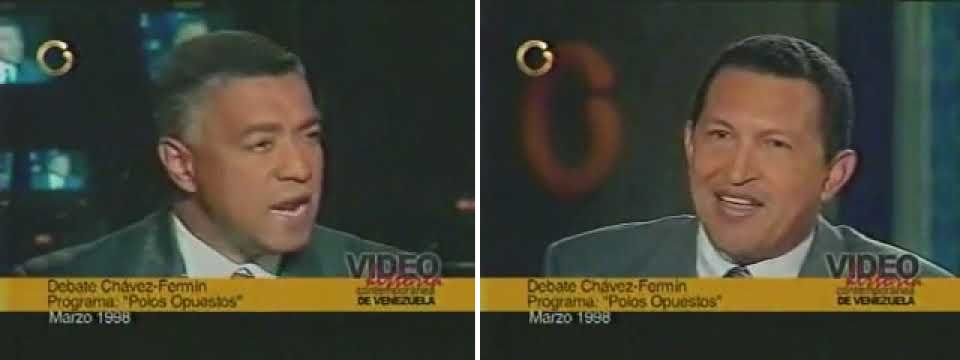
Claudio Fermín y Hugo Chávez participaron en un debate presidencial en marzo de 1998. (Cortesía)

¿Cuál es su evaluación del gobierno de Maduro?

Al presidente Maduro le tocó una época muy difícil, mucho más difícil que la del presidente Chávez en mi opinión. Fueron años de bloqueo infame, de conspiraciones terribles. Yo creo que fue un hombre muy valiente cuando eliminó el control de cambio y el control de precios, cuando propuso las zonas económicas especiales, que prácticamente eran una crítica absoluta del modelo económico chavista.

Eso es muy fácil decirlo cuando uno es de oposición. Pero tomar esas medidas desde un gobierno chavista…. Era muy difícil subsistir bajo esa tempestad, durante 14 años seguidos. Los ingresos petroleros, que llegaron a superar 50 mil millones de dólares al año, cayeron a menos de mil millones.

En los últimos años, Ud. ha intentado construir espacios de unidad en la oposición, por ejemplo en la campaña presidencial de Henri Falcón en 2018. Sin embargo, esos intentos terminaron fracturados por figuras extremistas como María Corina Machado. ¿Por qué le ha costado tanto a la oposición generar esa alternativa coherente?

Yo creo que para contestarles es útil hacer un breve recorrido histórico. Los primeros años de Chávez fueron momentos de ofertas infinitas, donde parecía que todo era posible y además había recursos. Era una política in crescendo. Chávez, además de su eléctrico carisma, verdaderamente hipnotizador, era un hombre que además cargaba una narrativa heroica.

La oposición inicial contra el gobierno de Chávez fue una oposición clasista, apostada a la confrontación. El Carmonazo [golpe de 2002], el paro petrolero, fracasaron porque fueron percibidos por el pueblo como iniciativas ajenas, puramente de una clase política. Y estaba todavía la luna de miel con Chávez. Sin embargo, en ese período se generó una conducta muy confrontacional, de parte y parte, en la política venezolana.

Llegó un momento en el que demostrar la mayor aversión, la mayor antipatía al chavismo, era estar contra el sistema y no participar. Así empezó María Corina Machado y Súmate, induciendo directa o indirectamente la abstención. Las elecciones de 2018 y las siguientes no se pueden interpretar sin esta abstención inducida, que terminó favoreciendo al chavismo. Esto sin quitarle los méritos que tenía, como la capacidad de organización y el trabajo de base.

Sin embargo, en 2015 hubo una alta participación y la oposición conquistó la mayoría en la Asamblea Nacional…

Las elecciones de 2015 fueron un momento muy particular. Es una elección importante, ya enfrentando el chavismo sin Chávez, y la oposición, que venía completamente atomizada, convergió. Me parece que tiene ciertos paralelismos con la elección de Chávez en el 98, donde había un deseo de castigar, de pasar factura, que permitió congregar a grupos dispersos.

Si hacemos un recorrido a lo largo de los años de discursos de los líderes opositores, Julio Borges, Leopoldo López, Henrique Capriles, Henri Ramos Allup, etc., se la pasaban insultándose unos a los otros. Pero en 2015 hicieron una especie de tregua y fueron inteligentes electoralmente al lanzarse con una sola tarjeta, evitando la dispersión.

Pero fue un momento de excepción. De inmediato al llegar a la Asamblea Nacional empezaron las riñas nuevamente, desde luego peleando por la presidencia del parlamento. En 2019 comenzó una nueva lucha, con la facción de Guaidó y los demás, que les llamaron “alacranes”. Guaidó terminó perdiendo la Asamblea Nacional en medio de su presidencia interina, que no era más que un vulgar intento de golpe de Estado.

Claudio Fermín actualmente dirige el partido opositor Soluciones. (Cronica Uno)

Aunque Ud. sea un político opositor, ha denunciado firmemente las sanciones de Estados Unidos contra Venezuela. ¿Nos puede hablar un poco de la realidad económica en los últimos años?

A partir de 2015, gracias a mi ex-admirado presidente Obama, se atacó a un país indefenso, donde los anaqueles estaban vacíos, los pensionados pedían limosna para sobrevivir. Era un país terriblemente golpeado por la situación económica, hundido en un interminable conflicto interno. Y la gota que faltaba eran las sanciones y el bloqueo económico.

Sin embargo, hay que mirar hacia atrás también. Hace 30-35 años, Venezuela exportaba aluminio, hierro, ganado. Había un mínimo de diversificación económica. Pero en 2015 era un pobre país monoproductor, y encima de eso nos cayó un bloqueo, que llevó al empobrecimiento total del país. Las sanciones son un atentado grave contra los derechos humanos en Venezuela. Todo pueblo tiene el derecho de comercializar libremente.

La intención era matar a Venezuela de hambre. Me acuerdo de unas declaraciones infames del ex-embajador [William] Brownfield, que decía que no importaba cuánta gente se muriera para que cayera el gobierno. No le habían podido ganar al carisma de Chávez, o a Maduro por los errores de la oposición, y buscaron la asfixia. El bloqueo ha sido un acto criminal que trajo una desinversión absoluta. El impacto en las pensiones, los salarios, los hospitales, el sistema eléctrico ha sido terrible. Y figuras como María Corina Machado o Leopoldo López pedían sanciones por la mañana y exigían aumento de salario por la tarde. A ese nivel de cinismo y demagogia llegaron.

El plan tuvo las consecuencias deseadas: vino la desinversión, aumentó el descontento, se desplomó la calidad de vida. Pero eso no tumbó al gobierno, lo tuvieron que hacer con una intervención militar el 3 de enero.

En los últimos 10 años, Venezuela solo contó con recursos gracias al comercio con países que desafiaron el bloqueo, como Rusia, China e Irán. Pero se hacía a escondidas, en alta mar, por canales paralelos, y todo eso era terreno para la corrupción. 

De igual modo, hay que señalar lo que yo llamo errores de administración. Por ejemplo, en medio de ese terrible bloqueo, ¿cómo se justifica mantener más de 30 ministerios y 6 vicepresidencias? Esos errores hay que apuntar y analizar, pero me parecen de una dimensión mucho menor que el impacto del bloqueo. No digo esto por respaldar a Maduro, sino que hay que tener sentido de las proporciones.

Venezuela cambió de una economía bloqueada antes del 3 de enero a una controlada por EEUU. ¿Cuál es su lectura al respecto?

Venezuela ha sido víctima de una infamia y de un vulgar robo. Por un lado, los países que se atrevieron a abrirle a Venezuela una compuerta para tener ingreso de divisas están ahora vetados. Estados Unidos impone una cortina de hierro y dice que solo podemos tener relaciones con ellos. El autoproclamado adalid del mundo libre prohíbe la libertad de comercio, amenazando de forma terrorista a quienes no obedezcan.

Junto con eso, en un acto de piratería, EEUU incautó varios buques petroleros venezolanos y luego llevó 40 millones de barriles que teníamos almacenados porque había un bloqueo naval que nos impedía venderlos.

El 3 de enero generó expectativas gigantes. Yo mismo admito, yo quiero que vengan las inversiones necesarias, las que se impidieron con el bloqueo. Pero no quiero que vengan a costa de nuestra soberanía. Pero en estos meses, en vez de recibir dólares, más bien se los han llevado, robado. El Financial Times hablaba de 13 mil millones en los primeros seis meses del año. También se han llevado cargamentos de oro. Los recursos se depositan en cuentas norteamericanas. Acá no ha entrado absolutamente nada.

Sumado a ese robo, tenemos todavía nuestros recursos bloqueados. Los derechos especiales de giro del FMI, cerca de cinco mil millones de dólares, también el oro secuestrado en el Banco de Inglaterra. Son recursos que mucha falta hacen, además de los que se llevan y de impedirnos relaciones con ciertos países.

Ud. también ha puesto la mirada sobre la deuda externa y los planes anunciados de reestructuración. ¿Nos puede hablar de la importancia de este tema?

Efectivamente. Se había impuesto una narrativa de que Venezuela debía 150.000 millones de dólares. Y de la noche a la mañana eso pasó a 240.000 millones. Eso es absolutamente falso. Venezuela no debe ese dinero a nadie.

Venezuela por supuesto que tiene que cumplir con sus obligaciones. El país no paga deuda externa desde 2017. Pero con el bloqueo, ¿con qué recursos lo podemos hacer? Por eso yo insisto en que esa deuda tiene que ser auditada.

La deuda tiene los bonos, pero gente que los compró baratos ahora pretende que se los paguen al precio original. Luego están las deudas a organismos multilaterales, las indemnizaciones por arbitraje, las deudas comerciales, etc. Todo eso tiene que ser auditado, por firmas profesionales, y tiene que haber un comité de reestructuración de la deuda integrado por venezolanos. 

Pareciera que en Venezuela no sabemos sumar y tiene que ser Marco Rubio quien designa a la compañía encargada de la reestructuración, Centerview Partners. Esta empresa cobra 50.000 dólares mensuales más 0,1% de la deuda. En otras palabras: zamuro cuidando carne. Es de su interés que el monto sea lo más alto posible, un robo a mano armada a la luz del día.

El dirigente ha llamado a la unidad nacional para defender la soberanía venezolana. (EFE)

Volvamos al 3 de enero, que es un punto de quiebre en la historia reciente venezolana. ¿Cómo evalúa Ud ese ataque y todo lo que se le siguió?

El robo que describía es consecuencia del 3 de enero, cuando un ejército extranjero bombardeó nuestro país. Fue un acto de agresión imperdonable por parte de Estados Unidos.

Secuestraron al presidente después de inventar una campaña que era el jefe del Cartel de los Soles. Ahora tenemos meses con la CIA, el Comando Sur metidos acá, y no han investigado a un solo militar por narcotráfico. ¿Dónde está el Cartel de los Soles? Es una mentira monumental, como las armas de destrucción masiva de Irak.

Lo que estamos viviendo es una vulgar recolonización, por la fuerza. Por la fuerza se llevan millones de barriles de petróleo, por la fuerza obligaron a modificar la Ley de Hidrocarburos y la Ley de Minas. Con la excusa teórica de hacer el sector atractivo para las inversiones y darles seguridad, lo que se hizo fue vaciar al Estado venezolano. Lo dejan sin fuerza, reduciendo a su mínima expresión las regalías e impuestos.

Tenemos un Estado venezolano que hoy es monoproductor. ¿Qué ingresos va a tener si su principal industria, además de la minería, no puede cobrar nada? Es más, si se viene una reestructuración de esa deuda que es un abuso, ¿cómo se va a pagar? Es un acto monstruoso lo que se está haciendo con los recursos venezolanos.

Pero lo que no faltan son personajes entreguistas, desde “activistas” que le escriben cartas al encargado de negocios estadounidense, pidiéndole insumos para el hospital tal, o falsos sindicalistas que le solicitan el aumento del salario. Me parece indigno y humillante. Incluso María Corina Machado, que le regaló su Premio Nobel a Trump y luego no logra que le preste atención.

El 3 de enero, y todo lo que se siguió, no fue un ataque contra el Chavismo. Fue una operación para apropiarse de los recursos venezolanos. Sobre eso hay que crear conciencia. Y Trump no va a estar ahí toda la vida. Me duele la ingenuidad de ciertos interlocutores que piensan que Trump está salvando al país. Venezuela vive la hora de la infamia, de confusión, de incertidumbre y de vergüenza. Si ni siquiera frente a una agresión tan grave como la que estamos teniendo somos capaces de unirnos…

Venezuela indudablemente ha sido el gran triunfo, quizás el único, de la política exterior de Trump. ¿Cuál es su opinión sobre la postura de Trump sobre Venezuela y las relaciones actuales entre Caracas y Washington?

Desde luego hay que decir que este ensayo de diálogo es una burla al país. Trump y Rubio se sacaron del bolsillo, como quien saca algo que se le olvidó, a esta Asamblea Nacional cuyo período se venció en 2020. Y impusieron que esa Asamblea dialogara con la actual. Tenemos entonces dos asambleas de “yes men” siguiendo las directivas de la Casa Blanca. Y es el señor Rubio quien anuncia lo que va a pasar en el país con su plan de tres fases.

Trump se burla de nosotros diciendo que la gente está bailando en las calles y ofreciéndonos ser el Estado 51. Una tremenda falta de respeto, sin que nadie alce la voz en contra. Venezuela tiene que tener una estrategia para denunciar al mundo lo que está ocurriendo, esta colonización imperialista basada en amenazas terroristas.

Venezuela ha perdido su soberanía, y eso es muy grave. Es doloroso, pero un hecho incontestable. Venezuela tiene todo el interés en tener buenas relaciones con Estados Unidos, como ha pasado durante casi toda nuestra historia, pero no podemos aceptar estas condiciones. Queremos las inversiones y comercializar con todo el mundo, pero no perdiendo la soberanía como nación. La renuncia a la soberanía no es una condición necesaria.

¿Hecho el diagnóstico, cuál es entonces, desde su posición, el camino a seguir para enfrentar la situación actual?

En los últimos 28 años me han llamado moderado, ambiguo, nini, por defender mis puntos de vista. Pero yo simplemente no estoy de acuerdo con las posiciones fanatizadas de los extremismos y denuncio lo que está ocurriendo en mi país hoy.

Desde que empecé, a partir del 3 de enero, a levantar mi voz sobre la gravedad de esta situación, casi nunca me volvieron a invitar para una entrevista. Hay un grave silencio y aquí estamos hablando del interés nacional. Sea usted chavista o adeco, empresario o buhonero, el interés nacional nos convoca a todos. Si una nación no es capaz de ponerse de acuerdo ni para defender su soberanía, se acabó. Es una cuestión existencial, no de quien quiere ejecutar las órdenes de Trump.

No tengo una receta, pero tenemos que reaccionar. Vamos a sentarnos a discutir, a buscar puntos en común. Pero empezando por admitir que tenemos un problema. Claro que hay que sentarse con el gobierno de Trump. Pero con un mínimo de dignidad, no con este tono de entreguismo, como si aquí no hubiera pasado nada.

Yo no invito a que enfrentemos a nadie. Tenemos que tener conciencia de nuestras debilidades también. Pero llamo a que defendamos lo nuestro. Vamos a construir una agenda, un plan de recuperación de la soberanía, para explicarle a Estados Unidos que, aún estando dispuestos a tener buenas relaciones y recibir las inversiones, somos un país independiente y vamos a luchar por eso.

Source link

Claudio Fermín: ‘We Must Forge a Consciousness Against the Recolonization of Venezuela’

Claudio Fermín. (Venezuelanalysis)

Claudio Fermín is a university professor and veteran political leader in Venezuela. Cutting his political teeth with Acción Democrática (AD) party, he became Caracas’s first elected mayor (1990-93). He went on to become a member of the 1999 Constituent Assembly as well as a perennial presidential candidate. Within the Venezuelan opposition, he has been known for his commitment to dialogue and opposing US sanctions.

In this exclusive interview, Fermín reflects on his role in the Venezuelan opposition, the consequences of the blockade against the Caribbean nation, the US “theft” of natural resources following the January 3 attack, and the challenge of recovering sovereignty.

Going back more than two decades, what was your relationship with former President Hugo Chávez like?

Chávez had a sharp tongue that spared no one. Yet whenever he referred to me, he always did so with respect and affection. I am grateful for his generosity.

In the early years, Chavismo was not just a vast popular movement but almost a religion. Since President Chávez spoke of me with such consideration, I think that filtered down to the base as well, and grassroots Chavistas have always been very warm toward me. I have never stopped going anywhere in my life, not even to the Esquina Caliente [a Chavista spot in downtown Caracas’ Plaza Bolívar]. Chavistas or Adecos [AD supporters], I greet them all the same. I have been fortunate in that regard.

My relationship with Chávez was always one of respect and consideration. As a conciliator, what people call a moderate, someone who doesn’t get carried away by extremes, I have always demanded respect for President Chávez and have always acknowledged the positive things his government did. Sometimes journalists are surprised and ask me for an example. I talk about Misión Vivienda [the public housing program], about the people who live much better there than in the shack where they used to live. And that is just one example; I could give you 30 more Chavista achievements that I defend, just as I could give you as many things I object to.

Chavismo knows that my criticisms are honest and sincere. We have had a good relationship. I deeply regret that it is, in my view, a very closed-off movement. Beyond its record in government, from a political standpoint my criticism would be its lack of self-criticism.

Claudio Fermín and Hugo Chávez took part in a presidential debate in March 1998. (Archive)

What is your assessment of the Maduro government?

President Maduro faced a very difficult period, much more difficult than President Chávez’s, in my opinion. These were years of an infamous [US] blockade and terrible conspiracies. I think he was very brave when he lifted currency and price controls, and when he proposed the special economic zones, which practically amounted to a wholesale critique of the Chavista economic model.

That is very easy to propose when you are in the opposition. But to take those measures from within a Chavista government… It was very hard to survive that storm for 14 straight years. Oil revenues, which had topped $50 billion a year, fell to less than $1 billion.

In recent years you have tried to build spaces for unity within the opposition, for example in Henri Falcón’s 2018 presidential campaign. However, those attempts ended up fractured by extremist figures such as María Corina Machado. Why has it been so hard for the opposition to build a coherent alternative?

To answer that, I think a brief look back at history is useful. Chávez’s early years were a time of endless promises, when everything seemed possible and there was money to back it up. Everything was in crescendo. Chávez, besides his electric, truly mesmerizing charisma, was also a man who carried a heroic narrative.

The initial opposition to the Chávez government was class-based and bent on confrontation. The Carmonazo [the 2002 coup] and the oil lockout failed because the people saw them as alien initiatives, the exclusive project of a political class. And the honeymoon with Chávez was still ongoing. However, that period gave rise to very confrontational behavior on both sides of Venezuelan politics.

There came a point when showing the greatest aversion, the greatest hostility toward Chavismo, meant being against the system and not participating. That is how María Corina Machado and her [US-funded] NGO Súmate got started, directly or indirectly encouraging abstention. The 2018 elections and those that followed cannot be understood without this induced abstention, which ended up benefiting Chavismo. That is not to take away from Chavismo’s own strengths, such as its organizational capacity and grassroots work.

However, in 2015 there was high turnout and the opposition won a majority in the National Assembly…

The 2015 elections were a very particular moment. It was an important election, now facing Chavismo without Chávez, and the opposition, which had been completely fragmented, came together. I think it has certain parallels with Chávez’s election in 1998, when there was a desire to punish, to make someone pay, which made it possible to bring scattered groups together.

If we look back over the years at the speeches of opposition leaders, Julio Borges, Leopoldo López, Henrique Capriles, Henry Ramos Allup and so on, they spent their time insulting one another. But in 2015 they called a sort of truce and were electorally smart in running on a single ticket, avoiding fragmentation.

But it was an exceptional moment. As soon as they reached the National Assembly the squabbling started again, for instance over who would hold the presidency of the parliament. In 2019 a new fight broke out between Guaidó’s faction and the others, whom they called “alacranes” [scorpions]. Guaidó ended up losing the National Assembly in the middle of his “interim presidency,” which was nothing more than a crude coup attempt.

Claudio Fermín presently heads the opposition party Soluciones. (Cronica Uno)

Although you are an opposition politician, you have firmly denounced US sanctions against Venezuela. Can you tell us a bit about the economic reality of recent years?

Starting in 2015, thanks to President Obama – whom I once admired – a defenseless country was attacked, a country where store shelves were empty and pensioners were begging to survive. It was a country terribly battered by the economic situation, mired in an endless internal conflict. And the last thing it needed was sanctions and an economic blockade.

However, we also have to look further back. Thirty to thirty-five years ago, Venezuela exported aluminum, iron, and cattle. There was at least a minimum of economic diversification. But by 2015 it was a poor, single-product economy, and on top of that a blockade fell on us, which led to the country’s total impoverishment. Sanctions are a serious attack on human rights in Venezuela. Every nation has the right to trade freely.

The intention was to starve Venezuela. I remember some despicable statements by former US Ambassador [William] Brownfield, who said it didn’t matter how many people died as long as the government fell. They had not been able to beat Chávez’s charisma, or Maduro, because of the opposition’s mistakes, so they tried to strangle the country. The blockade has been a criminal act that brought about a total collapse in investment. The impact on pensions, wages, hospitals, and the electrical grid has been terrible. And figures like María Corina Machado or Leopoldo López called for sanctions in the morning and demanded wage increases in the afternoon. That is the level of cynicism and demagoguery they reached.

The plan had the desired consequences: investment dried up, discontent grew, and the quality of life collapsed. But that did not bring down the government; the US had to do it with a military intervention on January 3.

Over the last 10 years, Venezuela only had resources thanks to trade with countries that defied the blockade, such as Russia, China, and Iran. But it was done covertly, on the high seas, through parallel channels, and all of that was fertile ground for corruption.

By the same token, we have to point out what I call administrative mistakes. For example, in the midst of that terrible blockade, how can you justify keeping more than 30 ministries and 6 vice presidencies? Those mistakes have to be pointed out and analyzed, but to me they are of a much smaller magnitude than the impact of the blockade. I am not saying this to back Maduro; one simply has to keep a sense of proportion.

Venezuela went from a blockaded economy before January 3 to one controlled by the US. What is your reading of the present context?

Venezuela has been the victim of an outrageous and barefaced theft. On the one hand, the countries that dared to open a door for Venezuela to bring in foreign currency are now off limits. The United States imposes an iron curtain and says we can only have relations with it. The self-proclaimed champion of the free world prohibits free trade, using terrorist threats against those who do not obey.

On top of that, in an act of piracy, the US seized several Venezuelan oil tankers and then took 40 million barrels that we had in storage because a naval blockade was preventing us from selling crude.

January 3 raised enormous expectations. I admit it myself: I welcome much-needed investment, the investment the blockade kept out. But I don’t want it to come at the expense of our sovereignty. Yet in these months, instead of bringing dollars in, they [the US] have taken them out, stolen them. The Financial Times reported $13 billion in the first six months of the year. They have also taken shipments of gold. The money is deposited in US accounts. Absolutely nothing has been returned.

On top of that theft, our resources are still frozen: the IMF special drawing rights, close to $5 billion, as well as the gold held hostage at the Bank of England. These are resources we badly need, in addition to what the US is taking and to its barring us from relations with certain countries.

You have also focused on the foreign debt and the announced restructuring plans. Can you tell us why this issue matters?

Indeed. A narrative had taken hold that Venezuela owed $150 billion. And overnight that became $240 billion. That is absolutely false. Venezuela does not owe that money to anyone.

Of course Venezuela has to meet its obligations. The country has not paid its foreign debt since 2017. But with the blockade, with what resources were we supposed to pay it? That is why I insist that this debt must be audited.

The debt includes bonds, but people who bought them on the cheap now expect to be paid at face value. Then there are the debts to multilateral organizations, arbitration awards, commercial debts, and so on. All of that has to be audited by professional firms, and there has to be a debt restructuring committee made up of Venezuelans.

It seems that in Venezuela we can’t do arithmetic, and it has to be Marco Rubio who appoints the firm in charge of the restructuring: Centerview Partners. This firm charges $50,000 a month plus 0.1% of the debt. In other words, the fox is guarding the henhouse. It is in its interest for the amount to be as high as possible. It is armed robbery in broad daylight.

The opposition politician called for national unity to defend Venezuelan sovereignty. (EFE)

Let’s return to January 3, a turning point in Venezuela’s recent history. How do you assess that attack and everything that followed?

The theft I was describing is a consequence of January 3, when a foreign army bombed our country. It was an unforgivable act of aggression by the United States.

They kidnapped the president after fabricating a campaign claiming he was the head of the Cartel de los Soles. Now the CIA and Southern Command have been here for months, and they haven’t investigated a single military officer for drug trafficking. Where is the Cartel de los Soles? It is a monumental lie, like Iraq’s weapons of mass destruction.

What we are experiencing is a crude recolonization, by force. By force the US is taking millions of barrels of oil; by force they imposed changes to the Hydrocarbons Law and the Mining Law. Under the supposed pretext of making the sector attractive to investors and giving them security, what was actually done was to hollow out the Venezuelan state. They leave it powerless, reducing royalties and taxes to a bare minimum.

Today we have a Venezuelan state that depends on a single product. What revenue will it have if it can’t collect anything from its main industry, or from mining? What’s more, if a restructuring of this abusive debt goes ahead, how is it going to be paid? What is being done with Venezuela’s resources is monstrous.

But there is no shortage of people eager to hand the country over, from “activists” who write letters to the US chargé d’affaires asking for supplies for this or that hospital, to fake trade unionists who ask him for wage increases. I find it undignified and humiliating. Even María Corina Machado gave her Nobel Prize to Trump and still can’t get him to give her the time of day.

January 3, and everything that followed, was not an attack on Chavismo. It was an operation to seize Venezuela’s resources. We have to create consciousness against that. And Trump is not going to be there forever. It pains me to see the naivety of certain voices who think Trump is saving the country. Venezuela is living through an hour of infamy, confusion, uncertainty and shame. If we can’t unite even in the face of an aggression as serious as the one we are suffering…

Venezuela has undoubtedly been the great triumph, perhaps the only one, of Trump’s foreign policy. What is your view of Trump’s stance on Venezuela and of current relations between Caracas and Washington?

First of all, it must be said that this so-called dialogue is a mockery of the country. Trump and Rubio pulled out of their pocket, like someone finding something they had forgotten, this National Assembly whose term expired in 2020. And they forced that [defunct] parliament into talks with the current one. So we have two parliaments of “yes men” following the White House’s directives. And it is Mr. Rubio who announces what is going to happen in the country with his three-phase plan.

Trump mocks us, saying people are dancing in the streets and offering to make us the 51st state. A tremendous disrespect, and nobody raises their voice against it. Venezuela needs a strategy to denounce to the world what is happening, this imperialist colonization based on terrorist threats.

Venezuela has lost its sovereignty, and that is very serious. It is painful, but it is an undeniable fact. Venezuela has every interest in having good relations with the United States, as it has had for almost all of our history, but we cannot accept these conditions. We want investment and to trade with the whole world, but not at the cost of losing our sovereignty as a nation. Giving up sovereignty is not a necessary condition.

Having made that diagnosis, what, from your standpoint, is the way forward?

For the last 28 years I have been called a moderate, ambiguous, a “nini” [neither-nor], for defending my views. But I simply don’t agree with the fanatical positions of the extremes, and I denounce what is happening in my country today.

Ever since I started raising my voice about the seriousness of this situation, from January 3 onward, I have hardly ever been invited for an interview. There is a grave silence, and we are talking about the national interest here. Whether you are a Chavista or an Adeco, a businessperson or a street vendor, the national interest calls on all of us. If a nation cannot agree even to defend its sovereignty, it is finished. This is an existential question, not a matter of who wants to carry out Trump’s orders.

I don’t have a recipe, but we have to react. Let’s sit down and talk, look for common ground. But let’s start by admitting that we have a problem. Of course we have to sit down with the Trump administration. But with a minimum of dignity, not with this tone of capitulation, as if nothing had happened here.

I am not calling on us to confront anyone. We also have to be aware of our weaknesses. But I am calling on us to defend what is ours. Let’s build an agenda, a plan to recover our sovereignty, to explain to the United States that, while we are willing to have good relations and receive investment, we are an independent country and we will fight for that.

Source link