Fred Claire, ex-GM whose Dodger team won ’88 World Series, has died
Fred Claire was an unorthodox choice for general manager, a former sportswriter and public relations man who didn’t play baseball beyond the junior varsity level in high school, and his 1987 promotion to head the Dodgers’ front office was met with skepticism around the game.
A year and a half later, after his shrewd moves helped turn the Dodgers into World Series champions in 1988, Claire was named Major League Baseball’s executive of the year by the Sporting News.
Claire, who spent 30 years in the Dodgers’ front office, died Monday on his 91st birthday. The news was shared on social media by former Dodger broadcaster Ross Porter.
An avid runner and golfer fit and trim enough to pass for a man a decade younger, the silver-haired Claire was diagnosed with squamous cell carcinoma in 2015 when what looked like a harmless spot on his lip turned out to be cancerous.
The growth was surgically removed, but the cancer returned in August 2016, and spread into the left side of his face. Claire underwent radiation and chemotherapy treatments to kill the malignant cells in his body, but the cancer returned again in 2017.
An immunotherapy clinical trial saved his life, according to a story in Pasadenanow.com, but then an infection forced him to undergo even more extensive facial reconstruction surgery at City of Hope in Duarte, replacing his jawbone with a bone from his leg.
Claire was so impressed with his treatment at City of Hope that he teamed with author Tim Madigan in 2021 to publish a book chronicling his career and capturing the hospital’s history as well the stories of patients and doctors. The book, “Extra Innings,” can be purchased at Amazon, with all net proceeds donated to City of Hope.
“The main thing that I liked and appreciated about the book was people buying it because of their interest in baseball,” Claire told the Desert Sun in 2021, “then to discover what a great place [City of Hope] is after reading it.”
Claire was also active in helping fund research — he and his wife, Sheryl, set up a scholarship fund with the USC Keck School of Medicine for research in head and neck cancer.
Claire was born Oct. 5, 1935, in Jamestown, Ohio. His parents moved the family — Claire had a brother and a sister — to Torrance when Claire was a teenager. After graduating from Torrance High, Claire earned a degree in journalism from San José State in 1957 before taking his first newspaper job.
“I graduated on a Sunday afternoon,” Claire told The Times in 1997, “and by Monday morning, I had a job at the Whittier Daily News.”

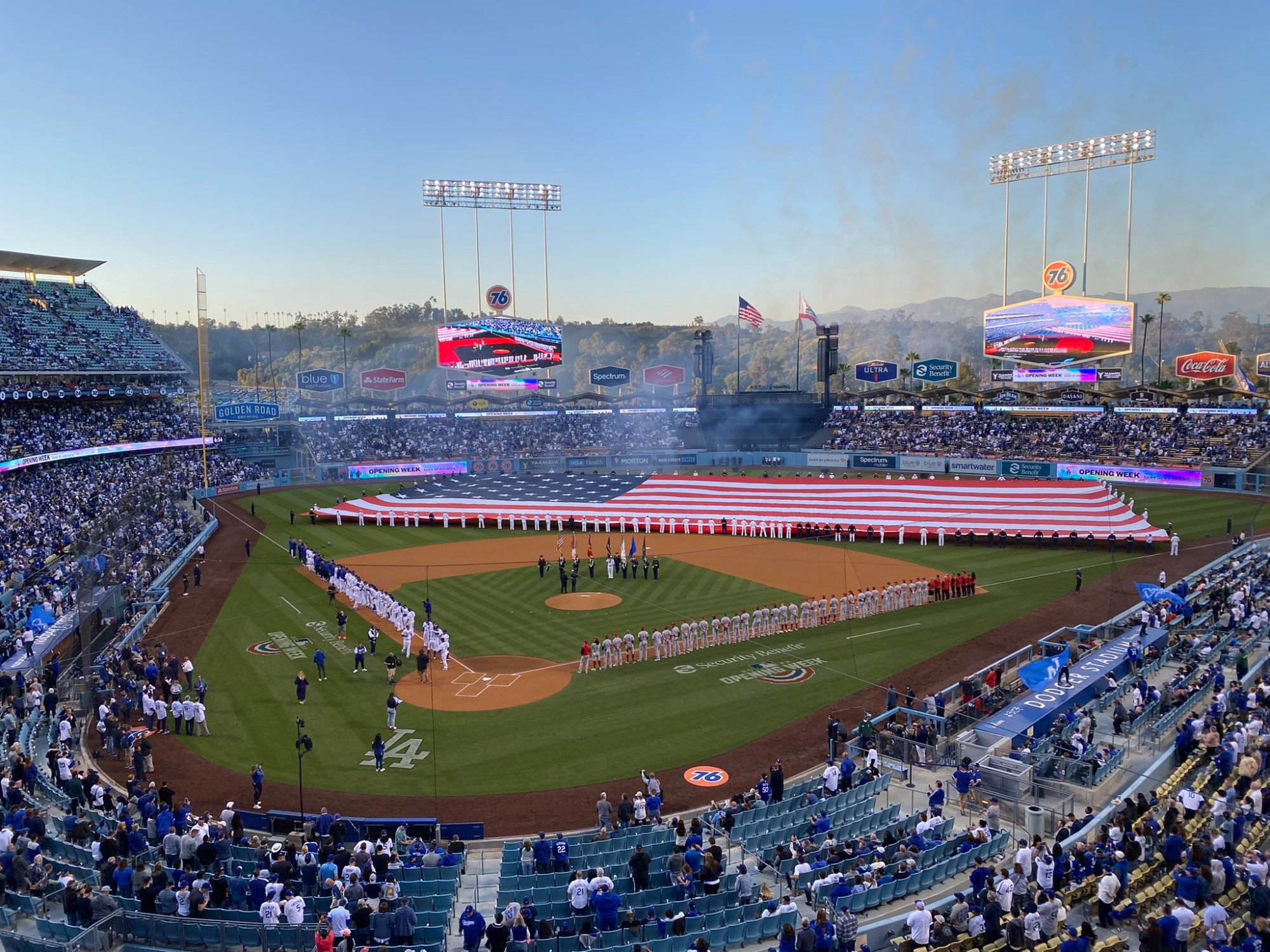
For 30 years, Dodger Stadium was Fred Claire’s home. “Honestly, in my heart and soul, it was a thrill and honor to have the opportunity to walk into Dodger Stadium every day and go to work,” Claire told the Times in 2017.
(Jack Harris / Los Angeles Times)
Claire spent 11 years as a sportswriter and was covering the Dodgers for the Long Beach Press-Telegram in the spring of 1969 when a position opened in the team’s public relations department.
Claire, who always longed to be involved in baseball, expressed interest in the job and was hired as a public relations assistant, remaining in the position until 1975, when he was promoted to vice president of public relations.
He was instrumental in creating the branding that came to be known as “Dodger Blue” and was directing the team’s marketing efforts when the Dodgers passed the 3-million mark in attendance for the first time. He also hired Ross Porter, a Dodgers broadcaster from 1977 to 2004.
In April 1987, then-Dodgers general manager Al Campanis was fired after making controversial and what many said were racist remarks about Black Americans on “Nightline,” during which he told the show’s host, Ted Koppel, that Black people may lack “some of the necessities” to be the field manager or GM of a major league baseball team.
Claire was then-Dodgers President Peter O’Malley’s surprise choice to replace Campanis, and his hiring raised the eyebrows of his new peers, who saw Claire as an outsider with no background as a player, coach, manager or scout.
“I knew some people might say, what does this guy know about baseball, he covered it from behind a typewriter?” O’Malley said in 2017. “But I knew Fred could do it. And he did it. He deserves a lot of credit for stepping in quickly, without advance notice, and doing a great job.”
The Dodgers suffered their second straight losing season in 1987, but Claire made several off-season moves — acquiring outfielders Kirk Gibson and Mike Davis, shortstop Alfredo Griffin and pitchers Jay Howell and Jesse Orosco — that fortified the club.
The Dodgers, led by National League Cy Young Award-winning pitcher Orel Hershiser and most valuable player Gibson, won the National League West in 1988 and upset the 100-win New York Mets in the NL championship series.
The gimpy Gibson hit his memorable pinch-hit, walk-off homer off Oakland closer Dennis Eckersley in Game 1 of the World Series to push the Dodgers toward their fifth championship since moving from Brooklyn to Los Angeles in 1958.

Kirk Gibson reacts to his game-winning two-run homer in Game 1 of the 1988 World Series.
(John Swart / Associated Press)
Claire dealt a smallish and seemingly fragile pitcher named Pedro Martínez to Montreal for second baseman Delino DeShields in what turned out to be one of the game’s most-lopsided trades. DeShields hit .241 in three years in Los Angeles, while Martinez went on to have a dominant 17-year career that earned him a 2015 Hall of Fame induction.
But during Claire’s 11-year tenure as GM, the Dodgers won a World Series, two division titles, a wild-card berth and a first-place finish in the strike-shortened 1994 season.
Claire also changed the culture in the front office, hiring an analytics expert, holding regular conference calls with coaches and scouts and canvassing the clubhouse to talk with players about everything from their families to their on-field performance.
“Fred gave us that first edge of being progressive and aggressive,” Hershiser told the Times in 2017. Added former Dodgers utility man Mickey Hatcher: “Fred Claire was amazing. For a guy who was suddenly put into the limelight, he asked all the right questions, listened to everyone and believed in all of us.”
Claire was fired along with then-Manager Bill Russell on June 21, 1998, five weeks after executives from Fox News Corp., which purchased the Dodgers earlier that year, engineered a blockbuster trade — deflating to many fans — of All-Star catcher Mike Piazza to the Florida Marlins without Claire’s involvement.
Claire, a man of “integrity and dignity,” as former Times baseball columnist Ross Newhan wrote, walked away with no harsh words or public regrets.
“Honestly, in my heart and soul, it was a thrill and honor to have the opportunity to walk into Dodger Stadium every day and go to work,” Claire told the Times in 2017. “This is truly enough for me.”
After his departure from the Dodgers, Claire worked as a columnist and analyst for MLB.com, a radio show host, an instructor at USC and a consultant to companies involved with sports. He co-authored an autobiography, released in 2004, titled “Fred Claire: My 30 Years in Dodger Blue.”
His response during an interview with Business Renaissance Quarterly in 2007 shed some light on Claire’s philosophy. The question: What do you want to be remembered for?
“I was once in the presence of the late Dodgers owner Walter O’Malley when he was asked this question by a reporter from United Press International,” Claire said. “Mr. O’Malley spun his ever-present cigar, paused for just a second and replied, ‘I want to be remembered for planting a tree.’
“Walter O’Malley’s answer, in my mind, overshadowed the great question. He wanted to be remembered for helping things grow, and in my mind, that meant his family, his friendships, the good causes he was involved in.
“I have seldom planted a tree, but I would proudly borrow Mr. O’Malley’s answer to this question.”
Claire is survived by his wife, Sheryl, and their three children, Jen, Jeff and Kim.


