civil right

MAGA can’t stop pretending it cares about kids

The latest nauseant from MAGA types pretending to care about children was dished up last week, but amid the internment of kindergartners, the slashing of funds to catch child predators and a measles outbreak at a detention center, you are forgiven for missing it.

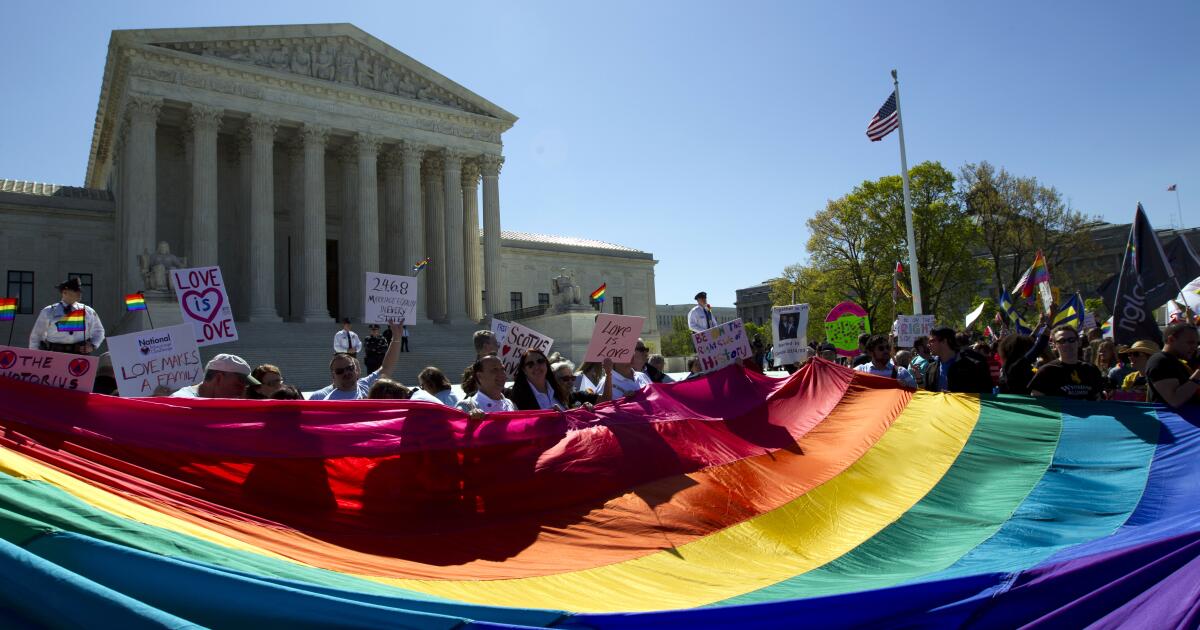
I am talking about a coordinated campaign launched by the religious right to overturn gay marriage, arguing it harms children. The effort is a direct attack on the Supreme Court’s 2015 Obergefell vs. Hodges decision making same-sex marriage a fundamental right of equality under the 14th Amendment, but also seeks to engage churches on the issue and change public opinion.

Good luck with that last part. Most Americans support marriage equality. But the Supreme Court? That’s much iffier these days.

But what disturbs me the most, while we wait for litigation, is that the campaign is yet another disingenuous ploy by MAGA to use children as an excuse for attacking civil rights, and attempting, Christian nationalist-style, to impose religious values on general society.

MAGA frames so much hate — especially around immigrants and diversity — as protection of children, and through decades’ worth of conspiracy theory has attempted to paint LGBTQ+ parents as deviant and predatory. (QAnon, for example, was all about saving kids from gay and Democratic predators.)

In reality, it’s the MAGA folks who are traumatizing children.

“Our children are afraid. They’re terrorized,” Chauntyll Allen told me. She’s the St. Paul, Minn., school board member who was arrested recently for her part in the church protest of a pastor who is also an ICE official.

“And we’re not just talking about immigrants,” she continued. All kids “are watching this, they’re experiencing this, and they’re carrying the terror in their body. What is this going to do for our society in 20 years?”

This campaign to undo marriage equality, far from protecting kids, is just another injury inflicted on them for political gain. It features two California cases that are meant to show how terrible any form of same-sex parenting is, but mischaracterizes the facts for maximum outrage.

The campaign also specifically targets in vitro fertilization and surrogacy as dangerous gateways to promoting LGBTQ+ families, an increasingly common position in far-right religious circles that would like to see more white women having babies through sex with white husbands.

Attacking marriage equality isn’t about protecting children any more than deporting immigrants is about stopping crime. Allowing it to be framed that way actually puts in danger the stability of the approximately 300,000 kids nationwide who are being raised by about 832,000 couples in same-sex marriages.

It endangers the physical and mental health of LGBTQ+ kids in any family who are growing up in a world that is increasingly hostile to them — with gender and identity hate crimes on the rise.

And it endangers everyone who values a free and fair democracy that separates church and state by eroding the rights of the vulnerable as precedent for eroding the rights of whomever ticks them off next. If LGBTQ+ marriages aren’t legally protected, how long before racists come for the Loving decision, which legalized interracial marriage?

If you doubt the MAGA agenda extends that far, when Second Lady Usha Vance recently announced her fourth pregnancy, one lovely fellow on social media wrote, “There is nothing exciting about this. We will never vote for your race traitor husband.”

Hate is a virus that spreads how it pleases.

Those behind the effort to undo marriage equality say that by legalizing the ability for LGBTQ+ folks to tie the knot, America put “adult desires” ahead of children’s well-being, which is dependent on being raised in a home that includes a married man and woman.

Never mind the millions of kids being raised by single parents, grandparents (looking at you, JD Vance) or other guardians who aren’t the biological John-and-Jane mommy and daddy of conservative lore. Never mind the many same-sex marriages that don’t include kids.

“Americans need to understand the threat that gay marriage poses to children and that natural marriage is directly connected to children protection,” Katy Faust, the leader of the campaign, said in an interview with a Christian news website.

Of course, the campaign also makes no mention of the hundreds of children currently held in detention camps around the country — on some days, the number of children locked up just by ICE (not Border Patrol or in the care of other agencies) has skyrocketed to 400 under Trump, according to the Marshall Project.

Outside of lockup, Black and brown children are being traumatized daily by the fear that they or their parents will be taken or even killed by federal agents. Thousands of kids across the country, including in California, have stopped going to school and other public places for fear of endangering themselves or their families. Don’t expect to see these folks campaigning to protect those kids.

The campaign also ignores the fact that U.S. Department of Justice funding to combat sex crimes against children was just slashed, leaving victims and prosecutors without crucial resources to fight that real and undoubtedly harmful exploitation of our youth by sex traffickers.

And Epstein. I cannot even start on save-the-children folks who seemingly ignore the victims of the sex crimes detailed in those files — many of them children at the time — while wringing their hands over families who don’t look like their own. It is a mind-blowing amount of hypocrisy.

But of course, none of this is about saving children — yours, mine or anyone’s.

But framing it around protecting children is a powerful manipulation — a last-ditch effort as same sex marriage does in fact become more accepted. Because who doesn’t want to save our kids? From whatever.

Don’t be surprised if this effort gains traction in coming months. As we head into elections, the MAGA machine will attempt to turn the lens away from immigration and back to old-school issues such as feminism, abortion and same-sex marriage, which time and again its base has been willing to vote on regardless of what else is happening.

Because they actually don’t care about kids. They care about power, and they’re perfectly willing to exploit kids to get it.
Source link

A California lawyer returns home to Minneapolis to fight for civil rights

How do you find the missing?

If you do find them, how can you help?

Oakland civil rights attorney James Cook has been on the ground in Minnesota for months figuring out answers to these question as he goes.

A fast-talking Minneapolis native who still lives in the Twin Cities part time, Cook is one of a handful of attorneys who have dropped everything to aid (for free) those caught up in the federal crackdown — protesters, immigrants and detained citizens — too many of whom have found themselves facing deportation, arrest or even been disappeared, at least for a time.

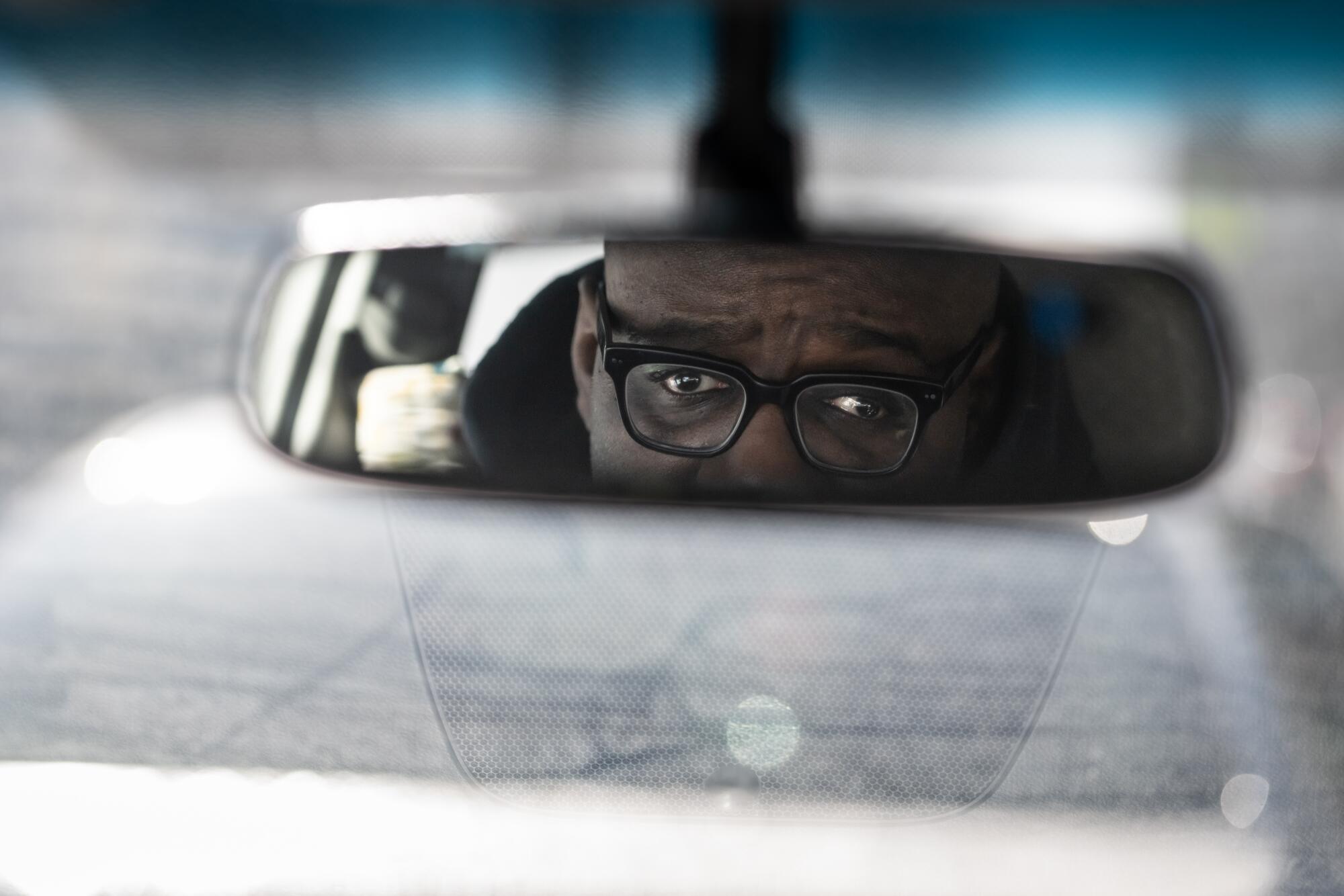
Civil rights attorney James  Cook in the rear view mirror as he makes phone calls in his car in Minneapolis.

Civil rights attorney James Cook in the rear view mirror as he makes phone calls in his car in Minneapolis.

(Caroline Yang/For The Times)

“They are leaders that are on the ground really helping people through this process,” Minnesota school board member Chauntyll Allen told me.

She’s one of the protesters arrested inside a local church, charged with conspiracy to deprive others of their constitutional rights by Pam Bondi’s politicized Department of Justice, which also Friday arrested journalist Don Lemon for the same incident. Cook is one of the lawyers now representing Allen.

“It shows us that the judicial arm, or some of the judicial arm of our democracy, is willing to step up and ensure that our democracy stands strong,” Allen said of Cook and others like him.

While it’s the images of clashes in the streets that captivate media and audiences, it’s lawyers like Cook who are fighting an existential battle in the background to preserve the rule of law in a place where it is increasing opaque, to put it gently.

The legal work behind detentions has largely been an overlooked battlefield that will likely rage on years after ICE departs the streets, leaving in its wake hundreds if not thousands of long-and-winding court cases.

Beyond the personal fates they will determine, the outcome of the civil litigation Cook and others are spearheading will likely force whatever transparency and accountability can be pulled from these chaotic and troubling times.

It’s time-consuming and complicated work vital not just to people, but history.

Or, as Cook puts it, “I’ll be 10 years older when all this s— resolves.”

Federal agents stand guard against a growing wall of protesters on Jan. 24 in Minneapolis.

Federal agents stand guard against a growing wall of protesters on Jan. 24 in Minneapolis, just hours after Alex Pretti was shot by federal agents.

(Caroline Yang/For The Times)

Cook told me this while on his way to the Bishop Henry Whipple Federal Building where some detainees are being held, maybe. It’s hard to find out. A few years ago, when immigration enforcement in Minnesota ramped up under the first Trump term, activists tried to get the name of the building changed, arguing Whipple, the first Protestant Episcopal bishop in the state, had been an advocate of the marginalized and wouldn’t want his name associated with what the feds were up to.

It didn’t work, but the movement’s slogan, “What would Whipple do?” still has resonance in this town, where two American citizens, Alex Pretti and Renee Good, have been fatally shot while protesting — incidents ugly enough that Bruce Springsteen wrote a song about them.

Cook is well aware that the guns carried by the federal agents are not for show, even without the Boss’ new ballad. Just a few days ago, one of the first times he drove his beat-up truck up to the gate, the federal guards at Whipple pointed their guns at him.

“I’m like, ‘Hey, I’m going to take my keys out of the ignition, drop them on the ground. So please don’t shoot,’” he said.

They lowered the guns, but Cook was scared, a feeling that doesn’t come easy.

Long before his law degree, when he was a punk-rock loving teen in the 1980s, fresh out of Southwest High, the public school not too far from Whipple, a former coach convinced him to give up college dreams and instead pursue a shot at making the first Muay Thai kickboxing team at the Olympics.

The martial art ended up not making it as an official Olympic sport, but the experience launched Cook into a professional boxing and kickboxing career that took him to competitions around the world, and taught him fear is not a reason to back down.

But, “Father Time is undefeated,” Cook said. “I got older and I started losing fights, and I was like, all right, time to get back to life.”

That eventually led him to obtaining a law degree in San Francisco, where after an intern stint as a public defender, he decided he wanted to be a trial attorney, fighting in court.

Civil rights attorney James Cook steps into his car to warm up and make phone calls in Minneapolis.

Civil rights attorney James Cook has been doing pro bono immigration work since the crackdown began in Minneapolis.

(Caroline Yang/For The Times)

He started cold-calling John Burris, another Bay Area lawyer who is an icon of civil rights and police misconduct cases. Burris, who has been called the “Godfather of Police Litigation,” was involved in the “Oakland Riders” case in 2000, when officers were discovered to have planted evidence. He also represented Rodney King, the family of Oscar Grant, and the family of Joseph Mann among many others.

But Burris, a boxing fan, didn’t respond to Cook’s calls until the young lawyer offered him free tickets to one of his fights, which he was still doing on the side.

“And then immediately I got a call back,” Cook said.

Burris said Cook’s history as a fighter intrigued him, but “I did say to James, you can’t be a fighter and lawyer. You can’t get punched in your head all the time.”

Cook did not take this advice.

Still, Burris said, “It was his persistence that I admired, because the type of work we’re involved in, you need people who are dedicated, who have some real commitment to the work, and he showed that kind of consistency and dedication.”

Cook’s been working with Burris more than 20 years now, but until recently, the labyrinth of the immigration system wasn’t his area of expertise. It’s been a crash course for him, he said, on the often arcane laws that govern who gets to stay in America and who doesn’t.

It’s also been a crash course on what a civil rights emergency looks like. Along with his work looking for locked-up immigrants, Cook spends a lot of time on the streets at protests, helping people understand their rights — and limitations — and seeing first hand what is happening.

“If you ever wondered what you would have done in Germany, now is the time,” he said. “Now is the time to do something. People are being interned.”

In the hours after Pretti was shot, Cook was at the location of the shooting, in the middle of the tear gas, offering legal help to anyone who needed it and bearing witness to conduct that will almost certainly face scrutiny one day, even if government leaders condone it now.

Law enforcement officers launch tear gas canisters in Minneapolis on Jan. 24.

Law enforcement officers launch tear gas canisters as they work to push the crowd back and expand their perimeter in Minneapolis on Jan. 24.

(Caroline Yang/For The Times)

“The way the officers chase people down, protesters who were really just protesting lawfully and were beaten and pepper sprayed and gassed — all those are civil rights violations,” Burris said. “And so the law is the guardrails. So there has to be lawyers who are prepared to protect those guardrails and to stand as centurions, as I refer to us.”

Cook has tried to calm protesters, he told me, and prevent clashes. But people are mad, and resolute. His greatest fear is summer — when warm weather could bring even larger crowds if enforcement is still ongoing. He’s worried that the actions of the federal agents will spill over into anger at local cops enforcing local laws, leading to even more chaos.

“I’ve always supported cops as long as they do their job correctly,” Cook said.

For now, he’s taking it one day at a time, one case at a time, one name at a time.

Protesters raise an inverted American flag as law enforcement officers launch tear gas canisters in Minneapolis.

Protesters raise an inverted American flag as law enforcement officers launch tear gas canisters in Minneapolis after Alex Pretti was killed by federal agents.

(Caroline Yang/For The Times)

Tuesday, Cook passed through the armed checkpoint at Whipple carrying a list of about seven people, folks who have been picked up by federal agents for one reason or another, or reasons unknown, and now cannot be located. They are not in the public online system that is meant to track detainees, and family and friends have not heard from them.

If he’s lucky, Cook will get information on one or two, that they are indeed inside, or maybe at a detention center in Texas, where many have been sent. But there will be more whose location remains unknown. He’ll make calls, fill out forms and come back tomorrow. And the tomorrow after that.

“This is what we do,” he said. “I’m always in it for the long run. I mean, you know, shoot, yeah, that’s kind of the way it works.”

Source link