Chávez’s Civic-Military Union: Another Collapsing Legacy
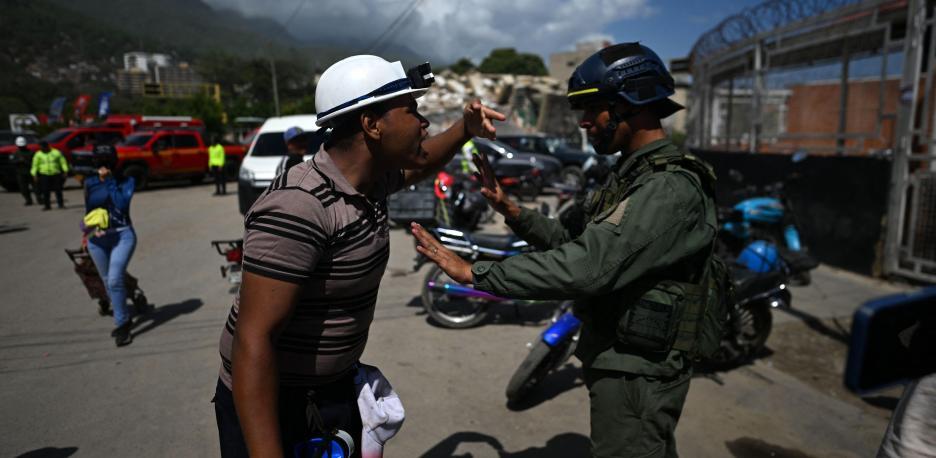
Photo: Juan Barreto / AFP
In 1999, Hugo Chávez coined the ‘civic-military union’ as a founding concept for the Bolivarian Revolution. At its core, he sought to blur the line between soldier and militant: the armed forces would no longer be subordinate to the civilian authorities, but become active political actors, essential not only to build and sustain the Bolivarian project, but to merge with the rest of society in conducting the nation. The old fuerzas armadas, FFAA, formed by the Army, the Navy, the Air Force, and the National Guard, were transformed into a single Fuerza Armada Nacional Bolivariana, FANB. Soldiers were granted the right to vote. Officers flooded the bureaucracy and started to give orders to civilians. They were, in practice, sworn to a movement rather than a constitution.
In its later years, chavismo stretched the phrase to unión cívico-militar-popular, supposedly integrating the whole of el pueblo into the martial body of the revolution. In 2008, Chávez created the Bolivarian Militia to provide military training to millions of civilians, and turned it into a branch of the armed forces in 2020, when it started to operate more as a propaganda and clientelism resource rather than a defensive corps.
How, then, were Venezuela’s armed forces made “useful”?
A government and an armed forces that claim to be in union with its people were caught outside of the massive, spontaneous popular mobilization Venezuelans pulled off…
In the Maduro years, soldiers guarded the ration lines of CLAP boxes and the gasoline pumps of the country with the largest oil reserves in the world. Others were stationed in the southeast of the country to run the Orinoco Mining Arc, formally assigned to FANB, in tandem with non-state armed groups—some pocketing up to $800,000 a month in gold as bribes. The luckier or best-positioned of the bunch got handed high-ranking positions in public companies and ministries. The “popular” leg, then, was never el pueblo but its keepers, united to protect the Bolivarian Revolution and themselves over their fellow countrymen.
In the morning of June 24th, the Financial Times revealed that Caracas would acknowledge a debt of roughly 240 billion dollars and prepare for the largest restructuring on record. Hours later, two M7.2 and M7.5 earthquakes changed the landscape of the country. As the news broke, Venezuelan civilians quickly organized to save relatives, friends, and strangers. For the first forty-eight hours, a somewhat coordinated response from FANB was nowhere to be seen, even after Delcy Rodríguez said a joint staff led by a National Guard general was managing the emergency response. It was as if Venezuela didn’t have soldiers.
What the State guarded most jealously was not the living, but keeping the credit. A government and an armed forces that claim to be in union with its people were caught outside of the massive, spontaneous popular mobilization Venezuelans pulled off after the earthquake. When civilians pulled strangers from the rubble with their bare hands without waiting for an order, they proved that el pueblo is perfectly capable of being a body on its own, and most notably, that the State is not the vital organ that Chávez envisioned, but a dead weight.
So the aid had to be captured, rerouted, or rebranded. On June 27, Delcy Rodríguez ordered the militarization of roads and access points to devastated areas like La Guaira, slowing down the flow of ordinary citizens delivering supplies for survivors and machinery for those trying to find more of them. Just a day after the quake, opposition party Vente Venezuela reported that police had stopped a truck of supplies in Altamira and would let it move only if the cargo were transferred into the officials’ own vehicles, and the UCV student movement denounced that seven trucks of supplies en route from Bolívar to Caracas were seized by state agents before they could arrive.
“When you are [repressing] on the Francisco Fajardo highway, you are badasses. Show me you’re a badass here, then. Show me with a pickaxe and shovel.”
Organizers from a donation center at Escuela Francisco Pimentel were informed that CONAS, a joint unit of police commandos and National Guards, would be taking over the site and its supplies. Would they have done the same if a PSUV banner hung next to the supplies? A video shows the truck carrying the donations away belongs to SENIAT, the tax authority commanded by Diosdado Cabello’s brother for 18 years until yesterday. Even digital efforts were policed: a network matching volunteer interpreters to foreign rescue teams shut down and wiped its database after participants were allegedly harassed by DGCIM and SEBIN officers.
When the authorities did appear where they could help, soldiers and policemen scrolled on their phones, posed in front of the rubble and left before their uniforms got dirty. They were the last responders. Why so late, then so heavy? Incompetence covers part of it, but watch what the greens reached for in the most critical moments of this crisis and the reason why the ‘union’ has propped up chavismo for decades becomes clearer.
DGCIM agents diverted an active rescue to recover an official’s rifles from a penthouse while people were still alive below. Neighbors stopped four CICPC policemen in Catia La Mar from trying to take cash found in the rubble, tearing the bills apart so they couldn’t. Chilean rescuer Francisco Lermanda says a soldier seized a colleague’s phone over suspicions of espionage after the crew videocalled their doctors to guide a rescue. At the Residencia Gradisca in La Guaira, where Mexican Topos had marked three points with signs of life, a Corpoelec crew sealed the site on a general’s order because a body, “por orden de arriba”, had to be recovered first. Our ‘protectors’ were filmed carrying off televisions and refrigerators, drinking the liquor they had found, lying on piles of donated clothes while giggling away.
When push came to shove, the union was not incompetent to protect the regime’s weapons, the regime’s secrets, the regime’s chain of command. The FANB did not forget how to save people during the earthquake. It never learned because saving people was not supposed to be part of the job. Faced with people to rescue instead of people to subdue, they stood guard over the dying. A man looking for his family among the collapsed buildings of Tanaguarena dared soldiers to be as brave as when they face dissidence: “When you are [repressing] on the Francisco Fajardo highway, you are badasses. Show me you’re a badass here, then. Show me with a pickaxe and shovel.”