People stopped for minor traffic violations will no longer be referred to US Immigration and Customs Enforcement.
Published On 7 Nov 20267 Nov 2026
The mayor of Houston, the most populous city in the US state of Texas, has ordered the city’s police force to sharply limit its cooperation with the United States Immigration and Customs Enforcement (ICE).
According to the order, Houston police will contact ICE only when a person is being arrested for a jailable offence, according to the Reuters news agency.
Whitmire said he had consulted Texas’s newly elected governor, lieutenant governor and comptroller before acting, and that the move was meant to reduce fear and anxiety across the city.
“Elections matter,” Whitmire told reporters. “I do this to begin a healing process,” he said, adding he hoped his executive order would become a model for other Texas cities.
Joining Whitmire at the news conference, Houston Police Chief J Noe Diaz said he supported the change and that his department had already begun to implement the new policy.
Under the new rules, people stopped for minor traffic violations will no longer be referred to ICE simply because they have an administrative immigration warrant.
The decision reverses a policy Whitmire put in place in April under pressure from outgoing Republican Governor Greg Abbott.
Abbott had threatened to withdraw about $110m in state public safety grants, arguing that a city council ordinance limiting police contact with ICE breached Senate Bill 4, a 2017 state law that bars local police from restricting cooperation with federal immigration authorities.
Texas Attorney General Ken Paxton also sued the mayor, the city council and the police chief over the ordinance.
“We’re taking an interpretation of the law today, working with the newly elected members of the state leadership, in implementing this policy,” Whitmire told reporters. “We don’t want people to worry about their workers, their family members, their students.”
The issue has drawn intense scrutiny in Houston. The Houston Chronicle found that city police contacted ICE at least 107 times in the first eight months of 2025, compared with nine times in the whole of 2024.
FIEL Houston, an immigrant rights group, called the order a victory for the city but said it was long overdue. “Today Houston won. Today our community can breathe easier,” FIEL Executive Director Cesar Espinosa said in a statement to KPRC.
Whitmire said he expected Houston’s approach to become a model for other cities. In Austin, Mayor Kirk Watson asked city officials on Friday to revise their own policy on ICE warrants.
DSA-backed Raman will lead America’s second largest city, promising action on homelessness and affordable housing.
Published On 5 Nov 20265 Nov 2026
Nithya Raman, a progressive Los Angeles City Council member, has defeated incumbent Mayor Karen Bass, putting her on track to become the first South Asian to lead the second-largest city in the United States.
The Associated Press called the race for Raman on Thursday, with Raman holding 52 percent of the vote.
Recommended Stories
list of 3 itemsend of list
Raman, 45, overtook Bass despite the incumbent’s support from prominent Democrats such as California Governor Gavin Newsom, former Vice President Kamala Harris and former House Speaker Nancy Pelosi.
Her campaign was backed by the Democratic Socialists of America (DSA), with her victory coming as part of a surge in visibility and electoral wins for the left-wing political movement.
A record number of candidates backed or affiliated with the DSA won federal offices in Tuesday’s midterm elections. On its website, the DSA has claimed credit for contributing to at least 300 candidacies or ballot referendums during the midterms, and it said it is on track to count 105 of those as victories.
Some of those wins came in congressional races, with figures such as Darializa Avila Chevalier, Claire Valdez, Melat Kiros and Chris Rabb winning their first terms as US representatives.
Raman’s victory in Los Angeles follows another high-profile democratic socialist winning a mayor’s race in New York City last year: Zohran Mamdani.
Raman was born in India and worked as an urban planner before running for office. Once an ally of Bass, she had initially endorsed her re-election campaign but reversed course, entering the mayoral race in February, just hours before the filing deadline.
In her victory speech, Raman promised to restore what she called an ambitious, creative and entrepreneurial Los Angeles.
“For too long our broken and unjust status quo has convinced Angelenos that this is the best that we can do,” she told the crowd.
Raman also pledged to expand affordable housing, improve neglected city services and take a different approach to homelessness by deploying more medical teams to assist people who are unhoused.
In addition, she called for replacing the city’s police chief over concerns about cooperation with federal immigration authorities.
Raman now faces the task of delivering on those promises in a city of more than 3.8 million people.
Los Angeles also faces the challenge of hosting the 2028 Olympic Games, which open in July of that year.
With the result, Bass has become the first Los Angeles mayor in more than two decades to lose a re-election bid.
Her defeat follows a difficult four years in office. Her administration faced mounting criticism over the city’s homelessness crisis and its response to the deadly Palisades Fire, which broke out while she was overseas and devastated communities across the Los Angeles area.
In a statement on Thursday, Bass congratulated Raman and said she was committed to ensuring a smooth transition.
“Four years ago, you elected me as the first Black woman mayor in the history of Los Angeles. You gave me the honor of serving the city that raised me, and every single day since, I have carried that responsibility with me,” Bass wrote.
“Moving this city forward is what Los Angeles needs from all of us.”
To stage the largest Olympics in history, LA28 is looking toward the cosmos for inspiration.
The committee in charge of bringing the Games back to L.A. for the first time in 44 years announced its slogan for the 2028 Olympic and Paralympic Games on Wednesday, hoping to rally athletes, volunteers and fans behind a simple call: “Stars align.”
“‘Stars align’ is when preparation meets opportunity,” LA28 chief marketing officer Alex Merchán said. “So together that creates something extraordinary, and that’s what we seek to do here.”
The slogan that will set the stage for the next 21 months developed organically within the organizing committee over several years, Merchán said. Only during the past 12 or 13 months did the team really start imagining ways to bring the phrase to life.
“Stars align” is a nod to the “stars in motion” emblem for the 1984 Olympics. It takes inspiration from the 50 stars on the U.S. flag. It speaks to L.A.’s Hollywood reputation.
But it also captures how the largest sporting event in history came to L.A. By the time the Olympics open on July 14, 2028, it will have been 11 years since the city won the original bid. More than a decade of planning and a lifetime of training for competitors align during the once-in-a-generation sporting event.
“Athletes commit so much and dedicate so much and sacrifice so much to get [to the Games] that we ground the idea in that effort, in that alignment,” Merchán said. “Alignment is teamwork, coordination, hard work and commitment.”
Along with the International Olympic Committee’s official motto of “Faster, Higher, Stronger — Together,” each organizing committee uses a slogan to share its vision for the Games. The 1984 Games in L.A. pioneered the marketing tactic with “Play a Part in History.” Those Games then turned into the most financially successful in history, relying largely on private sponsorship to produce a $235 million profit that has sponsored youth sports in L.A. for decades. Now official slogans are as ubiquitous as the Olympic rings when walking around the Games.
LA28 looked at translations of the slogan in the next 14 most-popular languages within the Olympic and Paralympic movement, finding equivalent messages. Some were exact translations. Others needed a different collection of words. The message always stayed the same.
“The simple idea of stars and constellations have, in recorded history, been a part of every group around the world,” Merchán said. “Every country, every tribe if you will, have looked upon stars as something filled with optimism.”
The Games return to L.A. at a high point. The popular Paris Games, which used the motto “Games wide open” to set the tone for a resurgent post-pandemic movement, reinvigorated the Olympics with international broadcast records and 12 million tickets sold across the Olympics and Paralympics.
LA28 is on pace to exceed some of those marks. With more than 6 million Olympic tickets already sold, the private organizing committee will open first-come, first-served Olympic ticket sales next year. Tickets for the first Paralympics in L.A. will go on sale in 2027. The Olympic torch relay will begin in spring 2028, uniting all 50 states en route to the opening ceremony. Wednesday’s slogan is only the starting point of LA28’s constellation of events, Merchán said.
“If we get this right,” Merchán said, “we like to think that we can bring the world together and connect people under this banner.”
Taiz, Yemen – As Houthi fighters tighten their siege on the government-held southwestern Yemeni city of Taiz, women who initially organised food deliveries for soldiers defending the city have begun raising money to buy weapons and ammunition.
The initiatives have emerged spontaneously since the resumption of fighting in early September in the western countryside of Taiz governorate, between Saudi-backed forces of the internationally recognised government and the Iran-backed armed group.
Recommended Stories
list of 3 itemsend of list
At first, women volunteers came together to bake cookies for fighters on the front lines.
The aim was “to strengthen the relationship between the supportive social base and the members of the national army and pro-government popular resistance forces stationed at the front lines in defence of their besieged city, which is subjected to daily shelling in preparation for an invasion,” said Amira al-Saghir, an activist involved in the campaign.
The cookie-making initiative attracted widespread participation among women volunteers, drawing encouragement and support on social media. It coincided with a broader community campaign to supply fighters with food and other basic necessities, as well as weapons, with people contributing from districts and villages across the governorate.
In Yemen, a conservative country and the poorest in the Middle East, the vast majority of women do not participate in active fighting in the civil war, which began in 2014. Instead, these initiatives allow women to take part in what they see as the defence of their city against an invading force, and support for the men who are fighting.
After nearly four years of relative calm following a United Nations-brokered truce in April 2022, Houthi forces launched a major ground offensive in western Taiz in early September. The armed group rapidly captured territory along Yemen’s Red Sea coast, including the strategic port city of Mocha on September 10 , expanding its presence around Bab al-Mandeb strait, a vital shipping route.
The Houthis, also known as Ansar Allah, Arabic for Supporters of God, subsequently advanced towards other parts of Taiz governorate, taking control of key routes into the provincial capital and effectively surrounding the city. Government forces have since launched counteroffensives, with control of some areas remaining contested.
The renewed siege has severely restricted the movement of people and essential supplies into the city, triggering shortages of food, fuel, and medicine.
From cookies to weapons
As the fighting intensified, the women’s initiatives expanded. What began with baking cookies and organising food convoys to supply arms kitchens gradually evolved into efforts to buy ammunition for fighters.
Women involved in the initiatives told Al Jazeera that they felt they had been “forced” to act because of the risk of their city falling to the Houthis.
The change began as more rural districts began falling to the Houthis, leading to some donors making their contributions conditional on part of the money being used to buy ammunition for fighters.
Al-Saghir believes the shift was encouraged by information and criticism circulating on social media suggesting that government fighters in Taiz lacked sufficient ammunition to continue defending the city and surrounding front lines.
The initiatives soon took off, encouraging more women to get involved. Among them was Huriya Wabel, a humanitarian activist.
“After we saw that those [Houthi] militias … are waging a war of extermination against our city, we felt that we had to take a serious stand to support the army, not just with food and clothing, but with weapons as well, especially since a siege has been imposed on Taiz and supplies can no longer reach it easily,” Wabel told Al Jazeera.
“We also found many civilians who wanted to participate in the fighting alongside the army in defence of the city, but they did not have weapons,” she added. “So it became incumbent upon us to help by focusing more of our activities on this aspect at this stage.”
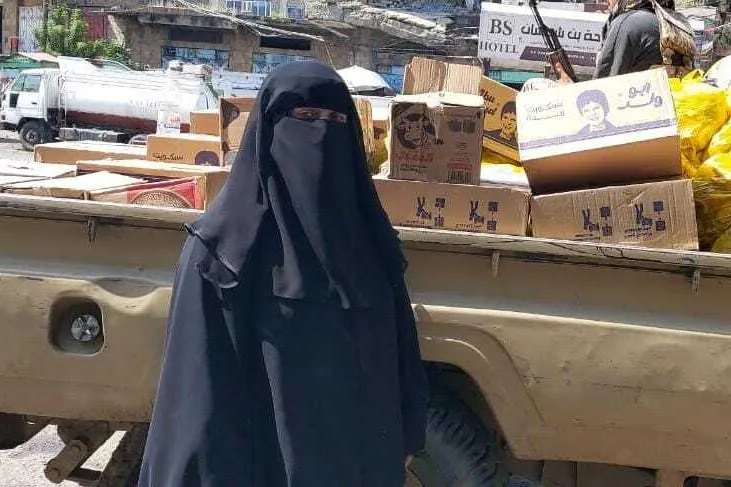
Khadija al-Majidi, a local activist, has begun gathering donations for weapons as well as food for government forces in Taiz [Courtesy of Khadiji al-Majidi]
Defending their city
For Khadija al-Majidi, the move from providing humanitarian supplies to delivering military equipment is a response to the growing threat facing Taiz.
“When the enemy reaches the gates of your city and imposes a complete siege on it in preparation for storming it by force, and everyone in it – including you, your children, and members of your family – is threatened with being killed, captured, or displaced … then what do you expect from us?” the activist told Al Jazeera. “Did you expect us to carry flowers for the criminal who came from the farthest reaches of the country to destroy our city and kill us?”
When Al Jazeera spoke to al-Majidi, she had just returned from the fighting around Jabal Sabir, the mountain overlooking Taiz from the south.
It was al-Majidi’s second trip to the front that day, delivering ammunition and other military supplies, which she valued at $3,000, to the commander on the front, along with winter clothing, shoes, food, and other necessities.
She said that after more than 10 years of living through Yemen’s devastating war, she no longer felt afraid to visit active battlefronts.
“Repeated visits to the front lines play a major role in removing fears, given what we see on the ground of the heroes’ courage and bravery in defending the city and their confidence in victory,” she added.
As fundraising expands, the women’s department of Taiz’s Supreme Council for Popular Resistance launched a campaign on October 8 , aiming to equip 10,000 pro-government fighters with rifles and ammunition.
Supplies are regularly delivered to government forces on Taiz’s frontlines [Courtesy of Khadiji al-Majidi]
The council has called for contributions from Yemenis across the country and abroad to support the initiative.
The campaign reflects the state of the fighting in Taiz, with government forces facing daily Houthi attacks, as they try to conduct their own counter-attacks.
But the longer the siege continues, the more difficult the military and humanitarian situation becomes in the city.
Al-Saghir and al-Majidi both explained that while many of the donations they receive come from Yemenis living abroad, people on the ground are also giving whatever they can, despite the humanitarian crisis in Taiz.
Al-Saghir said one woman whose husband was fighting in the army donated a wedding ring, while al-Majidi recounted stories of other women donating their gold jewellery.
Al-Majidi recalled a woman arriving at her home carrying envelopes containing Yemeni and Saudi currency.
The woman had written on the envelopes, “God willing, we will win. Buy ammunition for the heroes with this.”