city

Puppets, performers and politics filled the streets at LACMA’s first-ever Art Parade

Instead of the usual phalanx of cars and buses, Saturday evening traffic on Wilshire Boulevard was replaced by massive balloons, mobile sculptures, gaggles of gallerists and an endless array of elaborate costumes.

The first-ever Los Angeles Art Parade, a collaboration between the Los Angeles County Museum of Art (LACMA) and famed gallerist Jeffrey Deitch, transformed the stretch of Wilshire known as Museum Row into a human-powered exhibition of the city’s dynamic art scene.

About 146 groups, made up of more than 1,400 participants, marched in the parade, with projects ranging from larger-than-life marionette dolls to squads of children in do-it-yourself costumes to mobile re-creations of LACMA’s most iconic art pieces.

The parade followed an all-day block party thrown by LACMA as part of its Grand Opening Weekend, celebrating the new David Geffen Galleries and the completion of the 20-year-long, $724-million campus construction project. Together, the block party and art parade attracted an estimated 60,000 attendees, who swarmed the galleries, danced to explosive DJ sets, and lined the streets to watch the eclectic procession of artists.

People dance

People dance during Flying Lotus’ DJ set at the Los Angeles County Museum of Art (LACMA) in Los Angeles.

(Ariana Drehsler/For The Times)

According to LACMA Director and Chief Executive Michael Govan, the event was a long time coming and “just the beginning” of how his team plans to use the campus space, which he previously called the city’s “living room.”

“We’re not gonna close Wilshire every weekend, but it’s an example of what we can do,” Govan said. “It’s really exciting to see the building work.”

Following a crowd-drawing DJ set from electronic low-fi hip-hop artist Flying Lotus, Govan introduced L.A. County District 2 Supervisor Holly J. Mitchell. She said the event made her “proud to represent LACMA” and to be a Metro board member, referencing the recently-opened Metro D-line extension, which dropped attendees off a quick stroll from LACMA’s entrance.

“Just seeing you all at this amazing public facility does my heart good,” she said. “This is your local government at work.”

1

Silhouettes of people watching the parade.

2

A man and woman wearing tulle over them walk in the parade.

3

The crowd at the Los Angeles County Museum of History, Science, and Art (LACMA) Block Party.

1. Silhouettes of people watching the parade. 2. A man and woman wearing tulle over them walk in the parade. 3. The crowd at the Los Angeles County Museum of History, Science, and Art (LACMA) Block Party. (Ariana Drehsler/For The Times)

As the party raged on LACMA’s campus, hundreds of parade participants hurriedly prepared for their debuts in the corners of nearby streets and parking lots. One group inflated a giant disco ball, while another smeared themselves with body paint next to a line of rehearsing dancers. Elsewhere, a megaphone-wielding leader herded dozens of black cats in the style of artist Gary Baseman into some semblance of order.

Deitch originally staged the first Art Parades in New York City’s SoHo neighborhood between 2005 and 2008. While those took a more art-world-exclusive approach, Deitch said the Los Angeles version was designed with inclusion in mind. The call for parade proposals was open to “emerging and established artists and creatives of all ages and backgrounds,” according to guidelines, as long as the work was appropriate for all ages and didn’t require a motorized element.

“The New York one was much more oriented toward people in the art community. We didn’t put out this kind of open call,” Deitch explained. “This is very different in its openness and its diversity. There are some famous artists and famous choreographers, L.A. legends. But there are also mothers from the San Fernando Valley with their children. I really love that.”

Devil Jack in a Box with Crocodile

Artist Jordan Rountree’s rolling woodcut-sculpture called the Devil Jack in a Box with Crocodile appeared in Saturday’s Block Party and Art Parade hosted by the Los Angeles County Museum of Art’s (LACMA).

(Ariana Drehsler/For The Times)

“It’s just a very open platform, so you don’t have to have an M.F.A. to express yourself as an artist,” he added.

The procession was dizzying in its variety and scale. While many projects leaned into beauty and whimsy, others took a more overtly political approach, displaying anti-ICE messages on T-shirts and signs, sporting trans pride flags, or, in the case of performance artist Amy Kaps, wearing an unraveling U.S. constitution.

Some even referenced local causes, such as the “Boo Boo Bandage Brigade for Safe Streets,” which advocated for fixing sidewalks and increasing accessibility downtown. One particularly moving display by the Pali-Altadena Collective featured participants carrying miniature models of buildings and landmarks lost in the 2025 fires.

Chicana artist Nao Bustamante and Track 16 Gallery brought “Brown Disco” to the streets, which featured a giant gold disco ball and figures from decades of L.A. queer nightlife.

The crowd at the Los Angeles County Museum of Art (LACMA) Art Parade.

The crowd at the Los Angeles County Museum of Art (LACMA) Art Parade.

(Ariana Drehsler/For The Times)

“As a brown, queer person, I think that this really brought a light into our community, and now its presence [creates] an intergenerational conversation,” said Track 16 Assistant Director Steve Galindo. “The nightlife scene is how we come out as queer people, so it’s really special to be in the parade.”

For Joie Mitchell, volunteer coordinator for the Bob Baker Marionette Theater, which recently purchased its permanent Highland Park home, the parade was an opportunity to “show up for L.A. and be involved in the art history of this city.”

“Puppetry has been part of the arts for so many years,” added Daisy Hernandez, the theater’s production manager. “It’s a way that people express themselves, just like every other art form. So that’s what we’re here to do: express ourselves through puppetry.”

Source link

Lawrence Tanter was Lakers’ voice whose subtlety spoke volumes

For more than four decades his voice was embraced by millions, a calming baritone in a sea of Lakers bedlam.

Yet in the most unfair of twists, on the night his career ended he was silent and alone.

Three months ago, Lawrence Tanter was walking through his bedroom when he suddenly collapsed while losing all strength in his arms and legs.

He fell and couldn’t get up. He lives alone, so he couldn’t cry out for help. He was able to secure his phone, but he says he was too stubborn to call 911.

“I wanted to get up by myself,” he said. “I knew I would eventually get up by myself.”

But this 6-foot-7 bear of a man was too weak to get up by himself. Listening to a Lakers road game on a bedside radio, he remained on the floor and eventually fell asleep until finally summoning his oldest friend the next morning.

Lakers star LeBron James, center, salutes public address announcer Lawrence Tanter (not pictured) before a game in 2024.

Lakers star LeBron James salutes public address announcer Lawrence Tanter before the start of a game in 2024.

(Mark J. Terrill / Associated Press)

“I got there and I’m like, why didn’t you call sooner?” Joe Williams said. “I told him, ‘I know you’re a warrior but, c’mon man, this is serious.’”

Serious enough to be diagnosed as a stroke. Serious enough to quietly end the most sonorous, soothing stretch in local sports history.

For 43 years as the Lakers’ iconic public address announcer, Tanter has been the coolest sound in the city, the measured, reassuring voice that decorated the team’s two hype-filled homes with gravitas and grace.

When the Lakers announced his retirement last week as he continues to battle effects from the March 17 stroke, the man known to everyone as simply “LT” closed his career with taciturn perfection, summing up a Lakers lifetime in eight words.

“It’s been a great run,” he intoned this week from a hospital bed, his pipes still the strongest part of him. “I’ve been blessed.”

It is Lakers fans who have been blessed, gifted with a voice that, whenever they attended a game, reminded them they were home.

“LT is in every way a part of Laker history,” said former Laker and current broadcaster Mychal Thompson. “He too is a Laker legend.”

Lakers public address announcer Lawrence Tanter gets set up at the scorer's table before a game in 2011.

Lakers public address announcer Lawrence Tanter gets set up at the scorer’s table before a game in 2011.

(Gary Friedman / Los Angeles Times)

When the retirement news broke with the Lakers announcing they were moving LT into an advisory role — a classy good-bye — fans everywhere broke out their LT best.

“Toooo many steps.” … “James Woooorthy.” … ”LeBronnnn James.”

And, of course, everybody’s favorite…“Llllaker Girlsss.”

“I always imagine, if he could hear God’s voice, it would sound like LT’s,” Thompson said.

This was never more true than on a somber night in late January in 2020. LT put his giant arms around a grieving city with pregame introductions that will never be forgotten.

“At one guard, number 24, 6-6, 20th year out of Lower Merion High School, Kobeee Bryant.”

The player taking the court was Avery Bradley.

“At the other guard, number 24, 6-6, 20th year out of Lower Merion High School, Kobeee Bryant.”

Lakers public address announcer Lawrence Tanter watches play from his spot at the scorer's table during a game in 2012.

Lakers public address announcer Lawrence Tanter watches play from his spot at the scorer’s table during a game in 2012.

(Mark J. Terrill / Associated Press)

The player taking the court was Danny Green.

And on it went, all five Lakers introduced as Kobe Bryant before their game against the Portland Trail Blazers, the ultimate tribute before the Lakers’ first game since Bryant’s death.

It might have been LT’s finest hour, and every second of it broke his heart.

“The hardest introductions ever,” he remembered.

LT handled it simply by being LT, a comforting bard who could elicit much emotion with a slight change in cadence or key.

“With his timing, his rhythm, he could get excitement going without raising his voice,” said Bob Steiner, the retired Lakers executive who hired LT in 1982. “Lawrence became a star in the same way Chick Hearn was.”

While working for the Lakers, LT also worked for several jazz and rhythm and blues radio stations in town, most notably KJLH, which gave him built-in credibility in the city.

“If you go around town, you will find that he was known almost as much for his radio work as his public address work,” Williams said.

In combining the rhythm of jazz with the tenor of basketball, LT was the coolest cat at the scorer’s table, a distinctive figure in a white goatee and a newsboy cap who raised the roof while never raising his voice.

“I never tried to be a cheerleader,” said LT, 76. “I just tried to be a public address announcer.”

While many of today’s public address announcers are screamers, LT was so subtle that his most repeated call involved not the action, but the in-game entertainment.

“Everywhere we go, somebody recognizes his voice and does an imitation,” Williams said. “But nothing gets repeated like ‘Llllaker Girlsss.’”

Those two words, uttered at the end of every routine by the iconic dance team, contain the essence of LT’s greatness. He knows what you’re watching doesn’t need any embellishment; he’s capturing the scene with the power of subtlety.

“You’re sitting in the stands and when the dancers finish dancing, you say to your friends out loud, ‘Llllaker Girlsss,’ and everybody laughs,” said Pete Arbogast, who was the master of ceremonies when LT was inducted into the Southern California Sports Broadcaster Hall of Fame last year.

LT’s speech that afternoon was dominated by individual thank-yous to his many friends who attended the ceremony, typical LT humility.

“From my nose to my toes, I say thank you,” he concluded.

Lakers public address announcer Lawrence Tanter is given brownies by actress Dyan Cannon before the start of a game in 2011.

Lakers public address announcer Lawrence Tanter is given brownies by actress Dyan Cannon before the start of a game in 2011.

(Los Angeles Times)

Today it is the Lakers who are thanking him.

“Since the 1980s, LT has narrated every chapter of Lakers basketball, connecting generations of fans, players, coaches and staff while becoming a trusted and unforgettable part of the Lakers experience,” Lakers governor Jeanie Buss said in a statement. “I am incredibly grateful for everything he has given to this franchise.”

His next stop should be the Naismith Memorial Basketball Hall of Fame, where he deserves to be enshrined as a contributor, becoming the first public address announcer to receive such an honor.

What other PA voice defined a franchise like LT? Who else missed just two games in 43 years? Name another PA announcer who accumulated nine championship rings yet refuses to wear any of them, ever, because it was never about him?

“It’s high time the Hall of Fame inducts him as a valuable and legendary contributor to the game,” Thompson said.

And if he is one day inducted, how would he introduce himself?

“At one forward, number 43, 6-foot-7, from Thornton Township High School, Llllawrence TAN-ter …”

LT laughed at the thought. He never actually would say that. But wouldn’t you like to hear it? Just once?

“Laker games,” Thompson said, “will never sound the same again.”

Source link

UK’s ‘coolest’ city with codebreaking manor & indoor skydiving… that could have been home to new Universal theme park

WE all know that Universal is building its very first European theme park right here in the UK.

While it’s setting up base in Bedford, it could have been somewhere else completely – and it happens to be the ‘coolest’ city in Britain.

The Uk’s first Universal theme park could have been located in Milton Keynes Credit: Cover Images
One of Milton Keynes’ biggest attractions is Bletchley Park Credit: Alamy

Planning documents revealed that Universal had previously considered building its upcoming theme park on the outskirts of Milton Keynes.

But when certain “terms could not be agreed”, a site in Bedford was picked instead.

Milton Keynes is just a half an hour drive away from Bedford but is completely different being a city, and in Buckinghamshire.

Last year, Milton Keynes was named one of the top ten destinations for Brits to visit in 2025 behind the likes of Milan, Rome and Tokyo.

SCHOOL’S OUT

Just 6 weeks until school summer hols! Cheap all inclusives where kids go FREE


CHEAP DATE

Our fave cheap European destinations with flights under £20 & hotels from £24pp

The city was even declared one of the ‘coolest’ places to live last year by The Times.

There’s plenty of activities to do in Milton Keynes – most of which you’ll find at Xscape.

Inside there’s everything from indoor skydiving to bowling, arcades, climbing walls, trampolines, escape rooms – even indoor ski slopes.

For restaurants, there are high-end spots on 12th Street and plenty of bars too.

Milton Keynes has its own theatre too with plays and touring West End musicals on throughout the year.

Nearby is Willen Lake which is popular for watersports like paddleboarding, kayaking, aqua parcs and open water swimming.

Milton Keynes has plenty to do from indoor skydiving to seeing a show at the theatre Credit: Getty

There’s also Woburn Safari Park and Woburn Abbey which has a 3,000-acre deer park.

Bletchley Park which was once the top-secret home of Britain’s World War Two Codebreakers sits just outside of the city centre.

Visitors can spend the day at the attraction which celebrates the place where Alan Turing helped to crack Enigma and save millions of lives.

Tickets for adults start from £25.87, for children (between 12-17) entry starts from £13.50, for children aged 8-11 tickets cost £6.75.

You can even take advantage of its indoor ski slopes Credit: Alamy

The new Universal theme park will be constructed in Bedford and it has recently announced that it will be officially called ‘Universal United Kingdom Resort’.

The park was given the green light last year with work on the site starting in early 2026.

Once open, it will be the first Universal theme park in Europe, and it’s scheduled to open in 2031.

As for what kind of themed lands and rides would open at the UK Universal, very little is known.

But there are rumours suggesting that some could be based on James Bond, Paddington, Lord of the Rings, Minions, Jurassic World, and Back to the Future.

There’s also expected to be hotels on-site as well as a new train station.


Source link

How Paris’ oldest bridge, Pont Neuf, was turned into a mountain cave

There’s a present-day answer to the question that was posed in verse by the French medieval poet and street brawler François Villon: “Where are the snows of yesteryear?”

They’re right here, in high summer, on Paris’ oldest bridge, the Pont Neuf, where an enormous art installation, a trompe l’oeil inflatable snow-clad mountain range, has arisen over the river Seine.

Using about 200,000 square feet of printed fabric, Paris-born street artist JR has created “La Caverne du Pont Neuf.” It’s his version of and homage to the innovative work of groundbreaking environmental artists Christo and Jeanne-Claude.

They’re the fabled duo who first wrapped the arches of this same bridge in straw-colored fabric in 1985. Over the years, they also surrounded 11 islands in Florida’s Biscayne Bay with flamingo-pink cloth, hung saffron-colored fabric “gates” in New York’s Central Park, installed a “running fence” of billowing white material across nearly 25 miles of Sonoma and Marin counties and, in 1991, planted 3,100 yellow umbrellas, blooming like 20-foot-tall poppies, through the Tejon Pass north of L.A.

I interviewed Christo in 2011, and he was eloquent about how his and his wife’s work alters perceptions of nature, and about the deliberately transient character of the art itself. JR, an acolyte of their work, told me in an email that “an ephemeral artwork forces you to come now, and usually to come with other people. The visit becomes a shared moment … and this moment becomes a memory.”

In a city celebrated for artworks that have survived for centuries, this installation was very nearly too transient. A kooky hailstorm in late May, a heat wave in June, followed by ruthlessly ripping winds, delayed the opening by days. At last, beginning one midnight, the air pumps began and the work arose like a limestone-colored soufflé. It will be open around the clock until June 28.

Plus ça change, plus c’est la même chose. Back in 1985, Christo’s engineer on the Pont Neuf project, Ted Dougherty, pointed out that above 25 mph, “wind is not our friend.”

The piece works from two vantage points: from afar — visible from a lot of central Paris — and also from inside it, in the “cave” part. Pedestrians crossing the bridge pass through a fabricated interior, a cavern-like space printed in 3D realism and enhanced with a specially designed scent to evoke the dank, earthy aroma of humankind’s early habitations.

Men walk inside a cave-like space.

JR and Thomas Bangalter in “La Caverne du Pont Neuf” in Paris.

(Tara-Jay Bangalter)

JR intended it to be both. “From the start I designed two works in one. There is the silhouette — what you catch from the quais, from the bridges, from a boat on the Seine or simply walking past on your way somewhere else. That image belongs to everyone, including the people who never chose to look at art that day.”

And then, he said, “there is the inside, which is slower and more intimate, almost in the dark, hard to photograph.” That aspect is “a journey to cross the bridge, to go from darkness to light.”

When Christo and Jeanne-Claude wrapped the arches of the Pont Neuf more than 40 years ago, it took years of planning and permits to make it happen. “La Caverne du Pont Neuf” was a breeze by comparison.

JR, whose other vast outdoor works have delivered double-takes of humans’ scale and their architecture, told me that cities have come to understand “that public art brings people together and that the image travels around the world. Once Christo showed it could be done safely and beautifully, the conversation changed. It was much easier for me to have my project accepted, thanks to them. They also proved the economic positive impact to the cities they worked in. I believe there should be more large-scale, ambitious public art projects.”

It’s one thing to conceive of such a project and another altogether to make it happen — so much technology, compared to, say, mixing paints and choosing a paintbrush. But the science that “La Caverne” required “is the art, not an obstacle to it,” JR said.

Passengers on a boat look at a mountain over a bridge.

“Trompe l’oeil turns adults back into children,” JR said.

(Elea Jeanne Schmitter)

All the canvas, the engineering, the meticulous assembly, the permits — “none of that is preparation for the work, it is the work. Christo taught me this. The process is visible, and even more after the storm we experienced a couple of days before opening to the public. Nature always reminds you who is in charge. When the wind tore the canvas before we opened, we took it down, re-sewed it, reinforced it,” all in full public view.

“Where I stay careful is in not letting the technology become the subject. The augmented reality by Snap’s AR Studio adds to the project, doesn’t take you away from it.”

That air should be JR’s vital collaborator — no complex and costly scaffolding for these magic mountains — is nothing new in Paris.

The first free flight of humans above the earth, on Nov. 21, 1783, sent aloft two men in a hot-air balloon crafted by the Montgolfier brothers from silk fancifully painted in blue and gold with figures of the zodiac. It wafted across Paris for about 25 minutes at about 3,000 feet. Ephemeral, yes — and unforgettable.

Artists and couturiers are fond of the whimsy of trompe l’oeil, the trick of the eye, the illusion of reality. I am a sucker for it, for fashion like that of clothing designer Elsa Schiaparelli. JR has used it often, as a massive-scale magical deception to make the Louvre Pyramid “disappear” into the old Louvre, and opening up an imaginary subterranean world below the Eiffel Tower.

“Trompe l’oeil turns adults back into children,” he told me. “You know it isn’t real, you know that ‘La Caverne du Pont-Neuf’ is not made of rock, that this is printed canvas. And yet your eye wants to believe it, and for a moment you let yourself. That gap between knowing and believing is where the play happens, and people love being inside that gap.”

Source link

How the plan to expand the L.A. City Council got shelved once again

Good morning, and welcome to L.A. on the Record — our City Hall newsletter. It’s David Zahniser, with an assist from Noah Goldberg and Melissa Gomez, giving you the latest on city and county government.

It’s long been the Holy Grail for the reform crowd that tracks L.A. city government: expanding the size of the City Council.

The idea of giving L.A. more council members was endorsed by the city’s redistricting commission in 2021. Two years later, the concept was debated at length by a council committee focused on reform. After that panel failed to reach a decision, the idea was assigned to the city’s Charter Reform Commission, which endorsed the change, saying the council should have 25 members, up from 15.

Yet even after that five-year journey, the council voted Wednesday to push a proposed ballot measure on that topic off to the future, sending the idea to a new reform committee for more deliberations.

So what happened this time around?

You’re reading the L.A. on the Record newsletter

Sign up to make sense of the often unexplained world of L.A. politics.

For one thing, the 13-member citizens commission that recommended the idea didn’t offer a lot of specifics on how the change would work.

The commission recommended 10 additional council members, a move that would cause each district to shed more than 100,000 residents, leaving each member with about 159,000 constituents.

But it never explained whether that decrease should be accompanied by a similar reduction in a council member’s salary, now nearly $245,000 a year.

“That’s one of the reasons why [council expansion] is slated for further study,” Councilmember Bob Blumenfield said in an interview. “While the commission might have had a nice discussion and a negotiation among themselves, what we need to have in front of us to vote responsibly is context and information.”

A councilmember’s pay could be a major sticking point for voters during a campaign over council expansion — especially if an opposition campaign arose to defeat it.

Blumenfield said the commission failed to vet other issues, including the number of council aides needed for each district if a district is smaller.

Councilmember Tim McOsker expressed a similar view.

“I think there were gaps in what the commission proposed — substantive gaps,” he said.

Backers of council expansion have argued that an increase in the number of districts would make the council more responsive and more diverse. Opponents said bigger does not necessarily mean better representation.

Raymond Meza, who chaired the Charter Reform Commission, acknowledged that pay, staffing and the cost of each council office didn’t come up during his panel’s deliberations. Those questions should have fallen to the council, which reviews and approves the city budget each year, he said.

“They would need to figure this out through the budget process, like they figure out most other things in the city,” he said.

Meza said he believes that, in the end, council members didn’t want to dilute their own power. Former City Councilmember Mike Bonin offered a similar take, saying elected officials generally don’t want to risk changing the system that got them into office.

“They are in power because of the way the system is structured,” said Bonin, who now runs the Pat Brown Institute for Public Affairs at Cal State LA.

Before sidelining the expansion proposal, Council President Marqueece Harris-Dawson said a larger council would shift the balance of power at City Hall, giving the mayor greater authority and the council less of it.

In the end, none of these delays may end up mattering. No one at City Hall expected council expansion to happen until 2032 anyway, since the change would require a new round of redistricting — the process of drawing new boundaries for each council district. Redistricting won’t happen until after the release of results from the 2030 U.S. Census.

In other words, there’s still time for voters to act.

What happened to the City Hall misconduct measure?

Here’s another proposal that got shunted to the sidelines during the council’s eight-hour marathon meeting: what to do about city elected officials who are charged with serious crimes.

Charter reform was, in part, a reaction to a string of corruption scandals. Among them: three sitting council members who were charged with felonies between 2020 and 2023.

In each case, council members had to decide whether to use their power, spelled out in the City Charter, to suspend colleagues accused of wrongdoing — stripping away their duties until their criminal cases were resolved.

The council moved swiftly to suspend then-Councilmember Jose Huizar in 2020, taking action the day he was arrested, before he even pleaded “not guilty” to racketeering and other charges. The council suspended then-Councilmember Mark Ridley-Thomas in 2021 after a lengthy floor debate, with some saying he was being denied his due process rights. (Ridley-Thomas, who was found guilty of seven felonies, is fighting his conviction.)

A few years later, the council decided not to suspend Councilmember Curren Price, allowing him to step off of his council committees but preserving his other council duties as he contests charges of embezzlement, perjury and conflict-of-interest violations.

Although the case is still ongoing, Price is back on various city committees.

Each of those cases put the council in a bind. Voting in favor of suspension can mean depriving a council member’s constituents of representation. It also runs counter to the idea that a colleague is innocent until proven guilty.

Voting against suspension has its own set of dangers, such as undermining trust in city government. It could also allow an elected official accused of wrongdoing to continue taking part in decisions about contracts, real estate development and other matters where the potential for corruption exists.

Under the current system, a council member can be suspended with just eight votes. Harris-Dawson, who supported the suspension of Huizar but opposed it for Ridley-Thomas, said early on that he wanted the Charter Reform Commission to look at the process for disciplining elected officials accused of wrongdoing.

The Charter Reform Commission offered its answer two months ago, recommending that the council retain the power to suspend, but only with a three-fourths vote — 12 out of 15. That safeguard was meant to guard against potential abuses of power, said Meza, the former commission chair.

The council declined to put that idea on the ballot, saying it needs more study.

Asked about that decision, Harris-Dawson said he has long had serious problems with the idea that “one set of elected officials could suspend another set of elected officials.” He suggested that a third party in another branch of government — not the council — determine whether a member merits suspension.

Under that arrangement, the council could initiate the process but leave it to a judge or other party to make the final call, he said.

“I personally think that we have checks and balances in government that should be respected,” Harris-Dawson said.

A last-minute union threat

One ballot proposal that did survive this week’s gauntlet of votes was a plan to increase, not decrease, the council’s power. That proposal, backed by Councilmember Hugo SotoMartínez, would give the council the authority to set policy at the Los Angeles Police Department.

But even that proposal may be in danger, thanks to a dispute that has erupted between the city’s labor negotiators and the Los Angeles Police Protective League, the union representing rank-and-file officers.

Union leadership said this week that the league was not formally asked by management to meet and confer over various charter proposals dealing with the LAPD, including the one focused on policy. That step is legally required before such measures can be sent to voters, the union said.

City Administrative Officer Matt Szabo, the city’s chief labor negotiator, told council members on Monday that his office sent three emails to various employee units asking if they wanted to confer over the charter changes. He said his office received no response from the police union.

A day later, after learning of Szabo’s remarks, the league fired back.

In a letter to council members, the union said it only received emails about charter reform that had nothing to do with policing. Those emails did not constitute a formal invitation to meet and confer about potential changes at the LAPD, the union said.

The city “did not follow the law and did not formally contact us,” union President Ricky Mendoza said in a statement.

The council voted to draft the change in LAPD policy making, pending a confidential report from the city attorney on whether the city first has to bargain with the police union. Council members cast that vote even after the union demanded that they suspend any further consideration of the proposal for the Nov. 3 ballot.

If the city attorney concludes that the LAPD ballot proposal does not require further talks, the Police Protective League will file a lawsuit to protect its members’ legal rights, union officials said.

On Wednesday, Szabo said the proposal to give the council power over LAPD policy decisions doesn’t require collective bargaining.

The proposal to give council say over policy at the LAPD wasn’t the only one focused on that department. Another measure discussed by the council would have given the police chief power to terminate alleged problem officers.

The council sent it to a committee for more study. The union said that proposal also would have required a meet and confer process.

State of play

— CITY CHARTER GRAB BAG: As noted earlier, the council voted to draft an assortment of charter amendments for the Nov. 3 ballot, including one to allow the council to give noncitizen residents the right to vote in local elections. The council also ordered up a measure doubling the amount of money allocated for the Department of Recreation and Parks, discarding an alternative plan that would have increased it by 50%. Other measures would switch the city to a two-year budget process and require a five-year plan for maintaining and upgrading city infrastructure.

— KNOWING ME, KNOWING ULA: Looking to boost apartment construction, the council backed a surprise plan to rewrite Measure ULA, the tax on high-end property sales passed by voters in 2022 and sometimes called the mansion tax. The council voted 9-5 to instruct the city’s lawyers to draft a measure exempting apartment buildings sold within 10 years of construction from having to pay the tax. Another vote will be needed to get it on the ballot.

— ZOO STORY: Membership at the Los Angeles Zoo has fallen by 23% over the past year, dropping from 36,914 in April 2025 to 28,440 in February, according to a report issued by the Los Angeles County civil grand jury. That report urged the city to create a new public-private partnership to run the facility, saying such a move will be critical for the zoo’s long-term survival.

— SHERIFF SUBPOENAS: L.A. County’s Civilian Oversight Commission is suing the Sheriff’s Department, asking a judge to order the release of records on three use-of-force incidents involving its deputies. The commission issued three subpoenas to the agency in February 2025, but according to the suit, the department has declined to fully comply.

— UNION DUES AND DON’TS: A former high-level officer with L.A.’s firefighter union has been accused of stealing more than $82,000 from a charity for injured firefighters to pay for his online gambling, his mortgage and other personal expenses. Adam Walker, former secretary of United Firefighters of Los Angeles City Local 112, was charged with one count each of grand theft and forgery, prosecutors announced Wednesday.

— DOG DISASTER: The Los Angeles Police Department is facing a public outcry after its officers shot and killed the dog of a woman celebrating the New York Knicks’ NBA championship in Canoga Park. Video on social media showed the dog’s owner sobbing and hugging her dog, who was wearing a Knicks T-shirt, as several LAPD officers stood nearby.

— BASS WEIGHS IN: The Canoga Park incident prompted Mayor Karen Bass to issue a statement promising a thorough and transparent investigation into the death of Jameson, the dog killed by the LAPD. “Every life lost to violence is a tragedy, and we know that the devastating loss of Jameson will be felt by his family forever,” she said. “I have spoken directly to the Chief to ensure a full investigation and accountability for any wrongdoing.”

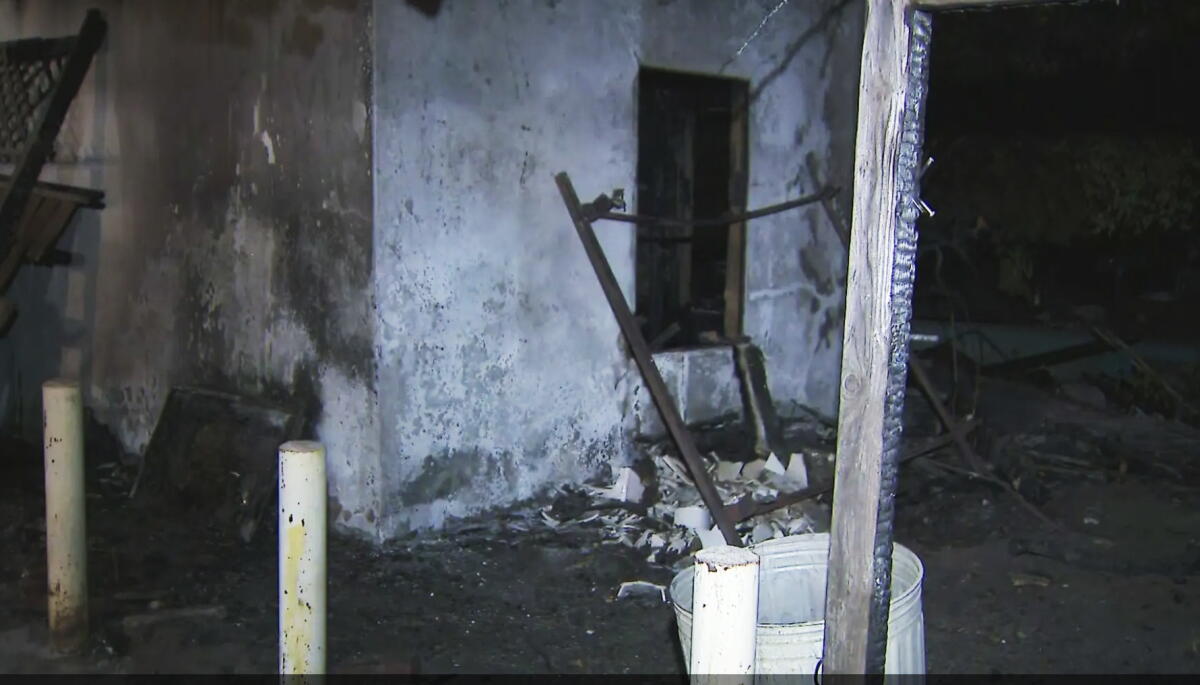
— OFFICE FIRE: A fire broke out at a building in Pacific Palisades where former mayoral candidate Spencer Pratt maintained an office for his crystals company. Pratt, whose home burned in the 2025 Palisades fire, called the latest blaze “very suspicious.” The fire department said it’s investigating.

QUICK HITS

  • Where is Inside Safe? The mayor’s signature program to address homelessness went to a stretch of Silver Lake Boulevard that passes under the 101 Freeway. That area is represented by Soto-Martínez.
  • On the docket next week: The council meets Wednesday to take up the massive 4th & Central project, which calls for offices, retail space and nearly 1,600 units of housing on a 7.6-acre site in downtown.

Stay in touch

That’s it for this week! Send your questions, comments and gossip to LAontheRecord@latimes.com. Did a friend forward you this email? Sign up here to get it in your inbox every Saturday morning.

Source link

They found a new park hiding in plain sight in the middle of L.A.

Just past noon, a young man appeared on the north side of San Vicente Boulevard, a block west of Hauser, and eyeballed the flow of westbound traffic.

When he saw an opening, he slid across to the median strip, where he waited for eastbound traffic to let up before crossing over to the south side of San Vicente to pick up some takeout food. And then he retraced his steps across the 150-foot wide thoroughfare that knifes through the heart of the city along what once was the Red Car line of the Pacific Electric Railway.

He should have used the nearby crosswalk, but there aren’t enough of those on the boulevard, so pedestrians routinely skitter and scoot across the street like they’re in a game of Frogger.

I watched this drama the other day from Dam Good Coffee, where I met with two guys who live in the neighborhood and, in their spare time, have been doing a lot of thinking. They’re fine-tuning a pitch to reengineer the boulevard, reduce traffic, improve access to two new transit lines and transform the Mid-City portion of San Vicente Boulevard — from the Beverly Center on the west to just past La Brea on the east — into a 3-mile, 30-acre linear park.

Ambitious. Outlandish. Insane.

Catherine Geanacouras, Oren Hadar and Michael Wacht, from left, of the San Vicente Park Foundation.

From left, Catherine Geanacouras, Oren Hadar and Michael Wacht of the San Vicente Park Foundation have a plan to turn a stretch of San Vicente Boulevard into a greenway.

(Christina House / Los Angeles Times)

It’s all of that and a longshot undertaking, given the countless obstacles that can derail their dream. But Oren Hadar, a sound engineer, and Michael Wacht, an architect, are serious, along with a small coalition of neighborhood believers.

“One of the things I always say is L.A. needs to get back into the business of taking big swings,” Hadar said. He is motivated in part by the fact that his two young kids don’t have a nearby park to play in.

The big swing comes at a time when Los Angeles has just fallen from 90th to 93rd in terms of park acreage, investment and accessibility in the annual Trust for Public Lands ranking of the 100 largest cities in the U.S. You’d think a city with great weather and thousands of apartment dwellers with little or no outdoor space would fight its way into the top 10 rather than settle for sinking to the bottom of the heap.

“What if L.A.’s next great park was already here, hiding in plain sight?” a narrator asks in a video that appears on the group’s San Vicente Park website.

Local resident Jo and her dog Elle carefully cross San Vicente Boulevard.

Local resident Jo and her dog Elle carefully cross San Vicente Boulevard in Los Angeles on Wednesday, June 17, 2026.

(Christina House/Los Angeles Times)

Sun-baked asphalt would give way to turf. Pedestrians and cyclists would have more breathing room. There’d be far less traffic.

“You can put in micro forests,” Wacht said. “You can do farmers markets. You can do growing areas. You can do fountains. Playgrounds.”

Catherine Geanuracos, a CicLAvia board member who was an advocate for turning the Silver Lake Reservoir into an aquatic park, joined our conversation and called the idea “eminently feasible.”

“I think this is what makes L.A. great,” Geanuracos said. She’s lived in New York City and San Francisco and thinks there’s greater opportunity here for engaged residents to advance their civic improvement ideas.

The advocates said they’d gotten some encouragement from Councilmembers Heather Hutt and Katy Yaroslavsky, whose districts include the area of the proposed park. Hutt’s office sent me a statement saying she supports “effrorts to create more walkable, green communities.” She said she has encouraged the group to keep exploring the vision, and she looks forward to hearing input from various other neighborhood groups.

Hadar writes a blog called The Future Is L.A., which is part love letter to Los Angeles and part lament on unmet potential.

“Just about every other major American city has a policy and research think tank dedicated to pursuing ideas that could make the city better,” Hadar recently wrote, calling for L.A. to have its own.

I don’t want to say the park idea’s chances are slim, but let’s look at a few hurdles.

Traffic passes through the intersection of San Vicente Boulevard and La Brea.

Traffic passes through the intersection of San Vicente Boulevard and La Brea in Los Angeles on.

(Christina House / Los Angeles Times)

L.A. city government has trouble managing existing parks and even the open spaces around City Hall, so how can it build and care for another 30 acres of greenery?

The cost would be in the millions, and the cup does not runneth over.

And then there’s the biggest pothole of all on the road to pastoral wonder:

Creating the park would mean squeezing off one or two lanes of traffic in each direction of San Vicente. That would dump more cars onto surrounding streets and set up another road diet clash that pits car culture against growing demand for a city that is safer and more inviting for those who walk, bike and use transit.

All of this would be examined in a feasibility study the advocates are raising money for. But the supporters claim San Vicente is lightly traveled compared to Wilshire, Pico and Olympic, so stealing traffic lanes wouldn’t be catastrophic.

I mentioned that I’d think twice about sending kids to play in a median strip park. But the supporters said San Vicente would become more of a neighborhood service street than a thruway, with safer crossings into the new park, which by the way already has plenty of full-grown trees.

When I took a walk and polled people on the park idea, I got mixed reactions.

“That’s a bad idea,” said a man who was walking along the median strip. He said he thought that after the addition of bike lanes a few years ago squeezed vehicular traffic, San Vicente became more dangerous, and the idea of a park between lanes of traffic sounded disastrous to him.

Miguel Lopez looked like he was trying to bring the park vision to life. He sat on the median strip reading a book and smiled when he was shown a rendering of San Vicente Park.

Blanca Vanburian practices tai chi in her yard along San Vicente Boulevard

Blanca Vanburian practices tai chi in her yard along San Vicente Boulevard on Wednesday.

(Christina House / Los Angeles Times)

Blanca Vanburian, who was doing a variation of Tai Chi on the lawn outside her apartment building, had several good questions, including one about whether the city could be trusted to maintain a new park. She said a lot of residents would be concerned about new traffic flows through side streets, and she wondered if the park would attract more homeless people.

Hadar told her the feasibility study would probe all of that, and the more she heard, the more Vanburian came around to the idea of the park.

“It’s up to us how we use public space,” Wacht said, looking out on a particularly unattractive stretch of roadway that generates so much exhaust and serves as a barrier, dividing two neighborhoods. “I get disappointed when I see so much of it devoted to this, and it’s keeping us from being more of a cohesive neighborhood.”

Margaret Free walks three basset hounds along San Vicente Boulevard.

Margaret Free walks three basset hounds, named Bob, Doris and Ruth, along San Vicente Boulevard in Los Angeles on Wednesday.

(Christina House / Los Angeles Times)

Margaret Free was walking three Basset hounds — Bob, Doris and Ruth. She said she and the dogs could be counted as four votes in favor of the park.

A woman named Jo safely managed a Frogger crossing with her dog, Elle. Jo said she was absolutely in favor of a park and doesn’t think losing lanes of vehicle traffic is a bad thing, but she feared backlash from drivers who disagree and asked me to withhold her last name.

Joshua Mock, owner of Dam Good Coffee, said everyone would benefit from the park, especially neighborhood children. “It’d be dope,” he said, “and good for business.”

For all the doubters, the advocates point to several projects around the country where public spaces were repurposed, including the New York City High Line. And they note that several local projects are in the design or construction phase, including the L.A. River master plan, the Broadway-Manchester streetscape project and the park under the Sixth Street bridge.

If you have ideas for remaking your neighborhood, send them my way.

And take big swings.

steve.lopez@latimes.com

Source link

Cagliari city break: Sardinia’s hidden gem you need to visit, with ‘best beach in the Med’

If you’re searching for a Sardinian city break with a difference, Cagliari has stunning Mediterranean beaches, flamingos and ancient history – and it’s just a short flight from the UK

If you’re contemplating a weekend escape this year, you’ve likely thought about one of Italy’s major destinations – timeless Rome or the enchanting cathedrals of Florence. Architecture, history, sunshine and some of the finest cuisine on the planet – Italian city breaks are difficult to surpass.

But here’s our suggestion – venture beyond the conventional and uncover something away from the masses, with even more on offer.

Roughly 220 miles from Rome sits Sardinia, and at the southern extremity the city of Cagliari is, according to my travel guide, “older than Rome”. It’s a city that combines multiple dimensions: ancient and contemporary, urban and natural, monumental and everyday.

Like Barcelona, it achieves the ideal balance between city and beach getaway. The beach, the largest stretch of sand I’ve witnessed in Europe, is merely 10 minutes drive from the centre, so you can transition from sipping cocktails in a rooftop bar in the Castello district, to barefoot walks along the shoreline.

And if you’re seeking a taste of nature, the salt flats – home to Cagliari’s flock of flamingoes – is a brief bus journey from the old town, reports OK!.

The historic core of the city is the Castello district, positioned on a limestone hill and surrounded by imposing walls. I had the privilege of exploring its delightful, narrow streets, and became captivated by the shaded piazzas and panoramic vantage points overlooking the Gulf of Angels.

While tourist favourites such as the Amalfi Coast and Rome continue to hog the limelight, Cagliari is steadily carving out a reputation as a must-visit destination — perfect for those seeking a hidden gem well away from the crowds. Here’s my ultimate itinerary.

Stay by the sea in Cagliari

You could always opt for the old town, but to truly soak up this coastal city, The MGallery Palazzo Tirso is a five-star boutique hotel tucked away in La Marina, one of Cagliari’s four historic quarters. From its rooftop terrace, you’ll be treated to stunning sea views alongside the magnificent sights of Castello.

For a holiday packed with rest and relaxation, Palazzo Tirso has everything you need, boasting a sauna, steam room, spa pool and a selection of L’Occitane-fuelled treatments. The 25-minute massage left me feeling as though I’d ascended into heaven.

The hotel also houses two restaurants: rooftop venue Cielo, offering all-day dining and aperitifs with DJs, and Terra, a genuinely gourmet spot showcasing prestigious recipes crafted by Palazzo Tirso‘s chefs.

My standout meal was at Sa Schironada, a charming little restaurant just a six-minute stroll from the Palazzo Tirso hotel. We shared a plate of traditional Sardinian bread and olive oil — which you simply can’t get enough of in Italy — and for my main, I tucked into a generous platter of mouth-wateringly delicious mussels in garlic and white wine sauce, accompanied by more Sardinian bread.

It was, needless to say, a glorious overload of carbs and seafood that left me fit to burst, but every single mouthful was absolutely worth it.

Spend a day flamingo spotting

Cagliari is extraordinary for its natural surroundings, so it’s essential you explore the Molentargius Salt Flats, where colonies of pink flamingos make their home. They’re situated within a protected park – a rare example of a lagoon ecosystem nestled inside an urban environment.

Alongside flamingos, you could also catch sight of the great white pelican, a cattle egret colony or, if you’re fortunate, the purple swamphen, with its metallic blue plumage and scarlet beak.

To enter the park, you can rent a bike for approximately €15 per day, or take a guided mini bus tour through the park, where they’ll provide a tour guide and a pair of binoculars.

Exploring the beach

Poetto Beach extends for several kilometres, and it’s among the defining features of local life. Far more than simply a beach, it’s a social hub: bustling throughout the year, where sports, relaxation, and community spirit converge.

The sheer scale of Poetto left me stunned. I’m accustomed to town beaches that are compact and pebbly, but this beach’s scenic expanse is magnificent.

From it, you also enjoy a stunning view of the Devil’s Saddle, the promontory at the precise centre of the Gulf of Angels and – according to legend – the location of the battle between good and evil. Good must have triumphed because the place is paradise.

Cocktails with a Michelin-starred chef

In an immersive cocktail experience courtesy of the Palazzo Tirso hotel, you can savour cocktail pairings crafted by Michelin-starred chef Pichaya “Pam” Soontornyanakij, aka Chef Pam – who received The World’s Best Female Chef status in 2024.

Her signature creations include Caviar-Crowned Tartare, Sun-Kissed Crab, and Squid’s Midnight Dip. Bite-sized masterpieces bursting with character, these are far from ordinary bar snacks.

Every piece is carefully designed to complement the drink alongside it, transforming an evening tipple into a truly curated occasion.

For wine enthusiasts, just 35 minutes north, tucked away amongst the rolling hills of Donori, lies Tenute Maestrale, a contemporary winery surrounded by undisturbed vineyards producing superb white, rosé and red wines, with tastings of three wines and traditional snacks starting from just £28.

When to visit Sardinia’s capital

Cagliari is stunning throughout the year, particularly during summer when the beaches and bustling streets truly come alive. For a genuine festival atmosphere, The Feast of Saint Efisio takes place annually from 1st-4th May.

It’s an 80km pilgrimage from Cagliari to Nora, retracing the route of Saint Efisio’s martyrdom. Thousands of participants, adorned in traditional costumes, accompany the saint’s statue on elaborately decorated ox-drawn carts.

It ranks amongst the longest and most ancient pilgrimages in the world, with the city traversed by a procession of 2800 people in traditional dress from across Sardinia, followed by 270 horsemen of Campidano, the Militiamen and the Guardiania.

How to book your Cagliari getaway

Rooms at MGallery Palazzo Tirso begin at £240 for bed and breakfast. You can reserve directly via the hotel’s website, or via Booking.com or Expedia.

Source link

Brits could face £43 tourist tax as European city proposes entry fee hike

The mayor of Venice is proposing an increase to the city’s controversial tourist entry fee, which could see the charge rise to as much as €50 (around £43) in a bid to tackle overtourism.

Brits heading to a beloved European holiday hotspot could soon face a new £43 levy. Simone Venturini, the newly appointed mayor of Venice, is putting forward plans to significantly raise a contentious tourist charge for visitors entering the historic city.

In 2024, Venice made history as the first tourist destination to impose an entry fee, initially set at €5, approximately $4.30, on busy days spanning April to July. Additional days were subsequently added to the scheme, with the charge for last-minute visitors later rising to €10, roughly £8.60.

Politicians maintain that the levy would help alleviate overcrowding in the ancient city and would deter people from visiting during peak periods. This comes as approximately 30 million people annually are believed to flock to Venice.

Mr Venturini is now pushing to raise the entry fee to as much as €50. This, he argues, will “discourage people further from coming to Venice at certain times of the year”.

Speaking to Corriere della Sera, he said: “If today it ranges from €5 to €10, my proposal is to increase it to €30 to €50.”

Critics of the initiative however claim it has made minimal impact on tourist numbers. Most visitors reportedly view it as “relatively insignificant” when weighed against the cost of a single glass of wine or a pint, reports The Telegraph.

Venice has continuously grappled with the challenge of overtourism. This comes as the city’s population has plummeted from approximately 170,000 in 1950 to roughly 48,000 today.

Visitors to Venice consistently exceed the number of locals. However, there were concerns that a hefty entrance charge might put off tourists who were deemed less affluent.

Former city mayor Massimo Cacciari went so far as to describe the fee as “barbarous”. He said: “There is no other city in Italy or Europe where you have to enter with a ticket, as though it was a museum.

“It is barbarous, uncivilised and, in my opinion, against the constitution. It is simply obscene. I thought that Venturini would be more intelligent than his predecessor and would scrap the fee.”

One business owner, however, has urged for the charge to be increased even more substantially. Jewellery shop proprietor Setrak Tokatzian suggests the city ought to be introducing a €100 levy on visitors.

Tourism expert Doug Lansky, recognised as ReThinkingTourism online, reckons the €5 charge would be unlikely to put anyone off. In a YouTube video he said: “I predicted that €5 wouldn’t have any effect.

“I mean, €5 isn’t enough to get me to choose one dinner entre over another at a restaurant, I’ve paid that much for a cappucino or a bottle of water at a concert.”

Source link

Mexico City looks to rein in street drinking after massive World Cup party | World Cup 2026

Mexico ‌City’s government said it is considering measures to limit ⁠the sale ⁠of alcohol in public spaces, after more than 700,000 people gathered downtown to celebrate Mexico’s football team advancing to the knockout stage ⁠of the World Cup.

Mexico’s victory against South Korea saw massive street celebrations, with fans dressed in green El Tri jerseys or wearing colourful Lucha ⁠Libre masks and dancing in the rain, waving flags, singing anthems and blowing on vuvuzelas.

Recommended Stories

list of 4 itemsend of list

The next morning, Reforma Avenue — one of the city’s main arteries — was littered with rubbish, and many of its yellow cempasuchil flowers had been ‌trampled over. Authorities collected some 40 tonnes of waste around the historic centre.

Mexico City’s government secretary Cesar Cravioto told a news conference on Friday that part of the government’s duty of care during the massive football event is prevention, and this involves controlling illegal sales of alcohol on the streets.

Cravioto said the government would ask restaurants and bars in ⁠the area to prevent customers from taking alcoholic ⁠drinks off premises and that convenience stores nearby could be asked to stop selling alcohol in the hours before a big game.

The government said it was planning on setting up ⁠seven more large screens around the centre-in addition to the current 12 — to help disperse crowds, ⁠and that it would deploy more personnel ⁠to limit the sale of beer by street vendors.

“We will keep insisting that fans have fun but without excessive alcohol consumption,” Cravioto said.

In Boston, another World Cup host city, Scottish fans, ‌known as the “Tartan Army”, drank such vast quantities of beer after Scotland’s team beat Haiti 1-0 at the city stadium that several bars reported ‌running dry.

Mexico is set to face the Czech Republic in the group stage on Wednesday.

Source link

Popular European city may hike tourist entry fee to ‘barbarous’ level as it fights back against 80,000 visitors a day

An image collage containing 2 images, Image 1 shows Tourists gather on the Rialto Bridge overlooking the Grand Canal in Venice, Italy, Image 2 shows Tourists crowd the area near the Rialto Bridge in Venice, Italy

ONE of Europe’s most popular destinations is set to hike its tourist entry fee in the fight against swarms of seasonal visitors.

The mayor of Italian jewel Venice is pushing to raise the city’s controversial entry fee to as much as €50 (£43).

Officials in Venice are pushing to raise the entry fee to €50 Credit: Getty
This proposal had been met with fierce opposition Credit: Getty

The proposal has already triggered fierce backlash, with critics branding it “barbarous” and unconstitutional.

Simone Venturini told The Times that increasing the charge is essential if Venice is to manage the growing pressure of overtourism.

He said: “The higher the ticket price, the better for us.”

Venice introduced its controversial pay-to-enter scheme in 2024, charging visitors on peak days up to €10 to access the historic city.

TRAIN CHAOS

Traveller chaos to major airport as officials say ‘do not travel’ after crash


DEEP DIVE

We’ve travelled all over Britain and found its best beaches – here are our faves

The scheme was introduced in 2024 to try and combat overtourism in peak months Credit: Getty
Those who do not buy a ticket can be hit with a €300 fine Credit: Getty

Under the current system, day-trippers who book less than four days before their visit pay €10, while those who reserve more than four days in advance pay €5.

Visitors entering before 8.30am or after 4pm are exempt, as are residents, people born in Venice, students and workers.

Tourists staying overnight in hotels or rental accommodation also do not have to pay.

Tickets are purchased online and checked at key entry points, including the railway station.

Those caught without one can face fines of up to €300.

The city is also expanding the scheme, increasing the number of chargeable days from 54 to 60 this year.

Opponents argue the scheme has done little to reduce visitor numbers.

Official figures show average daily visitor numbers fell only slightly during the summer, from 16,676 in 2024 to 13,046 in 2025.

Venturini insists the goal is not to put a cap on tourism altogether.

He said: “We need to keep an eye on the total number of visitors to Venice, but we do not want to put a maximum limit on tourists, so instead we can aim to get them to spread out and avoid coming on those days when we face the prospect of 80,000 visitors.

“That means getting the Italian parliament to approve higher prices, let’s say €30 or €50.

“That will cover the cost of services for tourists, including removing the growing amount of rubbish, but we could also offer ticket holders discounts for museums.”

The idea of charging visitors even more has provoked strong opposition.

Critics argue that if Venice is serious about reducing overcrowding, it should instead focus on limiting the number of properties being rented out through Airbnb.

Former mayor Massimo Cacciari said: “There is no other Italian or European city that you have to buy a ticket to enter, as if it were a museum.

“This is barbarous, uncivil and in my opinion anti-constitutional.”

Constitutional expert Ludovico Mazzarolli also told Corriere della Sera that a €50 entry fee could conflict with the Italian Constitution’s principle of free movement within the country.

Venice is not the only city trying to manage surging visitor numbers.

In Rome, authorities have introduced a €2 charge to access the lower area around the famous Trevi Fountain.

Meanwhile, the island of Capri continues to grapple with huge summer crowds, welcoming as many as 50,000 visitors a day during July and August.

To keep its narrow streets moving, visitors are encouraged to keep right when walking uphill and left when heading down.

Tour groups are now capped at 40 people, while guides leading more than 20 tourists must use wireless earpieces instead of loudspeakers.

Source link

Democratic socialists surge in mayoral races across the country as anti-Trump fervor rises

As Janeese Lewis George paves a path to the mayor’s office in Washington, D.C., she’s told voters they could have it all.

Her unapologetically expansive, left-wing agenda includes subsidized or even free childcare, increased down payment assistance for homebuyers and community resources to reduce crime, plus a promise to aggressively confront President Trump’s attempts to reshape the nation’s capital.

“People are tired of hearing what government can’t do. They want to hear what government can do,” Lewis George said in an interview before the city’s primary, where she defeated her Democratic opponents and positioned herself to win the general election in November in a city dominated by Democrats.

Lewis George’s victory signals a break with a quarter-century of centrist governance in Washington, and it puts her in the vanguard of democratic socialists who have ascended in urban politics over the last year. Zohran Mamdani toppled Andrew Cuomo, the scion of a political dynasty, on his way to becoming New York City mayor. Katie Wilson won an upset victory to lead Seattle last fall. And this month, Nithya Raman clinched a spot in the November runoff against Los Angeles Mayor Karen Bass.

All of them are members of the Democratic Socialists of America, or DSA. The political organization has seen its membership ranks swell from a few thousand to more than 100,000 nationwide over the last decade after an influx of younger Americans joined following the presidential bids of Vermont Sen. Bernie Sanders, also a self-described democratic socialist.

There’s little sign of national coordination among the candidates, and it’s unclear whether voters are gravitating toward their promises of improved government services, their vows to fight the Trump administration or their critiques of capitalism.

But from coast to coast, confrontational progressives are advancing in mayoral races. City leaders can draw outsized attention for their successes and failures, and democratic socialists will be under pressure from residents to deliver on their vows for a new kind of governance. Whether that translates to national politics is a next test for their movement.

“They are all channeling a displeasure with a status quo and a serious desire for economic populism that the establishment Democratic Party hasn’t been preaching,” said Eric Stern, a Democratic strategist with Fight Agency, a political consulting firm that strategized Mamdani’s mayoral campaign.

Stern added that Democratic voters appeared more willing to support the most progressive candidate in mayoral races rather than in contests for the U.S. House. Candidates like Mamdani and Raman, Stern said, are “daring voters to dream and fall in love not just with the individual candidates but also the political process as a whole.”

A rising left navigates America’s urban challenges

The trend of progressives surging in urban areas may have limits for its broader impact on Democratic politics. Democratic mayors in cities including Atlanta, Houston, Miami and San Francisco won on relatively moderate platforms in recent years.

Progressive have also faced noteworthy challenges. Chicago Mayor Brandon Johnson was endorsed by the city’s DSA chapter during his 2023 mayoral run but has since faced criticism from both moderate and liberal local leaders on issues such as immigration, the local budget and public safety. Recalls and public pressure ousted progressives elected to district attorney offices in multiple jurisdictions over the last five years, when criminal justice reform efforts ran into dissatisfaction over public disorder following the COVID-19 pandemic.

Trump’s hardline immigration and law enforcement tactics have also become a challenge for liberal cities. The president’s agenda poses an especially serious threat to Washington, D.C., because of its status as a federal territory.

“Maybe we take back Washington and run it on a federal basis,” Trump told reporters this month when asked about the potential election of a democratic socialist as the district’s mayor. “We won’t put up with it.”

But progressives hope the current wave of anti-Trump furor in deep blue cities across the country will help buoy the chances of those on the hard left.

“It’s not folks looking for the leftmost option so much as looking for a candidate who’s gonna be on their side,” said Ravi Mangla, speaking for the left-wing Working Families Party. The party often endorses the same candidates as the DSA and is readying to target more mayoral offices in the country’s biggest metropolises this fall and in 2028.

“It’s less about whether you are on the right or on the left so much as whether you are willing to punch up at the powerful,” he added.

Mamdani and Lewis George are both self-described “sewer socialists” who emphasize the need for responsive government services rather than critiques of market economics. The phrase recalls the socialist Gilded Age mayors whom critics derided as too preoccupied with managing public works projects.

The term’s revival is partly a strategic move to align leftist ideas with concerns over affordability and the economy, voters’ top concern in the midterm elections, and shift the public perception of democratic socialists from firebrands who support radical policies to independent-minded public servants.

“This is absolutely a change election and I’m excited to bring the change that people want, which is really putting people first in the city and having the moral clarity and courage to stand up to Trump,” Lewis George said.

For voters the ‘socialist’ label did not seem to matter

While conservatives have used the “socialist” label to attack Democrats as extreme or incompetent, some D.C. voters appeared ambivalent before Tuesday’s primary.

Several lifelong residents said they believed Lewis George was a “fighter” but didn’t think she’d have much of an impact on the local economy, given the city’s status as a federal district.

“I go back and forth on my own labels and whether I am supportive of that movement or not, but I am supportive of making D.C. more affordable,” Owen Fitzgerald, a University of Maryland graduate student, said of his support for democratic socialism.

Fitzgerald voted for Lewis George because she would stand up to Trump and said he’d first learned of her campaign from friends in his neighborhood. But he didn’t know she was a democratic socialist until he saw news reports describing her with the label.

“It sends a cultural message to this administration that the people who are surrounding them in the capital are opposed to their platform, opposed to their political agenda, and I think that it will send a message, both nationally and internationally,” Fitzgerald said.

Brown writes for the Associated Press.

Source link

An Anaheim vision: The Anaheim Angels in a new stadium, next to a youth sports complex

Civic pride, sure. But what is it really worth to the city of Anaheim to have its name on the hometown baseball team?

Hundreds of millions of dollars, the city has said. As the Angels’ stadium lease approaches its end, and as Anaheim prepares for negotiations either with Arte Moreno or a potential new owner, it’s worth keeping in mind.

So too is a concept floating around City Hall in Anaheim: What if we could put a new stadium and a youth sports complex next to one another?

Nothing is imminent, and even a bill winding its way through the state legislature would not necessarily require the Angels to return Anaheim to the team name.

It’s leverage: If the Angels’ owner wants to build atop the stadium parking lots, the city can pursue an exemption to a state law that currently restricts what can be built there, which could mean more money for the team and its development partners. In exchange for the exemption, the team name would revert to the Anaheim Angels.

If that’s the carrot, this is the stick: The city would have to approve the zoning changes that could make the land “two to three times more valuable than it is as a parking lot,” Anaheim Mayor Ashleigh Aitken said.

Said Aitken: “There are no gifts. For an ownership to truly be a partner to the city in what that property could be, there is going to have to be some realization that Anaheim is not Los Angeles.”

The Angels’ stadium lease expires in 2032, and the team can extend it through 2038. A new owner could move the Angels — or at least leverage the threat of a move — but Anaheim offers a 150-acre site with what every owner in pro sports covets: land around the venue to turn the property into a year-round money-making operation.

The standard ballpark villages include restaurants, shops, hotels, homes, offices and entertainment venues. The Ducks are launching one, called OC Vibe, around Honda Center, and within walking distance of Angel Stadium.

What intrigues the city, for at least part of the parking lots around Angel Stadium: a youth sports park for all those travel ball teams. Ontario is building a 199-acre one around a minor league ballpark; Irvine has a 194-acre one up and running at its Great Park.

Katie Wright, who books sports events for Anaheim’s tourism bureau, said there would be a market if her city built a sports park.

“The demand for, specifically, soccer, baseball and softball is tremendous,” Wright told the Anaheim City Council in April. “They would be filled every single weekend, I think.”

What Anaheim has that Ontario and Irvine do not: Disneyland down the street for visiting families, a variety of restaurants within walking distance, and hotel rooms aplenty. In Anaheim, 40% of the city’s general fund comes from taxes on hotel rooms.

“With Angels baseball right next to a youth sports facility, to have the synergy of hotels and restaurants, and players interacting with the Little League kids and soccer fields,” Aitken said, “I just think it’s a unique opportunity.”

Everything old is new again: In 1996, Anaheim pitched a youth sports center called the “Little A” in part of the stadium parking lots as part of a ballpark village that never materialized.

What might be in the best interest of the city now might not be in that of the developer, whether that turns out to be the Angels or a real estate partner. While a sports park might drive tax revenues to the city, a developer might pay the most for land used for hotel and retail properties, said Louis Tomaselli, the Irvine-based executive managing director at JLL, a nationally prominent commercial real estate brokerage.

“A youth sports complex would likely be at or near the bottom from a land value perspective,” Tomaselli said.

That’s all part of the negotiation, and for now the city of Anaheim has no party with which to negotiate. That leaves room for all sorts of brainstorming, including Aitken’s curiosity about flanking the development with high-rise residential buildings, similar to the condominiums that have risen next to Petco Park in San Diego. In some of them, you can watch the game from your balcony.

But let’s get back to the value of the Anaheim name on the baseball team.

“A lot of times, we get the question, ‘Exactly where is Anaheim?’” Wright, the Anaheim tourism official, told the City Council. “We’re always fighting to say, ‘We’re not L.A.’”

In 2005, when Anaheim sued the Angels after Moreno slapped the Los Angeles label on the team, the city commissioned experts that testified the name change would cost Anaheim nearly $200 million over the following decade and close to $400 million through 2029. The Angels dismissed both numbers as wildly high, but that is what the city presented in court.

I asked Sean Moran of Los Angeles-based Innovative Partnerships Group for an update. Moran estimated the worth of the Anaheim name at $26.5 million per year — or more than $500 million over the life of a 20-year deal — based on the value of references to the city on game broadcasts, digital and social media, highlight clips, betting sites, in fantasy leagues, and more.

“I don’t think you can put a monetary value on civic pride and respecting your fan base,” Aitken said. “So, if a new owner wants to come in and start fresh and really respect the fan base in Orange County, the name should not even be a negotiating point.

“It should be the first thing you do, out of respect for where this team is located, and the fan base that is so loyal in good times and bad.”

Perhaps. But, if I’m the new owner of the Angels and the city is on record saying its name on the team is worth hundreds of millions of dollars, the first thing I say to the city in negotiations is: You can get your name on the team for that $500 million, which would help me build a new ballpark that could cost $1.5 billion.

Who else could benefit from that? Moreno, as the need for a new owner to pay for a ballpark could lower the sale price.

Even without that exemption from state law, a new owner could pursue a fair amount of development on land Anaheim has failed to develop for 60 years, on a site the city’s own land use plan envisions as “an exciting mix of high energy uses while providing additional housing.” Or a new owner could simply inherit the existing lease and deal with potential development later.

You can start to get the shape of what the bargaining might look like. Avelino Valencia (D-Anaheim), the assembly member who introduced the bill in Sacramento intended to spur the return of the Anaheim Angels name, included a provision that says resolution would take precedence over legislation.

“If there is another outcome that takes place, in negotiations or deal-wise, there would be no need for this, right?” Valencia said.

All of that could be years down the road, so no sense arguing all the finer points now. Aitken promises a series of community meetings first, so that Anaheim residents can share how they envision the future of the Angel Stadium property, with or without a baseball stadium.

This should come up for discussion too: The Anaheim Angels name might be ideal for the city, but what, if anything, should the city give up to get it? The last time the city asked, Moreno just said no. If a new owner would be willing, should the taxpayers of Anaheim consider subsidizing the name?

Source link

Trump administration can replace Washington slavery exhibit in Philadelphia, appeals court says

The Trump administration can replace a slavery exhibit at George Washington’s home in Philadelphia, a federal appeals court panel said Thursday, striking down a lower court’s injunction that required the National Park Service to reinstall the interpretive panels.

The unanimous ruling by the three-judge panel of the 3rd U.S. Circuit Court of Appeals said a lower court judge wrongly interpreted Philadelphia’s contract claims involving Independence National Historical Park, saying the city merely having standing to sue did not mean its arguments had merit. The panel also praised the plans for the replacement installation, writing that they were “full of historical context,” despite objections from historians and city officials that the content appears whitewashed.

The ruling comes a week after a Massachusetts federal judge ordered the Trump administration to restore sites changed under an executive order calling for the nation’s museums, parks and landmarks to not display elements that “inappropriately disparage Americans past or living.” The federal government has asked for a stay on that ruling while it appeals.

It was unclear how the Massachusetts ruling would affect the restoration or replacement of the panels at the President’s House Site. About half the large panels at the outdoor exhibit had been restored before a February pause in the work.

Messages to spokespeople for the Department of Interior and the National Park Service were not returned.

In a statement on Instagram late Thursday, Philadelphia Mayor Cherelle Parker vowed to pursue legal avenues to reverse the decision.

“We cannot and WILL not rest until the full story of American history – including the existence of Slavery at the President’s House here in Philadelphia – is told, for our Nation and the World to see,” she wrote.

Dawn Chavous, a volunteer for Avenging the Ancestors Coalition, one of the advocacy groups that helped develop the site in the 2000s, said they are disappointed with the decision but are speaking to their attorneys and considering options.

“For decades, ATAC has worked to ensure that the stories of the enslaved African descendants who lived and labored at the President’s House are not erased, overlooked, or misrepresented,” the group said in an emailed statement. “That commitment remains unwavering. We believe that historical truth matters, and we will continue to advocate for the protection, preservation, and accurate interpretation of this important chapter of American history.”

The city of Philadelphia sued in January after the National Park Service, in response to President Trump’s executive order, removed the explanatory panels from the President’s House Site, where George and Martha Washington lived with nine of their slaves in the 1790s, when Philadelphia was briefly the nation’s capital.

The city had worked in tandem with the federal government, historians and private partners to create the exhibit in the early 2000s — as part of a longstanding cooperation agreement over the downtown historical park — and contributed $1.5 million toward its creation.

The city argued that the federal government must consult with the city before making changes to the President’s House Site. Justice Department lawyers argued the administration alone can decide what stories are told at National Park Service properties.

In its ruling Thursday, the appeals panel said the maintenance portion of the contract between the city and the federal government could not be interpreted to mean the site would remain as it was when it was completed.

“The duty to ‘maintain’ is better understood as a general management obligation that accompanies ownership, not a promise that the exhibits will forever remain in place regardless of the owner’s wishes,” the opinion said.

Casey and Lauer write for the Associated Press. Casey contributed to this report from Boston.

Source link

‘I love America!’: With the World Cup, Inglewood becomes an international hub

Daiki Kaneko had only 24 hours before his World Cup journey took him to Dallas, where his home country’s squad will take on Sweden.

The Japanese soccer fan was making the most of it on Tuesday in Inglewood, snapping pictures of SoFi Stadium before taking in a different kind of monument: a space-age, two-story branch of the chicken chain Raising Cane’s, complete with a 308-square-foot screen, a mirrored dog sculpture and a massive halo hovering around the exterior.

For Kaneko, 25, who lives in the Tokyo suburbs, it was the perfect encapsulation of American grandeur.

“All this for chicken,” he said. “I love America.”

Inglewood is already diverse — most residents are Latino or Black, and nearly a third are immigrants. But during the World Cup, it’s looking more like the United Nations. English, Japanese, Swiss, Iranians, Paraguayans, Bosnians, Belgians and others are flocking to the city of about 102,000, where eight matches are being played at SoFi Stadium.

Though visitors from abroad may not have heard of Inglewood until now, they’re soaking up the vibes of a city that has long been a major sports and entertainment hub, home to venues such as the Kia Forum and Intuit Dome, and a crucible of Black culture, immortalized in hip-hop songs by artists such as Tupac Shakur and Dr. Dre.

“We’re an international city now,” Mayor James Butts said.

Butts said locals were already proud of what the city has become, but the World Cup has put the celebratory feelings over the top.

“We have people from so many different countries migrating to Inglewood, and there’s an explosive sense of community pride,” he said.

Bartender Elijah Gonzalez, left, mixes a drink at the Nile Bar while customers watch World Cup soccer preview.

Bartender Elijah Gonzalez, left, mixes a drink at the Nile Bar in Inglewood while customers watch a World Cup soccer preview.

(Allen J. Schaben / Los Angeles Times)

City officials are doing everything they can to embrace the spirit of the tournament, including speeding up permits so small businesses and neighborhoods can hold World Cup gatherings and watch parties, Butts said. During the U.S.’s opening match against Paraguay on June 12, the city hosted the Wood Cup, a block party on Market Street that brought in more than 5,000 people.

Businesses across the city are embracing the tournament as well, vying for a piece of the roughly $17 million the city expects to haul in. For a few weeks, concerns about skyrocketing housing costs and gentrification, brought on by the city’s increasing popularity as a place to settle down, are taking a back seat to the sheer fun of international soccer.

The supersized Raising Cane’s had its grand opening on June 11, the first day of the tournament. During the USMNT’s opening match, Cinepolis, a luxury movie theater down the road from SoFi Stadium, turned into a global sports hub, according to CEO Luis Olloqui.

Maddy Daversa, a bartender at the Meeting Spot, a restaurant near the stadium, said 2,000 people poured in when the Americans played Paraguay.

“I was selling beers for five hours straight,” she said. “It was crazy.”

Daversa said the restaurant is usually closed on Mondays but opened in hopes of getting some spillover fans from the Iran-New Zealand game at SoFi.

“Every table was full,” she said. “We’re taking advantage.”

Tuesday was an off day for Inglewood, with no games at SoFi. But the energy was still palpable, with locals sporting soccer jerseys and tourists popping up across the city.

“I just want to be where the fans are,” said David Meier, a Swiss fan in town for his home country’s match against Bosnia-Herzegovina on Thursday.

Meier, 45, plans to explore L.A. via bars, restaurants and watch parties, taking in every game that his schedule will allow before heading north of the border to Vancouver, where Switzerland will face Canada on June 24.

“Everyone has been so kind,” he said. “Soccer and beer turns strangers into friends.”

Flags from a variety of countries competing in the World Cup are on display

Flags from countries competing in the World Cup are on display at Manchester Boulevard and South Market Street in Inglewood.

(Allen J. Schaben / Los Angeles Times)

The energy carried over to Market Street, a historic shopping district about a mile from SoFi Stadium. Businesses set up signs, posters and international flags to lure locals and tourists alike, while the Miracle Theater hosted a watch party for the match between France and Senegal.

Owen Smith, who co-owns the theater with his wife, Mariana, said a Senegalese friend who grew up in France asked if he would be willing to show the game on the big screen. A day later, fans of both teams assembled inside, snapping photos in front of a giant inflatable World Cup trophy in the lobby.

“The Miracle is a cultural event theater. It’s about accommodating the community,” Smith said.

Benyam Woldegiorgis, who co-owns the Nile Bar on Market Street, is showing every single World Cup match — all 104 of them.

“It brings in business,” he said. “Usually it’s just football, basketball and baseball, but now we’re adding soccer to the mix.”

Dionte Johnson, owner of the streetwear store Kingsrowe, partnered with Adidas to hold a watch party for the U.S. team’s opener and said the turnout was massive, bringing in loads of Mexico fans who are local residents, even though their team had already won their opener the day before.

“The downside of the World Cup is that tickets are so expensive, so a lot of locals can’t go check out the games themselves. That’s why we’re hosting events,” Johnson said. “The games are in our backyard, so this is something people have had on their calendar for a long time.”

Homeowners are cashing in as well, with some renting out their places on Airbnb for a small fortune, figuring that crashing on a friend’s couch or booking a hotel room elsewhere is well worth the lofty payouts brought by World Cup demand.

Across L.A., hotel demand lagged compared with initial expectations, but short-term rental prices still jumped 56% compared with typical rates, and more than 70% of rentals were booked by December 2025.

In Inglewood — especially for rentals walkable to SoFi Stadium — prices became dizzying.

David (pictured) and Peggy Orenstein, run an Airbnb across the street from SoFi Stadium.

David Orenstein and his wife, Peggy, run an Airbnb across the street from SoFi Stadium. It usually rents for $400 per night, but for the U.S. team’s opening game, it went for $3,000.

(Robert Gauthier / Los Angeles Times)

Peggy Orenstein and her husband, David, own a home steps from the stadium that typically rents for $400 a night on Airbnb. For the U.S. team’s opener, the nightly rate shot up to $3,000.

For other matches, the four-bedroom house is going for $1,200 to $1,500 a night. Orenstein said the high demand and international crowds are a teaser for what’s to come.

“Next up is the Olympics,” she said. “This is a great learning lesson for what we can expect.”

Source link

Mamdani gives New York Knicks keys to city after NBA title | Basketball

NewsFeed

The New York Knicks celebrated their first NBA title in 53 years with a frenzied ticker-tape parade through Manhattan. The Knicks, along with finals MVP Jalen Brunson were awarded keys to the city by Mayor Zohran Mamdani in front of thousands of fans.

Source link

Sun-soaked European city has Aperol Spritz for 86p – and UK flights from £17

Fans of the classic cocktail, which has seen a huge resurgence in popularity in recent years, should head to this sunny city where you can enjoy a glass of the summery orange drink for just one Euro

Head to the Mediterranean during the summer months and you’ll often see tables laden with oversized glasses of Aperol Spritz. The iconic orange cocktail has become a holiday staple, whether it’s served at a pavement café in a cobblestoned old town, or a beachfront bar with plastic chairs.

But like many so aspects of holidays, the price has been steadily rising in popular resorts, turning it into a costly treat. However, there are still places where you can pick up an inexpensive cocktail, and one city has been named the cheapest spot to enjoy an ice cold Aperol.

Travel money provider eurochange has put together an Aperol Spritz index, tracking the top ten cheapest destinations in Europe where you can enjoy this summery cocktail without worrying about your bar bill, and luckily the least expensive spot is just a three-hour flight from the UK.

According to the research, Naples in Italy is the cheapest place to order your Aperol with the average cost coming in at €2 (approximately £1.73), but one bar is famous for serving these sunset cocktails for just one Euro (approximately 86p). Don’t expect a fancy cocktail bar if you visit Cammarota Spritz as it consists of tables crammed into an alleyway and drinks served in plastic cups, but the lively atmosphere has seen it receive a raft of positive reviews, with one saying it was: “Our favourite bar in Naples, no messing about with ‘drink-in’ or ‘takeaway’ prices, no service charges, just good cheap Spritz.”

And after a few Euro spritzes, you may find yourself craving another Napoli staple; the city is the birthplace of modern pizza, and you’ll find plenty of hole-in-the-wall places where you can pick up a slice. A popular late-night snack is pizza al portafoglio, also known as ‘wallet pizza’ as it comes folded and served in paper so you can devour it while walking back to your hotel.

Naples is ideal for as a spring or autumn city break, offering about 210 sunny days a year, so you can enjoy the winding historic streets and visit attractions such as Museo Cappella Sansevero, home of the stunning marble Veiled Christ statue.

Explore the city’s ancient sites at Napoli Sotterranea – underground Naples – taking you through an extensive network of streets and squares built under the surface by Romans and Greeks. Pass throw the narrow tunnels of the aqueduct, see old air raid shelters from World War 2, and climb through a hatch into the ancient Roman theatre of Neapolis.

Naples also has a variety of beaches, including some small stretches of sand on the outskirts of the city. These urban beaches can be small and busy during heatwaves, but they’re perfect for when you simply want a quick dip in the Med.

You can also take buses further down the coast for a day at a beach club or a public beach. Close to Naples you’ll find Gaiola Beach, famous for its islets that rise from the sea that can be crossed by bridge. Or the craggy coastline of Scoglione Marechiaro, famous for its turquoise waters.

Have a story you want to share? Email us at webtravel@reachplc.com

Source link

Europe’s largest funfair opens in UK city this weekend with over 400 rides and attractions

EUROPE’S largest funfair is returning to the UK this weekend, as the huge stretch of rides comes back for its 144th year.

Over 400 spectacular attractions will be on offer for all the family, including a new record-breaking ride for the ultimate thrillseekers.

The Hoppings is back for another year, as the summer funfair hits Newcastle’s Town Moor Credit: Get into Newcastle
The funfair spans over half a mile in the city centre, making it the biggest in Europe Credit: Get into Newcastle

The Hoppings is back for its 144th year this weekend, as Newcastle’s Town Moor anticipates the return of Europe’s biggest funfair.

Located at the heart of the city centre, the funfair offers over 400 attractions and rides for thrillseekers and families alike – from the giant ferris wheel, to the classic helter skelter.

Despite occupying a smaller space than previous years, due to drainage works on the Moor, the fair still keeps all its excitement, and visitors can expect to see a jam-packed line-up.

After centuries of history, and a deep-rooted sense of North East nostalgia the fair evokes, generations of Geordie families love returning to The Hoppings year after year.

GREEN DREAM

Inside the little-known UK attraction used by Little Mix, Kylie and Bridgerton


SUN IN

Holiday expert reveals the cheapest all inclusive summer holidays – from £228pp

The fair includes a whole host of classic rides, and brand-new thrillseeking fun Credit: Alamy
JGA1A6 Hook-a-duck, The Hoppings, Town Moor, Newcastle upon Tyne Credit: Alamy

This year, the fair has unveiled a whole host of adrenaline-pumping rides, including the return of fan-favourites Atmosfear and Extreme.

The stage has been set for the arrival of a record-breaking high-flying experience with the launch of the brand-new Elevate85 attraction.

Climbing up to 80metres, this drop tower with flying chairs has been hailed as “the world’s highest travelling ride” – only 10metres shorter than London’s Big Ben.

Foodies have another reason to celebrate with a brand-new Spud Bros stall joining the line-up, only weeks after the launch of its popular North Tyneside store.

The fair has spent the last week in June on the Town Moor since 1882 Credit: Alamy
The Hoppings typically attracts 500,000 visitors every year Credit: Alamy

The daily line-up also includes a Live Lounge stage with country, rock, and pop music, alongside delicious treats on offer from the Feast Street food village.

The arrival of the Hoppings in the last week of June is a fixture of the Geordie calendar, and has been since 1882.

Opening on the Town Moor over a century-and-a-half ago, the fair was initially marketed as a tee-total event to counteract the boozy activities of Newcastle Race Week.

Its initial form included traditional amusements and roundabouts, as well as kite-flying contests and military shows – a step away from its current form.

The Hoppings has evolved to represent the warmth and welcoming nature of Geordies themselves, and shows a city beyond bustling nightlife and football passion.

Now, the fair attracts over half a million annual visitors to indulge in the vibrant lights, exhilirating rides, and all the fun of the fair.

For those wanting to visit Newcastle, The Hoppings is the perfect starting point for organising a tour, with the city centre situated a 30-minute walk away from the Town Moor.

From there, a walk along the Quayside to see the famous Tyne Bridge, The Glasshouse and River Tyne is a must, with foodstalls often lining the streets on weekends.

Newcastle city centre offers lovely views and exciting shopping experiences Credit: Alamy
Tynemouth Longsands, only a 30-minute commute away, is one of Britain’s best beaches Credit: Alamy

Newcastle, and surrounding North East towns, are incredibly well-connected with the Tyne and Wear Metro, with 60 stations and two separate lines.

Many may not know that the city has some of the best coastlines in the UK – travel 30 minutes east on the Metro and visit Tynemouth Longsands and enjoy the scenic views from the coastal villages.

Entry to The Hoppings is completely free this year, with standard ride prices ranging from just £3 to £5 and high-thrill attractions costing slightly more.

The Hoppings is returning for its 10-day bonanza between June 19 and June 28, running from 2pm to 11pm on weekdays, and 1pm to 11pm on weekends.

Source link

European city launches strict new ban on its streets after 666 accidents

This method of transport is a cheap and easy way to get around the city, but it has caused hundreds of accidents in the past year. Now there are calls for a ban across the European Union

A European city has banned a mode of transport that’s popular with tourists on day trips, after a huge number of accidents were reported in the past year alone.

Brussels will rid its streets of shared e-scooters as of January 2027, with authorities in the Brussels-Capital Region announcing the move last week. Currently, the Belgian capital has two remaining scooter operators offering shared e-scooters, Bolt and Dott, and once their licences expire at the end of 2026, they will not be renewed, according to the Brussels Times.

Authorities voiced their safety concerns around the use of e-scooters and the nuisance they can cause to local residents. The move means Brussels follows other European cities who’ve removed shared e-scooters, including Paris, Madrid, and Prague.

Brussels mobility minister Elke Van den Brandt and minister-president Boris Dilliès made a shared statement about the ban, calling shared e-scooters a “growing nuisance to other road users”, and pointing out that 666 accidents involved e-scooters in 2025, a year on year increase of 26%.

They also highlighted that rental scooters were often used for criminal purposes, and were involved in the cases of 25 shootings in Brussels last year.

Boris Dilliès said: “The decision to exclude self-service scooters from the Brussels urban landscape is part of a clear and consistent policy. Often synonymous with disorder, self-service scooters are a source of nuisance, cause serious injuries, clutter the streets and are, unfortunately, increasingly being used by organised criminals. Self-service bicycles, on the other hand, remain for us an essential part of a mobility policy.”

However, in a statement, e-scooter rental firm Bolt argued: “When scooters are the subject of public debate, whether regarding road safety or parking, private and shared scooters are almost always lumped together, even though they are fundamentally different.

“Banning [shared scooters] will not stop people from getting around. It will drive users towards private, unregulated, untraceable and genuinely dangerous scooters, or towards more polluting modes of transport. Neither of these scenarios serves Brussels’ objectives regarding safety, congestion or the climate.”

Since the ban was announced in Brussels, the Benelux Union, a partnership between Belgium, the Netherlands, and Luxembourg, has called for the European Commission to create a single framework for all EU countries, which could make it easier for other countries to make their own regulations.

Benelux pointed out there are inconsistent safety standards among member states, and not all vehicles on the market were safe and suitable to be used on public roads. The lack of guidelines also make it difficult to prevent unsafe vehicles from being put out for hire.

The UK has banned privately owned e-scooters from public roads and pavements, meaning the only legal place to ride your own e-scooter is on private land. There are a handful of legal rental schemes in some areas of London, Birmingham, and other cities, with strict criteria such as limiting the e-scooters to 12.5mph, banning riders under 18, and requiring a provisional licence to hire one.

Have a story you want to share? Email us at webtravel@reachplc.com

Source link

I spent 3 days in Europe’s sunniest city for a fraction of the cost of a UK staycation

Sipping coffee in a grand square at one of Europe’s oldest cafe’s, Lucy Williamson discovers a Mediterranean escape that manages to be a city break, beach holiday, and history lesson all at once

Malta: The Ultimate Lazy Traveler’s Weekend Guide

A spa day in the UK can easily set you back £150 before you’ve even ordered lunch. So when I found myself sipping coffee in a grand Maltese square at one of Europe’s oldest cafes, watching the morning sun bounce off honey-coloured limestone buildings after a £40 flight from London, I couldn’t help feeling I’d stumbled across one of Europe’s best-value city breaks.

Malta has long been a favourite with British travellers. Yet somehow it still feels slightly overlooked when conversations turn to weekend escapes. People talk about Lisbon, Barcelona and Rome. Meanwhile, sitting in the middle of the Mediterranean, Malta quietly enjoys more than 300 days of sunshine a year; making it one of the sunniest in Europe.

I spent three days there for a spontaneous solo trip and quickly realised Malta has cracked something many destinations haven’t. It manages to be a city break, a beach break and a history lesson all at once, without requiring military-grade holiday planning.

The first thing working in Malta’s favour is its size. This is not a destination where you’ll spend half your holiday staring at Google Maps, wondering whether the slightly disappointing mural is really worth a 45-minute metro journey and an existential crisis in the heat. Most places are close together. The capital city, Valletta, is wonderfully walkable.

Do you have a travel story to share? Email webtravel@reachplc.com

Things to do

If you stay in neighbouring Sliema, as I did at the Preluna Hotel (about £200 for two nights, includes its own beach club) accommodation is often cheaper than inside the capital itself. And the short ferry across to Valetta costs just a few euros. It glides over the water toward a city that looks like an enormous sandcastle built by a giant child who grew up to become an architect.

Many of the highlights cost nothing. The Upper Barrakka Gardens offer some of the finest views in the Mediterranean. Down below, crowds gather for the Saluting Battery (every day at 12pm and 4pm) where cannons are still fired in a tradition dating back centuries. Men in historical uniforms are responsible for the blasts which are to let everyone know what time it is. I loved it, but it seems an incredibly loud and dramatic alternative to just looking at your phone.

Jokes aside, it is an impressive tradition, although you only need to forget it’s happening once to understand why locals still flinch.

You also cannot miss the staggering Baroque interior of St John’s Co-Cathedral (€15 for adults) a church so violently covered in 24-carat gold leaf that it looks like the inside of a divine Ferrero Rocher.

Elsewhere, the city’s streets themselves do much of the heavy lifting. Ornate balconies lean over narrow lanes while laundry flutters overhead on washing lines. It is a deeply moving reminder that even though Valletta was built by the Knights of St John to defend European civilization from the Ottoman Empire, your romantic view of a historic fortress city is occasionally interrupted by a pair of massive beige knickers blowing in the wind.

Locals treat the sea like a public swimming pool that happens to have excellent views. Rocky platforms replace sand. Towels appear. People jump straight into the Mediterranean without the usual British negotiation involving sunbeds, parasols and passive aggressive towel placement.

No one seems to be running a system. It works anyway.

British nostalgia with better weather

Malta occasionally feels like Britain left something behind and never quite bothered to come back for it.

The island was part of the British Empire for more than 150 years, and the influence is still visible in ways that feel slightly surreal. English is an official language. Red phone boxes still stand in corners like they are waiting for a call that will never come.

I wandered into the local branch of Marks and Spencer to check on the progress of British civilization. I can confirm they did not have any picky bits in the Malta store; the traditional British tapas. But they did have tinnies – the traditional fuel for a British explorer. A Monsoon sits nearby. Even a copy of that day’s Daily Mirror at the local newsagent’s.

Where to eat

That blend of influences extends to the food scene. Malta borrows happily from Italy, North Africa and Britain, creating a character all of its own.

One street that perfectly captures the atmosphere is St Lucia Street. By day, it’s an attractive stepped lane. By night, it transforms into one of Valletta’s most buzzy dining spots, with tables cascading down the stone steps like a very tasty avalanche. I spent my second evening at Taste nursing an Aperol Spritz and a plate of rigatoni, which seemed to accidentally on purpose precede a huge tiramisu (€25 bill).

One of Europe’s oldest cafes

For a deeper glimpse into Malta’s past, I found myself at Caffe Cordina, one of Europe’s oldest cafés and one of Valletta’s most enduring institutions.

You will have to resist the temptation to just wander into the air-conditioned void of Starbucks just down the road for some whipped cream and regret. Keep walking, because you will be rewarded with an establishment that has spent nearly two centuries serving Maltese society.

The family’s story began in 1837, when their ancestors arrived from Italy and sold nougat from a donkey cart. They eventually opened a small shop that was destroyed by a German bomb during the Second World War. Yet, as the current owner, Luca Cordina, told me, that bomb was ironically “the best thing that ever happened to us”. It forced his grandfather, Cesare, to take out a bank loan, pivot, and establish the café in its current Valletta location in 1944.

It was a massive gamble. “My grandfather’s friends actually questioned him about the decision, calling him crazy,” Luca explained, noting that the bustling square we see today was little more than a garden at the time. But Cesare believed in the location when very few people did. His response to the doubters was simple: “When the sun rises, it warms everyone”.

That warmth has since attracted a staggering mix of patrons, hosting everyone from Queen Elizabeth II and King Charles to the 1984 Italian national football team. The café inspires just as much loyalty from its staff as its customers, with one employee noted to still be working the floor at 76 years old.

I had a coffee and a traditional ricotta pastizzi (€5.70 bill) and watched the world go by – stunning.

‘The Silent City’

My other favourite lunch spot was in Mdina, the former capital and one of the most atmospheric places on the island.

Game of Thrones fans will recognise parts of it immediately. Everyone else will spend the visit walking past groups who are absolutely certain they are standing exactly where something important happened and are more than willing to explain it in detail whether you asked or not.

It is known as the Silent City because it is incredibly quiet, which is a nice change from London, where the soundtrack is the incessant beeping of a stolen Lime bike.

That wonderful silence was much enjoyed on the roof terrace of the family-run cafe – Fontanella Tea Garden – which is built into the city wall and offers one of the best panoramic views around (Pizza + coffee came to €19).

Mdina is completely enclosed within ancient walls to stop medieval enemies from entering, though it seems they let any old person in these days – especially if you are wearing shorts and carrying a bottle of Fanta Lemon.

The verdict

Three days felt about right. Long enough to see Valletta, Mdina and the coastline without rushing. Short enough that it never drifted into routine. May was an ideal time to go – still warm, not baking, and a little quieter.

Malta works best for couples or solo travellers (like me on this occasion!) who like variety without effort. You get history, sea swims, good food and a walkable city without needing to plan your day around transport logistics or opening times.

Flights from London can be found for around £40 one way. I flew from Luton and returned to Gatwick using Avios points via British Airways, which made the trip back feel particularly smug.

By the time I got home, I’d spent less than many people pay for a day wrapped in a fluffy robe somewhere in the Home Counties.

The cost

  • Flight from London to Malta (one-way): £40
  • Preluna Hotel, Sliema (2 nights): £200
  • St John’s Co-Cathedral entry: €15
  • Dinner at Taste (Aperol Spritz, rigatoni, tiramisu): €25
  • Coffee and ricotta pastizzi at Caffe Cordina: €5.70
  • Pizza and coffee at Fontanella Tea Garden: €19
  • Sliema–Valletta ferry: €5
  • Return flight: Not included (paid using Avios points via British Airways) – would have been about £80

Approximate combined total: ~£295

Follow Lucy’s travels on TikTok and Instagram.


Source link

Trump signals swift return of sanctions on Russian oil as G7 refocuses on Ukraine

The United States could soon reimpose sanctions on Russian oil shipments after President Trump and fellow leaders at the Group of Seven summit of major industrialized democracies moved Tuesday to put the war in Ukraine back on top of their agenda, more than four years after Russia launched its full-scale invasion.

The Iran war has recently overshadowed Ukraine, but Trump said he wants to shift the focus following the announcement of an agreement to end the 3½-month-old conflict in the Gulf.

Trump said Iran will soon be “back in the rearview mirror.”

Trump said the sanctions on Russia that were eased during the Iran war to help lower oil prices can go back in place as more oil moves through the Strait of Hormuz.

“Soon we’ll be able to do that because the oil is now flowing,” Trump told reporters in Evian, the French spa town close to the Swiss border that is hosting the summit. “We’re in a position to do that soon.”

The U.S. in March temporarily eased some sanctions on some Russian oil shipments as crude prices sharply increased. The waiver has been extended.

Zelensky joins G7 leaders for talks

Ukrainian President Volodymyr Zelensky joined the G7 leaders for talks on the war in his country. They wrapped quickly, after just 75 minutes.

Zelensky said Ukraine is serious about peace while Russia toys with world leaders. “The entire ‘Seven’ supports Ukraine unanimously today,” he said.

Zelensky added that G7 leaders supported Ukraine’s need for more Patriot missiles and discussed how to increase production by licensing production. Patriot missiles are able to counter Russian ballistic missile attacks on Ukraine’s power grid and cities.

As the U.S. under Trump has cut back aid to Ukraine, France and its European allies are now the biggest providers of military and financial support to Kyiv.

Trump downplayed the impact of the Russia-Ukraine war on the U.S. but lamented the death toll.

“The whole thing is ridiculous,” Trump said. “So, yeah, I’m going to do whatever I can.”

Meanwhile, the U.K. announced new sanctions targeting the “shadow fleet ” Russia uses to ship oil and gas, and the finance networks used by Moscow to evade Western sanctions. The ships targeted include several recently purchased by Russia to transport liquefied natural gas from its sanctioned Arctic LNG 2 project.

Russia fires again at Ukraine’s biggest cities

Hours before the summit began Monday, Russia fired hundreds of drones and dozens of missiles at Ukraine’s biggest cities in a barrage that killed 11 people and set fire to a religious landmark.

The attacks came after Zelensky and Putin spoke separately by phone with Trump on Sunday, the U.S. leader’s 80th birthday.

While campaigning in 2024 for a return to the White House, Trump claimed he could end the Russia-Ukraine war within 24 hours of taking office. However, negotiations have faltered and Trump has acknowledged it has proved much harder than he thought.

Ukraine on Monday officially started European Union membership negotiations, launching a process that will require its government to commit to years of political reforms even as it fights the Russian invasion.

Ukraine sees EU membership as a security guarantee for a stable future once the war ends. Its best guarantee would be membership in the NATO military alliance, but the Trump administration insists that cannot happen, and others are wary of Ukraine joining while the war continues.

Trump says he may send Iran deal to Congress

The U.S.-Iran ceasefire deal got plenty of attention at Tuesday’s sessions, with Trump voicing his openness to sending the deal to Congress for review. The text has not been made public.

“I like the idea, send it to Congress please,” Trump said at the start of a meeting with United Arab Emirates President Sheikh Mohamed bin Zayed Al Nahyan on the summit’s sidelines. He added, “I mean who wouldn’t approve it?”

Republicans on Capitol Hill say they want Trump to provide more information about the agreement, with some expressing skepticism that the deal can deter Iran from pursuing a nuclear weapon.

Trump also met with the Emir of Qatar, Sheikh Tamim bin Hamad al-Thani. The Gulf nations are not part of the G7, but French President Emmanuel Macron extended invitations to their leaders at a fraught moment for their region.

Trump also expressed frustration over Israel’s continued hostilities with the Iranian-backed militia Hezbollah in Lebanon, telling reporters he’s “not happy with the way Israel has handled themselves with Lebanon and with Hezbollah.”

Trump said Israeli operations to target Hezbollah “should have been able to deal with them faster,” adding: “It just goes on forever. And when that happens, it throws a negative light on the big deal. And that’s the deal with Iran.”

Macron said France and other Western partners are “ready to take action very quickly” to help reopen the Strait of Hormuz peacefully to ease the economic impact of rising oil prices. France and the U.K. have championed a mission to restore maritime security there as soon as conditions allow.

The G7 comprises France, the United States, Canada, Germany, Italy, Japan and the United Kingdom. Other guest nations, including Brazil, India, Kenya and South Korea, were invited to participate in some discussions.

Superville, Corbet and Madhani write for the Associated Press. Madhani reported from Geneva. AP writers Jill Lawless and Samuel Petrequin in London, Collin Binkley in Washington and Illia Novikov in Kyiv contributed to this report.

Source link

I stayed at the city centre hotel with new Banksy-themed suites

A CENTRAL city hotel with fun rooms? We’ve got you covered.

Here’s everything you need to know about staying at Manchester Marriott Hotel Piccadilly.

Here’s everything you need to know about a stay at the hotel Credit: Marriott

What is the hotel like?

The Manchester Marriott Hotel Piccadilly is set over eight floors, so it has great views over the city.

It looks swanky too – with a curvy glass exterior, a huge bar and Elemis spa. We loved the nods to Manchester bands throughout the hotel.

What are the rooms like?

We had a lovely spacious family room on the eighth floor – with two double beds, lots of wardrobe space, big tv, table and chair AND, a big bathroom with separate bath and shower – which you hardly ever get in a city centre.

It was really clean, really fresh looking and had incredible views.

Read more on hotel reviews

LOCO FOR VOCO

The Manchester hotel with on-site ‘cinema’ is right by the train station


SUITE DEAL

I stayed at the boutique Manchester hotel with Indian restaurant and cosy rooms

We just missed out on staying at the new Banksy-style suites where the walls are adorned with some of their famous artwork, as well as each package including tickets to the exhibition.

A double room starts at £95 for one night. See marriott.com

The suites are a fun nod to the famous artist Credit: Manchester banksy suites

What is there to eat and drink?

There’s a decent restaurant serving classic fare such as Lancashire cheese and onion pie and ribeye steak, but we chose to go next door to Freight Island.

Tagged an “urban market and festival space” it’s a huge old warehouse filled with bars, food trucks, massive screens, restaurants, a sports bar and roller disco. Nice prices too.

What else is there to do nearby?

There’s info about all the family-friendly activities in the area and a Banksy exhibition that opened on March 13 at Depot Mayfield. Families can explore more than 200 recreated works by the elusive street artist, including the shredding of Girl With Balloon.

Highlights include a fully “Banksified” London Underground carriage and interactive spaces perfect for visitors of all ages.

The hotel is very trendy with a fantastic bar and restaurant area Credit: Marriott

Is it family friendly?

Some of the rooms sleep up to four people, with ajdoining rooms possible.

Kids can also eat for free at the breakfast buffet, and even get a free goodie bag with an activity book.

Is it accessible?

The hotel has step-free access to the lobby, with lift access to all floors.

There are also 17 accessible rooms with a range of adapted designs such as widened doorways, lower electric outlets, and bathrooms with bath seats and grab rails.

Source link