
city budget

LAPD may cancel some police academy classes ahead of 2028 Olympics

The LAPD is considering whether to shut down its police academy for part of 2028 in order to put hundreds of officers back to work on the streets in time for the Olympic and Paralympic Games, according to four department sources.

The sources, who requested anonymity because they were not authorized to publicly discuss internal matters, said the proposal was floated at a senior staff meeting last week. The idea has sparked debate, the sources said, with some officials worried that a pause would set back the department’s efforts to hire more police officers and replenish its dwindling ranks.

The LAPD declined to make any official available for an interview about the proposal. In response to an inquiry from The Times, the department released a short statement that said: “The Olympic Games are two years away. The LAPD will be prepared as always to keep the citizens and visitors of Los Angeles safe. We look forward to a memorable event.”

Much could still change between now and the start of the Olympics. The size of recruit classes are dictated by the department’s annual budget, which is approved by the City Council before each fiscal year.

Recently, the council signed off on a $15-billion city budget for 2026-27, preserving Mayor Karen Bass’ plan to hire 510 officers — only enough cops to replace those who are expected to leave over the next fiscal year.

It’s not uncommon during large events for the department to mobilize officers from specialized units and others who don’t normally work in the field. But the potential cancellation of more than half of the 13 academy classes that the LAPD typically graduates in a given year came as a surprise to some.

Under the proposal, the academy could cease operations for roughly seven months after the January 2028 class, which would let the department temporarily reassign more than 300 officers from its training division. These include instructors who would normally be spending their days teaching the basics of how to handle firearms, pull over speeding motorists, collect evidence at a crime scene and interview victims and suspects.

Sources said the proposed plan calls for increasing academy class sizes before and after the Olympics and Paralympics in order to offset resignations and retirements.

The plan has still been met with deep skepticism in some quarters, with officials pointing to the department’s well-documented recruitment struggles in recent years. Any interruptions in recruiting officers could set the department back, the skeptics argue.

L.A. City Councilmember Tim McOsker said he understood the need for the department to continue its recruitment efforts, but said that putting training officers back to the field felt like a necessary “sacrifice to be able to host the Olympics.”

Late last month, L.A. officials reached a tentative deal with Olympic organizers laying out the process for reimbursing the city for potentially hundreds of millions of dollars for public services, ranging from traffic control to trash pickup. But the question of how the city will pay for police protection remains largely unsettled.

The costs could theoretically be covered by the $1 billion in funding the federal government has allocated for the Games’ costs. However, some elected officials have expressed concern that the money might not materialize once the Games are over. Another funding option is a $270-million contingency fund maintained by LA28 that can be distributed as a surplus if the Games make money or be used to cover any losses in the event of a shortfall.

For months, LAPD Chief Jim McDonnell has warned that public safety will suffer if the city doesn’t hire more officers to not only safeguard Olympic venues, but also continue normal operations over the 66 days between the July 14 start of the Olympic Games and the end of the Paralympic Games. At a budget hearing last year, McDonnell called on the council to fund new hires — while arguing against creating any delays in recruiting and on-boarding more officers.

Some City Council members have pushed back, saying overspending at the LAPD could force city leaders to contemplate cuts to other city jobs, which they oppose.

The Olympics will also be staffed by thousands of officers from agencies from across the state. A bill currently under consideration in the California Legislature would pave the way for the hundreds of officers from other states to help police the 2028 Games. The proposed legislation is opposed by the Peace Officers Research Association of California, the state’s largest law enforcement labor organization, which has argued that bringing in officers who don’t meet statewide training standards could spell disaster.
Source link

In deal with business leaders, $30 minimum wage for L.A. hotel and airport workers will be delayed

A $30 minimum wage for hotel and airport workers will be delayed after Los Angeles elected officials persuaded a group of business leaders to drop a ballot measure that would have devastated the city budget.

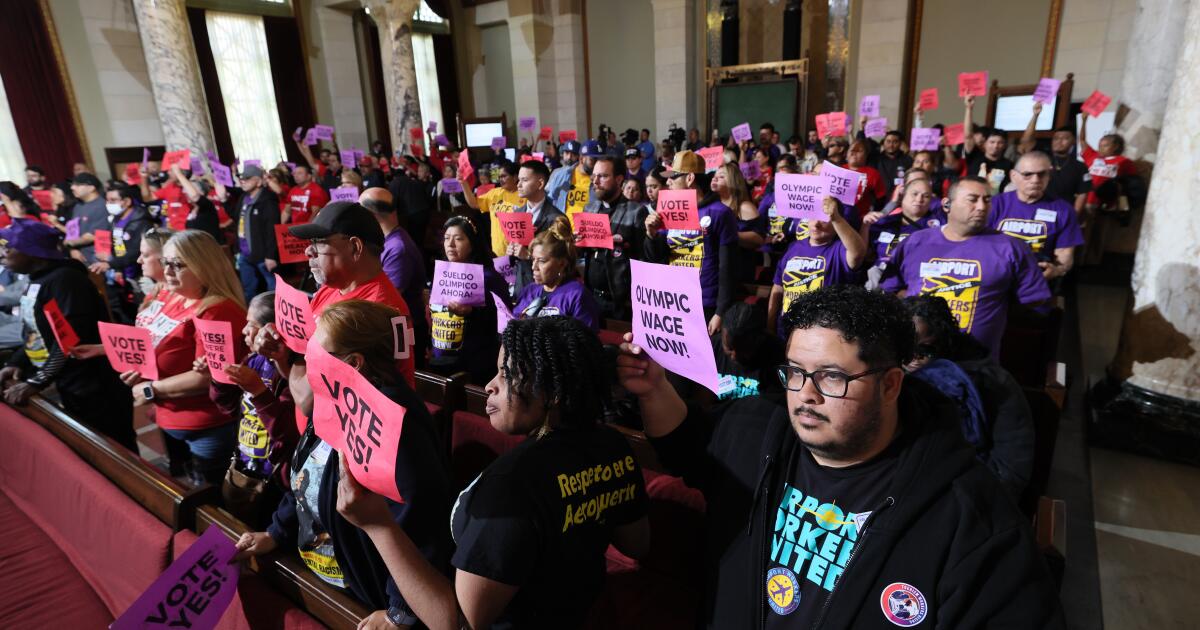
On Tuesday, the City Council approved the 18-month delay, which will postpone the wage increase until after the 2028 Olympics and fend off the business-backed initiative to eliminate the gross receipts tax, which is the city’s second-largest revenue stream.

The minimum wage will still increase to $25 in July and continue in increments until reaching $30 in January 2030.

Because the 11 to 4 vote was not unanimous, the new pay schedule will head to a second vote next week. Councilmembers Eunisses Hernandez, Ysabel Jurado, Nithya Raman and Hugo Soto-Martínez cast the “no” votes.

In May 2025, the council approved a proposal that would have increased the minimum wage to $30 in July 2028 and also raised an hourly payment for healthcare coverage.

In response, a coalition of airline and hotel businesses gathered enough signatures to place a measure on the Nov. 3 ballot that took aim at the city’s gross receipts tax, which is imposed on a vast array of businesses, including entertainment companies, child-care providers, law firms, accountants, healthcare businesses, nightclubs and many others.

If approved by voters, the measure would have stripped $740 million from the city’s general fund over the first year, according to city officials, and over five years would have amounted to a $860 million loss annually on average.

City officials, hotel and airport businesses and labor unions had been in continuous negotiations since last Wednesday, when the council narrowly approved an initial postponement of the wage increase to allow time to reach an agreement. The business coalition agreed to withdraw the measure if the council permanently approved the delay.

In addition to delaying the $30 minimum wage, the council on Tuesday pushed back the hourly healthcare payment to start at $8.15 an hour for airport workers in July 2027 and $4.25 for hotel workers July 1 of this year.

The council also voted to set up a committee to study possible changes to the business tax structure.

“Imposing wages and benefits without bringing business to the table is not reasonable,” said Nella McOsker, president and CEO of the downtown business group Central City Assn., at the council meeting. “It is reasonable to ask us to partner together to be on the other side of the table and negotiate, but it is not OK to do so without that process.”

Kurt Petersen, president of Unite Here Local 11, which represents the hotel workers, accused city officials of giving “into blackmail.”

“They now have a playbook. The next time workers win something, they’ll threaten to blow up the city,” Petersen said of the business coalition. “It’s a bad day for workers.”

Council President Marqueece Harris-Dawson described the process as painful but nearing a conclusion.

“I think we walked away from the negotiating table, like many negotiating tables, where no one was happy about the outcome, but everybody came away better than when we started off,” he said.

Shortly before the council vote, Mayor Karen Bass issued a statement that said she was called in by both business and labor leaders to close the deal.

She called the proposed repeal of the gross receipts tax “an existential threat to the city budget and the services it supports,” including street repairs, public safety and efforts to clean the city.

“This agreement ensures workers are paid fairly and that businesses that create jobs can continue serving LA and hiring Angelenos,” Bass said.

On Tuesday, the council chamber was filled with union workers in red, purple and yellow shirts.

Laura Esquivel, a janitor at Los Angeles International Airport, expressed frustration that council members were not standing by their earlier commitment.

“We’re sick and tired of being exploited. Some members of the council that are here, now we know, do not stand with workers,” Esquivel said. “We are not giving up, we will continue to fight and we’ll be back here in 2028.”

Before voting against the delay, Soto-Martínez, a former Unite Here organizer, called it sad and enraging.

“I cannot support anything that is going to take away money from workers,” he said.

Councilmember Imelda Padilla, who spoke in Spanish, was critical of the way the negotiations unfolded.

“If this thing about the gross tax receipts passes, we don’t have a city,” Padilla said. “The business community has us by our necks.”

She said workers deserve the wage increase, though she voted for the delay.

“Next time, let’s negotiate, and let’s negotiate well,” she said.

Times staff writer Suhauna Hussain contributed to this report.

Source link