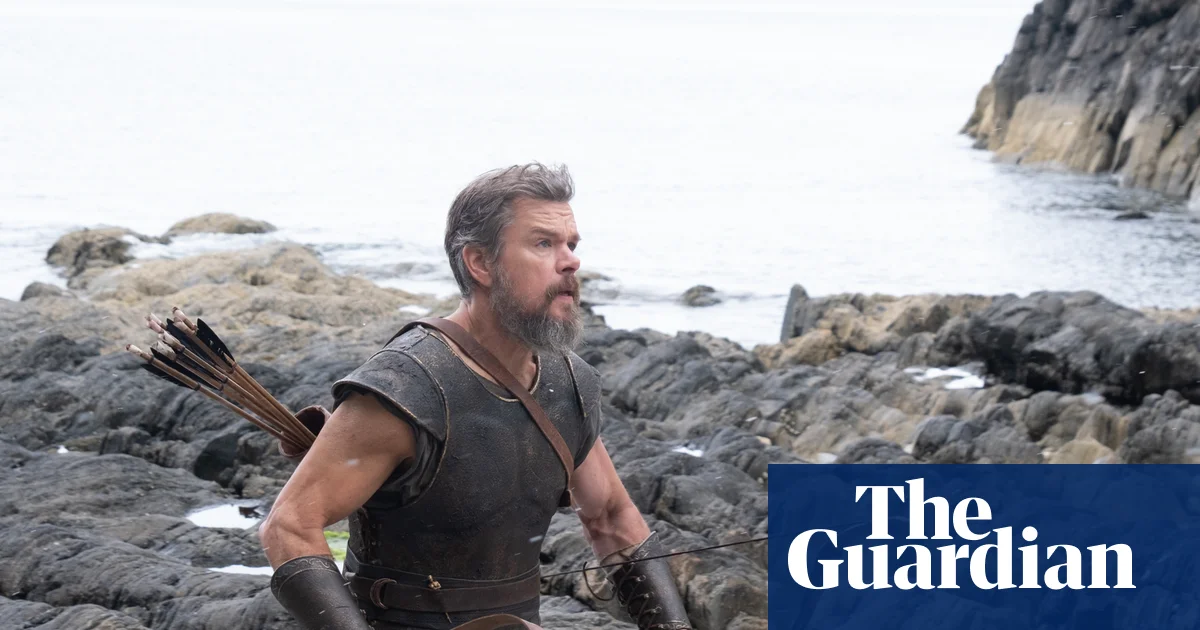
Why Scotland’s cinematic Moray coast made it a perfect location to shoot The Odyssey | Scotland holidays
The incoming tide has made a labyrinth of the beach. As silvery rivulets spread across Culbin Sands to meet the mudflats, my walk becomes increasingly circuitous: weaving inland towards the pine forest, backtracking closer to the waves, skirting tidal pools and scaling dunes constantly resculpted by the North Sea breeze.
In this shapeshifting stretch of north-east Scotland’s Moray coast, there’s not another soul in sight, nothing to anchor me to the modern day. It’s easy, then, to imagine a longship bringing weary warriors ashore, or a band of man-eating giants marauding from the woodland. Which is exactly what happens here – on screen – in Christopher Nolan’s adaptation of The Odyssey.
At first glance, Scotland is not an obvious backdrop for a nearly 3,000-year-old Greek epic. While the poem describes the Ithacan king Odysseus and his men being cast adrift on mysterious, far-flung shores, its imagined geography is the Mediterranean (unsurprisingly, Sicily, Morocco and the Peloponnese are the movie’s other locations). Few people who live in Moray, including me, anticipated Hollywood actors Matt Damon, Zendaya and Tom Holland descending on our local beaches and sleepy fishing villages last summer. The Moray coast isn’t even well known domestically, overshadowed by the likes of the Isle of Skye and the North Coast 500 driving route in the Highlands.
The more I think about it, though, the more Nolan’s decision makes sense. Unfurling due east of Inverness in a series of vast sand dunes, shingle bars, pine-edged marshes and sandstone skerries, this coastline is both cinematic and unusually varied. The absence of tourist crowds and coastal development must be a boon to film-makers.
Yet the resonances between the world of The Odyssey and these Scottish seafaring communities run deeper than scenery. Legends cling like barnacles to Moray’s shores. Superstitions intermingle with real histories of sieges and tragedies. Take the “Atlantis of the North” at Culbin Sands, the RSPB nature reserve and forest where Matt Damon’s Odysseus clashes with the giant-like Laestrygonians. A thriving agricultural estate and village stood here until 1694, when a freak sandstorm buried the settlement in a single night. Locals blamed either a witch’s curse or their reckless laird’s bargain with the devil.
Photograph: Jan Holm/Alamy
“The lore you hear along this coast is worthy of a Homeric epic,” says Moray-based author and classicist VJ Randle, whose novel The Athenian Murders is inspired by Greek mythology. She leads me along a section of the 50-mile Moray Coast Trail. Through an early morning Stygian sea-mist, we set off from the fishing village of Hopeman, the sandy footpath weaving between tangles of gorse and heather, before we clamber over the rock pools of Clashach Cove to a shadowy opening between the golden sandstone cliffs.
“This cave always reminds me of Calypso’s home,” Randle says. “Although locally, it’s said that a scarier sort of sea-spirit lives here.” She’s talking about the Grin Iron Wife – a witch with pale-green skin, rusted-red teeth and hair of seaweed who drags children and the elderly down to her underwater lair.
Such tales were once shared by seanchaidhean – oral historians who preserved heroic battles, local legends and clan genealogy. They were to Scottish Gaelic culture what the wandering bards were to ancient Greece.
It’s a fading tradition that local storytellers like Michelle van den Hout of Otherworldly Tales are helping to revive. Her walking tours introduce figures with striking parallels to classical mythology: the Scottish creator goddess and giantess Cailleach, a titan if ever there was one, islands and mountains formed from the rocks that fell from her creel basket; or the siren-like Ceasg, luring sailors who listened to her song to a watery grave.
Photograph: Helen Hotson/Alamy
Such tales were never simply about frightening people, van den Hout explains: “For isolated coastal communities, storytelling was a way to pass down lessons about survival, respecting nature and how to treat strangers. Rather than warning a child with, ‘Careful, that place has a riptide,’ it was more effective to say that a witch lives there.”
Threats coming from the North Sea could sometimes be made of flesh and blood, of course. In the town of Burghead, I stand on the grassy promontory overlooking granite cottages huddled around a working harbour. This is where The Odyssey’s film crew docked a 35-metre (115ft) longship last year alongside the usual fishing vessels. My attention turns to the raised earthworks beneath my feet: the remains of one of the largest Pictish forts ever built, burnt down in the 10th century, most likely during a Viking raid.
Along the neighbouring beach of Roseisle, dozens of barnacle-covered concrete blocks and pillboxes are wedged in the sand, half buried, like the ruins of a forgotten civilisation – and resembling the Trojan horse in the movie. But these relics are not ancient; they’re part of a vast defensive frontier from the second world war, when Moray became a secret training ground for the D-day landings. This legacy continues beneath the waves, where several sunken tanks from the wartime exercises can be explored on scuba diving excursions.
Heading further east, the cliffs steepen and craggy outcrops have long stirred up stories of metamorphosis. The soaring, 50ft sea-arch of Bow Fiddle Rock, for instance, is a giant that’s fallen beneath the waves, only the edge of his fiddle still visible, and the cries of nesting seabirds are its mournful music.
A few miles further on, the ruins of Findlater Castle cling to a narrow promontory. Befitting its turbulent past, from Viking occupation to being besieged by troops loyal to Mary, Queen of Scots, this is where Nolan has the sorceress Circe bewitch Odysseus’ men into swine.
There’s magic on my visit, too, only it erupts from the ocean below. The setting sun is a bronze shield, the sea uncharacteristically calm, when a dozen dorsal fins pierce the surface. Bottlenose dolphins. They’re a regular sight along these shores, with the Moray Firth home to Europe’s most northerly resident pod. Minke whales, humpbacks and orcas sometimes pass through, too, making this one of the UK’s best cetacean-spotting locations.
A motor launch scuds across the bay, heading for shore apace as dusk falls. My thoughts turn to homecomings. That, after all, is the essence of The Odyssey, more than monsters or battles. The hero’s yearning to return. His wife Penelope anxiously waiting. Countless women through the centuries have surely done the same from this very clifftop, staring out to sea for a sign of a familiar sail.
But a visit to Buckie and District Fishing Heritage Centre the following day reveals that the Moray coast’s fishwives were no idle, passive Penelopes. While the menfolk were at sea, they baited thousands of hooks by hand, gutted and packed herring, and trudged 13 miles inland to sell their catch.
One faded, sepia photograph in the display is unforgettable: it shows the female fishers, barefoot and skirts hitched, carrying their husbands on their backs through the surf, ensuring the men’s boots stayed dry before they boarded their boats. These are, perhaps, the true heroes of these Scottish shores: not a cunning soldier-king, as Homer would have it, but the stalwart, unsung “fisher lassies”, sharing a sea-swell of stories and ballads as they worked.
Where to stay
The Odyssey’s cast and crew made their base at The Seafield Arms in Cullen (doubles from £150). “The production team turned our meeting rooms into a working base for editing the film,” says owner Charles Milne, “while our grand ballroom became a private cinema where Christopher Nolan and the crew watched the day’s footage each evening.” Its refurbished self-catering accommodation Bow Cottage, where Matt Damon stayed, has been decked out with ancient Greek-inspired touches and movie memorabilia for visiting fans (sleeps seven from £300 a night, minimum three-night stay.) While you’re in Cullen, browse the shelves at Beinn Books for collections of Scottish folklore or perhaps a translation of Homer’s original.
How to get there
National rail services run to Inverness and Aberdeen, with onward train and bus connections to larger coastal towns. Hiring a car is the easiest way to reach its more remote beaches, castles and walking trails.