The history of all living things is examined through five key species chosen for the way they move, feed and reproduce and also for their size and intelligence

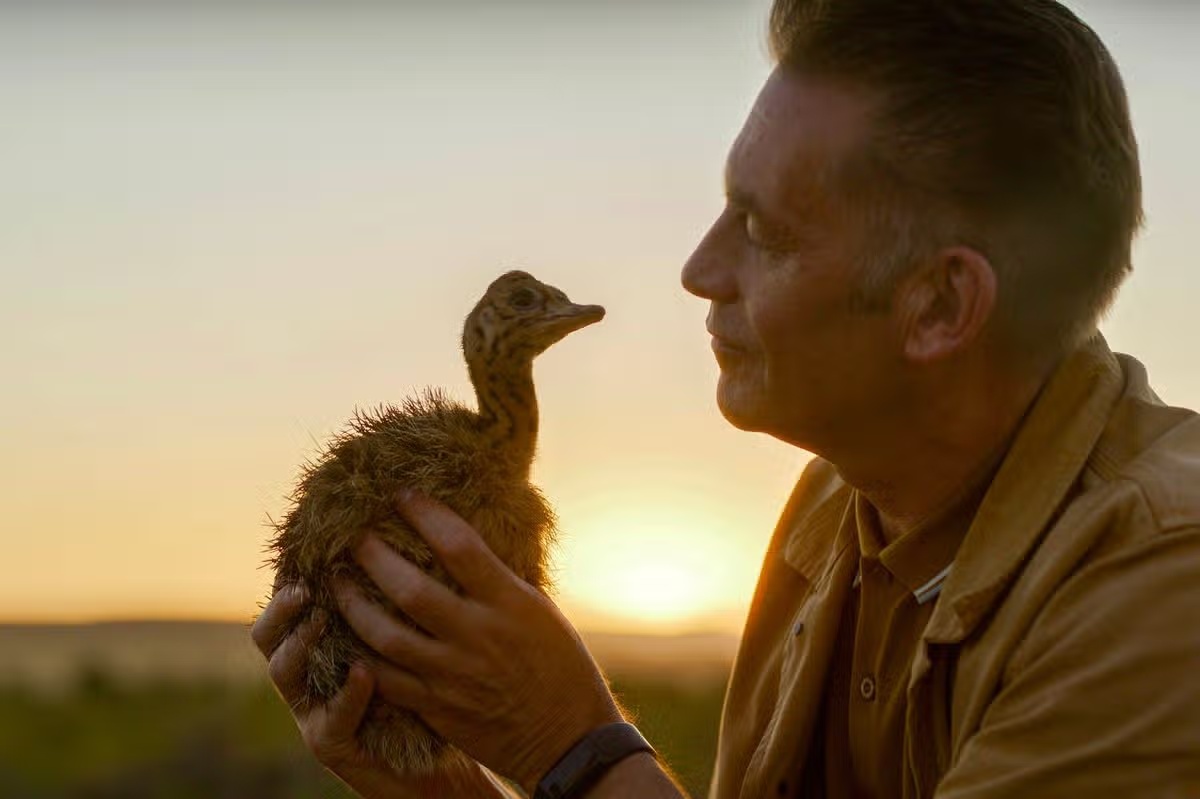
Chris Packham holds a baby ostrich which has just hatched in his hands(Image: CREDIT LINE:BBC Studios/Will Edwards)
Chris Packham famously hates so-called “T-shirt” animals – preferring beetles and bugs to the more box-office elephants, lions and tigers.
But for his major new BBC series examining the history of every living creature’s existence, the presenter had to block that prejudice as he looked back over 4 billion years. In Evolution, viewers will see how every plant and animal evolved – differently – from a single celled organism called LUCA.
And in order to explain this effectively, the five episodes focus on the elephant (size), ostrich (reproduction), horse (movement), bat (feeding) and dolphin (intelligence) to show what changes have happened over the millennia until they started to look a bit like the creatures we recognise today.
“TV likes an iconic species, something to put on the T-shirt,” Chris laughs, acknowledging that he doesn’t normally go for these “celebrity” animals which tend to draw in viewers, but go against the grain for Chris. “On Springwatch we’re always keen to champion the underdog, we make films about slugs and snails and flies and all those sorts of things, so we’re trying to build up that idea in people’s minds that everything counts – not just the fluffy birds in the nest, or the cute pine-marten kits. Survival of the cutest has always been an issue.”
“But had we picked, I don’t know, some innocuous little bug, it wouldn’t have looked great,” he laughed. “I’m not a great fan of T-shirt animals, but I am a fan of using them constructively.”
He even admits that filming the series, in different locations around the globe, brought him one of the best moments of his life, when he found himself right in the middle of a pod of dolphins during a break in filming. “It was absolutely extraordinary,” he says. “There were times when the cameraman was doing something and I was still in the water and I could just actually just be there with them.
“I dived down about four metres and I looked down and I had a dolphin right underneath me, under my chest. And I had couple on one side, I mean they never touch you, but they’re close, and a couple on the other side – and then I looked up and they were above me. And I was like in the middle of a pod of dolphins. You can hear them the whole time, they’re constantly clicking. So you can here that that’s that communication going on.
“It was just five minutes or something, it wasn’t a lot of time, but long enough to actually just engage, and realise that this was one of the most remarkable moments in my entire life. To be in that environment with these astonishing animals. I thought ‘blimey, I’m Flipper’.”
The five-part science show, which must be Packham’s most ambitious programme to date, has clear similarities in scope to Sir David Attenborough’s 1979 series Life on Earth, which set out to look at the earliest life forms. “I’d say it was more modern in its narrative structure,” he says thoughtfully. “Also, we’re catering for an audience that we know we need to surprise. We want to feed them short snippets, which are basically entry information into a bigger story, if you like. Those twenty-second things that get people to prick up their ears. And we want people to down the pub and say, ‘do you know what? I just watched this programme and, you won’t believe it, we couldn’t have a head before we had an arse’.
“I don’t think Life on Earth is like that. That felt very 1970s, because that’s when it was made, this just feels like a really modern, cutting-edge version.”
To film the series the BBC team were very careful about where they went in order to limit the carbon footprint. “Ten or 15 years ago, we would have gone to multiple locations to make a series like this,” Chris says. “But I’m pleased to say that each of our programmes was essentially made in one location.”
The elephants in the series opener were filmed in Kenya and the ostriches in South Africa. The horses were in the UK, with three days in France which was reached by train. Then the dolphins were in the Bahamas and the bats were in Borneo.
Chris says his role as presenter on the show, from the team who previously brought us Earth, is to keep the audience enthralled, and showing his own excitement is a big part of that, just as he experienced while watching his hero Attenborough. He particularly remembers a programme made by the veteran broadcaster about birds of paradise, filmed in Papua New Guinea.
“They were my dream birds because they’re mental, they look like space aliens,” he explains. “And I was sat there waiting for it to come on, just thinking, ‘you b****rd, I want to go to Papua, I want to see that.’ But in fact my response to the programme, and a testament to his broadcasting, was that I absolutely loved it because I felt the connection to the birds through his joy.”
Chris found himself caught up in some beautiful moments that will also tug at the audience’s heartstrings, such as when a baby ostrich hatched out of its egg right into his hands. “You’re peering into it, it’s not even in the world yet, and it’s like you’ve had a sneak preview into a life which is going to unfold,” he marvels. “It’s just this little thing moving, and that was really very emotional, that formation of new life.”
Learning new stuff is “the greatest joy” of his job. “I get to work with people who know more about a subject than I do. And their job is to tell me and the team everything they know about it in 30 seconds,” he says. “So my joy is that I attend the University of Zoology every single day that I’m working, and this is updated information, so we’ve constantly gone to the latest science.”
While they don’t skirt away from the technical stuff, like explaining how DNA works, Chris feels it is carefully woven into the narrative. “There’s no dumbing down, but we are conscious constantly of building a narrative which will keep our audience engaged.”
– Evolution, BBC2, Monday 13 July, 9pm