South Korea chipmakers weigh U.S. pressure, home plans

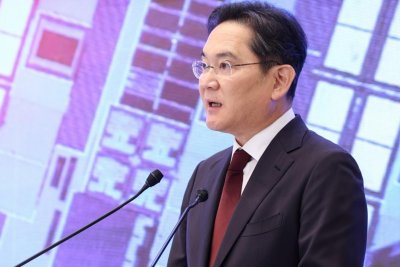
Samsung Electronics Co. Chairman Lee Jae-yong announces an investment plan during a meeting at the presidential office Cheong Wa Dae in Seoul, South Korea, 29 June 2026, to unveil the government’s three mega projects aimed at attracting large-scale investment in semiconductors, physical AI and AI data centers. South Korea plans to develop a new semiconductor production base in the country’s southwestern region through 800 trillion won (517.9 billion US dollar) in corporate investments that will create four memory chip fabrication plants. Photo by YONHAP / EPA
July 5 (Asia Today) — Samsung Electronics and SK hynix are facing a strategic balancing act as they move ahead with major U.S. semiconductor projects while preparing to invest about 800 trillion won, or $523.7 billion, in a new chip cluster in South Korea.
The two companies announced plans last week to build a semiconductor cluster in South Korea’s southwest, part of a broader government-backed effort to strengthen the country’s position in artificial intelligence chips and advanced memory.
The project is expected to include four new fabrication plants, two each from Samsung and SK hynix. But the plan comes as the companies are also watching possible pressure from the United States, where President Donald Trump has repeatedly used tariffs and investment demands as tools of industrial policy.
In a recent securities filing, SK hynix listed U.S. tariffs and trade restrictions as a business risk.
“If major countries, including the United States, impose or strengthen trade restrictions such as tariffs on imports, including semiconductors, our business performance could deteriorate,” the company said.
The United States has imposed reciprocal tariffs and other import-related charges since 2025. Semiconductors have not been included in some measures, but Trump has previously threatened tariffs of up to 100% on memory chipmakers that do not build factories in the United States.
Samsung and SK hynix already have major U.S. investment plans.
Samsung is building semiconductor facilities in Taylor, Texas. Its U.S. investment plans have been reported at more than $37 billion through 2030, with the Taylor site expected to include advanced foundry production.
SK hynix is investing $3.87 billion in West Lafayette, Ind., to build an advanced packaging and research facility for AI memory. The Indiana plant is expected to support high-bandwidth memory products used in AI accelerators.
The U.S. projects are already large, but they are smaller than the companies’ planned domestic investment. That could draw attention from Washington as the Trump administration seeks more manufacturing commitments from global companies ahead of the U.S. midterm elections.
Industry officials say the more realistic option for Samsung and SK hynix may be to accelerate existing U.S. projects rather than announce entirely new plans, given the size of their commitments in South Korea.
Samsung could further clarify plans for a second Taylor fabrication plant. The company said in April that it was conducting an initial review of the second Taylor fab while holding discussions with global customers.
SK hynix may face closer scrutiny because its U.S. investment is smaller than Samsung’s and because it is preparing to list American depositary receipts on Nasdaq on July 10.
Both companies are highly exposed to the U.S. market. Samsung’s Americas sales accounted for 32.5% of first-quarter revenue, while SK hynix’s Americas sales accounted for 68.8%, according to their quarterly reports.
Funding will be the key question if Washington presses for faster or larger U.S. investment. Both companies have already outlined enormous capital spending plans at home and abroad.
For now, their cash generation remains strong. Brokerage estimates cited by local media project Samsung’s second-quarter operating profit at about 85 trillion won, or $55.6 billion. SK hynix’s second-quarter operating profit is projected at about 65 trillion won, or $42.6 billion.
Analysts say AI-related semiconductor demand remains in an early phase. Kevin Warsh, chairman of the U.S. Federal Reserve, recently compared the AI boom to the first or second inning of a baseball game, saying the technology shift represents a major paradigm change for economic policy and the wider economy.
Industry officials say the semiconductor cycle could last longer than the traditional three to four years because demand for AI data centers, advanced memory and high-performance computing continues to expand.
For Samsung and SK hynix, the challenge is how to satisfy U.S. expectations for local production while also carrying out South Korea’s largest semiconductor investment push.
— Reported by Asia Today; translated by UPI
© Asia Today. Unauthorized reproduction or redistribution prohibited.
Original Korean report: https://www.asiatoday.co.kr/kn/view.php?key=20260705010001617