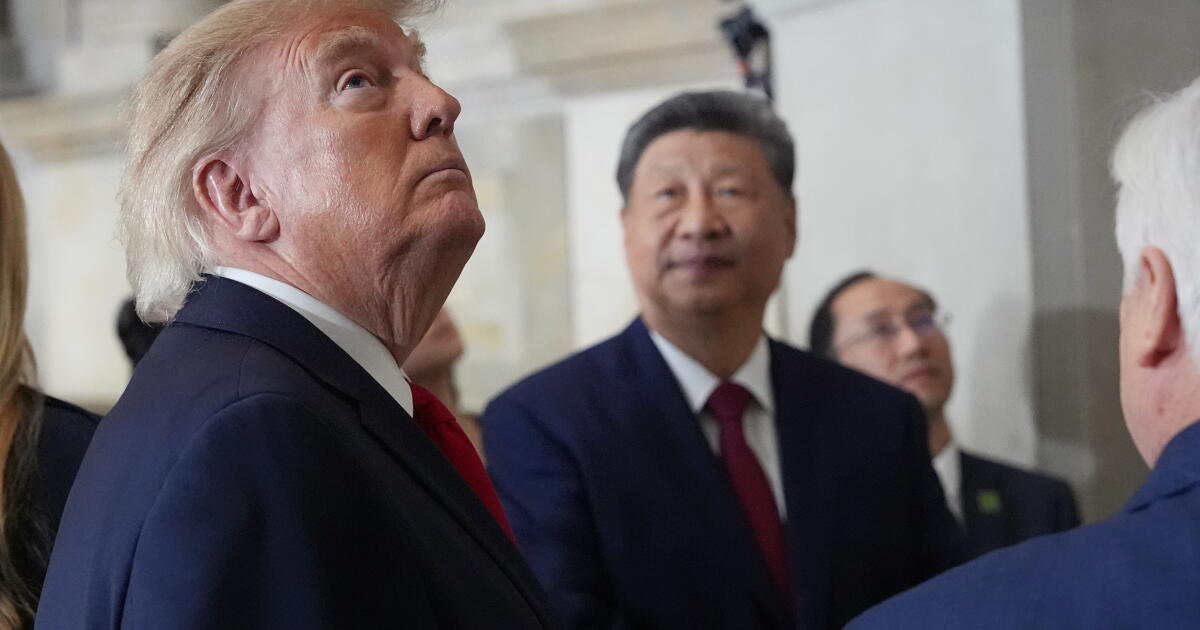
Trump’s troubles at home deepen Asian fears of a pivot toward China
MANILA — Fifty years ago, a disgraced Republican president led his party to historic defeat in the 1974 midterm elections. Richard Nixon’s resignation months prior during the Watergate scandal was not enough to stem the political fallout.
But the Chinese Communist Party — among Nixon’s greatest admirers — never abandoned him. He would go on to visit Beijing several times under a banner of friendship.
Donald Trump can expect similar treatment on his second trip to China in less than a year, a first for an American president, despite receiving a similar rout from American voters earlier this month. “We do not forget our friends,” one Chinese official told The Times.
Trump’s overtures to Chinese President Xi Jinping in his second term mark a sharp break from his first, raising alarm among longtime U.S. allies in Asia that they have been sidelined in a great power bargain as Beijing grows more assertive across the region.
The first stop on the president’s trip, in the Philippine capital on Tuesday night, is designed to allay those concerns. Trump will gather in Manila with leaders from powerful democracies across the Indo-Pacific — a group called the Quad, built to counterbalance China’s military presence in the region — and meet with other regional allies from across Southeast Asia.
But regional delegates here fear the visit is mere lip service ahead of the president’s visit to China later in the week, for a meeting with Xi on the sidelines of the APEC Summit in Shenzhen and, afterward, an exceptional trilateral engagement with the Chinese leader and Russian President Vladimir Putin.
Trump’s courtship of Xi is set to continue, with White House officials saying the president has no plans to raise China’s alleged spy campaign targeting Nvidia co-founder Jensen Huang — a scandal that sent the AI titan tumbling from grace last week.
“This is all taking place against the context of a dramatically negative election result for President Trump, beyond anyone’s expectations,” said Kurt Tong, former U.S. ambassador to APEC and consul general to Hong Kong and Macao, now serving as managing partner of the Asia Group.
“The president will undoubtedly be seeking to use this trip to reassert leadership and authority,” he added, “demonstrate his statesmanship capabilities, and essentially show off on the international stage.”
The stunning electoral sweep by Democrats, while weakening Trump at home, has little effect on his power and influence abroad through the remainder of his term, several Asian government officials said.
Trump has been seen throughout the region for more than a decade as an erratic and unpredictable force. Asian allies and adversaries alike fear the midterm results, far from humbling the president, could push him to focus more heavily on foreign affairs, where his powers remain greatest in his final years in office.
The president’s unpredictability has been underscored not only by his conciliatory approach to China. Trump’s war with Iran has made energy and food more expensive across Southeast Asia, while his trade policies have made access to the American market less reliable.
Ahead of Trump’s state visit, Philippine President Ferdinand Marcos Jr. urged the region to use its collective diplomatic leverage to negotiate with Washington, promoting greater stability over the next two years. “It is very important that we are united,” he said, “and find plans and solutions to address these problems.”
Prime Minister Lawrence Wong of Singapore said last month that U.S. trade policies were fragmenting the global economy into regional factions, potentially pushing Southeast Asian commerce toward Chinese businesses.
“In a more unpredictable and messier world, stability and trust matter more than ever,” Wong said.
Trump initially took credit for reviving the Quad — comprising the United States, Japan, India and Australia — as a coalition of democracies checking China’s rise, even renaming U.S. Pacific Command in 2018 to incorporate the entirety of the Indo-Pacific.
But his meeting with the group’s leaders in Manila this week will be their first in two years, a gap widely viewed in the region as a diplomatic slight.
By contrast, his meeting with Xi this week will be the fourth of his second term.
A White House official said the meeting would assert the Quad as a “partnership of action,” underscoring Trump’s commitment to a “free and open Indo-Pacific.” But the official also described the president’s agenda in Manila as “America first,” seeking deals with Southeast Asian allies reflecting “more balanced and fair trade for American businesses, farmers and workers” — a refrain likely to further disquiet the region.
“I do not expect substantial deliverables on any front,” said Scott Kennedy, trustee chair in Chinese Business and Economics at the Center for Strategic and International Studies. “The most important element of President Trump’s travel to Asia is the trip itself. This will be the first time in history an American president has been to China twice in one year. His trip to Manila also signals his interest in U.S. allies and regional issues.”
“In short,” Kennedy added, “the trip is the message.”