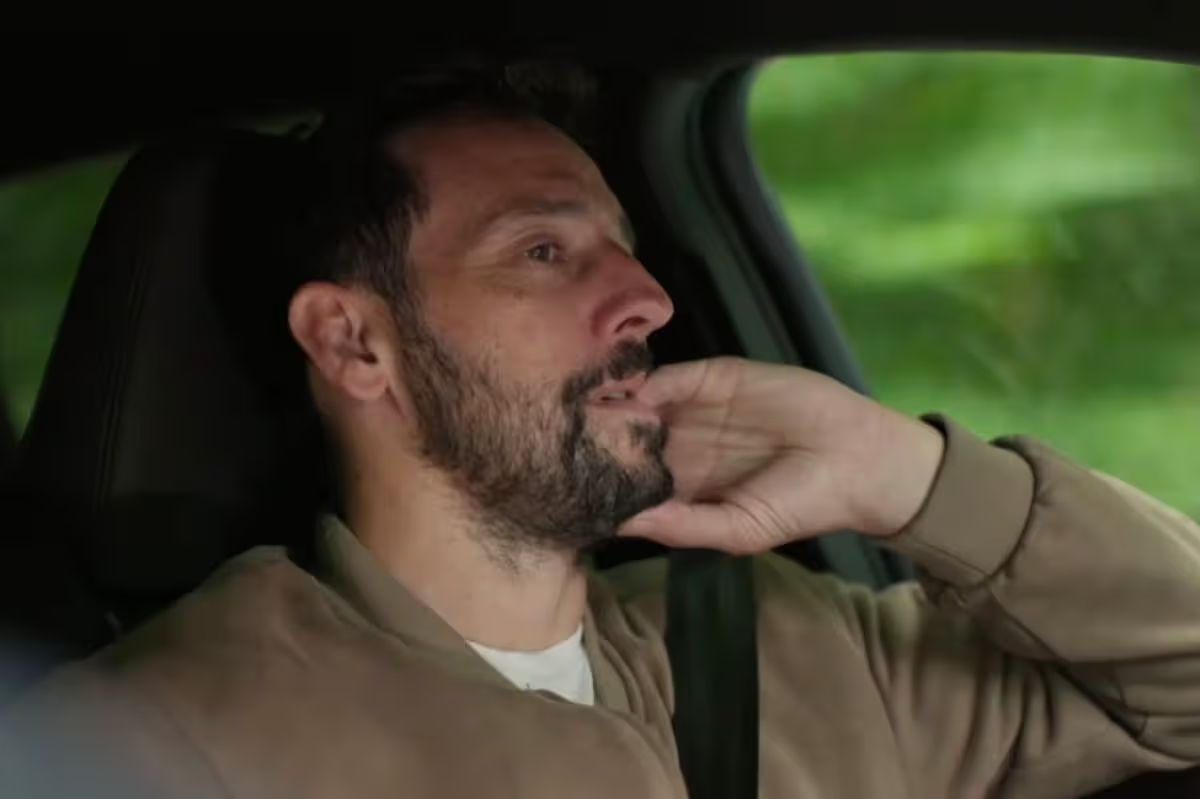
Ralf Little got emotional as he candidly opened up during the latest episode of Will & Ralf Should Know Better
Ralf Little got emotional as he candidly opened up during the latest episode of Will & Ralf Should Know Better(Image: U)
Death in Paradise star Ralf Little fought back tears as he shared the heartbreaking reason he doesn’t have children.
During the latest episode of Will & Ralf Should Know Better, Ralf, 46, and Will Mellor decided to face their fears, from dangling on a trapeze and tackling fatherhood to the ultimate horror of performing stand-up in front of a Glasgow crowd.
At the start of the show, Will, 49, pointed out to Ralf: “I think I’ve actually done something that you would find more frightening than any of that. What I’ve done that I think you’d find more frightening… is have a child.
“Yes, yes, actually commit to something, commitment. I have had two kids and brought them up. So, to give you a little taste, I’m taking you to a place, it’s like a charity set-up, where dads can go and learn how to be good parents. What to expect from a baby, how to be a parent” to which Ralf admitted: “This my living nightmare!”
At the charity set-up, Ralf was asked “what’s the worry about children” to which he admitted: “It’s a lot of work, innit? I bought a bread maker once and I loved making that bread, but after a little while, I was like, I’ll just unplug it and put it under the cupboard. You can’t really do that with babies, can you?”
The leader of the charity set-up then asked: “Ralf, what is it that you’re most afraid of?” to which the former Death in Paradise star said: “I’ve lived a lot of my life having a mentality where there’s nothing I can’t walk away from.
“It’s actually terrifying to me, the idea of loving something so completely and irreversibly. I can’t walk away from it intact. That’s terrifying to me.”
Following the charity set-up and being given a baby doll to look after, it made Ralf think deeper about why he doesn’t have children. He said: “Yeah, it’s been a funny old day. Just in general for me” to which Will added: “I can see it threw some questions into your mind that you weren’t expecting. I could tell from your reaction that you were a bit like maybe there is a reason a bit deeper why I haven’t had children.”
To which Ralf emotionally admitted: “For sure. My parents were fantastic with us and did the best that they could. But their relationship broke down really in a really difficult way and that was very difficult for us.
“You know, there’s no way of putting this that’s not blunt, but, you know, they had three kids and an idyllic family life and then one of the kids was alive one week and dead the next.
“Everything, their entire lives crumbled right in front of their eyes from that moment on. It’s like, you know, you can’t protect them.”
Ralf then fought back tears as he composed himself and continued: “My mum was really… my mum was really protective of us. Really protective.
“And it happened anyway. It happened anyway because you can’t wrap your kids in cotton wool and protect them 24-7. Like, it’s a lot. And it’s only when I’m forced to sort of say these things out loud that I realise quite what a lot it is.”
Ralf has said that the tragedy was partly to blame for his parents’ divorce and deeply affected his other sister Rowena – but it made him push himself academically and in extracurricular activities.
Will and Ralf Should Know Better is available to watch on Channel 4 and 4oD, as well as U.
**For the latest showbiz, TV, movie and streaming news, go to the new ** Everything Gossip ** website**
‘There! There – I can see it!” The cries of my four-year-old echoed around the ruins of 13th-century Urquhart Castle, causing a group of US tourists to come running over to the corbelled bartizans (overhanging turrets) where we stood. “It’s Nessie, I saw her,” he insisted, pointing at the ripples spinning out from the back of a sightseeing vessel on Loch Ness.
This was day four of a budget, week-long Scotland adventure for the two of us, and we were spending the day in Drumnadrochit, on the shores of the country’s most famous body of water, looking for the fabled monster.
It wasn’t the first time that reality and wishful thinking had seemingly combined on this holiday. When I told people I was going to take my son on a week-long trip across Scotland and my budget was £500, they were sceptical – especially as we were travelling in the school holidays. But as a woman who likes a challenge, I was up for proving them all wrong.
We’d begun our adventure in Glasgow, having travelled by train(£30), then picked up a cheap hire car for the five-hour drive to the Isle of Skye. Accommodation on Skye is pricey, but I had a secret weapon – my tent.
The car journey was punctuated by stops at lochs so enchanting they could have been lifted from the pages of a children’s book. We finally reached the island and checked in at Camping Skye, a community-owned campsite by the sea in Broadford. For the £16 cost of a pitch, we spent the evening playing beneath the flanks of Beinn na Caillich, eating chips and mushy peas from the local shop, and roasting marshmallows on a firepit.
Camasunary Bay near Elgol on the Isle of Skye was a hit with Phoebe Smith’s son. Photograph: Phoebe Smith
The next morning, primed for a mini-expedition and stocked up with supplies, we drove to the southern enclave of Elgol. The crowds who flock to the island for the Fairy Pools and spectacular Quiraing rock forms melted away as we went deeper into the countryside. We pulled over at a nondescript parking area and I explained the plan to my son. We were going to walk about 2.5 miles (4km) to our accommodation – and no, mummy couldn’t carry him as I would be carrying all our supplies. Excited by the carrot on a stick in the form of a bag of Percy Pigs, we set off, me with a full backpack, him clad in waterproofs, clutching a walking pole.
“I can do this. It’s going to be hard, but it’s going to be worth it,” I heard him muttering to himself as the ascent kicked in. Along the way I pointed out the purple petals of the devil’s-bit scabious flower – mythology claims the devil was so enraged by the plant’s healing properties that he chewed its roots, leaving them short and jagged. My son loved how stories such as this and the landscape combined, and it distracted him from the climb. When we reached the highest point, we could see down to Camasunary Bay, and the thought of playing on the beach made our descent fly by.
Our accommodation was a free (unbookable) bothy and, being first to arrive, we picked the top bunk of the sleeping platform, and I laid out our things. As more people came, my boy confidently greeted the guests as though welcoming them into his own home, proudly telling them this was his first bothy.
Reindeer in the Cairngorms national park. Photograph: Simon Whaley Landscapes/Alamy
That evening was spent running around on the near-black sand beach just outside the door, making trenches, cooking pesto pasta on my camping stove and laughing at the “loo with a view” that sits above the bothy on the hillside.
Having stayed in many bothies over the past 15 years, I had wondered how taking a child would pan out. But his presence brought everyone together in an amazing way, and by 9pm all 12 residents were fast asleep, likely lulled by the white noise I was playing for him on my phone.
Next morning, my son’s determination to reach the car was only eclipsed by his desire to have ice-cream for breakfast, which I had promised as an incentive to climb up the hill. He was beaming with pride when he told the owner of The Creel pop-up cafe by Elgol harbour that he’d walked more than 5 miles “all by myself” and made friends in a bothy.
From there, it was back to the mainland and a two-hour drive on to Drumnadrochit for a stay in a private room at Loch Ness Backpackers Lodge (£60), with an afternoon spent in the nearby Loch Ness Centre, learning all about Nessie. After the novelty of sharing a bunk bed (me on top, him below), the next day was reserved for paddling in the shallows of the loch, running around the aforementioned Urquhart Castle and getting visitors’ hopes up with proclaimed sightings of the legendary plesiosaur.
That afternoon we journeyed to our final stop – the Cairngorms national park. At the reindeer centre in Glenmore Forest, we met the UK’s only free-ranging herd (which had been brought here to be checked over by a vet) and joined a scavenger hunt designed to teach children about these creatures. We ended the day at Loch Morlich, building sandcastles with children my son befriended in that easy way kids seem to do. I pointed up to the summit of Cairn Gorm – the sixth highest mountain in Britain. “That,” I told him, “is where we go tomorrow.”
Phoebe Smith’s son was happy to walk miles with the right incentives. Photograph: Phoebe Smith
After a night in a camping pod at the Speyside Trust’s Badaguish outdoor centre (£75), we braved the mountain during rain squalls on a guided hike (£35) which involved taking the mountain railway to Ptarmigan top station at 1,097m, then an hour’s walk to the summit. As we stood on the misty peak, our guide told us we were at 1,245m. I’ve never seen such a proud look on my son’s face.
The UK’s highest restaurant, the Ptarmigan, sits at the railway’s top station, and we indulged in hot chocolate before exploring the learning zone’s exhibition, with its panoramic film showcasing the landscapes around us in much better weather than we experienced. There are also interactive sandboxes where children can create their own natural environments. We rounded off the day by taking the train back down and going tubing (£15pp), laughing gleefully as we slid down the purpose-built dry slope in giant rubber rings.
Determined to make the journey home part of the adventure, I had booked the sleeper train back to London – our biggest indulgence at £170 for a cabin with a private loo and shower. Dusk hit as we boarded in Inverness, and the sky began to turn black outside the picture windows while we ate macaroni cheese in the dining car and my son told incredulous strangers about our adventures.
The truth is that kids love holidays – but they love spending time with their parents most of all. And by taking my son on my kind of adventure, I had bonded with him in a way I never thought possible. Children see magic in even the smallest of adventures – and their enthusiasm is utterly infectious. Our total spend after six days away was just under £500 which, when I think of the memories we have made, and the stories my son continues to tell, seems to me the best buy ever – even more fantastical than a magic monster that lives in Scotland’s largest loch.
Interpol’s Operation Eclipse, conducted between February 2025 and January, focused on dismantling networks linked to producing and distributing child sexual abuse material, with the primary goal of identifying victims and reopening cases that had remained unsolved for years. File Photo by Wallace Woon/EPA
March 5 (UPI) — An international police operation coordinated by Interpol led to 60 suspects accused of sexual crimes against minors arrested and 65 child victims rescued after a yearlong investigation in nine Central American, North American and Caribbean countries, the agency said.
Operation Eclipse, conducted between February 2025 and January, focused on dismantling networks linked to producing and distributing child sexual abuse material, with the primary goal of identifying victims and reopening cases that had remained unsolved for years.
Most of the victims were between 5 and 13 years old, and about 80% were girls, Interpol said.
“Investigating old cases not only serves to deliver justice and protect victims, but also to prevent further harm,” said Cyril Gout, acting executive director of Police Services at Interpol.
“Operation Eclipse demonstrates that, thanks to international cooperation and specialized expertise, it is possible to uncover abuse committed even years ago and bring those responsible to justice.”
The countries that participated in the operation were Belize, Costa Rica, El Salvador, Guatemala, Honduras, Mexico, Nicaragua, Panama and the Dominican Republic.
Some victims had appeared for more than a decade in international archives that collect child sexual exploitation material without having been identified.
Investigators said the alleged perpetrators had different levels of relationship with the victims, including relatives, friends, neighbors, educators, online predators and foreign tourists, showing that sexual offenders do not fit a single profile.
The operation received support from the United Nations Office on Drugs and Crime and the Child Rescue Coalition. Police and judicial authorities across the region synchronized investigations, conducted targeted interventions and gathered evidence in multiple countries.
Interpol said it provided technical support, real-time information sharing and strategic guidance.
One of the most notable cases occurred in Panama, where authorities resolved an investigation in which a victim had remained unidentified for more than 10 years in Interpol’s international database. The identification, the agency said, allowed investigators to gather key evidence for the judicial process and also led to the location of another victim.
Interpol also maintains the International Child Sexual Exploitation Database, which is used by investigators in more than 70 countries to analyze and compare images and videos of child abuse.
The system allows authorities to establish connections between victims, offenders and locations through digital analysis software, helping identify related cases across different countries and preventing duplicate investigations.
According to the organization, the database contains 4.9 million images and videos and has helped identify more than 42,300 victims worldwide.
A joint study by Interpol and global network ECPAT International also found that more than 60% of the unidentified victims in that material are prepubescent minors, including babies and young children, while 65% are girls and 92% of the visible offenders are men.
Interpol provided several cases of the background of victims.
In the Dominican Republic, two minors ages 10 and 13 were allegedly abused by their mother and a transnational sexual offender who lived with them. Both suspects were arrested during the operation.
In Costa Rica, one of the suspects initially posed as an online celebrity to contact his victim. He later used child-grooming tactics, sextortion and threats against the victim’s family to maintain control over her.
A bilateral meeting between Panama and the Dominican Republic led to identifying two suspects wanted by Panamanian authorities for sexual crimes. Both were located in Dominican territory, leading to the start of extradition procedures.
As part of the operation, participating countries also reviewed 57 existing international notices related to individuals believed to live within their borders. These included Red Notices, issued for suspects wanted internationally, and Blue Notices, intended to gather additional information about a person’s identity or location during an investigation.
So far, 12 of those people have been located and detained, while efforts continue to locate and extradite other suspects, Interpol said.
Authorities also said that 45 suspected child sex offenders remain wanted in the countries that participated in the operation.
US First Lady Melania Trump has presided over a UN Security Council meeting focusing on children in conflict days after dozens of children at a school in Iran were reportedly killed after Israel and the United States launched attacks.
SUZI Quatro has revealed how her first husband, and the father of her children, has Alzheimer’s and that she’s now in charge of his finances.
The American rock star, 75, who is now married to her second husband Rainer Hass, revealed the sad news whilst speaking to Kaye Adams.
Sign up for the Showbiz newsletter
Thank you!
Suzi Quatro has opened up about her first husband’s Alzheimer’s diagnosisCredit: instagram/@kayeadamsfanpageSuzi revealed her ex-husband Len Tuckey is battling the devastating diseaseCredit: AlamySuzi revealed she is in charge of Len’s finaces now, following his diagnosisCredit: instagram/@kayeadamsfanpageSuzi shot to fame in the 70s and has enjoyed an incredible careerCredit: Rex Features
Michigan-born Suzi, who is credited with helping women break into the world of rock and roll music, opened up on the Loose Women star’s podcast, How To be 60.
In a candid interview, the singer talked about how her first husband Len Tuckey is battling Alzheimer’s Disease.
Suzi married Len, who was her long-time guitarist, in 1976, but they divorced in 1992.
During their relationship they had two children together, Laura, 44, and Richard, 42.
Speaking to Kaye’s podcast, Suzi, who is now married to her second husband Rainer who she wed in 1993, talked about the breakdown of her first marriage to Len.
She then talked about how despite their divorce they remained good friends, and how she became his “power of attorney” because of his Alzheimer’s diagnosis.
Suzi made the admission when she talked about when she decided to leave Len, and how she came about that decision.
“When I did leave, I was sure. I wasn’t doubting. I was sure that it’s time to go,” she revealed to Kaye.
“So I gave it the six years to turn it around. You know, that’s fair.
“You got two kids together, you know. Don’t break it up if you don’t need to. I really tried, but I can’t lie to myself. Nobody can lie to themselves.”
Suzi is now married to her second husband, Rainer HassCredit: Getty
Continuing Suzi said: “I remember saying to him one time during Andy Get Your Gun, actually when that had finished, so it would have been 87, I remember we were sitting in the room here talking. And I said to him, ‘Do you realise how far away you’ve let me go?’
“So I gave him hints along the way, many, many hints, but he didn’t take them.
“And I’m his executor and power of attorney, so we’re still close.
“And he lives in my son’s house because he’s got Alzheimer’s.”
Suzi and her first husband Len divorced in 1992Credit: Alamy
American singer-songwriter Suzi shot to fame in the 70s as the first female bass player to became a major rock star.
The star is known for singles like Can the Can and Your Mamma Won’t Like Me, and has sold more than 50 million albums.
She is credited with helping women become part of the rock and roll era.
Speaking about this, Suzi once told the Metro Times: “Before I did what I did, we didn’t have a place in rock ‘n’ roll.
What are the early signs of Alzheimer’s disease?
IN the early stages, the main symptom of Alzheimer’s disease is memory lapses.
For example, someone may:
forget about recent conversations or events
misplace items
forget the names of places and objects
have trouble thinking of the right word
ask questions repetitively
show poor judgement or find it harder to make decisions
become less flexible and more hesitant to try new things
There are often also signs of mood changes, such as increasing anxiety or agitation, or periods of confusion.
And trouble with language, thinking and reasoning difficulties, and a shift in how things are seen and heard are also common.
“Not really. You had your Grace Slick and all that, but that’s not what I did. I was the first to be taken seriously as a female rock ‘n’ roll musician and singer.
“That hadn’t been done before. I played the boys at their own game.
“For everybody that came afterward, it was a little bit easier, which is good.
“I’m proud of that. If I have a legacy, that’s what it is. It’s nothing I take lightly. It was gonna happen sooner or later.”
Over the years Suzi has also dabbled in acting, and was famously on Happy Days.
Suzi continues to perform to this dayCredit: Getty
Names marked with an asterisk have been changed to protect identities.
London, United Kingdom – “People here are tired, scared and feel forgotten,” says Nabila*, a Muslim mother of two in Basildon, a town in the English county of Essex.
Recommended Stories
list of 4 itemsend of list
Sitting in her living room with a mug of tea, a Qur’an visible on the bookshelf and Japanese prints hanging to its right, she recalls a string of incidents in recent months: Glass thrown from a residential building at Muslim children, a racist attack on the local mosque where red crosses were daubed across its walls alongside the words “Christ is King” and “This is England”, and reports of drivers accelerating as Muslim women cross the road with their children.
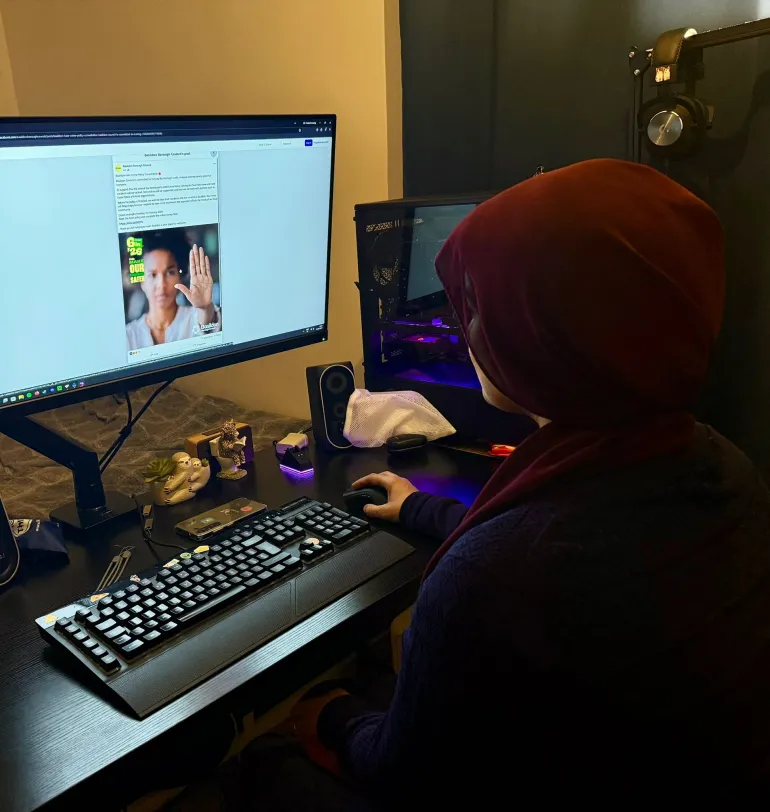
Nabila has been documenting incidents of racism in Essex, her home county [Courtesy of Nabila]
According to the 2021 census, Basildon is 93 percent white, and Muslims make up less than 2 percent of the population. Campaigners have warned that in areas where ethnic minority communities are smaller and more geographically isolated, they face heightened risks, as visibility increases vulnerability.
A single mother working full time, Nabila has been documenting incidents of racism, supporting victims and organising meetings with local authorities.
She said she no longer feels safe in the place she calls home.
After being racially abused while walking through her favourite park, she stopped going there altogether. Women, she said, are increasingly changing their daily routines, constantly watching over their shoulders. Racism now permeates every aspect of their lives, she added.
At a women’s listening circle organised by Nabila in collaboration with the local authority at the Wat Tyler Centre, another Muslim woman, Zarka*, spoke about her experiences as a young mother in Basildon who wears the hijab.
After being told to “take that rag off your head” during the school run by a passer-by, she stopped taking her children to school for two weeks. Beyond verbal abuse, she described the cumulative effect of everyday hostility, from cars failing to stop at zebra crossings and hostile looks from passersby.
‘I can’t do this any more, Mum.’
Hundreds of miles north, similar experiences are unfolding in Scottish classrooms.
Etka Marwaha’s daughter Anisa was seven when she first experienced racist taunting at her primary school in Glasgow.
Marwaha said Anisa became quiet and withdrawn. She was isolated on the playground and subjected to racial slurs. Months later, she broke down in tears in front of her mother, explaining the abuse she had suffered.
On multiple occasions, Marwaha contacted the school, urging them to take action, even offering her own support on understanding racism. But, she said, they failed in their duty of care, and the extent of the problem was kept hidden.
It went on for two years before Etka felt compelled to take her daughter out of the school.
“The plan was never to move her into a different school,” she told Al Jazeera. “But she was refusing to go to school; she would come home very, very upset. She was isolated.
“She was in tears, saying, “I can’t do this any more, Mum.’ So she made the decision, at that young age, that ‘I want to get out of here.’”
The girl’s new school is not in the catchment area, nor is there a direct bus to it, causing further inconvenience. But it has a zero-tolerance approach to racism, and Anisa is happier.
At her new school, Anisa can speak about her experiences of racism and how it made her feel.
The ordeal brought back painful memories for Marwaha’s own experiences at school.
“The racist bullying, for me, started at secondary school. You’d think times have changed, that people have been educated, but I think things have changed for the worse when a seven-year-old can openly make a racist comment and that’s accepted by society, and parents don’t address it.”
Sam*, a doctor in northwest Scotland with dual heritage children, said he has been surprised by the level of racism in local schools.
“There has been a clear normalising of racist jokes and name-calling. Every one of our kids has been affected,” he said. “Perhaps the biggest surprise is how few other students stand up against racism. When I was growing up, if someone was racist, they would be the person being socially excluded. Now, silence. It has forced us to look at moving out of the UK.”
‘Racism is out of control’
In the latest incident of alleged and potentially dangerous racism, a man walked into Manchester Central Mosque on Tuesday, reportedly with an axe and weapons. The man was arrested. There had been 2,000 worshippers in the mosque at the time, for the evening tarawih prayers during Ramadan.
Official figures underline the scale of the problem.
In October 2025, the UK Home Office revealed that the number of hate crimes recorded by police in England and Wales had risen for the first time in three years, including increases in racially and religiously motivated offences.
Religious hate crimes against Muslims rose by 19 percent, with a spike following the Southport murders and subsequent riots in mid-2025, the Home Office said.
The rise comes as hard-right politicians and activists, such as Reform leader Nigel Farage and the Islamophobic activist Tommy Robinson, rail against immigration. According to recent YouGov polling, if a general election were held tomorrow, Reform would lead with 24 percent.
Shabna Begum, head of Runnymede Trust, a race equality think tank, said, “Mainstream political and media actors have played in normalising and enabling racist narratives that have scapegoated migrants, people seeking asylum, Muslims and people of colour generally.”
In a report released last year, How Racism Affects Health, Runnymede highlighted the hypervigilance that people of colour have to operate with in order to guard their safety, and which causes long-term physiological damage, affecting life expectancy and mental health outcomes.
“For those that live in more disparate communities where they show up as minorities in a more visible way, that sense of threat is acute,” said Begum.
School suspensions for racist incidents have more than doubled in recent years, according to UK Department for Education data.
“Children as young as four are being sent home for racist behaviour,” Begum said. “This shows a society where racism is out of control, and that our school systems are failing to deal with the problem.
“They are making calculated decisions about where they will go, what travel routes they will take; withdrawing from regular social and community activities because they can no longer trust that those spaces will be safe for them.”
Recreational activities combined with yoga in Gaza help children recover a sense of normalcy despite war, teacher says.
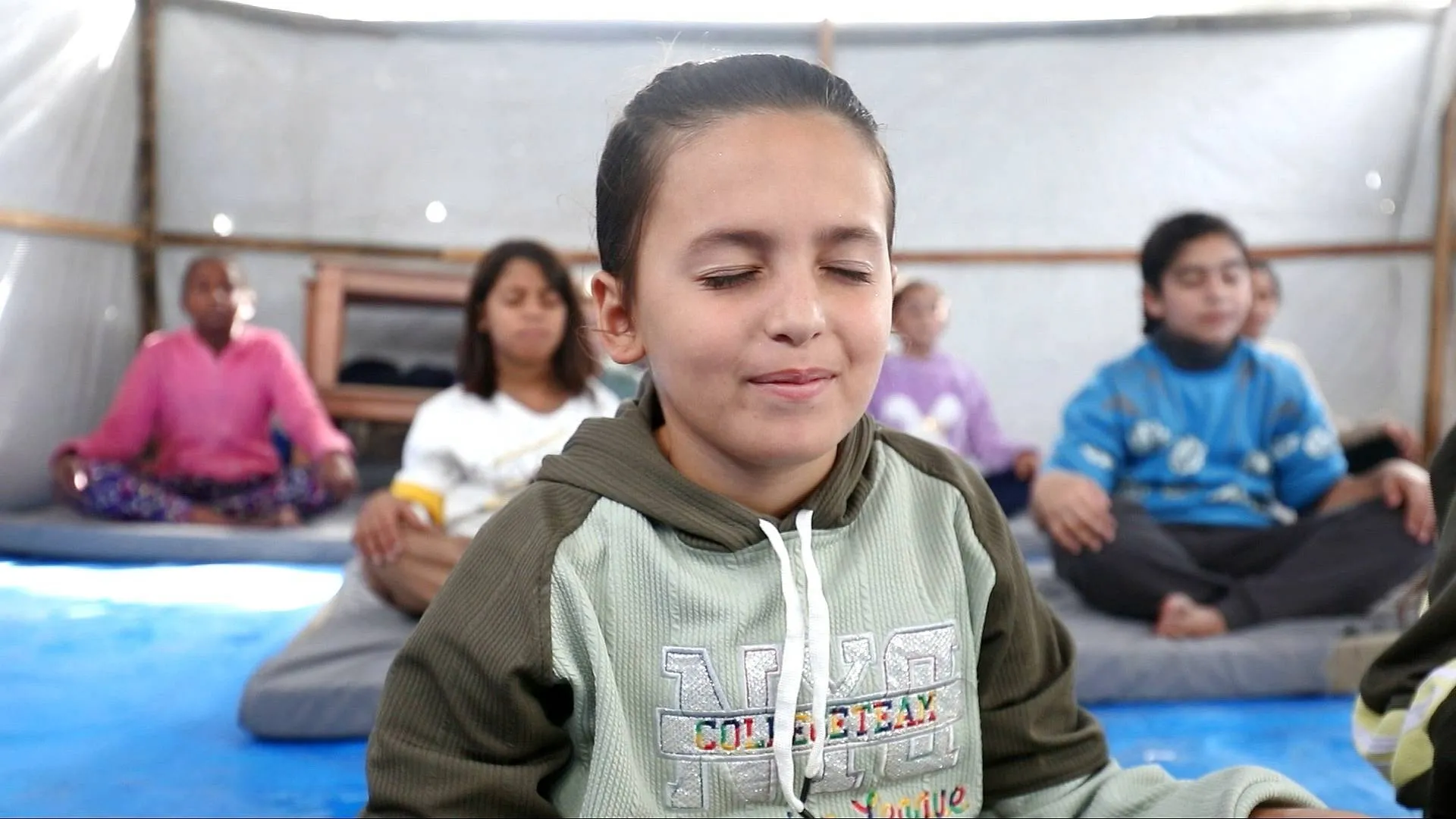
Gaza City – In northern Gaza, a Palestinian teacher has transformed a tent into a small space for yoga classes, offering children moments of peace from the hardships of daily life in the besieged enclave.
The idea to bring the practice to Gaza City came from Hadeel al-Gharbawi, who has been working on finding ways to help children cope with trauma. Through simple movements and breathing, the class offers moments of calm, safety and joy.
Recommended Stories
list of 3 itemsend of list
Children sit cross-legged on a thick mat, eyes shut. Some concentrate, while others fight back shy smiles, sneaking sideways glances to see whether their classmates are following the teacher’s instructions, amused by the unfamiliar exercise.
“I wanted to expand the activities I do with children beyond drawing and colouring. I searched online and discovered that yoga can help children recover from trauma,” al-Gharbawi told Al Jazeera.
“Since yoga isn’t widely available here in Gaza, I decided to learn online and practice it with the children. Through yoga, they can release stress and cope with the difficult life around them.”
Children in Gaza have been exposed to continuous cycles of violence and trauma, profoundly affecting their mental health, according to a report by the World Health Organization.
The constant bombing, displacement, loss of family members and physical pain of Israel’s two-year war on Gaza have caused emotional distress, social withdrawal and grief, among other symptoms, the report says.
International organisations have been warning that the conflict will leave a long-lasting impact.
“All children in Gaza require mental health, and psychosocial support services after two years of horrific war, displacement, and exposure to traumatic events,” the United Nations Children’s Fund (UNICEF) said earlier this month.
This is why yoga classes are more than physical exercise in Gaza; they allow children to step away from fear, release emotions, and feel in control, even for a few minutes, the participants say.
“We come here to do yoga, to learn and to do art,” Suwar, a displaced student, told Al Jazeera. “These activities allow us to forget, even for a short time, the war, the harsh weather and the queues for water. Yoga, in particular, gives us a moment of calm and helps us feel safe and happy.”
Alongside yoga, the tent offers educational and recreational programmes that al-Gharbawi said aim to activate the children’s imaginations.
“Combining learning with playful and therapeutic activities helps the children deal with trauma and regain a sense of normalcy,” al-Gharbawi said.
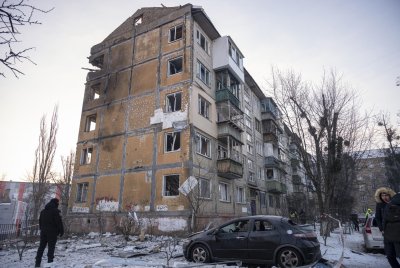
A Russian drone strike on a five-story residential building in Kyiv, Ukraine, shows why a third of Ukrainian children are displaced, as reported by UNICEF on Tuesday. Photo by EPA/Stringer
Feb. 18 (UPI) — As the Ukraine war nears its fifth year, more than a third of Ukrainian children remain displaced following Russia’s invasion of its neighboring nation.
Russian forces invaded Ukraine on Feb. 24, 2022, which has led to the displacement of 2.59 million Ukrainian children, UNICEF reported on Tuesday.
The number of displaced children includes 791,000 who are still inside Ukraine and nearly 1.8 million who are refugees living outside of the country’s borders. Russian forces also have taken many Ukrainian children and relocated them to Russia.
“Millions of children and families have fled their homes in search of safety, with one in three children remaining displaced four years into this relentless war,” said UNICEF Regional Director for Europe and Central Asia Regina De Dominicis.
“For children in Ukraine, safety is increasingly hard to come by as attacks on civilian areas continue across the country,” De Dominicis said. “In many ways, the war is following these children.”
Many children and their families have been forced to flee their homes several times during the war as Russian forces targeted civilian areas.
A recently published UNICEF survey showed that a third of teen respondents between age 15 and 19 said they moved at least two times due to safety reasons so far during the war.
Bombardments by Russian artillery, attack drones and ballistic missiles have killed or injured more than 3,200 children since the war started.
Each year, the number of dead and injured has increased among Ukraine’s children, according to UNICEF.
“Obligations under international humanitarian law must be upheld, and every possible measure to protect children and the civilian infrastructure they rely on must be taken,” De Dominicis said.
“Every child has the right to grow up in safety, and without exception that right must be respected.”
Many of the support services for the country’s children also have been damaged or destroyed, including more than 1,700 schools and other education facilities, which deprives a third of Ukrainian children from attending school on a full-time basis.
Russian strikes on Ukraine’s energy infrastructure have deprived millions of Ukrainian children and their families of the power needed to heat their homes and water during the country’s extremely cold winters.
Babies and young children are especially vulnerable to harm due to a lack of electrical power, which could lead to hypothermia and respiratory illnesses.
More than 200 medical facilities also have been damaged or destroyed in Ukraine over the past year and many more before then.
The stress of the ongoing war is putting a severe mental strain on Ukraine’s children, who often experience a constant fear of attacks that force them to seek shelter in basements and remain isolated while at home.
About a fourth of Ukrainian youth between age 15 and 19 say they are losing hope for the country’s future.
UNICEF officials said they are working with local and national authorities to support Ukrainian children and provide them and their families with safe water, healthcare, food, educational support, mental health services and similar needs.
Ali Juwon’s future shattered at the same time his father’s leg did. The year was 2012, and the 9-year-old, hand in hand with his mother, was fleeing his home in Borno State, northeastern Nigeria. Boko Haram members had stormed their community in Gwoza, killing neighbours and burning buildings Ali had known his entire life.
As he and his mother ran, a familiar voice cried behind them. Both turned to see that Ali’s father had crashed to the ground, crushing his leg in the process. Yet, with all the odds stacked against them, the three managed to make it out with their lives.
The family travelled for half a day to Nigeria’s federal capital, Abuja, and sought refuge in the Durumi IDP camp like many survivors at the time.
The camp, with the flurry of Borno survivors, was overcrowded, but Ali’s mother promised him it would not be home, only a resting place before they could find their footing again. Over 14 years later, the Juwon family continue to reside there.
Ali, now 23, explained how the situation derailed his life, “Before fleeing, my father had a business and was able to afford all my needs. Since he broke his leg, he hasn’t been able to work, and because we couldn’t get him properly treated, his leg never healed well. He hasn’t walked since the fall. Suddenly, all the luxuries we could afford before have vanished.”
Being the only child in his family, Ali took it upon himself to care for his parents. The only thing he needed was a decent education that would lead to a business or accounting degree. He planned to join whatever lucrative fields these courses would thrust him into and use his money to get himself and his parents a place away from the camp.
But Ali quickly learnt that he was no longer in Borno, dependent on his well-to-do father. His education now rested in the hands of IDP leaders, non-profit donors, government promises, and his own hustle. As the years wore on, he learnt that even with seemingly more helpers, his chances of finishing school had dimmed significantly.
In the Durumi IDP camp, displacement does not end with fleeing violence. For many, it continues in the classroom. While primary education is often supported by NGOs or private donors, secondary school is where the system collapses.
According to camp leaders, the girls in the camp are often married off after their basic education ends, as secondary education is no longer attainable without sustained government intervention. Hundreds of displaced boys, on the other hand, are forced to choose between survival and schooling, a gap that is reshaping their futures and deepening Nigeria’s long-term social and economic vulnerabilities.
No way past secondary school
“In primary school, things were okay. NGOs sponsored my schooling, but once I got to secondary school, that was where the real problem began. No one sponsored secondary schooling for us,” Ali explained.
Liyatu Yusuf, the woman leader of the Durumi camp, finds the schooling situation distressing.
“We had certain sponsors who do everything for these children. Usually, it’s from an individual with a good heart. We used to do their secondary school education in the camp as well, but due to a lack of teachers and overcrowding, we had to stop it.”
According to her, over 1,000 students occupy the less spacious class, forcing them to have seven different sessions in just one class. But that’s not just the problem. There is a lack of teachers, too.
“The teachers we have are university volunteers. They would come three times in a week, but then refuse to come the next week because no one was paying them or giving them transport money,” Liyatu said.
A classroom meant to hold more than 2oo standing students at a time. Photo: Rukkaya Saeed/HumAngle.
Liyatu says the children never receive government sponsorship, and that many of the people who help the children through primary school are good-natured individuals or NGOs. Despite record education budgets announced in Abuja, camp leaders say they have not seen much implementation, especially for the displaced children like those in Durumi.
In a 2025 press release by the Presidential State House Villa, Nigeria’s Vice President, Kashim Shettima, called for collaboration between the government and the private sector to invest in education, as the burden of educating children cannot fall entirely on the government’s shoulders. But in the Durumi IDP camp, help has come mainly from the camp leaders and individual sponsors.
So, with no one to help him through secondary school, Ali did what several boys in the camp chose to do: work and fund his education in tandem. This way, he would be able to pay for school with the money he made and leave some for his unemployed parents.
But this was not an easy route, and soon the stress of paying for so much caught up with the boys. Salim Aliyu, for example, now runs a small provision shop near Durumi, as his education ended in Senior Secondary (SS) 1.
“I’m 25 now,” he said. “I stopped at SS1 because it was too expensive. Transport alone was about ₦1,000 every day. How much was I earning to pay that?”
At the time, Salim did menial jobs, sweeping houses and cleaning compounds to survive. Eventually, the numbers stopped adding up. “One day, I realised I couldn’t continue. I just had to leave school.” His story is common in the camp. For many boys, the challenge is not only tuition fees but the impossible balance between earning and learning.
Get our in-depth, creative coverage of conflict and development delivered to you every weekend.
Subscribe now to our newsletter!
Sulieman Nobo repeated SS3 three times after running out of money repeatedly. By his final attempt, anxiety had overtaken ambition. “In junior secondary school, I learned a lot,” he said. “But in senior secondary, I was focused on passing, not learning. I didn’t have time to retain anything.”
School ended by mid-afternoon. Work began soon after. By nightfall, he was too exhausted to revise his notes. Despite the strain, Sulieman managed above-average grades. Others were not as fortunate.
“I was funding my education myself,” Usman Selman, another young man in the camp, told HumAngle. “My school fees were ₦20,000 a year, so I had to work. But the stress became too much.”
The dual burden affected his concentration. “No matter how hard I tried to listen in class, the only thing on my mind was money.” For some, the pressure pushed them out entirely. Aliyu Usman began paying his own fees at 15. By 17, even ₦3,000 per semester proved unsustainable.
“I was tailoring while in school,” he said. “But I couldn’t cope with fees and transport. I dropped out in SS2. Now I do laundry. It feeds my family.” He paused before adding, “If I could go back to school, I would. But I know in my heart I can’t.”
Salim, now financially stable enough to run his shop, no longer sees school as essential.
“Even if I had the chance, I wouldn’t go back,” he said. “Everything I need for business, I learned here. And after school, where is the job? Unless you already have money, there’s nothing waiting.”
For the few who make it through secondary school, graduation does not guarantee anything. Umar borrowed ₦87,000 to register for the West African Examinations Council (WAEC) exam, one the final secondary school tests that qualify one for further education in the university and other higher insitututions. It took him half a year to repay the debt. In those six months, he was forced to cut back on food. “After all that, I still didn’t get a job,” he said. “If university graduates are struggling, who am I with only a WAEC certificate?”
The repeated disappointments take a toll. According to Liyatu, who coordinates the camp, more than half of the 1,000 boys there are currently out of school and unemployed. “If they even register for WAEC, we are lucky,” she said. “Most cannot finish secondary school. When they see there’s no support, they lose hope.” She worries about the ripple effects.
“With no school and sometimes no work, small arguments turn into fights. I saw boys punch each other over ₦200. I don’t excuse it, but I understand the frustration.”
Humanitarian worker Mohammed Abubakar, who has spent over a decade in Nigeria’s humanitarian sector, says prolonged educational exclusion carries broader consequences. “When young people are cut off from opportunity, their productivity drops,” he said. “They become more vulnerable to exploitation and manipulation.” He cautions that marginalisation, not ignorance alone, creates risk. “If society neglects them, others will step in, sometimes with harmful intentions. That is how cycles of insecurity and poverty sustain themselves.”
Beyond security, he points to economic cost. “When you underinvest in education, your population becomes less competitive. It affects productivity, innovation, even GDP. The impact goes far beyond one camp.”
Yet, despite the barriers, many of the boys continue to dream. Sulieman plans to register for JAMB, hoping for a scholarship. If that fails, he wants to join the armed forces.
“My dream is simple,” he said. “To live a better life and take my parents out of this camp.”
Umar still hopes to study computer engineering. Aliyu once imagined becoming a doctor. Sadiqi Shauku, 18, who left school in SS2, says he would return “if someone helped.” And Ali Juwon, still carrying the weight of his family’s survival, has not let go. “If there is anyone who can help me continue my education, I will continue,” he said. “I want to study something that will help me start a business or work in government. I want to be a better man.”
For now, he survives on friends’ support and periodic food distributions. Hope remains, but evidence of escape is scarce.
“Since I started primary school, I have never seen anyone gather enough money to leave this camp,” Sulieman said. “I believe in my future. But no one has gotten out.”
WASHINGTON — Since a government raid near Waco, Tex., turned into a fiery disaster two years ago, Atty. Gen. Janet Reno has steadfastly defended her decision to storm the besieged compound of the Branch Davidian religious sect and cited a need to rescue the 24 children inside from unsafe and worsening conditions.
But as the episode becomes the focus of renewed attention in the nation’s capital and beyond, fresh questions are centering on certain tactics used by federal agents–specifically the firing of hundreds of rounds of a military-style tear gas into the camp–that may themselves have endangered the children.
At 6:02 a.m. on April 19, 1993, following a 51-day standoff, FBI agents in military tanks advanced from siege lines around the Branch Davidian compound and fired volleys of CS gas inside the buildings to immobilize the heavily armed occupants.
The wooden structures were filled with the gas over the next six hours before the building erupted into flames, leaving more than 80 people dead, including all of the children. Before giving the order to advance, Reno said, she was assured by military experts that CS gas would cause no serious harm or permanent damage to the children of the besieged cult members.
However, it is now clear that medical literature and manufacturers’ warnings available at the time dispute that conclusion.
CS gas is potentially so hazardous when applied in confined spaces that California prison guards are cautioned against using it in the cells of unruly inmates. A Sherman Oaks company suspended sales of CS to the Israeli government in 1988 at the same time Amnesty International linked the gas to the deaths of Palestinians in homes and other buildings in the occupied territories.
Although adults can withstand CS exposure by wearing gas masks, and the Branch Davidian compound was well stocked with military equipment, no masks were available to properly fit children.
“All of those young children who breathed that gas for hours and didn’t have masks would have been in intensive care if they had survived,” said Dr. Alan A. Stone, a Harvard University professor of law and psychiatry who was chosen by the Justice Department to review its performance at Waco and only recently began to speak out. “This seems so clear and apparent that it’s hard for me to imagine how the attorney general, who I have great respect for, could have OKd this.”
The official cause of death for the children, whose bodies were badly burned in the blaze, could not be determined. Smoke inhalation was a leading possibility. However, autopsy records also show that some of the victim’s bodies contained cyanide, a chemical emitted when CS gas–and other substances such as plastic–are heated in a fire. Many of the toddlers and infants may have been overcome by the gas before they died, some experts believe.
In contrast, a government specialist in riot-control agents who requested anonymity said scientific studies indicate that it would be “almost virtually impossible” for large quantities of CS to severely injure any of the Davidians, including the 17 children under age 10. And Justice Department officials say they doubt that many, if any, Davidians breathed significant amounts of CS because of strong winds that whipped through large holes knocked in the building by tank-mounted battering rams to insert the gas.
*
Controversy surrounding the Branch Davidian incident has been fanned by the Oklahoma City bombing on April 19, the second anniversary of the Waco blaze. The leading suspect in the fatal attack on the federal building, Timothy J. McVeigh, reportedly considered the Waco siege an example of government’s intention to crush individual liberties, particularly the right to bear arms.
He is not alone. Some conservatives and civil libertarians question whether the full story of the government’s actions at Waco has come to light. At least two congressional committees plan to hold hearings into the Branch Davidian incident this summer.
Officials at the Bureau of Alcohol, Tobacco and Firearms, which conducted the initial raid at Waco to serve search warrants related to weapons violations, maintain they have learned painful lessons from their mistakes and adopted changes to ensure they are not repeated.
But the Justice Department has denied being at fault, instead blaming the loss of life solely on Branch Davidian leader David Koresh, who was suspected of stockpiling illegal weapons.
“There is much to be angry about when we talk about Waco, and the government’s conduct is not the reason,” Reno told a gathering of federal law enforcement officers this month. “David Koresh is the reason.”
Henry Ruth, a former federal prosecutor who served on the independent board that reviewed the ATF’s actions, said he found the Justice Department’s review of Waco full of glowing appraisals.
“That is appalling to me when children die in a fire and there is a precedent for it,” said Ruth, citing the five children who burned to death in 1985 when authorities dropped a bomb on the MOVE community building in West Philadelphia. “When they don’t learn their lessons, are children going to die the next time?”
The FBI was called in on Feb. 28, 1993, to resolve an exceedingly difficult situation at the Branch Davidians’ compound after the ATF raid there went awry. As ATF agents stormed the compound, armed cult members opened fire, killing four officers and five Branch Davidian members. After negotiating a cease-fire with Koresh, the FBI decided that its principal goal was gaining the release of the children inside, according to the Justice Department review of the incident.
Koresh sent out 21 children and 14 adults through March 23. But the releases stopped, and he showed no willingness to surrender.
*
As weeks passed, the uncertainty about the outcome began to mount. The FBI’s longest previous standoff had lasted four days. When the Waco encounter entered its second month, the situation became more “dangerous” because of the difficulty in maintaining security around such a large area and because the FBI’s hostage rescue team was exhausted and in need of retraining, Reno said. The FBI had no backup unit.
On the 22nd day, FBI officials recommended using tear gas to clear the compound. Three weeks later, on April 12, the attorney general was briefed on the FBI’s proposal to use CS gas.
In meetings with military experts, Reno was reassured that the plan to drive out the Branch Davidians with gradual applications of CS gas was safe. They referred to cases of children who had completely recovered within hours of being exposed to CS with no long-term effects.
Reno spent more time weighing the merits of the gassing strategy than any other issue at Waco, said Justice Department spokesman Carl Stern. Among those she consulted was Harry Salem, a toxicologist at the Army’s Chemical and Biological Defense Command.
Reno was advised that although no laboratory tests measuring the effects of CS gas on children had been performed, “anecdotal evidence was convincing” that there would be no permanent injury, according to the Justice Department report. “The military personnel made Reno feel more confident with the concept of tear gas, as opposed to the original concept in her mind of ‘gassing,’ ” the report said.
Salem declined to be interviewed. In written responses to questions submitted by The Times, Salem wrote that CS can be used indoors as long as safety ratios are not exceeded. Achieving lethal concentrations of CS, Salem wrote, would be “extremely difficult.”
After the Waco standoff’s fiery end, Stone, one of the experts retained by the Justice Department to examine what happened, specifically requested the briefing materials Salem provided to Reno. Stone said he was furnished a copy of a 1971 report by the British government that advocated CS as a crowd-control agent in open-air settings.
“There was nothing the attorney general was given in her material and nothing I was ever given which addressed the problem of CS gas in a closed space,” Stone said.
Stone issued a scathing 33-page report in November, 1993, which the Justice Department declined to make available, that criticized the decision to deploy CS gas. In the Justice Department report, Stone wrote, there is no mention during Reno’s deliberations that young children do not have the lung capacity to use gas masks.
“I find it hard to accept a deliberate plan to insert CS gas . . . in a building with so many children,” Stone wrote. “It certainly makes it more difficult to believe that the health and safety of the children was our primary concern.”
Reno has discounted Stone’s criticism, saying he lacks expertise in the field of toxicology.
The danger of applying CS in enclosed spaces is spelled out in an array of medical literature and manufacturers’ reports, including the Army’s guidelines on civil disturbances. Army Field Manual FM 19-15, published in 1985, warns that CS “is not to be used in buildings, near hospitals or in areas where lingering contamination could cause problems.”
Kelly Donahue, spokeswoman for Federal Laboratories Inc., which produces CS gas, said the chemical is designed for use in a large, open area. “If you were to shoot too much in a building or enclosed area, you could suffocate individuals.”
*
CS takes its name from two scientists, B.B. Corson and R.W. Stoughton, who invented it in 1928. The chemical, ortho-chlorobenzal malononitrile, is considered a “super tear gas” because it works instantly, causing burning eyes, coughing, breathing difficulty, stinging skin and vomiting. Though it is commonly referred to as a tear gas, CS is actually a white crystal that looks like talcum powder. In 1959, the Army adopted CS as its standard riot-control agent, and the chemical was used extensively in the Vietnam War.
The widespread use of CS by South Korea on hundreds of thousands of civilians in 1987 was researched by the Physicians for Human Rights group. After discovering that civilians suffered serious acute illnesses, sometimes with permanent injury, the group called for banning the use of CS on humans.
“Exposure to high concentrations of tear gas in small, enclosed spaces for 10 minutes is potentially lethal, particularly to infants and children. . . ,” the organization concluded.
High levels of CS exposure have led to heart failure and death in adults, according to a 1989 report in the Journal of the American Medical Assn. The principal author of the study, Dr. Howard Hu of Harvard University Medical School, said he would have strongly recommended against firing CS into the Branch Davidian compound if there was any chance the occupants would remain inside.
*
In the days leading up to the assault, FBI officials told the attorney general they planned to introduce the CS gradually over two or three days. They hoped to force the Davidians out the front door by using gas at opposite ends of the compound.
But the tear-gas raid on April 19 was anything but gradual.
Within minutes of the initial delivery of two bottles of CS, the Davidians fired automatic weapons at the military armored vehicle, according to the Justice Department report. Two M-60 tanks and four Bradley fighting vehicles responded by launching an all-out assault on all areas of the building. Under the plan approved by Reno, the FBI was authorized to escalate the gassing operation if the tanks encountered resistance.
By 6:31 a.m., half an hour after the mission began, the entire building had been filled with CS. The rest of the morning, the FBI continued to deliver gas volleys through all openings of the residential structure to increase the pressure on the occupants.
The attack was so rapid that the tanks quickly exhausted the supply of tear-gas canisters that was to last for several days. At 7:45 a.m., senior FBI officials requested additional rounds of CS from field offices around the country. By the time the final gas volleys were fired at 11:40 a.m., the Bradley tanks had fired at least 300 rounds at the building and the M-60 combat vehicles had made six gas injections.
*
Clive Doyle was inside the chapel when an M-60 tank burst through the front door spraying CS and as additional so-called ferret rounds from the Bradley vehicles landed through the windows. While most Davidians in the chapel had gas masks, Doyle said, they only worked for about half an hour before the filters started to fail. He said there were screams as the gas burned the skin of some people and left others gasping.
“The ferret rounds were almost like rockets,” said Doyle, 54, who lived at the compound off and on for nearly three decades and was acquitted of all charges at the Branch Davidian trial last year.
“They crashed through windows, came whistling past your head and embedded themselves in the wall,” he said. “You could hear them hissing once they broke open. We were praying to God that somehow we would be delivered.”
Doyle said there was “no doubt” the gas poured into an aboveground concrete bunker where the women and children had retreated. The 20-by-21-foot bunker, which had been used as a locked vault and food cooler, was waist-deep in stored ammunition.
“The children had no protection from [the gas] being sprayed because there were no windows or major holes,” Doyle said. “I can imagine it was agonizing for them without gas masks and being in a cul-de-sac part of the building with no wind.”
FBI officials offered a contrasting view. They say that any suggestion that CS could have worked its way through rooms into the bunker is highly improbable.
“They probably would not have had to don gas masks or shed one tear from the CS that would have entered that bunker,” said the government specialist on tear gas.
The charred remains of children, including at least 10 who were younger than 3, were found in the bunker along with 13 women, seven men and a fetus. Coroner’s investigators determined that mothers put wet blankets around the children and held them in their arms before they died.
Given the large quantities of CS pumped into the building, it would have been very difficult for children to have walked out to safety, as envisioned by the FBI plan, some experts say.
“The kids would never have made it,” said George F. Uhlig, a retired Air Force lieutenant colonel and professor of chemistry at the College of Eastern Utah who has researched the use of CS at Waco. “Eventually you pump in enough gas and you exclude breathing.”
An arson investigation team compiled by the Texas State Rangers found that the ensuing fire that engulfed the compound was deliberately set by one or more people inside the building. The team concluded that the fire was not caused or spread by any chemicals used in the gassing operation.
It is unclear how many Davidians inhaled the CS gas, according to the Justice Department report. The passage of at least an hour between the last gas attacks and the end of the fire would have allowed evidence of the gas to dissipate in the bodies.
“It is impossible to predict what role CS played in this case,” said Dr. Nizam Peerwani, chief medical examiner of Tarrant County, Tex., whose office performed the toxicological tests on the bodies.
While the criticism has mounted, the Justice Department has held firm that the use of the CS was appropriate. Within the past two weeks, Reno went back to Salem to ask him about the safety of CS gas, according to Justice Department spokesman Stern.
“He hasn’t changed his thinking at all,” Stern said.
Times staff writer Ronald J. Ostrow contributed to this story.
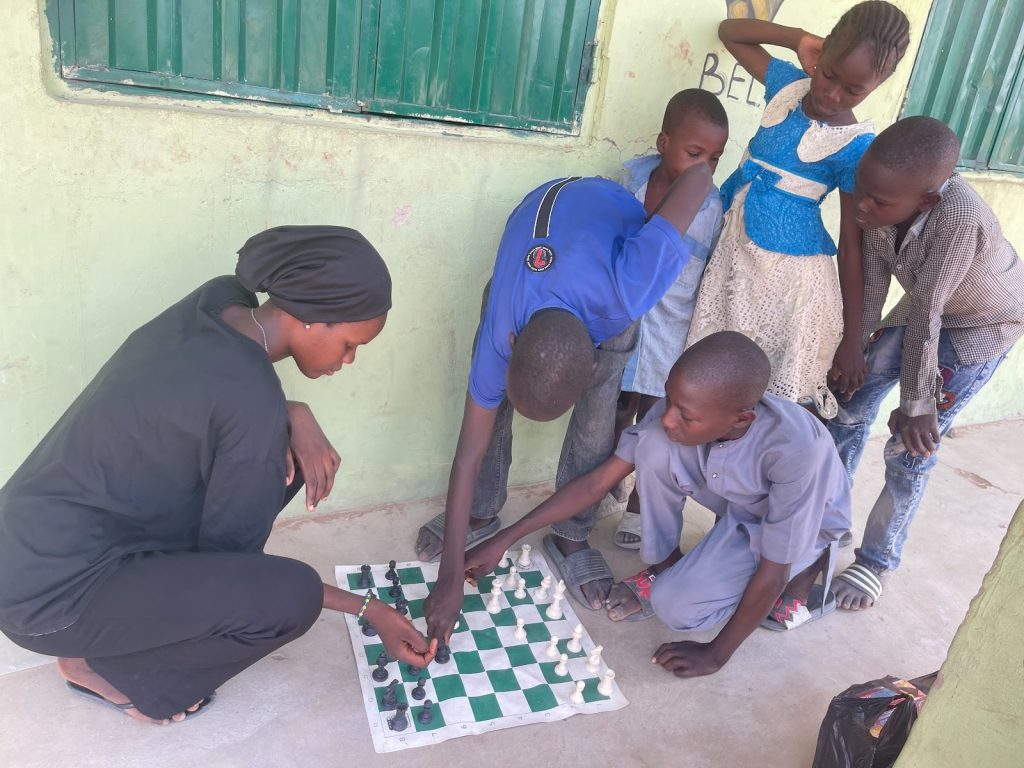
A group of children gather on a Saturday morning in front of a three-block classroom at the Ekklesiyar Yan’uwa a Nigeria (EYN) displacement camp in Wurro-Jabbe, a community in Yola, Adamawa State, northeastern Nigeria. They run across the dusty fields, playing and chatting, but when a chessboard is laid in front of the closed classroom, the children fall silent and move closer to the scene. Their sudden silence and concentration do not come as a surprise because on the chessboard before them, new possibilities begin to unfold.
Seventeen-year-old Partsi David, one of the oldest players in the group, sets up the chessboard and gives instructions before the teachers arrive. She randomly selects the first team to play and urges the next group to be patient as each player is eager to demonstrate their moves first.
It has been a decade since EYN established the camp to accommodate displaced persons from Mubi, Michika, Madagali, and other communities attacked by Boko Haram. While most residents from Mubi have returned home following the restoration of peace in their communities, those from Madagali and other parts of Michika remain in the camp. Apart from relying on donations from EYN and other humanitarian organisations over the past decade, the displaced persons have also taken up farming and menial work to survive.
Survival became a priority over the years, pushing education down the list, and many children relied on the camp’s only primary school, run by older displaced persons who taught the younger ones basic English and numeracy. With barely enough chairs and tables inside the three-block classroom, the pupils bring mats from home to sit on.
According to the United Nations International Organisation for Migration, Boko Haram has displaced over 200,000 people in Adamawa State so far, with residents of Michika and Madagali being among the most affected populations. As of 2025, 69 per cent of children living in internally displaced persons (IDP) camps across Adamawa, Borno, and Yobe were said to lack access to education services.
However, through the Chess in IDP Camp Initiative, displaced children at the EYN camp are now being relocated to formal schools in Yola, where they have been receiving structured education over the past few years. The change came after a young woman, Vivian Ibrahim, introduced chess to the displaced children in 2023.
After establishing the initiative in the EYN camp, Vivian replicated it in Malkohi, another Yola community where a displacement camp is situated. It was in this environment that chess began to take root.
Partsi David sets the chessboard and gives instructions before the teachers arrive. Photo: Saduwo Banyawa/HumAngle.
The game of chess
The displaced persons in Malkhohi are from Askira Uba, Gwoza, Damboa, and other parts of Borno State. Having developed a passion for chess during her junior secondary school years, Vivian’s experience enabled her to teach the game to the children.
She recounted that barely a few minutes after she introduced the game to them, the children began to catch up. “The kind of moves and the thinking ahead that I saw some of them doing left me amazed, and I was like, these kids are very intelligent,” Vivian said.
On social media, she showcased how the children had embraced chess and how well they played.
People began reaching out with tokens of support for the initiative, and soon, more chessboards were acquired. As monetary donations kept flowing, Vivian conceived the idea to direct every penny donated to the campaign toward the educational development of children from the various camps. The initiative’s goal is to use chess as a tool to help displaced children access opportunities in life.
That same year, the initiative secured secondary school admission for five children at the Malkhohi IDP camp, and after she shared the success story on Facebook, the President of the Gift of Chess, an international chess club, reached out to her.
“He donated $500, so I used it to get more of them back to school. And we got books, school uniforms, sandals, school bags, and all of those things,” she said.
From the Malkhohi camp, Vivian began expanding her work to displacement camps in Yola alongside her younger brother, who was also skilled at the game and her only volunteer at the time. They held weekly chess lessons for the children after establishing chess clubs at Malkhohi and EYN camps. “We recently enrolled three-year-olds,” Vivian said with a smile.
As the years rolled by, the children’s skills steadily improved. She noticed a shift in their mindset, particularly in their career aspirations. She explained that many of them believed their future was limited to manual labour since they were displaced children, but after several chess lessons, many of them felt they were really good at something. Vivian believed that participating in tournaments outside the camp would help the children realise not only that they were capable, but also that they were deserving and worthy of every opportunity.
A section of makeshift tents at the Malkhohi IDP camp in Yola. Photo: Saduwo Banyawa/HumAngle
New opportunities
As the children’s confidence grew, the initiative organised a tournament between the two camps and later expanded it across the state, so the young players could showcase their skills. They competed in the state chess tournaments and emerged as champions. The children said their confidence was boosted, and their learning efforts doubled.
For twelve-year-old Timothy Hassan, it was an opportunity to shine.
“I love to calculate. I love mathematics,” he stated.
However, he never thought his dreams could come true, since he didn’t have access to secondary education; education at the EYN camp stops at the primary level. So when the game was introduced to his camp in 2024, Timothy was among the first group to show interest.
“I’ve participated in local tournaments within Adamawa and even travelled to Lagos and Delta states to compete,” he told HumAngle with a bright smile.
Get our in-depth, creative coverage of conflict and development delivered to you every weekend.
Subscribe now to our newsletter!
Timothy says the feeling he gets anytime he’s set to travel for a competition is indescribable because he never thought it would be possible for him to leave the camp or even travel outside the state. Now, he gets to compete with other chess players, and the initiative has enrolled him in a secondary school where he is continuing his education.
“The game has made me a more focused person. It has reduced the rate at which I play around the camp unnecessarily as I spend my free time practising with the chessboard,” Timothy said. “I want to be an engineer,” he added.
Timothy Hassan is surrounded by other chess players at the EYN IDP camp. Photo: Saduwo Banyawa
When preparations were underway for the National Sports Festival in 2025, the Chess in IDP Camp initiative seized the opportunity, as there was no group to represent Adamawa State in the chess section.
“I made contact with the Adamawa State Sports Council, and I presented the kids to them. They played a match. The people at the sports council were impressed,” Vivian told HumAngle.
The children were then selected to represent the state during the chess tournaments in Delta State. They competed against teams from other states in Nigeria and finished fourth.
Partsi, one of the chess players who represented the state at the National Sports Festival, says she’s getting better at the game with each passing day. She also participated in a secondary school tournament in Adamawa, where she emerged as the female winner.
While she wants to become a doctor, Partsi aspires to be a famous chess player.
“I want to be seen on TV, and I also want to be the winner in every competition. I want to win for Nigeria,” she said.
In 2024, Vivian noted that the Commander of the 105 Composite Group, Nigerian Air Force (NAF), who is a patron of the NAF Chess Club in Maiduguri, Borno State, reached out to the Chess in IDP Camp Initiative in Yola, requesting that the programme be introduced to some displaced camps in Borno. Led by Vivian and Tunde Onakoya, a Nigerian chess master and founder of Chess in Slums Africa, the initiative reached Maiduguri, with Tunde directly engaging players at the Muna and Shuwari IDP camps.
Tunde’s visit was said to have brought further media and public attention to the role that chess can play in healing, learning, and reimagining futures for children affected by conflict.
“This game makes me calm whenever I’m playing because chess doesn’t want your attention to be divided. It wants your full attention,” Partsi said.
After Tunde became affiliated with the initiative, Vivian explained that several chess players in the state, mostly young people, volunteered to teach the children. This increase in human resources helped the initiative to reach more children in the camps.
Vivian highlighted that the initiative teaches chess to over 200 IDP children from both camps, ranging from ages four to 18. The chess clubs operate on Saturdays for two hours during the school term, but during the holidays, volunteers visit two to three times a week to tutor the children.
Fifteen-year-old Emmanuel Paul, one of the players who joined the club in 2024, said he needed no persuasion to join.
“The game itself impresses me. The game requires a lot of calculation,” he told HumAngle.
The boy explained that the game makes him feel confident, and anytime there is a forthcoming tournament, he feels ready to play. Emmanuel said the hardest part of the game is the endgame when a tournament is drawing to a close.
“If you don’t strategise well during the endgame, your opponent will win,” he said.
Like many other chess players in the camp, Emmanuel has been enrolled in a secondary school by the Chess in IDP Camp Initiative.
Mary Zira, a renowned chess player from the EYN IDP camp, secured a scholarship for secondary education at a private school in Yola. This came shortly after she returned from an international competition in Georgia in 2025. There, she competed in the Chess Community Games, won a silver medal, and earned a chance to speak at the United Nations.
Impressed by her performance, an individual reached out to the initiative and offered to sponsor her secondary education. While Mary is currently in a private boarding school, her mother, Hannatu Victor, spoke to HumAngle about the achievement.
One of the Chess players lifts her Bishop at the EYN IDP camp during a chess game. Photo: Saduwo Banyawa/HumAngle
“I am a very proud mother,” Mary’s mother stated.
She explained that she had never imagined her daughter’s life would change overnight because of a game. “This game is helping us, especially our kids, in furthering their education. It also exposes them because they go out to meet other children when they play in different places,” she said.
From chessboards to classrooms
Following several tournament victories by the displaced children, the Chess in IDP Camp Initiative has gained widespread recognition. Although the initiative has not yet partnered with any local or international humanitarian organisation, Vivian remains grateful to individuals who have given the children the opportunity for a better life.
According to Vivian, about 70 young chess players from both the Malkhohi and EYN IDP camps have been enrolled in various private and public secondary schools in Yola, with the initiative covering their fees. The oldest student has recently completed secondary school and is now ready to pursue a university education. Scholarships have also been secured for some of the children.
Apart from chess, a group of young volunteers from the Modibbo Adama University, Yola, who recently joined the initiative, are incorporating AI and tech sessions into several chess classes. Their goal is to equip the children for a rapidly changing world.
Elisha Samson, one of the volunteers at the camp, told HumAngle that the children have shown noticeable improvement in STEM subjects integrated into their sessions. The volunteers have been teaching the children how to use Arduino, an open-source platform used for building electronics projects.
The children are also learning other tech skills. Photo: Chess In IDP Camp Initiative
“I feel that, going further in the future, maybe we could have a lot of them build very cool tech on their own without us guiding them to do it,” Elisha said.
Elisha noted that the major challenges they face as volunteers are the lack of electricity in the camp, as some of the tech and AI concepts they are introducing to the children require electricity.
“Sometimes we have to come with a backup power supply from home, and then we use it for them. We also need more Arduino kits to be able to handle more students or show more students what we’re talking about and have lots of practicals because our practicals are limited, as the kits we have are very limited,” he added.
Jerry Sunday, another volunteer with the initiative, explained that sessions are more interaction-based.
“When we notice that a student is trying to lose interest or is not doing well, we break the concepts down into basic everyday examples, and they quickly understand and relate to it,” he said, adding that students who don’t do very well are often paired with better-performing colleagues who serve as their tutors.
Despite these efforts, sessions are sometimes disrupted.
“There is no consistency in attendance, especially during the rainy season, because most of them go to help their parents on the farm,” the volunteer said.
A 2024 fact sheet on Nigeria’s education, developed by the United Nations Children’s Fund (UNICEF), shows that rural and poor children across all levels have lower school completion rates than urban and wealthier children, whose completion rates are above average. The report further states that while 90 per cent of children from the wealthiest quintile complete senior secondary education, less than 16 per cent of children from the poorest quintile do so.
Against all odds, the children continue to excel.
Rebecca David, a displaced woman from Madagali whose daughters participate in the chess programme, noted that their confidence has improved since they enrolled.
“They are now smarter and more critical in doing regular things at home,” she said.
With a focus on long-term sustainability, the initiative aims to partner with local and international organisations to enrol more children in school, expand opportunities for the children, and ensure that displaced children have the chance to dream beyond the confines of their camps.
“I think what has kind of misled children is the belief that if you are not a typical girl, if you like playing with trucks, or boys who like dressing up or that you have same-sex attraction that means that you’re trans and actually it’s not like that but those are all normal variations,” she said.
For families, the Palm Springs Air Museum is an unexpected gem. Kids 12 and under are free, and many of the volunteer docents are veterans who can share insights and firsthand stories about what’s on display — and that is a truly impressive spectacle of aircrafts. Over 75 planes, helicopters, jets and other aviation marvels are parked around the museum’s five air-conditioned hangars, including several that were used during World War II, the Korean War, the Vietnam War and the global war on terror. With no velvet ropes cordoning them off (unless they’re undergoing maintenance), kids can walk up right next to these aircrafts, many of which are still in flyable condition.
For kids with big dreams of manning the controls someday, there’s a designated area where they can sit in former airplane cockpits and play pilot, all alongside a fire engine, a “Star Wars” X-wing model and the nose of a Flying Boxcar that’s open for exploring. And every Saturday morning, the cockpit of a select aircraft parked inside the hangar is made available to guests who are able to climb inside.
There are also unique learning opportunities within the museum, which is dedicated to educating the public about the role that air power has played in upholding American life. The upstairs Education Center holds over 13,000 titles, as well as flight simulators that anyone can test out. And through the museum’s First Flight Experience, students from the Coachella Valley and surrounding areas who are 12 to 17 years old may apply to take their first flight lesson onboard the museum’s Cessna 182 Skylane, Inspiration One, at no cost. As part of the program, students work with a flight instructor to learn about protocols during an actual flight with the time spent in the air counting toward the number of hours required to qualify for a pilot’s license.
For those who would rather remain in the role of passenger, the museum offers the chance to fly on several different warbird planes. Ranging in price from a few hundred dollars to several thousand, visitors may board military cargo planes or fighter jets in group or private settings and take flight over the Coachella Valley.
The Sudan Doctors Network said the deadly strike was carried out by the paramilitary Rapid Support Forces.
Published On 12 Feb 202612 Feb 2026
Share
A drone attack on a mosque in central Sudan has killed two children and injured 13 more, according to a Sudanese doctor’s association, amid a rise in similar attacks across the region.
The Sudan Doctors Network said the attack was carried out at dawn on Wednesday by the Rapid Support Forces (RSF), a paramilitary group engaged in a three-year civil war with the Sudanese Armed Forces.
Recommended Stories
list of 4 itemsend of list
The children were reportedly studying the Quran at the Sheikh Ahmed al-Badawi Mosque in North Kordofan State when the building was hit by a drone in a “blatant violation of international humanitarian law and a grave assault on places of worship”, the doctors’ group said in a Facebook post.
“Targeting children inside mosques is a fully constituted crime that cannot be justified under any pretext and represents a dangerous escalation in the pattern of repeated violations against civilians,” the doctors said.
The Sudan Doctors Network said the RSF has previously targeted other religious buildings for attack, including a church in Khartoum and another mosque in el-Fasher, reflecting a “systematic pattern that shows clear disregard for the sanctity of life and religious sites”.
“The network calls on the international community, the United Nations, and human rights and humanitarian organizations to take urgent action to pressure for the end to the targeting of civilians, ensure their protection, open safe corridors for the delivery of medical and humanitarian aid, and work to document these violations and hold those responsible accountable,” it said.
The UN separately said on Wednesday that a recent series of drone attacks have been reported on civilian infrastructure in Sudan’s South Kordofan, North Kordofan and West Kordofan states.
A World Food Programme (WFP) warehouse in Kadugli was also hit by a suspected rocket attack on Tuesday night, according to UN spokesperson Stephane Dujarric. He did not say which group was responsible for the attack.
“The fact that we have to reiterate almost every day that civilians and civilian infrastructure, places of worship, schools and hospitals cannot and should not be targeted is a tragedy in itself,” Dujarric told reporters.
The UN has warned that Sudan’s civil war is expanding from western Darfur into the Kordofan region.
It has documented more than 90 civilian deaths and 142 injuries caused by drone strikes between the end of January and February 6, which were carried out by the RSF and Sudanese Armed Forces.
Targets included a WFP convoy, markets, health facilities and residential neighbourhoods in southern and northern Kordofan, the UN said.