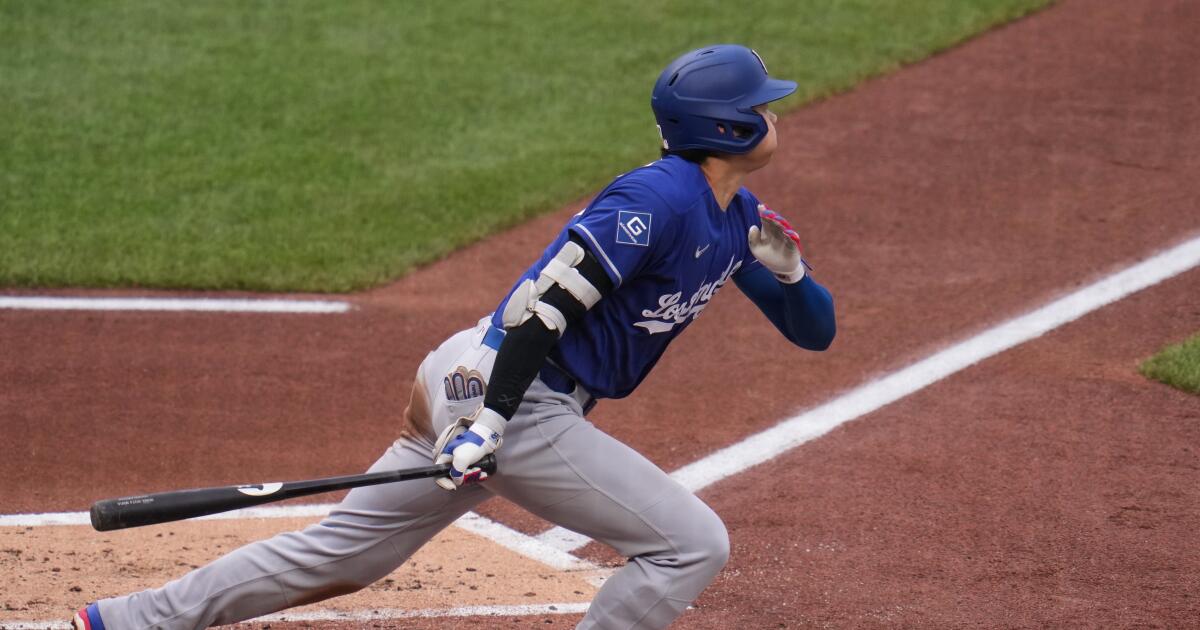
CHICAGO — Dodgers superstar Shohei Ohtani was out of the lineup Friday against the White Sox after exiting the game before with discomfort in the back of his left knee.
Manager Dave Roberts had expressed optimism Thursday night, after the Dodgers’ 8-6 win against the Pirates at PNC Park, that Ohtani would not miss additional time for the ailment. But he added: “Obviously with the travel [to Chicago on Thursday night], we’ll just kind of see how he comes in.”
Especially at this point in the season, the Dodgers have incentive to play it safe with Ohtani’s recovery. Pushing him to return early and exacerbating the injury would be a larger blow to a team seeking its third straight World Series championship.
With Ohtani out, left fielder Alex Call was in the leadoff spot, and Santiago Espinal served as the designated hitter.
It was not immediately clear whether the injury would affect Ohtani’s next pitching start. He’s lined up to take the mound Wednesday against the Rays, before the Dodgers’ off day Thursday.
Around 7 a.m. Saturday, in a lot beside the shuttered Santa Monica Civic Auditorium, a strange set of cars and trucks began to gather. Three Model A’s. A couple of ’60 convertibles. A 1964 Chevrolet Impala station wagon. Also, a big bull on trailer wheels.
“Am I in the right place?” asked a man in one of the Model A’s.
“Going to Chicago?” asked a guy in a white Denali.
“I wish I could do the whole thing,” said Joe Hernandez of Pasadena, wistfully standing by.
Share via
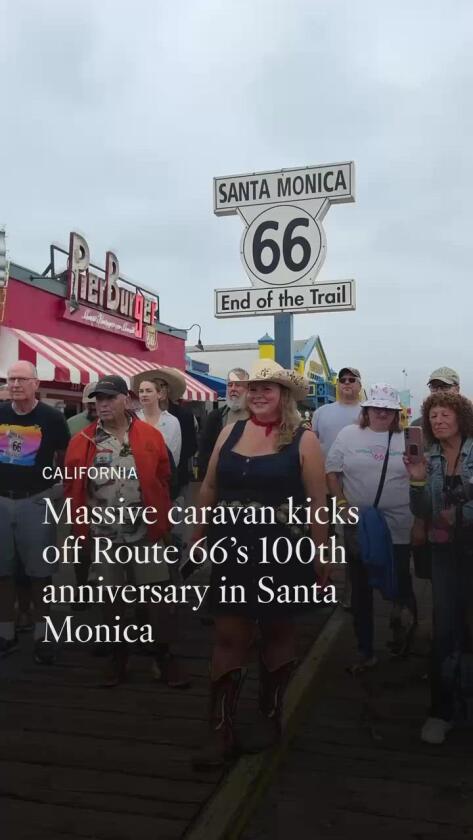
This was the starting line for roughly 70 drivers who gathered to celebrate the centennial of Route 66 with a 2,448-mile, 20-day caravan to Chicago. Most had come from outside California to share an adventure with fellow “roadies” and boost awareness of the classic scenery and independent businesses along the eight-state route.
But soaring gas prices and hesitant international travelers have added uncertainty to a trip that was always going to be a logistical challenge. Day 1 alone might terrify an L.A. commuter: From the Pacific to Pasadena by surface streets, including miles on Santa Monica and Colorado boulevards.
“I don’t know how it’s all going to happen,” said Gary Daggett, president of the Old Route 66 Assn. of Texas. But he and his wife, Stephanie, have more than a little Route 66 experience to draw upon.
Mike and Lisa Visket of Prescott, Ariz., pose in Santa Monica at the pier in their Route 66 clothing on June 6, 2026.
“This is our 30th trip over 20 years,” Daggett said. “You can’t see everything. There’s so much…. You start meeting the people, you get hooked on the people.”
Shortly before their 8:30 departure time, organizer Rhys Martin called drivers together.
“Leaving here is going to be a little complicated,” he said.
Martin, who is part of the Route 66 Road Ahead Partnership, is president of the Oklahoma Route 66 Assn., and serves as manager of the National Trust for Historic Preservation’s Preserve Route 66 initiative. For the journey, he is driving a ’64 Chevy Impala station wagon with a GPS unit inside so that armchair travelers can follow his journey on the web.
“It’s going to be impossible to keep everybody together,” he said during preparations. “We’re encouraging people to spread out and support independent businesses rather than all going to one place and demolishing the kitchen.”
William Cooke of Pinon Hills participates in a caravan from Santa Monica Pier to Chicago, celebrating the centennial of Route 66.
In song and literature, the route is celebrated as an east-to-west journey. This caravan, running in the opposite direction, will travel from California through Arizona, New Mexico, Texas, Oklahoma, Kansas and Missouri to Illinois.
From Santa Monica, the Day 1 schedule took drivers to Beverly Hills City Hall, Grand Central Market downtown for lunch, the Chicken Boy statue and Galco’s Soda Pop Stop in Highland Park, then an overnight in Pasadena.
Day 2 takes the group from Pasadena to Barstow. Day 3, from Barstow to Needles. On June 25, the caravan is due to arrive in downtown Chicago.
The loose procession was led by a core group of 15 cars, including representatives of all eight states on the route. Since anyone can join or leave the caravan at any time, the number of vehicles will vary by the hour.
Through the decades, the road has grown from an American artifact into a global symbol of small-town Americana. Many merchants, restaurateurs and hoteliers along 66 now say that their summer customers are mostly travelers from abroad, especially Europe. One of the caravan’s drivers, in a rented pickup truck, was Dries Bessels, co-founder of the Dutch Route 66 Assn.
Brady Wilson of Amarillo, Texas, displays an assortment of Route 66 pins on his cowboy hat. Wilson is part of a caravan of Route 66 enthusiasts who set out from Santa Monica Pier on June 6, 2026, for Chicago.
Though the Model A’s will surely raise eyebrows on the road, the caravan’s most startling element is the fiberglass bull representing the Amarillo-based Big Texan Steak Ranch restaurant, one of the event’s sponsors.
“It’s the same one my dad brought home in ’71. His name is Big Moo,” said Danny Lee, who co-owns the restaurant with his brother, Bobby Lee. “He’s 12 and a half feet high. About 500 pounds. It’s all fiberglass.”
In 21 cities along the drive, the Big Texan team aims to stage nightly steak-eating contests, giving free dinners to anyone who can eat 72 ounces of steak, a baked potato, three shrimp, a side salad and a roll in 60 minutes.
The caravan’s first challenge came at the Santa Monica Pier, where there was no room for the cars due to a construction project, World Cup preparations and a Children’s Hospital fundraiser. Instead, the caravan gathered by the Santa Monica Civic Auditorium. Drivers strolled over the pier for a photo op, then returned to their cars.
“Herding cats,” said George Kulakowski of Huntington Beach, at the wheel of a 1931 Ford Model A Panel Delivery truck.
Participants in a Route 66 centennial caravan pose for a photo before they depart from Santa Monica Pier on June 2, 2026, for Chicago along the historic highway.
Another challenge awaited in West Hollywood, where Santa Monica Boulevard (aka Route 66) was busy with crowds for the city’s WeHo Pride Street Fair. By plans laid ahead of time, most caravan vehicles detoured around the party while select caravan cars followed a police escort through the action.
This way, Martin said, “another community along Route 66 gets to share its identity with the community at large.”
Allison Lehn of Boston participates in a caravan from Santa Monica Pier to Chicago, celebrating the centennial of Route 66.
By 11:15 a.m., Martin’s car had reached Sunset Boulevard in Silver Lake. Meanwhile, assorted other parades and caravans are traveling Route 66 in other states this year; most of them concentrate on short segments.
By 12:45 p.m., caravaners had met the mayor of Beverly Hills and rolled through West Hollywood’s Pride festivities, arriving at Grand Central Market, running slightly ahead of time.
On May 30, an estimated 3,596 classic cars joined a “Capital Cruise” on Route 66 in Tulsa, Okla., becoming a Guinness Book of World Records holder for the largest parade of classic cars, drawing an estimated 100,000 spectators and overwhelming local traffic.
In Arizona, the Williams Historic Route 66 Car Show was set for Friday and Saturday. In Texas, the Amarillo-based Texas Route 66 Festival is running Thursday through June 13.
William Cooke of Pinon Hills, left, and Sarah Jane Woodall of Tecopa, Calif., drive along Wilshire Boulevard in a 1960 Edsel Ranger Convertible as part of a Route 66 centennial caravan.
In those states and beyond, the caravan from Santa Monica will find hotels and motels in every kind of condition, vintage neon, road food, blue states, red states and purple states.
As a package of Times stories described in May, some landmarks date to the highway’s days as a scene of Depression desperation in the 1930s, others to its giddy postwar years in the late 1940s and ‘50s.
Route 66 was created in 1926 as a highway stitching together hundreds of local roads. Nicknamed “the Main Street of America” by its boosters and “the Mother Road” by John Steinbeck in “The Grapes of Wrath,” the highway inspired Bobby Troup’s song “(Get Your Kicks on) Route 66” in 1946.
But economic life along Route 66 has been precarious since the late 1960s, when interstate highways and chain hotels began stealing traffic away from the older, slower road. After Route 66 was decommissioned as a highway in 1985, about 85% of the old route remained in use, often as small-town thoroughfares, country highways and frontage roads alongside Interstate 40.
Efforts to save and rebuild the route as a historic resource began in the late 1980s and gained ground after the 2006 release of the Pixar/Disney animated features “Cars,” which tells the story of the highway’s rise and fall. In small towns such as Tucumcari, N.M., and Seligman, Ariz., the highway remains central to local identity and economy.
A vehicle in the Route 66 caravan is photographed June 6, 2026.
This year’s centennial improvements along the route “are things that are going to go into the future,” Martin said. “The real impact is going to be next year and the years after.”
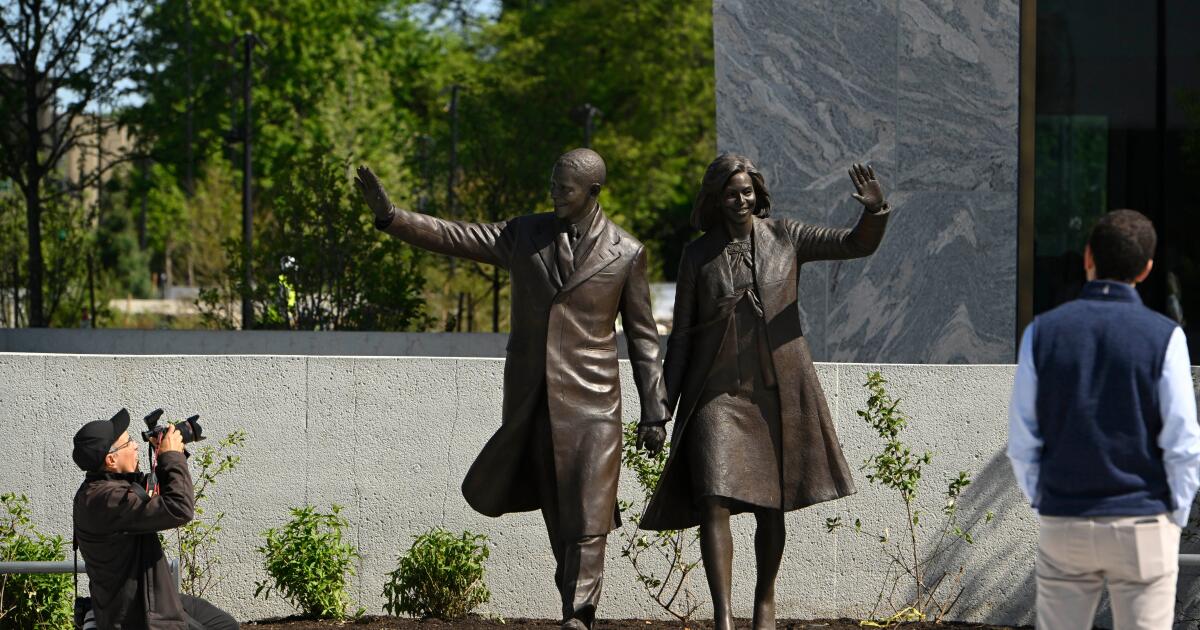
CHICAGO — Former President Obama’s influence in his presidential museum runs deep, from the location on Chicago’s South Side to textured stone adorning its dramatic tower to striped reading chairs that resemble ones in his own home.
The Obama Presidential Center opens to the general public on Juneteenth after a celebratory dedication in Chicago with dignitaries. But tens of thousands of people — friends and family of museum staff, students and journalists — have already been offered a sneak peek of the nearly 20-acre campus as crews finish final art installations and landscaping.
The roughly $850 million project covers the political and personal realms of the nation’s first Black president. Campaign memorabilia and presidential artifacts are displayed in the admission-based museum tower while public spaces of the sprawling campus feature other things important to Obama: a new library, basketball court and picnic area with grills.
“This is a safe space for people to come and, yes, reflect on the historic moments of this presidency and the campaigns, but also to come together as a community to think about what change you can bring to your own neighborhood,” Josh Harris, the Obama Foundation’s vice president of public engagement, said during a recent tour with The Associated Press.
Here’s a closer look at the top attractions of the campus that is expected to draw as many as 1 million visitors annually.
President for a day
Obama’s presidential museum will be the first fully digital museum of its kind. There will be no official papers on display. Instead, visitors will experience high-tech and hands-on exhibits spanning the campaigns, key moments of Obama’s presidency and life at the White House.
One of the largest attractions is a life-sized replica of the Oval Office.
On a recent day, a stream of visitors, including schoolchildren, walked through the circular room, stopping to sit behind the desk and pose for pictures. The top drawer holds a copy of a handwritten letter from his predecessor, President George W. Bush, and Obama’s beloved BlackBerry phone.
“We want to make sure that people from all walks of life have the opportunity sit behind the Resolute Desk,” said Harris. “You think about the possibilities that if a young organizer from the South Side of Chicago can be president, you can be president too.”
Other sections of the museum detail the Affordable Care Act, immigration policies, and smaller moments such as when Obama unexpectedly sang during a 2015 eulogy for those killed in a South Carolina church shooting. A large television screen plays a clip of Obama singing “Amazing Grace.”
Peppered throughout are areas for personal reflection, which museum organizers say is key.
“We’re passing that baton and inviting people to bring change home, however change may be defined, both small or large,” said Louise Bernard, the museum’s director.
Touching iconic ballgowns
When Obama touted the museum’s contents at its groundbreaking in 2021, he predicted one of the top draws.
“We want this center to be more than a static museum or a source of archival research,” Obama joked at the site. “It won’t just be a collection of campaign memorabilia or Michelle’s ballgowns, although I know everybody will come see those.”
Roughly a dozen outfits on mannequins are behind glass, including a black and red dress designed by Narciso Rodriguez that the former first lady wore on Election Night in 2008 in Chicago.
Visitors will also get a chance to touch swatches of the fabrics, including the rose gold chain mail Atelier Versace evening gown she wore at her final state dinner in 2016.
Obama’s personal touches
The museum’s location is near where Barack Obama started his political career, taught law at the University of Chicago and where the family lived. Michelle Obama also grew up on the South Side.
A lifelong basketball lover, Obama requested a glass-paneled, professional grade basketball court to be used for community programs.
The former first lady designed a garden, where lettuce and strawberry plants are sprouting. There are also charcoal grills available for public use — an element that Obama envisioned when he pitched the plan in community meetings nearly a decade ago.
“President Obama always talked about his feelings of being in Chicago and one of his memorable moments was grilling in the park,” Harris said.
The Obamas’ design tastes and love of history are also evident.
The museum campus features dozens of commissioned works of art while different parts of the campus are named after prominent figures. The central “John Lewis Plaza,” named for the late congressman and Civil Rights leader, is designed as a public gathering spot.
Inside a new Chicago Public Library branch, a 70-foot mural depicts literary figures, including Walt Whitman and James Baldwin. At the center, Toni Morrison reads to a boy wearing orange shirt, representing a young Obama.
The presidential reading room features thousands of books chosen by the Obamas, ranging from presidential biographies to best-selling fiction. One of Obama’s favorite parts are two high-backed chairs with blue, yellow and black stripes. They were selected by the former president as top-notch reading chairs similar to ones he has at home.
Pricey admission with free options
Tickets are $30, the highest of any U.S. presidential museum or library. Next on the list is the Richard Nixon Presidential Library and Museum in California, where tickets are $29.
Obama Foundation leaders say the prices are justified for the state-of-the-art facility.
Tickets at the adjacent Griffin Museum of Science and Industry are $25.95. In downstate Illinois, tickets to the Abraham Lincoln Presidential Library and Museum in Springfield cost $15.
Along with free days and discounts for Illinois residents, Obama Foundation officials also argue that most of the campus is free, with only four floors of the museum tower requiring tickets.
Anyone can walk the campus, use the playground, library, sledding hill or grilling area. The tower’s top floor, which feature panoramic views of the nation’s third-largest city, is also free.
“The idea behind this institution, this campus, was to make it accessible to as many people as possible,” Harris said.
May 29 (UPI) — Reports that the U.S. Attorney’s Office in Chicago is investigating President Donald Trump accuser E. Jean Carroll are denied by that office, one day after widespread reporting by multiple news outlets.
“In light of wide-spread reporting and intense media and public interest into the E. Jean Carroll matter in New York, the Chicago U.S. Attorney’s Office can confirm that it has not opened — and has never opened — a criminal investigation into E. Jean Carroll. Any claim to the contrary is categorically false,” U.S. Attorney for the Northern District of Illinois Andrew S. Boutros posted a statement on X.
CNN broke the news Thursday, citing multiple sources familiar with the matter, and other news outlets confirmed with their sources. They reported that Acting Attorney General Todd Blanche had recused himself from the investigation because he had represented President Donald Trump in one of his appeals of a civil case brought by Carroll.
Carroll won two civil suits against Trump. One alleged that he sexually assaulted her in a New York department store in the 1990s and another one was for defamation in 2019, after he denied the assault and said she made up the attack to boost book sales. In the assault case, Carroll was awarded $5 million, and in the defamation case, she was awarded $83 million.
The reported investigation was allegedly into a 2022 deposition in which Carroll said she received no outside funding for the suit. Later, it came to light that billionaire Reid Hoffman, co-founder of LinkedIn, paid some of her legal fees and expenses.
The BBC reported Friday that CBS News had initially reported the investigation but later reported that its source had clarified that Carroll’s testimony about funding for her lawsuits against Trump was being looked at as part of an investigation into a nonprofit run by Hoffman. CBS published an editor’s note Thursday to clarify.
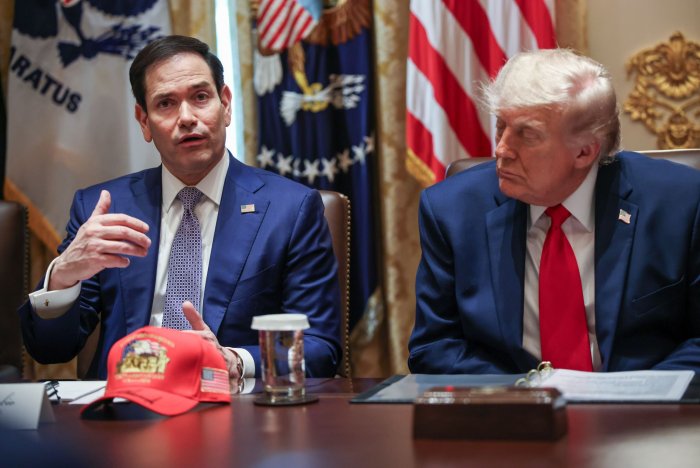
Secretary of State Marco Rubio and President Donald Trump participate in a Cabinet meeting in the Cabinet Room of the White House on Wednesday. Photo by Samuel Corum/UPI | License Photo