Oct 30, 2026, 9:47 AM ETBy: Liz Kiesche, SA News Editor
AlexSecret
The Chicago PMI dipped to 55.3, missing the 56.0 consensus, from 58.8 in September, according to data released by MNI and the Chicago Institute for Supply Management on Friday.
A reading over 50 indicates economic growth. So the lower number in October suggests that growth slowed from the September pace.
Mustache. Aviator sunglasses. Bears sweater vest. Though Mike Ditka‘s look may be iconic, his time as a player and coach is what cemented his name in NFL history.
Ditka, the first ever tight end to be inducted into the Pro Football Hall of Fame and coach of the legendary 1985 Chicago Bears, has died. He was 86.. His family announced his death in a statement Friday.
“It is with profound sadness that we announce the passing of our beloved husband, father, grandfather, and friend, Mike Ditka,” The family said. “While the world knew Mike as a Hall of Fame football player, legendary coach, and leader of the Chicago Bears’ Super Bowl XX championship team, we knew him as the heart of our family. Mike will be missed beyond measure and remembered forever.”
With nicknames “Iron Mike,” “Da Coach” and “The Hammer,” Ditka was inducted into the Pro Football Hall of Fame in 1988 after a 12-year playing career that featured five Pro Bowls, 427 receptions, 43 touchdowns and 5,812 receiving yards.
Ditka, who won two Super Bowls as a coach and one as a player, revolutionized the tight end position, transforming it from a primarily blocking-focused role to one that could pose a threat in receiving.
Notorious for his fiery personality, Ditka also took his stardom from field to screen, starring alongside Will Ferrell in “Kicking & Screaming,” in which he played himself. Though instead of coaching the championship-winning Bears, he helps coach a little league soccer team — but his competitive spirit remains the same. He also made several TV appearances, including in “Cheers,” “L.A. Law” and “Entourage.”
Born in Carnegie, Pa., on Oct. 18, 1939, Ditka was a first-round draft pick of the Chicago Bears in 1961. The team at the time was helmed by Bears founder, president and head coach George Halas, who later bestowed Ditka with his first NFL head coaching job in 1982.
Coming from the University of Pittsburgh, where he also played basketball and baseball and received All-America honors in football, Ditka immediately became a mainstay in the Bears lineup, going on to start 84 straight games. He was named rookie of the year with 56 catches for 1,076 yards and 12 touchdowns, becoming the first tight end to reach 1,000 yards receiving in his rookie season.
He also earned All-NFL honors from 1961 to 1964 and made the NFL Pro Bowl five times in his first six seasons. Ditka was enshrined into the College Football Hall of Fame in 1986.
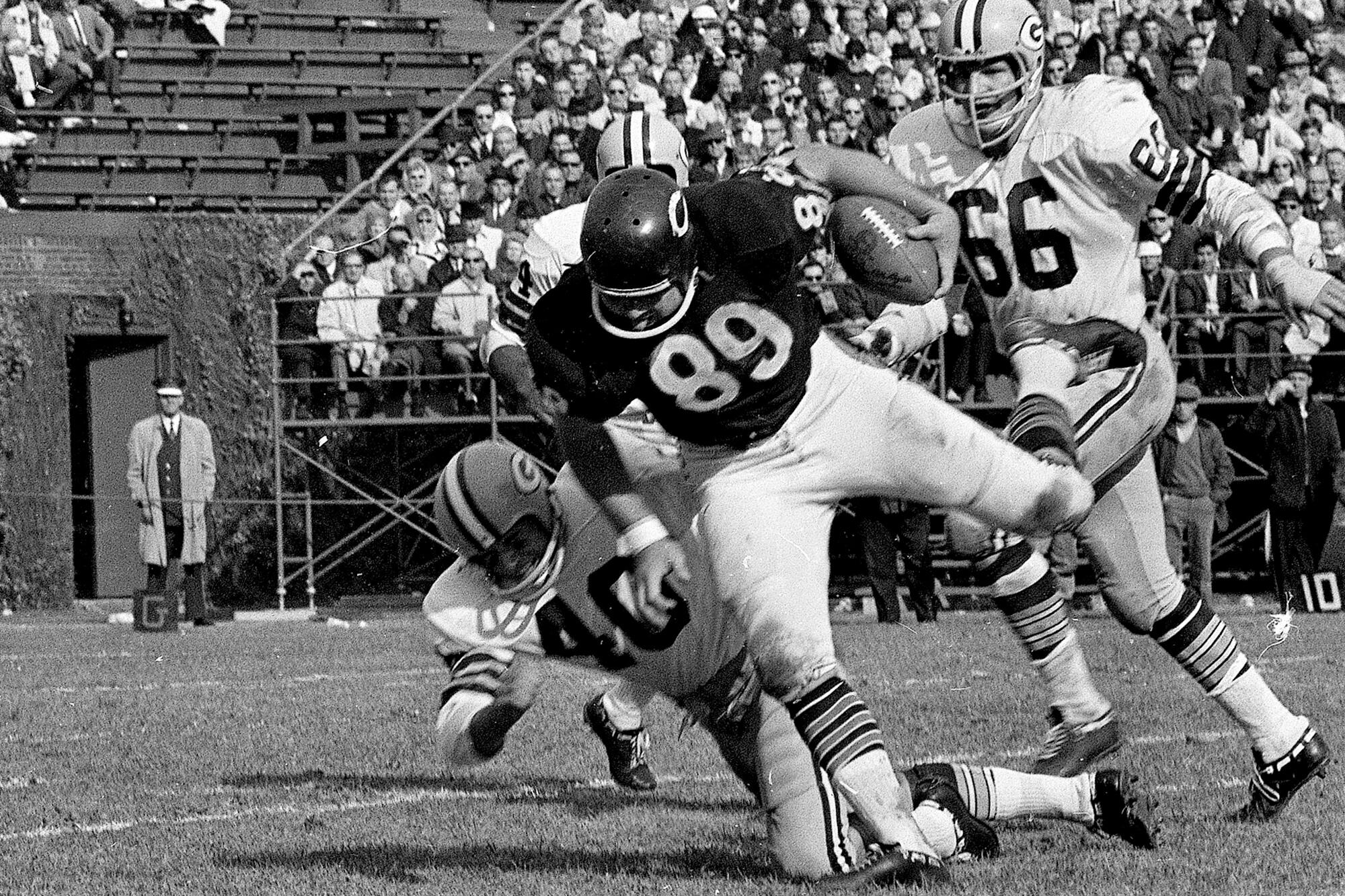
Chicago Bears tight end Mike Ditka is tackled after a pass reception against the Green Bay Packers at Wrigley Field on Oct. 16, 1966.
(Associated Press)
The tight end eventually became a coach, famously leading the 1985 Chicago Bears. The team, one of the best in NFL history, went 15-1 and scored 456 points while only allowing 198. The Bears had plenty of personality that year as well, audaciously recording a rap-styled video called “The Super Bowl Shuffle” that was released during the regular season.
But it was not only a strong season on paper — Ditka is credited with leading the Bears back to relevance and luster after losing records in 1980, 1981 and 1982. He built them back to a team fans adored and competitors feared.
“I think that’s the way Mr. Halas always wanted it,” Ditka told The Times in 1985. “He wanted to have a ballclub with a certain personality, a team made up of, you know, rough, tough guys, a team that didn’t take any crap from anybody and could dish it out.”
Ditka and the team brought triumph to Chicago in Super Bowl XX in New Orleans with a 46-10 win against the New England Patriots.
Winning NFL coach of the year with the ’85 team, Ditka is one of only two who have won a Super Bowl as a player, assistant coach and head coach.
“I believe Mike Ditka represents us, in more ways than one,” then linebacker and captain Mike Singletary told The Times. “We know he’s not coaching the Chicago Bears because he needed a job. The Bears mean something to Mike Ditka. The team is part of him.”
His time in Chicago wasn’t all glitz and glamour, though. Ditka wasn’t immediately welcomed back to the Bears as a coach, with his temper a source of strain between him and the owners. He also had a DUI conviction in 1985 and suffered a heart attack in 1988.
“There was a (magazine) poll of 200 NFL players who said the coaches they would least like to play for were, first, (Tom) Landry and, tied for second, Don Shula and me. I was flattered. What a great compliment,” wrote Mike Ditka in his 1986 autobiography.
Ditka was entrenched in controversy, having been outspoken about Washington not changing its name from the Redskins, also facing backlash for comments he made in 2016 criticizing Colin Kaepernick and social justice protests, later apologizing.
Despite it all, his name is etched in NFL history.
“Ditka was proud and headstrong,” wrote former Times sports columnist Mike Downey. “He was common and condescending. … He did as he pleased. But he restored the reputation of the Chicago Bears, made them winners and made them watchable.”
During his playing career, he made an iconic 63-yard catch-and-run against the Steelers on Nov. 23, 1963, which stands in 69th place on NFL’s 100 Greatest Plays. The highlight helped the Bears to a 17-17 tie after being down 17-14 in the fourth quarter; the team later went on to win the NFL championship.
In 1967, he was traded to the Philadelphia Eagles and then to the Dallas Cowboys in 1969. During his time with the Cowboys, Ditka made it to two Super Bowls, with a loss in 1971 and finally a win the following year in which he scored the final touchdown in a 24-3 win against the Miami Dolphins.
After retiring in 1972, Ditka joined the Cowboys as an assistant coach. He got his hands on the Super Bowl trophy once again in 1977 with the team and stayed on until joining the Chicago Bears.
The Hall of Famer’s ties with Chicago were once again severed, this time with his firing in 1993 following a 5-11 season. But he refused to shed the navy and orange in the years after he went 106-62 and led the Bears to seven playoff appearances in 11 seasons.
“Yeah, I was fired by the Bears, but that’s life,” Ditka said during a visit to Chicago’s practice field in 2013. “There has never been a time I was not a Bears fan. I have a right to be a Bears fan as much as anybody. I played on a championship team and I coached a championship team.”
The Bears retired Ditka’s number, 89, in 2013.
His involvement with the NFL expanded off the green as he explored TV commentating, even earning Sports Emmy nominations for outstanding sports personality in 1994 and 1996.
Ditka did have one more head coaching stint in the NFL from 1997 to 1999 with the New Orleans Saints. After two 6-10 seasons, the Saints traded all of their draft picks — plus a first-round selection in 2000 — to move up and select running back Ricky Williams. But the team went 3-13 in 1999 and Ditka was fired after the season.
He finished his coaching career 121-95 after the 15-33 stint in New Orleans.
“I’ve been to the top of the mountain and I’ve seen it,” Ditka told The Times in 2004. “And I’ve been to the bottom of the mountain and I’ve seen that too. I don’t want to get anywhere between them anymore.”
Professional football would not see the last of him, however, as he went on to do radio and TV broadcasting for programs such as The NFL Today, Monday Night Football and SportsCenter. His passion for football would never fade, apparent in his launch of X Football, women’s tackle football competition league, in 2021.
And his mark on Chicago was not confined to the stadium gates; he was a partner in Ditka’s Restaurant Group which first opened a steakhouse in downtown Chicago in 1997, boasting its signature dish, “Da Pork Chop.” While the original location closed in 2020, there are still locations in Oakbrook, Ill., and Pittsburgh.
After a short stint living in Florida, Ditka and his wife, Diana, replanted roots in Chicago at the end of 2024.
‘‘I was born in Pennsylvania and raised in Pittsburgh, but Chicago is my home . . . and it is my life,” Ditka told the Chicago Sun Times.
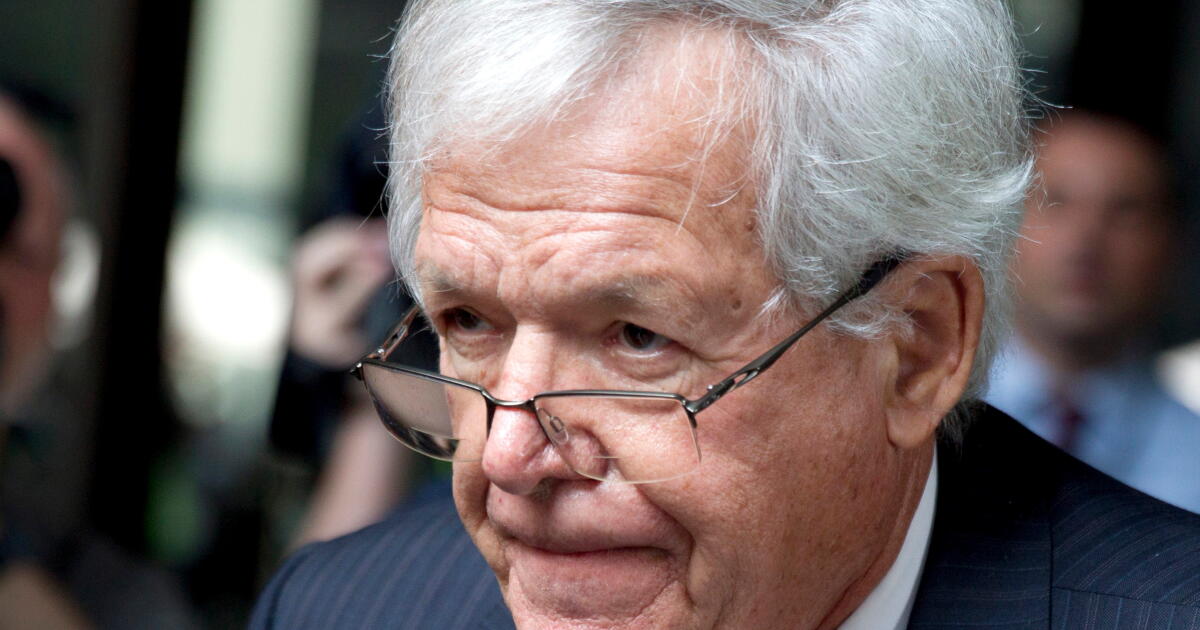
CHICAGO — Dennis Hastert, the nation’s longest-serving Republican House speaker, who helped turn much of President George W. Bush’s agenda into law before his own political legacy was forever fouled by allegations that he molested high school athletes when he was a wrestling coach, died over the weekend, a coroner said Monday. He was 84.
Hastert, who was speaker from 1999 until 2007, died of natural causes at his home, according to Kendall County Coroner Jacquie Purcell.
When he was sentenced in 2016 to more than a year behind bars, the former history teacher became one of the highest-ranking American politicians ever ordered to prison.
In the late 1990s, Hastert was a little-known Illinois lawmaker with a reputation for congeniality that had helped him ascend the ranks of congressional leaders. When Newt Gingrich lost support because of ethics violations and the GOP’s poor showing in an election, Republicans elected Hastert to succeed him. In his first weeks on the job, he presided over the House while the Senate conducted Bill Clinton’s impeachment trial.
After the GOP reclaimed the White House, Hastert took much of what Bush proposed and steered it to passage, including massive tax cuts and a measure that amounted to a huge expansion of prescription drug benefits — the biggest change in Medicare in decades.
His legacy was suddenly thrown into doubt in 2015, when he was accused of evading banking regulations as part of a plan to pay hush money to conceal unspecified “prior misconduct.” Nearly a year later, prosecutors filed papers that described what media reports had suggested for months: Hastert’s misconduct involved the sexual abuse of teenage boys on his wrestling team in the small town of Yorkville, west of Chicago.
During a 16-year coaching career, he led his team to a state championship and was named national coach of the year in 1976. But behind the accolades, prosecutors said, Hastert sexually abused at least four team members from 1965 to 1981.
The person Hastert was paying, identified in court papers only as Individual A, said the abuse occurred in a motel room when he was 14 on the way home from wrestling camp. Hastert allegedly touched other wrestlers in a locker room after saying he would give them massages. Two wrestlers said Hastert performed sex acts on them.
Prosecutors also described a recliner where Hastert often sat in the locker room with a direct view of the stalls where the boys showered.
Hastert agreed to plead guilty to evading banking laws. In all, he paid more than $1.7 million out of $3.5 million that he had promised to Individual A, sometimes in lump sums of $100,000 cash.
At the sentencing hearing where he received 15 months behind bars, the visibly angry judge called Hastert a “serial child molester.” A former wrestler struggled with his emotions as he told the court about his “dark secret” from adolescence.
In his own statement, Hastert said he was “deeply ashamed” and admitted that he “mistreated” some of his athletes. But he never referred directly to sexual abuse.
The public knew nothing about Hastert’s past when Republicans lost seats in the 1998 midterm elections. Hastert confronted Gingrich about dissatisfaction in the GOP ranks, saying it was unlikely Gingrich could hold his post, Hastert wrote in “Speaker: Lessons from 40 Years in Coaching and Politics.”
“Well, I’ll make them support me,” he quoted Gingrich saying of the GOP rebels. Told that was unlikely, Gingrich asked Hastert what to do.
“Do what you have to do,” he replied. The next day, Gingrich stepped down as speaker and left the House.
Hastert’s path to the speaker’s office was cleared when Louisiana Rep. Bob Livingston, who was considered a lock to replace Gingrich as speaker, resigned after acknowledging several extramarital affairs.
In January 1999, Hastert broke with tradition by delivering his acceptance speech from the House floor and by allowing Minority Leader Dick Gephardt, a Missouri Democrat, to briefly preside over the day’s proceedings.
“Solutions to problems cannot be found in a pool of bitterness,” Hastert said in his speech. “They can be found in an environment in which we trust one another’s word, where we generate heat and passion, but where we recognize that each member is equally important to our overall mission of improving the life of the American people.”
Hastert was aware of the personal pitfalls of holding the powerful position.
“You know, in this business, especially in a job like this, you can get your head someplace where it shouldn’t be,” Hastert said in a 1999 interview with The Associated Press. “But you come back home, and you’re home. You’re back where you’ve always been, and your feet are back on the ground.”
He was generally viewed as a friendly, even-tempered lawmaker. His wrestling experience followed him to Washington, with GOP colleagues often calling him “coach.”
Hastert said he lacked the appetite for higher office.
As the recount of the 2000 presidential election dragged on, Hastert’s aides briefed him on the possibility that he might become acting president in the event of an Electoral College deadlock.
“I really didn’t want to be president, temporary or otherwise,” he wrote in his book. But he decided that he would not pass the office to the constitutional officer next in line if an Electoral College deadlock extended beyond Inauguration Day. In the end, the Supreme Court’s 5-4 ruling ended the recount, and Bush moved into the White House.
Hastert’s journey to Congress from his boyhood farm appeared to be the result of fate and luck.
In 1980, he finished third in an Illinois House primary. But the incumbent became fatally ill, and GOP leaders chose Hastert to take his place on the November ballot, where he won in a traditional GOP stronghold.
Hastert became a congressional candidate in 1986, when local Republican leaders put him on the primary ballot, replacing freshman Rep. John Grotberg, who was battling cancer. Hastert went on to beat the Democrat with 52 percent of the vote, his smallest margin of victory in a congressional race.
In Washington, Hastert served quietly in House leadership, working closely with Gingrich and then-House Majority Whip Tom DeLay after Republicans took control in 1995. Several years later, DeLay was the force driving Clinton’s impeachment and was simply too toxic to seek the speaker’s chair.
Hastert’s tenure was marked by a shift of power from committee chairmen to GOP leaders, fealty to the Bush administration and an explosion of congressional pet projects known as earmarks. Democrats fumed that he weakened the ethics process that ensnared DeLay, who left Congress under a cloud of criminal charges in 2006.
Hastert became wealthy largely through a complex web of transactions that coincided with one of his own highway earmarks increasing the value of land he had purchased in his district.
He was forced to step down as speaker in 2007, when Democrats gained control of the House, and he resigned his seat later that year. In 2008, he joined the Washington lobbying firm of Dickstein Shapiro as a senior adviser, specializing in government law and strategy.
Born in Aurora, Illinois, Hastert earned a bachelor’s degree in economics from Wheaton College in 1964 and a master’s in education from Northern Illinois University in 1967.
In 2007, Wheaton named its newly created public policy center the J. Dennis Hastert Center for Economics, Government and Public Policy. After Hastert’s indictment, the school removed his name in 2015. Other organizations abandoned associations with Hastert, and his portrait was removed from a hallway outside the House chamber.
Hastert lived his entire life in Chicago’s suburbs, primarily in the Yorkville area. While growing up, he helped his father with the family feed business.
Survivors include his wife, Jean, and two adult sons.
Tarm and McCann write for the Associated Press. Tarm and McCann are former Associated Press reporters.
LAS VEGAS — Leo Carlsson had a goal and an assist, Lukas Dostal made 27 saves, and the Ducks opened the season by holding off the Vegas Golden Knights 4-3 on Friday night.
The teams met last season in the second round of the playoffs, with Vegas winning in six games and going on to win the Western Conference. The Golden Knights opened Tuesday night at home with a 5-2 victory over Chicago.
Carlson set up Beckett Sennecke’s goal with eight seconds left in the first period, then scored at 7:03 of the second to cap a three-goal burst for a 4-0 lead. Alex Killorn and Jeff Malott also scored.
Shea Theodore, Tomas Hertl and Braeden Bowman scored for Vegas in the third period, with Bowman connecting with 2:50 left. Hertl struck on a power play.
Carter Hart stopped 16 shots for the Golden Knights.
Up next for the Ducks: vs. Florida at Honda Center on Sunday.
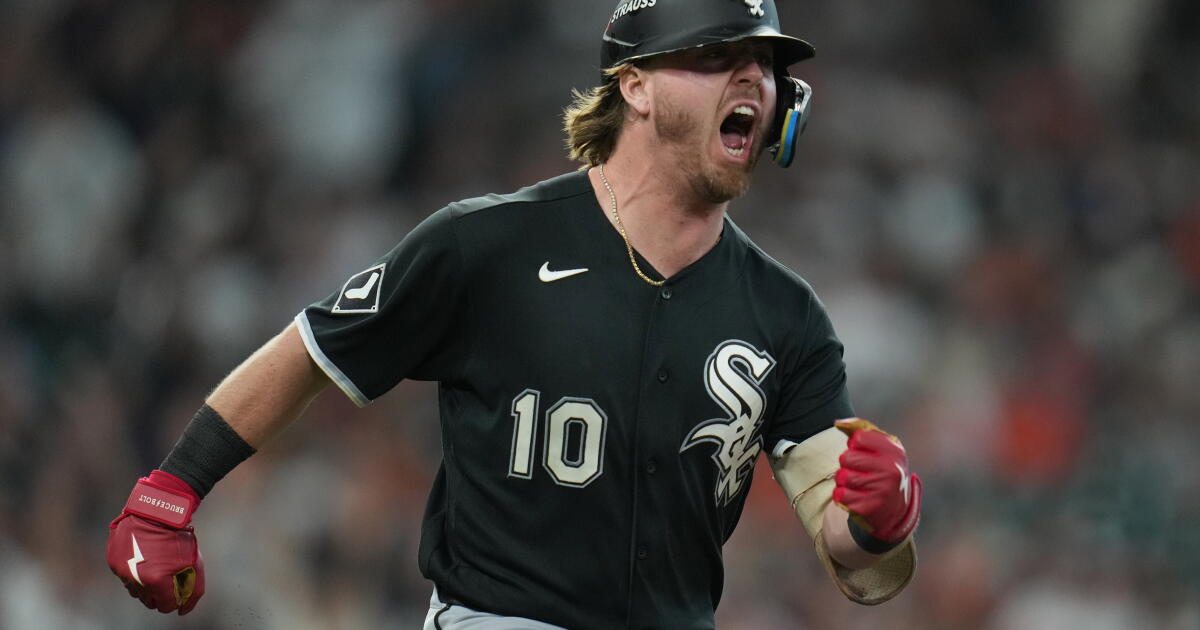
The Chicago White Sox used a big first inning and a three-run homer from Chase Meidroth to propel them to a 7-3 win over the Houston Astros on Wednesday to sweep their AL Wild Card Series.
It’s the first time Chicago has won a playoff series since beating Houston in the World Series in 2005. Under the direction of second-year skipper Will Venable and with a letter of support from Pope Leo XIV, the White Sox advanced to face AL Central champion Cleveland in the AL Division Series beginning Saturday in Cleveland.
The White Sox, who lost 100 games in each of the last three seasons, are the only team in major league history to follow consecutive 100-loss seasons with a playoff berth.
The AL West-winning Astros went 81-81 to become the first team to reach the postseason without a winning record. Their recent playoff woes in Houston continued Wednesday as they dropped their ninth straight home playoff game in a ninth trip to the postseason in the last 10 years.
Chicago pounced on the Astros for four runs in the first inning a day after scoring three in the first two innings of a 6-3 win. Houston ace Hunter Brown was lifted after getting just two outs and wasn’t helped by a sloppy defense which committed two first-inning errors.