cheese

I went hiking in Switzerland and found cheese, chocolate and muscles I never knew I had

HIKING down the mountain, butterflies fluttering past, the sound of moo-sic fills the air. It seems the native black Hérens cows, adorned with huge bells, are on the move, too…

My daughter Ava, 12, and I are on an idyllic, hour-long trail in the Swiss Alps that starts at Cabanes-des-Violettes cable car and has us venturing across a spring, wildflower meadows and alpine forest.

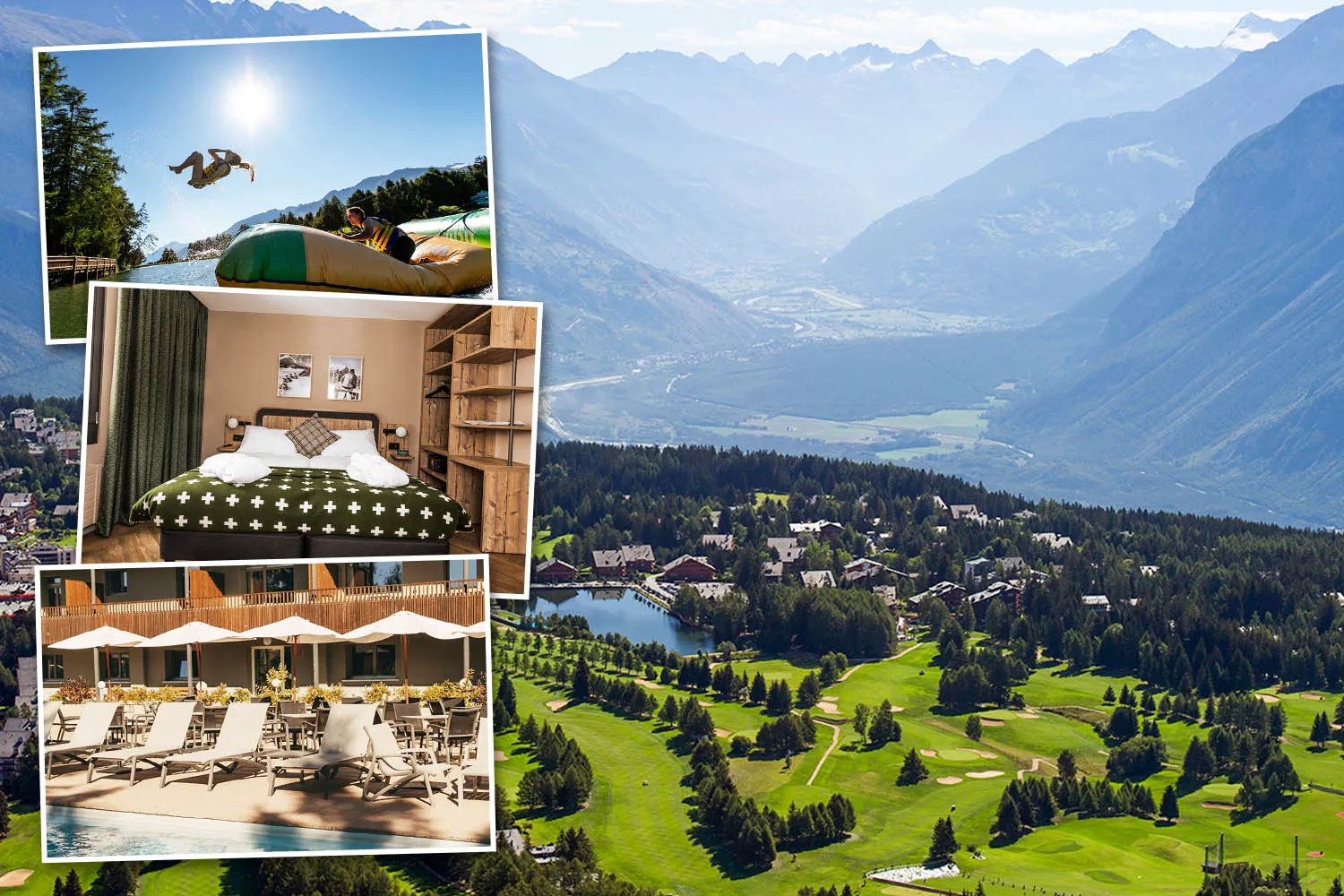
Take in the wildflower meadows and alpine forest while hiking in ValaisCredit: OLIVIER MAIRE
Hotel Valaisia features roomy balconies leading off its comfy doublesCredit: RICARD ROMAIN
There are indoor and outdoor pools, as well as a saunaCredit: Supplied by PR

And just when I think Ava is on her last legs, we round a bend to discover the Relais de Colombire restaurant, perched as high as the paragliders.

It’s the perfect spot to refuel on fondue, £27, and local Marmotte Hippie IPA, £6, while Ava makes light work of the giant cookie and ice cream, £11.20 (Colombire.ch/en/restaurant).

Fun-icular times

We’re kipping in the pretty town of Crans-Montana, with its elaborate flower displays, boutiques and eight lakes, in the French-speaking region of Valais.

It’s a scenic two-hour train around Lake Geneva then a thrilling funicular ride to get here from Geneva airport, and Hotel Valaisia makes the most of the scenery, with roomy balconies leading off its comfy doubles.

TRAILBLAZERS

The 10 best women’s hiking shorts for 2023


MAGICAL CITY BREAK

I found beautiful hiking islands & rooftop pools in this ‘stopover’ city

There are indoor and outdoor pools, a sauna, cosy snug and games room, and at Eteila Brasserie, we feast on tasty dishes such as salmon with baked potato and mango salsa, £42 for three courses. You can also bike and hike from the doorstep.

Hopping on two wheels is a great way to get your bearings – more so if you’re over 16 and can e-bike!

We do our best to keep up with guide John, and even test our skills on a forest obstacle course.

Afterwards, we treat our wobbly legs to pulled veal burgers, £33, on La Plage’s terrace at Lake Moubra, where I try (unsuccessfully) to tempt Ava to sample my bourguignon-style escargots, £11 (Restaurant laplage.ch).

A one-hour bike tour costs £61 (Esscrans-montana.ch).

Love at frost bite

Even in August, you can still find snow up high. We catch a gondola to 3,000m above sea level, spying cute mountain goats and Roger Moore’s Bond pad on the way.

At the top, Plaine Morte Glacier – an 8km expanse of glistening ice – is breathtaking, as are views of the snowy peaks of Mont Blanc and the Matterhorn – the mountain Toblerone was modelled on.

It’s that same chocolate I find myself scraping out of my bowl that evening at Le Mayen, a short stroll from our beds, where the Toblerone mousse, £12, is a must.

Surrounded by check tablecloths, dirndl-wearing waitresses and a waft of cheese, we soak up the full Swiss experience, carb-loading on rosti – a heavenly mix of raclette, fondue and local dried meat, £31 (Mayen.ch).

Wakeboard me up, before you go, go!

On our last morning, we swap snow for the palm-tree-lined beach of Étang Long lake and watch a 140m wakeboarding cable give people the ride of their life, from £23 (Cransmontana.ch).

It looks easy, until I nose-dive into the water.

Swap snow for the palm-tree-lined beach of Étang Long lakeCredit: PATRICK GUELLER
Fab Mag’s Kirsty with daughter AvaCredit: Supplied by Kirsty Spence

The lake inflatables – free with the MyExplorer Card hotel guests receive – are more our bag, then as we await our Beach Club crêpes with goat’s cheese, walnuts and honey, £17, Ava challenges me to a volleyball match. . .

I’ve done more exercise in just a few days here than I have in weeks back home.

There’s clearly something in the air – and it’s not just cheese.

BTW

Double rooms at Hotel Valaisia start from £235 B&B (Faernresorts.com).

Flights from the UK to Geneva cost from £42 return.

Plan your visit at Switzerland.com.

Source link

Best Venezuelan and Colombian spots for arepas in Los Angeles

In the streets of Cartagena, Colombia, cumbia musicians beat tambora drums and blow into flautas, women in red, yellow and blue ruffled dresses whisk by, and sweating food vendors push carts, their arepas sizzling.

Among the music and striking color of Cartagena, my dad handed me my first arepa. Arepas are the most essential dish of Colombia and neighboring Venezuela, centered around South America’s most treasured crop: corn.

To prepare an arepa, corn kernels are ground into flour or pre-ground corn flour is used (often the iconic yellow bag of Venezuelan brand P.A.N.), and mixed with water and salt. The soft dough is then fried, grilled or baked into a pancake-like shape. The result is delightfully simple yet endlessly customizable.

“My memory of arepas is eating them morning, afternoon and night,” said Yesika Baker, owner of Chamo’s Venezuelan Cuisine in Pasadena. “In Venezuela, the areperas are open 24/7.”

The arepa has deep roots. Before Colombia and Venezuela came to be known as separate territories, they were unified by Indigenous groups with similar culinary traditions. When the Spanish first arrived in South America, Indigenous women were cooking corn cakes similar to the modern arepa, meaning the tradition likely goes back thousands of years, according to University of Venezuela anthropology professor Ocarina Castillo.

Today, the arepa is popular in both countries. In Colombia, an arepa tends to be simple: topped with cheese by street vendors, filled with egg for a tasty breakfast or, most often, served as a side to a hearty meal. Some say the masa of a Colombian arepa tends on the thinner side as well.

“Growing up in Colombia, the arepa is like the Mexican’s tortilla. Everything comes with an arepita,” said Santiago Restrepo, owner of Sus Arepas in East L.A. “Venezuelans, on the other hand, use it like a pita — stuffed. With Venezuelan-style arepas, you can really have fun with the fillings.”

The Venezuelan arepa “rellena” or stuffed style, is one that you’ll see dominate this list, with an experimental appeal that makes them a favorite for Angelenos. One of Venezuela’s most popular arepas is the Reina Pepiada, which translates to “curvy queen” and is typically filled with shredded chicken, avocado, cilantro and mayonnaise. According to Castillo, the name is in honor of a real beauty queen, Susana Duijm, the first Venezuelan to win Miss World in 1955.

In Colombia and Venezuela, it’s common to eat arepas at least once a day, especially at breakfast. But for a dish so essential to millions of people, for a long time, arepas were underrepresented in L.A.’s food scene.

“When I first moved to L.A. [in the ‘80s], you couldn’t find arepas anywhere,” Restrepo said. “Up until 2020, I wouldn’t have considered them a popular dish here. But just in the past few years, they’ve exploded.”

Restrepo credits their meteoric rise to a photogenic appeal. If you’re an avid consumer of food content online, then you’ve likely seen the arepa rellena — after a typical wait time of 20 minutes, they come layered and overflowing with ingredients like shredded beef, stewed beans, melted cheese or plantains.

“A good arepa rellena is all in the fillings,” said Mercedes Rojas, chef of the Arepa Stand, which pops up at local farmers markets on the weekends.

From creative picks stuffed with mango and cheese to a Koreatown-inspired arepa with bulgogi and plenty of traditional options, this guide features nine standouts in L.A.’s growing arepa scene.

Although, for your sake, don’t try to ask which country created the arepa, or who does it best. “It’s a long fight, amiga,” Baker said. “From Venezuela or Colombia, we defend our arepas.”

Source link