The acclaimed actor stars as the sweet-natured Adam Trask in Netflix’s East of Eden
East of Eden is now streaming on Netflix(Image: Netflix)
East of Eden viewers are wondering where they’ve seen one of the show’s stars before.
The Netflix series is an adaptation of John Steinbeck’s novel of the same name and stars a glittering cast including Florence Pugh as literary legend Cathy Ames, while Mike Faist and Christopher Abbott portray the brothers who fall for her, Charles and Adam Trask.
Netflix’s synopsis reads: “This fresh interpretation of Steinbeck’s masterpiece will explore the multigenerational saga of the Trask family, focusing new attention on its indelible antihero, Cathy Ames.”
The seven-part series arrived on the streaming platform just last week and it is currently at the top of Netflix’s most-watched TV series in the UK list. As fans dive in to the episodes, many have wondered about one particular cast member.
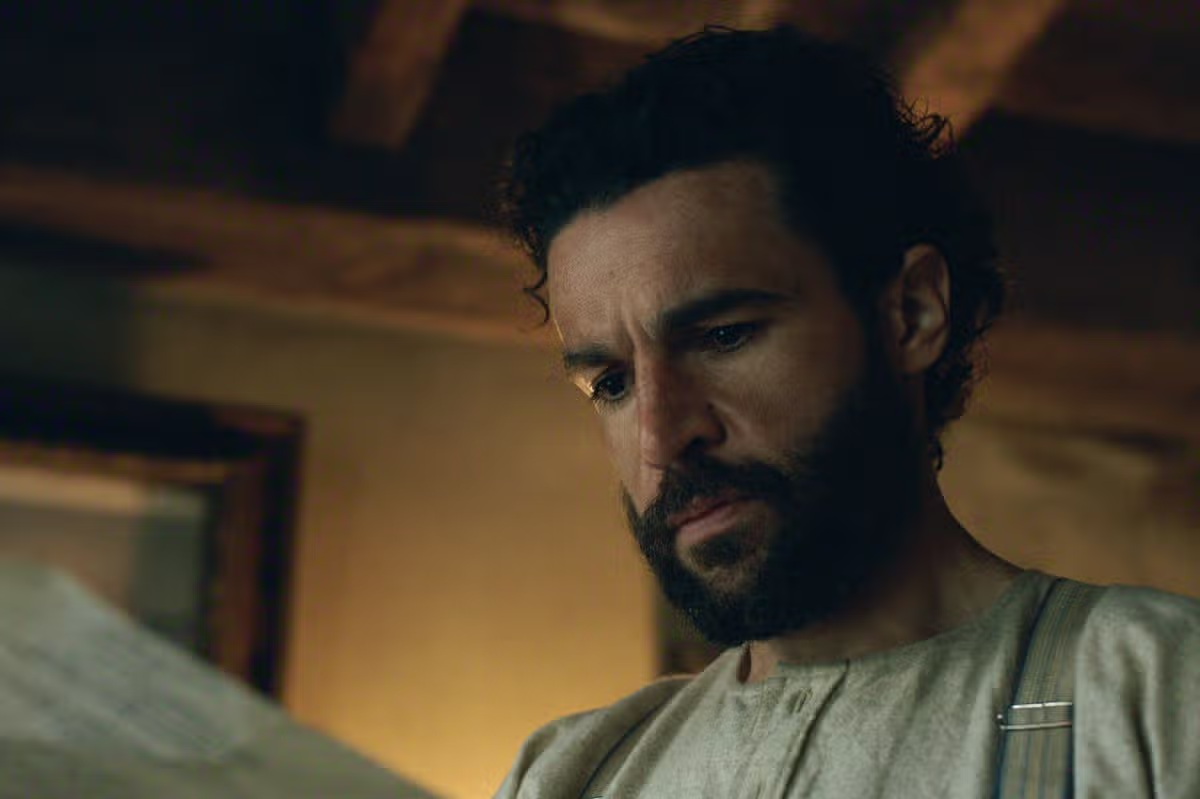
Christopher Abbott plays the sweet-natured Adam Trask who shows kindness to Cathy Ames when she appears bloodied and beaten at the door of his home, shared with his brother, who at first is much more sceptical of their new arrival. Adam nurses her back to health and they go on to marry.
Even before he whisks her away to California however, cracks have started to show. While it is a place he has always dreamed of, Cathy does not share that dream and she makes no secret of it.
Google searches for Christopher Abbott’s past movies and TV shows have soared since East of Eden’s debut, so where might viewers know the star from?
What films and TV shows has Christopher Abbott been in?
His breakout role was as Charlie Dattolo in the HBO series Girls. He was a recurring cast member, portraying the kind boyfriend of Marnie Michaels (Allison Williams). More recently he has had leading roles in Poor Things alongside Emma Stone, 2025 horror film Wolf Man and 2022 comedy-thriller, Sanctuary.
He is no stranger to literary adaptations and previously took the lead role of Yossarian in Catch-22, a TV series based on the Joseph Heller novel of the same name.
Discussing his role as Adam, Christopher told Netflix’s Tudum: “He’s a character that has lived a lot of different lives, and he’s sort of changed his personality throughout it.
“He starts off, like, hopping trains and living like a vagabond and stealing stuff and then becomes a different human when he has son. It’s a big epic arc to track.”
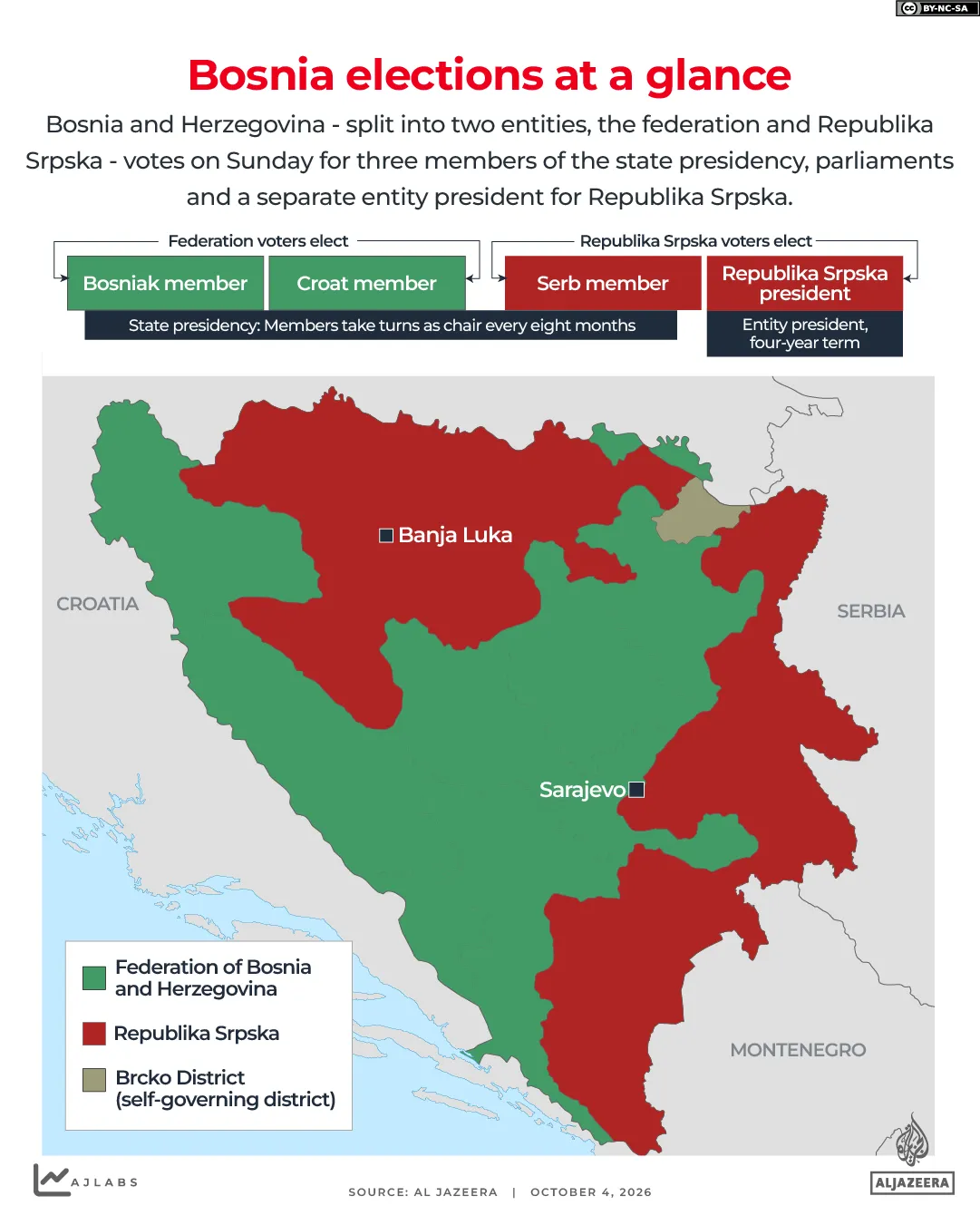
Bosnians are heading to the polls to choose the next government at all three of the state, entity and canton levels. It may seem complicated, but for a country divided into two entities – the Federation of Bosnia and Herzegovina and Republika Srpska, along with Brcko District – this is nothing new.
When do Bosnia’s elections take place?
The general elections are scheduled for Sunday, October 4. More than 3.4 million people are eligible to vote.
[Al Jazeera]
What’s different about this election?
This year, new election technology will be used. Voters will be identified using biometric devices, while ballot papers will be scanned rather than simply placed in ballot boxes.
The use of scanners, however, does not mean voting will be fully electronic. Votes will still be cast and recorded on paper, but verification and counting should be faster and more transparent, while voter identification should be more accurate.
Who is running for the Presidency?
Candidates for the Bosniak representative include current Presidency member Denis Becirovic of the Social Democratic Party (SDP), Bakir Izetbegovic of the Party of Democratic Action (SDA), Semir Efendic of the Party for Bosnia and Herzegovina (Stranka za BiH), and Fahrudin Radoncic of the Union for a Better Future of BiH (SBB).
Izetbegovic, the president of the centre-right SDA, the biggest Bosniak party in the country, is running for his third term after being defeated by Becirovic in 2022.
Three candidates will run for the Croat seat in the Presidency: Darijana Filipovic of the Croatian Democratic Union of Bosnia and Herzegovina (HDZ BiH), Slaven Kovacevic of the Democratic Front (DF), and Zdenko Lucic, a candidate supported by a coalition of five Croat parties.
The current Serb member of the Presidency, Zeljka Cvijanovic from the right-wing Alliance of Independent Social Democrats (SNSD), is running for a second term. During her term on the country’s top state body, which began in November 2022, just a few months after Russia’s war in Ukraine started, she maintained close and continuous cooperation with Russia and its president, Vladimir Putin.
SNSD is led by Milorad Dodik, the former president of Republika Srpska, best known for his separatist moves and for challenging the Constitution of Bosnia and Herzegovina and the decisions of former High Representative Christian Schmidt.
Cvijanovic will face Marinko Bozovic of the Serb Democratic Party (SDS) and Nebojsa Vukanovic of the List for Justice and Order.
[Al Jazeera]
Who else is on the ballot?
Voters will be choosing representatives for 14 governments, as well as members of the country’s three-member Presidency.
Each entity has its own president, assembly, prime minister and ministers. The Federation of Bosnia and Herzegovina is further divided into 10 cantons, each with its own government.
For all this to happen, the Central Election Commission (CIK), the main body responsible for overseeing the voting process, earlier said that 75 political parties and four independent candidates were registered and eligible to participate.
How are Presidency members chosen?
When registered voters go to the polls, they do not elect one president, but choose one of three members of the country’s collective head of state. They are the representatives of the three constituent peoples – Bosniaks, Croats and Serbs.
The Bosniak and Croat members are elected from the Federation of Bosnia and Herzegovina, while the Serb member is elected from Republika Srpska.
This is because the majority of Bosniaks and Croats live in the Federation, while most Serbs live in Republika Srpska.
The election of the Croat member has weighed on Bosniak-Croat relations for years and has often been used as a reason for political blockades.
Parties gathered around the centre-right Croatian Democratic Union of Bosnia and Herzegovina (HDZ BiH) are demanding changes to the Election Law, saying they want to prevent Bosniak voters from influencing the election of the Croat member of the Presidency.
But that would also require changes to the Constitution, which allows all citizens in the Federation to choose whether they want to vote for the Bosniak or the Croat member.
[Al Jazeera]
What about citizens who live outside their constituent group’s voting area?
A Serb living in the Federation, or a Bosniak or Croat living in Republika Srpska, who wants to run would not be able to do so, nor can they vote for those they consider to be their own representatives.
That is one of the many paradoxes of Bosnia and Herzegovina’s electoral system.
How is the state-level government chosen?
Citizens elect representatives to the Parliamentary Assembly, which consists of two houses.
Forty-two representatives will be elected to the House of Representatives.
Two-thirds are directly elected from the Federation of Bosnia and Herzegovina, and one-third from Republika Srpska.
A quorum consists of a majority of all members elected to the House of Representatives.
The second chamber – the House of Peoples – has 15 delegates and is elected indirectly through the institutions. It consists of Bosniaks, Croats and Serbs – five from each group.
What happens with the entities?
The election of entity-level authorities works somewhat differently.
In Republika Srpska, citizens directly elect the National Assembly, as well as the entity president and vice presidents.
They do not directly elect the government – it is confirmed by the National Assembly.
In the Federation of Bosnia and Herzegovina, citizens directly elect the House of Representatives of the Federation Parliament and the cantonal assemblies.
Those cantonal assemblies then elect delegates to the Federation’s House of Peoples.
The president of the Federation, the entity government and the cantonal governments are formed after the elections, through parliamentary majorities and political agreements.
Why is it a challenge to form the government?
It is difficult not only because the electoral system is complex, but also because of the lack of agreement among representatives of the three different ethnic communities.
Frequent blockades and obstruction make decision-making difficult at all levels, even though many politicians invoke the politics of compromise.
Elections in Bosnia and Herzegovina, therefore, are not only about who wins, but about whether a system designed to represent everyone can serve its citizens.
Why are the elections important?
New election technologies might reduce potential fraud, but much more will be needed for the country’s path towards the European Union.
The outcome of the election could unblock, or further slow down, the adoption of key laws needed for the country’s progress towards EU membership.
The EU granted Bosnia and Herzegovina candidate status in December 2022 and opened accession negotiations in 2024.
However, the country’s progress has since been assessed as very limited and slowed by political blockades.
These elections will also be a test for the ruling coalition, which promised to focus on social and economic issues amid the rising cost of living.
When are the results?
The first preliminary results are traditionally published by CIK late on election night, on October 4, and are updated every few hours.
In the days after the elections, CIK gradually enters votes from the remaining polling stations, mobile voting teams, as well as ballots received by mail and from diplomatic and consular missions.
The official results will be known no later than November 20.
Netflix viewers have hailed this latest ITV release as an “utterly absorbing” watch.
Hayley Anderson Screen Time TV Reporter
21:19, 28 Sep 2026
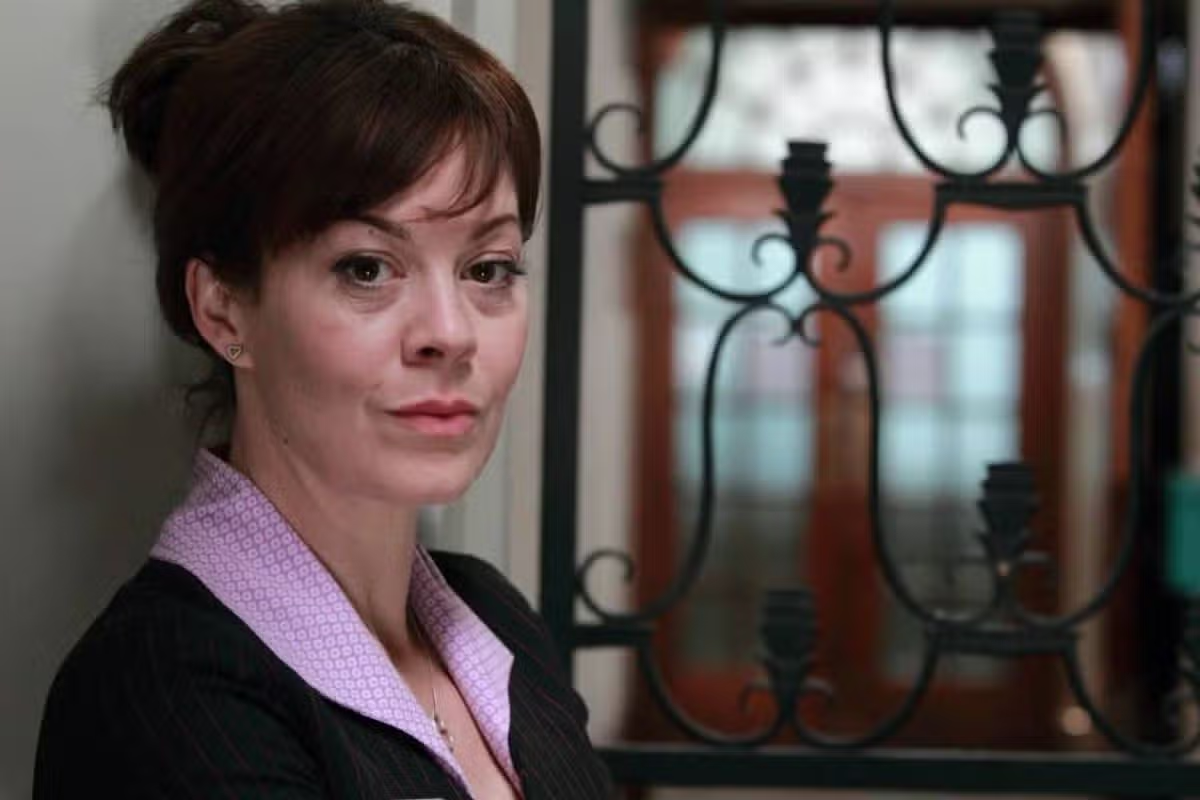
Helen McCrory stars in this “utterly absorbing” drama. (Image: ITV)
ITV viewers can’t get enough of this forgotten “brilliant” drama from a Peaky Blinders legend.
Peaky Blinders might be over but fans are still discovering some of its stars’ best work years before they even stepped foot into Tommy Shelby’s (played by Cillian Murphy) chaotic world.
One series that’s just started to grab fans’ attention is three-part ITV drama Leaving which originally made its debut 13 years ago.
Leading the cast is none other than actress Helen McCrory who portrayed Polly Gray, the dangerous matriarch of the Shelby family in Peaky Blinders’ first five seasons.
She isn’t the only recognisable face though in Leaving as McCrory is joined by Masters of the Air star Callum Turner who married singer Dua Lipa earlier this year.
Leaving revolves around 45-year-old wife Julie Ranmore (Helen McCrory) whose job as a hotel events manager keeps her from thinking too much about her loveless marriage. But things quickly change when she is introduced to unemployed 21-year-old Aaron (Callum Turner) who is still living with his parents.
They start working at the same hotel and what starts off as a flirtationship quickly escalates into a full-blown affair with the couple having to deal with the consequences.
Taking to IMdB to sing the show’s praises, someone simply described it as a “little gem”.
A fellow viewer said it was “utterly absorbing”, adding: “Brilliantly acted, often tense and heartbreaking, this is an outstanding drama…the late Helen McCrory gives an unforgettable performance.”
Another labelled it as “maddening all the right ways” and others hailing it as perfect for a “little binge on a rainy afternoon”.
McCrory sadly died of breast cancer in 2021 at the age of 52, keeping her illness private and only telling those closest to her.
She died ahead of the sixth series of Peaky Blinders being filmed which was postponed during the coronavirus pandemic.
Her husband and Homeland star Damian Lewis said at the time she had a “heroic battle with cancer”, stating that she was a “beautiful and mighty woman”.
He added: “She died as she lived. Fearlessly. God we love her and we know how lucky we are to have had her in our lives.”
The new Netflix thriller is currently sitting at number one on the streaming platform’s most-watched films
22:33, 26 Sep 2026Updated 22:34, 26 Sep 2026
Netflix viewers have shared their verdicts on the new film (Image: Netflix )
The true-story thriller has been slammed by furious viewers who ‘wasted an hour and a half of their lives’.
Brand new film Unabomber is based on the real story of lone wolf American terrorist Theodore Kaczynski, who carried out a mail bombing campaign that killed 3 people and injured 23 more. Known as the Unabomber, he committed his crimes between 1978 and 1995.
Netflix’s take on the late criminal’s story explores his transformation from a bright Harvard student into the infamous Unabomber. It stars 19-year-old actor Jacob Tremblay as the title character.
The main cast also features Oscar winner Russell Crowe, playing a Harvard professor who gets caught in Theodore’s orbit. While beloved actress Shailene Woodley portrays an FBI agent determined to get to the bottom of the Unabomber’s crimes.
The film has already climbed to Number 1 on Netflix’s most-watched charts after just one day on the streaming platform. But many viewers have urged others to skip the star-studded drama.
Writing on Rotten Tomatoes, one disappointed viewer said: “What an absolute waste of time. As far as movies go this had an okay cast. The story was based on real life so interesting I guess as it did happen. It’s sad it happened though but it did. I watched it and was expecting more than I receive.”
Someone else joined in to add: “A word that comes to mind is HOW. HOW DO THEY GET SO MANY BRILLIANT ACTORS IN 1 MOVIE AND STILL FIGURE OUT HOW TO MAKE THE MOVIE SUCK. I WAS BARLEY ABLE TO FINISH IT. COULD OF USED THESE ACTORS TO MAKE SOMETHING GREAT. LET DOWN.”
Get Netflix free with Sky
This article contains affiliate links, we will receive a commission on any sales we generate from it. Learn more
Sky is giving away a free Netflix subscription with its new Sky Stream TV bundles, including the £15 Essential TV bundle. This lets members watch live and on-demand TV content without a satellite dish or aerial and includes hit shows like Stranger Things and The Last of Us.
Someone else simply wrote on X: ” #unabomber on Netflix is an hour and a half of my life I’m not getting back.” At the time of writing, the thriller has a sour 22% score on Rotten Tomatoes.
But others have rushed to the movie’s defence, with one sharing: “Surprised by the negative reviews. I found the film very well done and with a captivating story, quite well engineered. Acting is brilliant and everything is top notch (costume, music, etc). Great film.”
While a second fan added: “I actually loved this. I was just hooked at the very start. And I’m not easily entertained by movies. First of all I loved the switch from the 50s to the 90s it was refreshing. “
United States President Donald Trump and China’s President Xi Jinping are set to meet in Washington, DC on Thursday for a summit that is expected to cover trade, artificial intelligence (AI), Taiwan and the US-Israel war on Iran.
In advance of the talks, US Treasury Secretary Scott Bessent said Washington had proposed an AI “notification mechanism” with China – effectively a hotline to alert each other when AI incidents threaten national security.
The meeting comes as leading AI companies warn about the technology’s risks, while both superpowers push to accelerate their AI race. In this visual explainer, Al Jazeera compares the US and China’s AI strength in computing power, AI models, spending and research.
Who has more computing power?
Training and running AI requires enormous amounts of computing power. The more powerful chips and computers a country has, the faster it can build and improve AI models, making computing power one of the biggest advantages in the AI race.
Computing power is measured in FLOP/s (floating-point operations per second) – or how many calculations a computer can perform in one second.
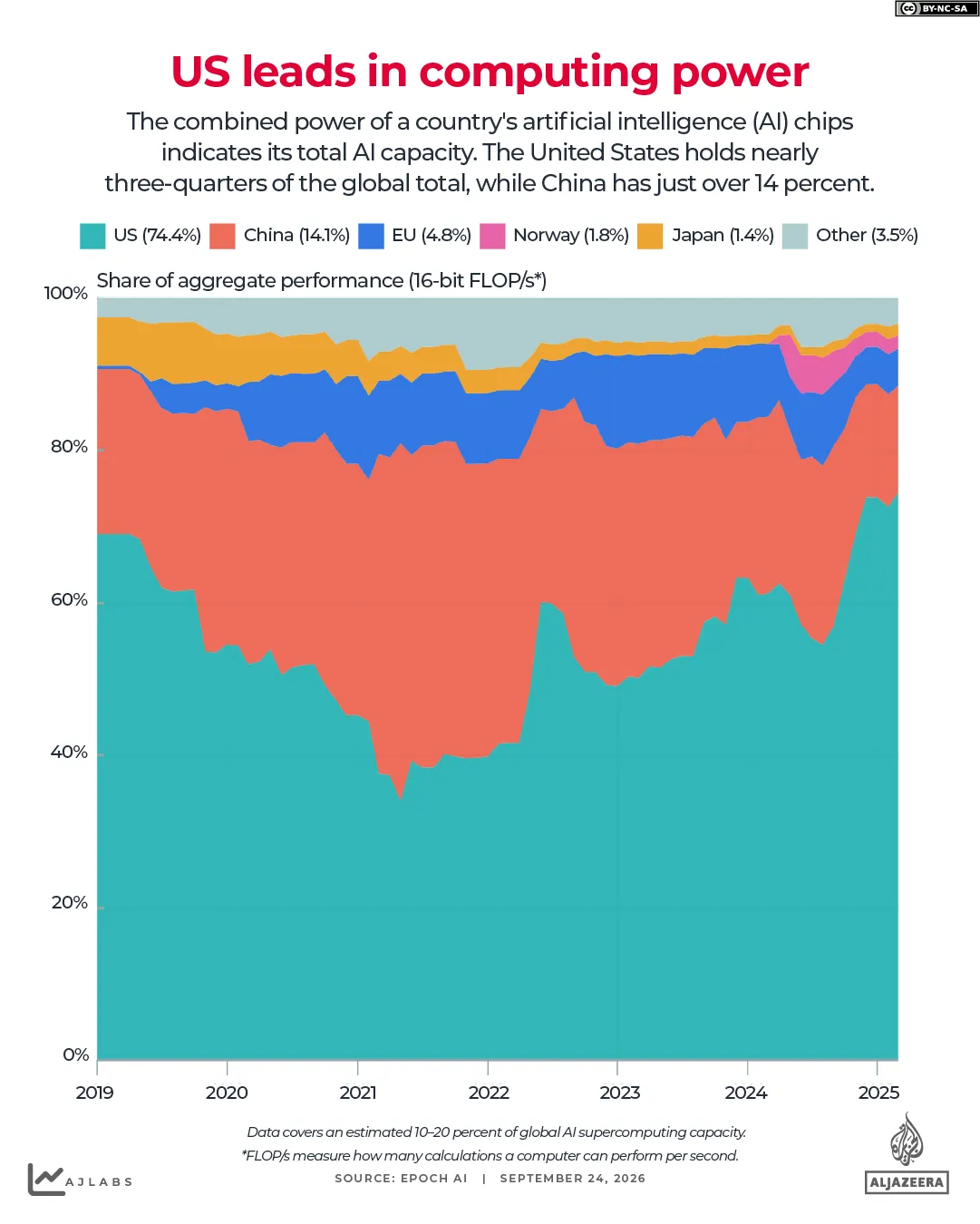
Adding up the computing power of all the AI chips a country has gives a sense of its total AI capacity. By that measure, the US is well ahead, accounting for nearly three-quarters of the world’s total AI computing power, while China holds just more than 14 percent, according to Epoch AI, an AI research institute.
The US lead comes largely from its access to the most advanced chips. US company Nvidia accounts for more than 60 percent of global AI computing capacity among major chip designers, while China’s Huawei holds a much smaller, but growing share, according to Stanford University’s 2026 AI Index.
Those chips also need somewhere to run. The US has more than 5,400 data centres – the large buildings which house thousands of computers – about 10 times as many as any other country. It also leads in dedicated AI data centres, with 84, more than the next eight countries combined.
Whose AI models are people using?
Frontier models are the most advanced AI systems, such as OpenAI’s GPT, Anthropic’s Claude and DeepSeek’s models in China. They are trained using vast amounts of data and computing power to write, reason and code.
The US has led the development of these models, but Chinese models are gaining ground.
As of March 2026, US and Chinese AI models were closely matched on Arena, a leaderboard where users compare two anonymous models and vote for the better answer. US companies Anthropic, xAI, Google and OpenAI ranked near the top, alongside China’s Alibaba and DeepSeek.
On OpenRouter, a platform that ranks AI models by real-world use, Chinese models dominate the leaderboard. Models from Chinese companies DeepSeek, Z.ai and Tencent hold the top three spots on OpenRouter by tokens processed, the units of text that AI models read and generate.
This is partly because Chinese models are cheaper to use. Many are also open-weight, meaning developers can download, adapt and run them themselves.
Chinese models can now compete with US ones in many real-world tasks, with Chinese AI models “months, not years, behind US frontier models”, according to a July analysis by the Centre for Strategic and International Studies (CSIS).
In May, the US government’s Center for AI Standards and Innovation (CAISI) estimated that DeepSeek V4 Pro, released in April, was about eight months behind leading US models.
Who is spending more?
The US is spending far more than China on the infrastructure needed to build AI, giving its tech companies a significant advantage in the race for computing power.
Goldman Sachs estimates that US hyperscalers, the giant tech companies that run large-scale cloud computing and data centres, will spend about $764bn in 2026. That includes Amazon, Microsoft, Google, Meta and Oracle. By comparison, China’s Alibaba, Tencent, Baidu and ByteDance are expected to spend $102bn.
But China’s spending is increasing faster. TrendForce, a market research firm, expects China’s four hyperscalers’ capital expenditure to rise by more than 80 percent in 2026, compared with a projected growth of 76 percent for US hyperscalers, according to the news agency Reuters.
The spending gap reflects the scale of the US tech sector, whose companies have larger revenues to reinvest in chips, data centres and talent.
Who is leading in AI research and talent?
China is producing more AI research and training more technical talent, but the US remains a magnet for the world’s top AI researchers.
China accounted for more than 27 percent of global AI publications in 2024, including journal articles, conference papers, working papers and preprints compared with 12 percent from the US, according to the Center for Security and Emerging Technology. The figures only cover publications with an English-language title or abstract.
China also trains more top researchers. According to a study by MacroPolo, 47 percent of the world’s top 20 percent of AI researchers completed their undergraduate studies in China in 2022, up from 29 percent in 2019. The study also found that 72 percent of the top AI researchers educated in China were working in the US.