

Article content
The company’s annual disclosure unveils its Value Plan 2030+

Mayor Karen Bass has had a lengthy political career, spending six years in the state Legislature, 12 years in Congress and the last three in the top elected office at Los Angeles City Hall.
Now, facing the toughest reelection battle of her career, Bass is marketing herself in a way that might surprise some Angelenos: She’s running as a champion of change.
And she’s not alone.
City Councilmember Nithya Raman, who has represented a Hollywood Hills district since 2020, says her last-minute decision to enter the race was fueled by “a sense of urgency that things needed to change.”
Three other major candidates, all political newcomers, argue that an outsider is needed to shake up the status quo.
“We can no longer keep our city together with duct tape and slurry,” said Rae Huang, a leftist community organizer, at a recent candidate forum on housing and transportation.
The race to embrace the mantle of change in the June 2 primary election comes at a moment of political peril for Bass, a veteran Democrat who has racked up high disapproval numbers in several voter surveys.
In recent months, Bass has revamped her messaging, saying she’s been tackling problems that have “been around for multiple decades,” such as homelessness, sluggish police hiring and trash-strewn streets.
Last week, speaking to the Pacific Palisades Democratic Club, Bass said she wants another four years to finish that work. She also implied that, in her zeal to fix the city’s problems, she quietly pushed out a dozen high-level bureaucrats, including those who dealt with trash pickup and police recruitment.
“Let me just tell you that in three years and three months, it is difficult to change what has been a practice for over four decades,” Bass told the group. “I am very clear that there needs to be massive change, and I’ve done a lot of change.”
Raman has portrayed herself as someone who shook up the system while in office, securing a 4% cap on rent increases for more than 600,000 apartments and opposing initiatives she viewed as “disastrous” for the city’s budget. She said the city is falling short on an array of issues, including traffic deaths and housing affordability.
“So much of what’s happening in L.A., our inability to address our biggest crises — our housing crisis, our homelessness crisis, but also essential services like lights and potholes — so much of this has resulted from a lack of clear urgency in decision-making at City Hall,” said Raman, the first L.A. council member to win office with the backing of the Democratic Socialists of America.
Those types of arguments have elicited salty responses from Huang, tech entrepreneur Adam Miller and conservative reality TV personality Spencer Pratt.
Miller, who described himself as a lifelong Democrat, pointed out that Raman runs the powerful five-member council committee on housing and homelessness. He argued that both she and Bass have failed on those issues, as well as on public safety and much needed infrastructure repairs.
“These are the people who have been running the government,” said Miller, who made a fortune developing education software. “So I don’t understand how they could describe themselves as change-makers. They’re the ones who have been the problem.”
Pratt offered a similar take on social media, calling Raman and Bass “two peas in a pod,” while portraying himself as a change agent.
“I’m a wrecking ball to the status quo,” he said in one post.
Neither Pratt nor his representative responded to an interview request.
In one recent high-profile poll, about 56% of respondents said they had an unfavorable view of Bass. In another, about 40% of those surveyed said they had not yet made up their minds about who should lead the city.
“It’s clear that there are concerns among voters about the direction of the city — and the state, quite frankly,” said Pomona College politics professor Sara Sadhwani, referring to the race for governor. “In both instances, there are lackluster candidates, and so we see voters being very much undecided in both of these incredibly consequential races.”
The election season got underway a little more than a year after the Palisades fire, which destroyed thousands of homes and left 12 people dead.
Bass, who was out of the country when the fire broke out, was unsteady in her early public appearances and, since then, has faced sharp criticism over the pace of the rebuilding. She has defended her record on the recovery, saying she cut red tape and suspended city permit fees, while also pressing the Trump administration to crack down on insurance companies that fail to compensate wildfire survivors.
The back-and-forth over change and the status quo broke to the surface during last month’s housing forum in downtown L.A.
At one point, Raman voiced alarm over the city’s elevated “people mover” being built at Los Angeles International Airport, saying it is so far behind schedule that it won’t be ready before the World Cup, which starts in June.
Raman said that as mayor, she would ensure that such projects are finished on time — and replace airport leadership if it fails to happen.
“Nithya, you’ve been on City Council for six years, though,” Huang shot back. “Why have you not moved this forward?”
(At five years and four months, Raman’s tenure is slightly less than that.)
Raman countered that, as a council member, she only has control over certain issues.
“So much of what’s going wrong in Los Angeles requires the mayor to get involved,” she said.
Bass did not attend the forum, traveling instead to New Orleans for a reelection fundraiser. Pratt also skipped. In their absence, the three remaining candidates pounded on a wide array of municipal ills, including broken sidewalks, high rents and sluggish housing production.
Raman, at that event and elsewhere, has sought to differentiate herself from Bass, and City Hall more broadly, by highlighting her dissenting votes.
In 2023, Raman opposed a package of police pay increases negotiated by Bass, saying they were too expensive and would deprive other city departments of funding. Last year, she voted against a $2.6-billion upgrade of the Convention Center, citing similar long-term cost concerns.
Bass, for her part, said she’s been shifting the direction of the city in critical ways. Previous city leaders were too hesitant to build temporary housing for homeless people, she said, leaving them to languish on sidewalks while waiting for government-funded apartments to be built.
After taking office in 2022, Bass declared a local emergency on homelessness and launched her Inside Safe initiative, which has put thousands of people into hotels and motels. Raman signed off on the emergency and the funding for Inside Safe but now says the program is too expensive.
The mayor said she also pushed for changes in LAPD hiring, not just by making officers’ salaries more competitive, but by hacking away at a slow and bureaucratic recruitment process. Speaking to the Palisades Democrats, Bass said she got that done, in part, by changing the leadership and staff at the city’s personnel department.
Bass told the group she’s preparing to launch an initiative to clean up the city’s streets — and that she made a personnel move in that regard as well.
“In terms of cleanliness, I’ve had to change the leadership of the Department of Sanitation, because I couldn’t get the job done,” she said.
Sadhwani, the Pomona College professor, said she doubts that voters will view Bass as a reform candidate. Raman, she argued, is also part of the establishment.
“They cannot run from the fact that they have been in power,” she said.

SHAMED TOWIE star James Argent left his model girlfriend with cuts and bruises to her neck, arms, and leg during the horror beachfront attack – and a year on he’s reunited with his best pal Mark Wright.
The list of appalling injuries he inflicted on former Miss Sweden Nicoline Arturrson, 33, were contained in a shocking court file after he threw her down the steps of their Spanish villa.
Prosecutors were reportedly so appalled by her injuries they wanted to charge Argent with wounding and were pushing for a nine-month jail sentence.
But as part of a plea deal he agreed to admit the lesser offence of ‘mistreatment’.
James’ jail let-off saw him handed a six month suspended sentence and a two-year restraining order banning him from contacting Nicoline.
He has largely stayed out of the spotlight since the scandal, but now, he has reunited with his reality TV pals in a local boozer.
Read more on James Argent
The group were seen laughing and joking as they sat down for a meal.
James’ best pal, Mark Wright, 39, was spotted nicking his sandwich and a few chips from his plate.
The TV personality burst into laughter as he told fans, “some things never change.”
Their meet up looked very casual as James was seen wearing a black long sleeve top and Mark was in a pair of black joggers and a white t-shirt.
It seemed the pals reconnected at a big drink up as they were spotted in a large group of four others.
In a group snap James shared on Instagram, the lads were seen sitting around a big table as they smiled for the camera.
James captioned the post: “It’s good to be home and catch up with the boys,” followed by a smiley face emoji.
Mark and James have been close pals for over 10 years, finding fame on The Only Way Is Essex together back in 2010.
They were both central cast members, often appearing in scenes together.
The singer is thought to have moved to Spain following the attack on his ex-girlfriend.
The court report of the incident reads: “During the argument, and with the intention of harming her physical integrity, he grabbed hold of her tightly by her arm and pushed her causing her to fall down the stairs.
“The injured woman suffered several bruises to her neck, a bruise to her right forearm, several abrasions to her right arm, and abrasions to her right hand and on her right leg.
“The injuries she suffered healed in seven days on skin and soft tissue.”
At the time pals close to the couple slammed James – saying: “The plea deal was the easy way out.”
DOMESTIC abuse can affect anyone – including men – and does not always involve physical violence.
Here are some signs that you could be in an abusive relationship:
If any of the above apply to you or a friend, you can call these numbers:
Remember, you are not alone.
1 in 4 women and 1 in 7 men will experience domestic abuse over the course of their lifetime.
Every 30 seconds the police receive a call for help relating to domestic abuse.

The Panama Papers, one of the biggest ever data leaks, revealed the vast scale of offshore financial networks used by the global elite.
On April 3, 2016, the International Consortium of Investigative Journalists (ICIJ) and the German newspaper Suddeutsche Zeitung released more than 11.5 million documents from the Panama-based law firm Mossack Fonseca. It exposed a network of offshore shell companies linked to the global financial elite, including current and former government leaders.
More than 350 journalists from over 80 countries worked in secrecy for more than a year to analyse 2.6 terabytes of leaked data then published their findings.
Here’s what we know about the Panama Papers ten years on, and whether the leak led to any changes.
The 2016 Panama Papers scandal was about the leak of 11.5 million confidential documents including emails, contracts and banking statements from the law firm Mossack Fonseca.
The papers revealed a massive global network of offshore shell companies linked to some of the world’s richest people including politicians, business leaders and public figures, spanning countries from the United Kingdom to Russia, Australia to Brazil. They were using companies based in tax havens such as the British Virgin Islands, the Bahamas and Panama to move and store wealth away from the scrutiny of tax authorities.
About 214,000 entities were linked to individuals and companies in over 200 countries and territories. The documents covered from the 1970s up to 2016.
The Panama Papers were leaked by an anonymous whistleblower using the pseudonym John Doe, who initially shared the documents with Suddeutsche Zeitung, which then collaborated with journalists worldwide on reporting and releasing the findings.
P Vaidyanathan Iyer, managing editor at The Indian Express and one of the hundreds of journalists who worked on the Panama Papers, said that the process of identifying the information was like “looking for a needle in a haystack”.
“We were continuously, for about six to eight months, just reading data,” he told Al Jazeera.
“My team of three and I had a small cubicle to ourselves in the office, and we were cut off from the rest. Day and night, we were going through data, downloading documents onto our laptops and computers, which were all very secure, with restricted access. It was arduous work,” he added.
Hundreds of people, including more than 140 politicians, were identified as directors, shareholders or beneficiaries of offshore shell companies revealed in the Panama Papers. Among them were Mauricio Macri, then president of Argentina, and Petro Poroshenko, who was Ukraine’s fifth president from 2014 to 2019.
Other leaders, including former Pakistani Prime Minister Nawaz Sharif and former Icelandic Prime Minister Sigmundur Gunnlaugsson, were also named – all linked to ownership of shell companies in offshore tax havens.
Offshore companies are legal entities incorporated in a jurisdiction outside the owner’s country of residence.
Shell companies, on the other hand, are entities that have “no real substantial business or operations in its place of incorporation or registered office,” Kehinde Olaoye, a professor of commercial law and business law associations at Hamad bin Khalifa University in Qatar, told Al Jazeera.
Shell companies are often used to create legal paperwork to cover for fraudulent or dodgy financial transactions. If they’re based in a country other than the owner’s, they’re offshore shell companies.
No. Offshore shell companies are not automatically illegal. The purpose of such companies is to create trusts, which then can be used to protect wealth or create estate planning.
However, “there is always a thin line between legitimate and illegitimate purposes” in using offshore shell companies, Olaoye noted.
“Usually, individuals and companies receive advice from financial advisers and legal advisers on how they can structure their business to take advantage of ‘favourable’ tax benefits,” she said.
A month after the Panama Papers were leaked, Iceland’s Gunnlaugsson resigned as prime minister following mass protests. According to the leaked documents, Gunnlaugsson and his wife allegedly established a company, Wintris, in the British Virgin Islands with the assistance of the Panamanian law firm. His resignation led to the fall of the Icelandic government at the time.
In 2017, Pakistan’s Supreme Court also disqualified then prime minister Sharif from office following the leaks, despite an earlier ruling that found insufficient evidence of corruption. The Panama Papers revealed that his children held several companies in the British Virgin Islands. In 2018, Sharif was banned from politics for life.
Mossack Fonseca, which had over 40 offices worldwide, also faced significant operational impacts following the leaks, including staff reductions, and ultimately shut down in 2018. Its co-founders, Jurgen Mossack and the late Ramon Fonseca, were acquitted by a Panamanian court, along with 26 others accused of setting up shell companies implicated in scandals in Brazil and Germany.
Between 2016 and 2026, governments worldwide recovered around $2bn in taxes, penalties and levies, according to the ICIJ. Countries such as the UK, Sweden and France each recovered between $200-250m, while others, including Japan, Mexico and Denmark, recovered around $30m each.
However, the amount that remains unaccounted for is significantly higher.
In India alone, the government brought forward close to 425 tax cases, according to Iyer.
“But the amount realised in taxes, which the government got back into its treasury was just about 150 crore rupees, which is around $16m. Whereas the total tax which was brought under investigation was about $1.5bn,” he noted.
Other countries, including Austria, Slovenia and New Zealand recovered between $1m and $8m.
Panama, the country where the leak was revealed, recovered about $14.1m.
Since the release of the Panama Papers, governments have taken steps to curb the misuse of shell companies by introducing new laws and regulations. They include the Corporate Transparency Act in the US, which requires the disclosure of “beneficial owners”—individuals who ultimately profit from offshore entities — as well as measures to improve information sharing between tax authorities.
The United Nations is also considering draft proposals for a Convention on Taxation. In addition, several nations have signed bilateral double-taxation treaties to reduce tax avoidance and prevent income from being taxed in multiple jurisdictions.
But gaps remain in the global tax system. There’s no one overarching international taxation principle that everyone needs to follow — and often there are overlapping treaties and agreements that allow those with the shrewdest financial advisors to choose, or shop, from among those pacts, based on whatever works best for them.
“The main challenge in international tax law is that there is no multilateral tax convention, which creates problems of tax competition and ‘treaty shopping’,” Olaoye said.
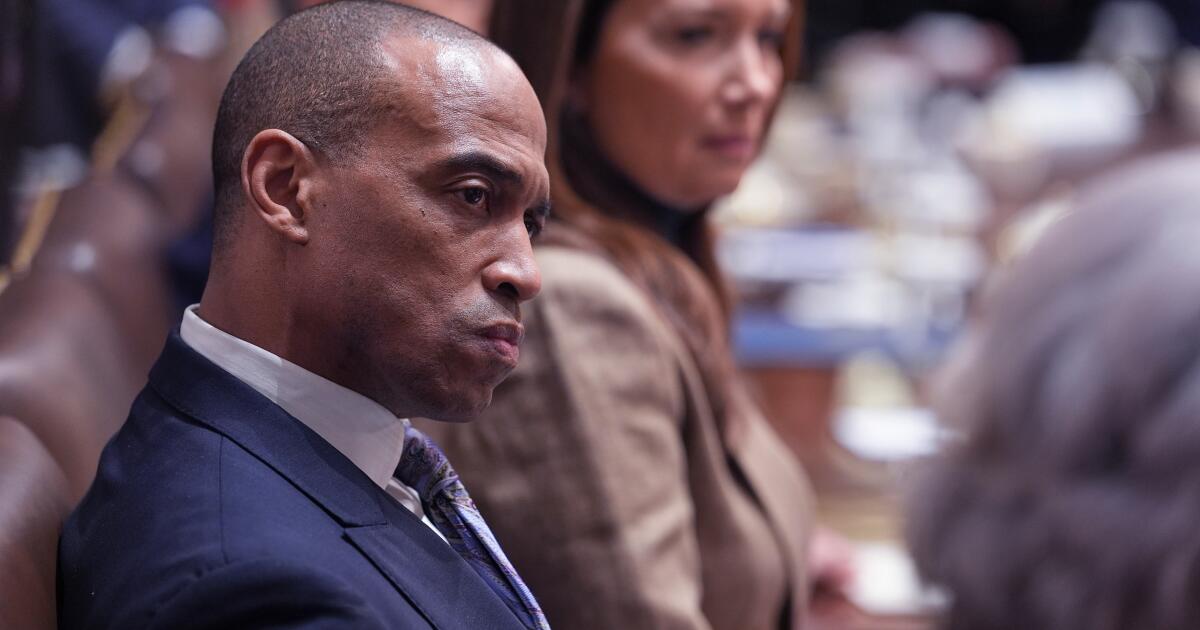
A federal judge in Rhode Island ruled on Tuesday that the Trump administration’s effort to dramatically change the criteria to get tens of millions of dollars in funding to aid homeless people was unlawful.
Several nonprofits filed a lawsuit last year accusing the U.S. Department of Housing and Urban Development of changing the rules for receiving $75 million to build housing for homeless families and individuals. The plaintiffs accused the Trump administration of issuing a new Notice of Funding Opportunity, or NOFO, for the Continuum of Care program to better align with its social policies.
U.S District Judge Mary McElroy, nominated by President Trump, said the department’s “slapdash imposition of political whims” was unlawful and she ordered it to scrap the new policy.
“Once again, this Court is faced with a case in which an executive agency has made a last-minute decision to make major, disruptive changes to grants within its purview, all for the express purpose of accomplishing the current administration’s policy objectives,” McElroy said in her ruling that the NOFO violated the Administrative Procedure Act, a law governing how federal agencies develop and issue regulations.
A spokesperson for HUD did not immediately respond to a request for comment.
Advocates for plaintiffs welcomed the ruling.
“For more than three decades, the federal government has supported housing providers and communities through HUD’s programs to help people experiencing homelessness move into stable housing,” Skye Perryman, president and chief executive of Democracy Forward, co-counsel for the plaintiffs, said in a statement. “We are pleased that the court has stopped the Trump-Vance administration from holding life-saving funding hostage to a political agenda.”
Ann Oliva, chief executive of the National Alliance to End Homelessness, said the ruling was “a victory for people across this nation who have overcome homelessness and stabilized in HUD’s permanent housing programs.”
“Today’s news reinforces a fundamental truth: that the work to end homelessness is not partisan, and never should be interfered with for political means,” Oliva said in a statement.
Plaintiffs argued the Trump administration was aiming to upend polices in place for decades to satisfy its political considerations, including whether jurisdictions “support sanctuary protections, harm reduction practices, or inclusive policies for transgender people.”
The Alliance and the Women’s Development Corporation argued that HUD lacked the authority to make the changes, adding that the new award process was “shockingly unlawful” and would “irreparably injure qualified applicants for these funds and the communities they serve.”
In its court filings, HUD argued the new criteria was an effort “to ensure the availability of funding to protect our Nation’s most vulnerable individuals and families from the trauma of homelessness while simultaneously promoting self-sufficiency.”
“Defendants acted reasonably and prudently because the NOFO conditions, focusing on public safety, cooperation with law enforcement and prohibitions on illegal drug use, are sufficiently related to the funding goals of self-sufficiency and reduction of trauma,” HUD wrote.
Casey writes for the Associated Press.

Article content
The company’s annual disclosure unveils its Value Plan 2030+

THIS CONTENT IS RESERVED FOR SUBSCRIBERS ONLY
Subscribe now to read the latest news in your city and across Canada.
SUBSCRIBE TO UNLOCK MORE ARTICLES
Subscribe now to read the latest news in your city and across Canada.
REGISTER / SIGN IN TO UNLOCK MORE ARTICLES
Create an account or sign in to continue with your reading experience.
THIS ARTICLE IS FREE TO READ REGISTER TO UNLOCK.
Create an account or sign in to continue with your reading experience.
or
Article content
STAMFORD, CT — Philip Morris International (NYSE: PM) today released its Value Report 2025, offering a holistic perspective on the company’s approach to sustainable value creation. The report marks the completion of PMI’s 2025 Roadmap, communicating achievements for each aspiration introduced by the company in 2020, and introduces its Value Plan 2030+, set to guide the company’s continued path to sustainable growth.
Article content
Article content
Article content
“
Article content

Top Stories
Get the latest headlines, breaking news and columns.
By signing up you consent to receive the above newsletter from Postmedia Network Inc.
Thanks for signing up!
A welcome email is on its way. If you don’t see it, please check your junk folder.
The next issue of Top Stories will soon be in your inbox.
We encountered an issue signing you up. Please try again
Article content
For more than a decade, PMI has pursued an industry-leading shift away from cigarettes—a transformation that goes far beyond product innovation to encompass how we allocate capital, engage stakeholders, and measure success
Article content
,” said Jacek Olczak, Group Chief Executive Officer.
Article content
“‘change in motion’ captures the reality that transformation is not a project with a defined end date, it is the continuous work of improvement, innovation, and adaptation that keeps us relevant and resilient. We transform continuously because markets evolve, science advances, stakeholder expectations rise, and new opportunities emerge. This is who we are: a company perpetually in motion toward a better future, refusing to stand still even as we celebrate how far we have come
Article content
Article content
Built on the progress that PMI has made over the past decade, the report explains how the company is securing the resources, capabilities, and stakeholder trust that will sustain its business for decades to come. The sustainability of the business is PMI’s strategy; it is how it secures resources, manages risk, meets stakeholder expectations, and future-proofs a business built to deliver results today, while securing the ability to deliver tomorrow.
Article content
“
Article content
Our approach to value creation is anchored in a simple conviction: long-term financial success depends on the health of the resources and relationships that make it possible.
Article content
By investing in natural, human, social, intellectual, and manufactured capital—what we define as non-financial capitals—we strengthen the very foundations on which long-term financial success depends,
Article content
” said Emmanuel Babeau, Group Chief Financial Officer. “
Article content
This is fundamental to our growth, resilience, and identity as a forward-thinking organization.
Article content
Article content
PMI achieved meaningful progress across both product and operational impact in 2025, as it closed its 2025 Roadmap.
Article content
PMI’s Business Transformation Metrics (BTMs) have provided stakeholders with clear, comparable indicators of our progress toward a smoke-free future. These metrics go beyond traditional reporting frameworks to capture aspects unique to PMI’s change of motion. They include the following:
Article content
Article content
Article content
In addition, PMI celebrated progress on:
Article content
Article content
“We have identified six strategic priorities that reflect what matters most to our stakeholders and our business: consumers and product health impact, circularity, climate change, nature and biodiversity, our own workforce, and workers throughout our value chain, which are consolidated in our Value Plan 2030+. This plan identifies where our actions intersect most significantly with business imperatives, ensuring our initiatives drive tangible outcomes across various forms of capital, creating a strategy that is comprehensive yet focused, ambitious yet pragmatic, and deeply integrated into how we operate and grow,”
Article content
said Jennifer Motles, Chief Sustainability Officer.
Article content
“Our plan is explicit about what we control directly and what requires the action of, and partnership with others, setting a strong foundation for effective action. That is the spirit with which we present our Value Plan 2030+, as an invitation to dialogue, a platform for collaboration, and a roadmap for the next chapter: turning sustainability into lasting business value.”
Article content
PMI’s Value Plan 2030+ sets the course for the company’s next chapter—a continuation of the change in motion that has defined PMI’s evolution over the past decade. It focuses on accelerating the growth of its smoke-free product portfolio, working to make cigarettes obsolete, and exploring adjacent avenues of growth in wellness, while maintaining responsible sales and marketing practices, investing in human and natural capital, and strengthening the operational resilience that underpins long-term, sustainable value creation.

22:15, 29 Mar 2026Updated 22:15, 29 Mar 2026

A single mum-of-three was moved to tears(Image: Channel 5)
A single mum-of-three, drowning in debt, was moved to tears after a millionaire invested £100,000 in her budding restaurant venture and paid off her debt on Rich House, Poor House.
Valerie Mayer, from Portsmouth, who is juggling raising her three children and working as a full-time carer, appeared on the Channel 5 hit show on Sunday (March 29) night alongside mum Cleopatra.
The talented home cook has always had dreams of launching a Zimbabwean restaurant in the UK, however with a weekly budget of just £53 her lifelong passion has been pushed to the side as she battles to make ends meet.
In a heartbreaking moment, she admitted that she has faced threats from debt collectors. She revealed: “My financial situation got so bad that I had bailiffs come in, and I just went into a state of panic. I was looking out of the windows to see if anyone was there. I got scared to leave the house.”
Seeing how the top 1% live, Valerie swapped homes for a week with tech startup millionaire, Steve Bolton, who lives in a plush £1m, six-bedroom property in Bournemouth.
The father of four left school at 16 with no qualifications but built a business from scratch, with his company now boasting a portfolio worth £750m.
Given his hectic life as an entrepreneur, he missed out on quality time with his children, so he decided to invite his eldest daughter, marketing guru, Ella, and his clothes shop owner son, Charlie, to join him on the show.
The family traded their home with two lounges, a dining room for eight, six bedrooms and five bathrooms, for a week-long stay in Val’s council house 60 miles along the coast.
While Steve and his two children had to manage on £51.93 for the week, Valerie and her mum experienced a glimpse of luxury living with a weekly budget of £2,000. Val and Cleopatra indulged in costly seafood, went on shopping trips for clothes, and even treated themselves to a day at the races.
However, Steve and his family found it difficult to adapt in their new environment and things took an emotional turn as Steve visibly moved after finding out about Valerie’s debt.
It was clear that Steve wanted to help Valerie get her life on track as he had a few surprises for her when they finally reunited after their swap.
The millionaire not only committed to investing £100,000 into her restaurant venture, but also cleared all her debts and transformed her garden.
Sitting opposite each other, Steve went on to say: “We’ve been talking a lot about how we might be able to help you guys because that’s obviously a big part of what we want to do and we’ve thought about three things that we can do to help you.”
He continued: “The first one is already done and it’ll be a surprise when you get home, the second one is about your debt situation, so we wanted to get you out of debt and then the third thing is we want to back your vision, your dream, your passion and your talent for business.
“Support you financially, support you with mentoring, support you with anything and everything you need up to a value of £100,000.”
Valerie broke down in tears as she struggled to get her words out: “Oh, wow. I don’t even know…How do you say thank you? Thank you. Wow, this is amazing.”
With tears streaming down her face she said: “I’m feeling really overwhelmed right now. Happy tears. This can change mine in my family’s life. I really wanted this so much and I’m so glad that my family’s also going to be involved in this because it’s going to change everything for the better.”
Rich House, Poor House airs Sunday night from 9pm on Channel 5

A watered-down resolution calling for Congress to “repair” the nation’s “historically broken” immigration laws won bipartisan support by the state Senate on Monday.
The Senate voted 32 to 0 to support Senate Joint Resolution 8 by Sen. Lou Correa (D-Santa Ana).
The measure originally called for illegal immigrants to have access to “a logical and streamlined path to citizenship,” but it was changed to provide that path for “individuals after they gain legal status.”
The resolution also originally said: “This reform should also include a way to help families remain together throughout the lengthy bureaucratic process,” but that provision was removed. It now calls for the reform to “recognize the societal and cultural benefits of keeping the family unit intact.”
Senate Republican leader Robert Huff of Diamond Bar noted that California is home to a large number of illegal immigrants, many of them providing important work in agriculture, and he said immigration laws are not working.
“The status quo is hurting our state,” Huff said.
Sen. Anthony Cannella of Ceres is among the Republicans who have supported proposals in Washington that include a path to citizenship for illegal immigrants.
“We must recognize the hard work and contribution of our immigrant community,” Cannella told his colleagues Monday.
ALSO:
Brown goes electric to lure Chinese tourists
Brown’s first day in Shanghai is heavy on ceremony

Lauren Betts arrived at UCLA unsure she could continue playing college basketball.
After a turbulent freshman season at Stanford almost took her out of the game entirely, she joined rising stars Gabriela Jaquez and Kiki Rice in Westwood.
Betts blossomed in three seasons as a Bruin, but none of her games were as special as the final one she played at Pauley Pavilion. During a second-round NCAA tournament win over Oklahoma State on Monday that at times was closer than many expected, Betts dropped a career-high 35 points and nine rebounds to lead UCLA to the Sweet 16.
“This community, the minute that I transferred over here, has just welcomed me with open arms,” Betts said. “The fans have just been so supportive of me through my entire journey, through my mental challenges, through just basketball, everything. I feel like I’ve grown so much, and they have really taken care of me here.
“It’s not even about basketball to me at this point. Like the people, like Coach Cori [Close] said, that we’ve been able to affect and just the difference that we’ve made, I think has been huge. And so for me, like, just to see all the people waving at us at the end of the game was really special.”
Suicide prevention and crisis counseling resources
If you or someone you know is struggling with suicidal thoughts, seek help from a professional and call 9-8-8. The United States’ first nationwide three-digit mental health crisis hotline 988 will connect callers with trained mental health counselors. Text “HOME” to 741741 in the U.S. and Canada to reach the Crisis Text Line.
Betts wrote about her journey to joy on March 9 in The Players Tribune, the second time she has spoken or written in detail about her battle with depression and thoughts of taking her own life. She has become well known for not being afraid to be honest about her mental health challenges and being an advocate for those in need of support. It has endeared her to the UCLA community that’s embraced her, along with her teammates.
She wrote that her transparency about suicidal thoughts and an ensuing hospital stay midway through her sophomore season, first with her UCLA teammates, felt like a release from all the anxiety and self doubt that hounded her as she tried to live up to expectations at Stanford and UCLA.
“I want people to know that I’m doing better,” Betts wrote. “But I also want to be very realistic. My mental health isn’t perfect. It’s an ongoing project.”

UCLA center Lauren Betts, left, and teammate Charlisse Leger-Walker laugh together on the bench during Monday’s NCAA tournament game against Oklahoma State.
(Ronaldo Bolanos/Los Angeles Times)
Her teammates are in awe of her efforts to be the best person she can on and off the floor.
“She makes everyone better not just because of the basketball player she is, but the leader she is,” said Gianna Kneepkens, a graduate student who transferred from Utah to UCLA. “She challenges us, she pushes us, she just wants what’s best for the team. When people are getting tripled, she’s not worried about, ‘Oh, like, can I get the points?’ She’s seeing who is open so that we can score. So I just have had such a great time playing with Lauren and she’s one of the biggest reasons I came here.”
During the Oklahoma State win, UCLA led from wire to wire. But the Cowgirls outscored the Bruins in the second half and the Bruins’ shooting fizzled out during a tense third quarter. Betts, however, didn’t falter.
Her 35 points came in just 34 minutes. She was 15 of 19 from the field and nearly reached a double-double with nine rebounds.
Betts had long established herself as one of the best players in the country, but she doesn’t lead the nation in scoring, in part, because UCLA is a balanced team with many scoring options. Her performance against Oklahoma State was a reminder that she is still the Bruins’ most formidable player and remains the heart of the program’s push to win a national championship.
“That [scoring is] always in her bag,” Jaquez said. “Maybe some nights she passes more, but that’s just what makes her so special. She’s going to win 99% of her matchups.”
UCLA’s offense runs through its star center even with some of the best shooters in the country. Their starting lineup spaces the floor, with former Washington State leading scorer Charlisse Leger-Walker as a fifth option.
“She puts a lot of pressure on herself a lot of the time and always blames herself when she shouldn’t be and no one else is thinking that way,” Leger-Walker said of Betts. “And I think over this past year, she’s really been working on trying to not do that so she can be the best she can for this team. We obviously need her to be confident, just being able to trust herself, because that is what is going to make our team so much better.”

UCLA center Lauren Betts shoots the ball during the Bruins’ NCAA tournament win over Oklahoma State at Pauley Pavilion on Monday.
(Ronaldo Bolanos/Los Angeles Times)
There are games that often belong to someone else. Jaquez has turned in big games this season and Rice was the Big Ten tournament most outstanding player. The Bruins have featured six different leading scorers across all games this season.
But it still always comes back to Betts, who has been UCLA’s top scorer a team high 14 times.
“Lauren is one of those players that is always so dominant,” Leger-Walker said after the win over Oklahoma State. “I didn’t even know until she came out that she had 30-something [points.] I was like, ‘Yeah, what the heck?’ That’s just her, you know, she’s a bucket. And she’s gonna always be dominant in that fashion and she is just such an impact player for this team.”
Betts’ 27 minutes, 17.1 points and 8.7 rebounds per game are slightly down from last season. Her 3.2 assists per game are slightly up. Her role, like many other UCLA players, has evolved to fit the star-studded lineup.
In the same way Leger-Walker went from a three-point sniper to a point guard or Rice went from a distributor to a shooter and Jaquez from a hoop driver to a three-level scorer, Betts transformed from a post-up only scorer to the conductor of the Bruins’ office in the middle of the floor.
“She anchors us on both ends, down in the paint, especially defensively,” Rice said. “Her ability to switch out on guards and play on the perimeter and help us out is really, really big. And obviously offensively, she’s such a big offensive player.”
If the Bruins do win a national title, it’ll be on the back of their star. Sure, UCLA is a team full of them, but Betts is still, as Jaquez describes her, “that girl.”
For one last run, Betts can be that for a community and team where she’s found not just acceptance, but true celebration.
“I think she’s found a really deep purpose,” Close said. “And when you can use your pain for great purpose and other centeredness to have an incredible legacy in the lives of others, that’s an incredible gift. But it’s a gift that she’s worked really, really hard for.”


Lucy Young has lived in Benidorm for over 20 years and shares insights on her YouTube channel – she’s warning British tourists that April will see stag and hen parties in full force after a busy Easter
Source link

Alice Sjoberg Social News Reporter
15:21, 25 Mar 2026

Holiday paradise Tenerife was recently hit by severe weather in Storm Therese (stock image)(Image: Getty Images)
Weather chaos has been wreaking havoc across Spain recently as Storm Therese sweeps through the Canary Islands, particularly Tenerife and La Palma – prompting numerous holidaymakers to abandon their plans after anticipating days basking in the sunshine.
The storm is currently bringing an unusual mix of torrential rain, 100 km/h (62 mph) winds, and significant snowfall at higher elevations. Authorities have issued a full-scale emergency in Tenerife, calling it one of the most serious storms to strike the archipelago in more than a decade. Despite this, it appears locals are beginning to see light at the end of the tunnel, as they’re encouraging people to maintain their holiday plans.
Taking to TikTok, one British expat named Mattie Barnett posted on the Tenerife First Excursions account, where he works, to reveal that a major shift is anticipated to arrive in Tenerife in April.
“Bollocks to the rain in Tenerife,” Mattie declared at the opening of the video, before briefly outlining that they’d been forced to endure days of rainfall in the Spanish holiday hotspot. But now, the sunshine had finally returned.
Gesturing towards the popular Playa del Camisón beach, he remarked: “There were people queuing at eight this morning to get the sun beds after half a day of rain.”
Mattie, who hails from Lincolnshire, went on to predict that the weather will likely remain sunny with pleasant temperatures of around 24 degrees through to the weekend. While early April may bring some overcast conditions, Mattie expressed optimism that the warm summery weather would return shortly afterwards.
It appears holidaymakers are placing their trust in Mattie’s forecast, as numerous people confirmed they’re pressing ahead with their travel plans.
“Coming next Wednesday. Need to be seeing blue skies, palm trees and everything in between,” one person commented. Another user stated: “I come on the 28th hopefully still good weather.”
Spain’s meteorological agency, AEMET, is forecasting that the rainfall will cease by Friday, 27 March, when sunshine will return, with temperatures hovering around 21 degrees for the remainder of the week and throughout Easter weekend, which is typical for this period.
Meanwhile, weather maps from WXCharts suggest that portions of the UK could be battered by heavy snowfall and temperatures plummeting to -9C between April 3 and April 5 – Easter weekend.
Weather charts indicate the snow zone stretching approximately 480 miles from the Scottish Highlands across northern England and the Midlands down towards areas of southern England.
At least 12 major cities could find themselves in the trajectory of the wintry conditions, which may trigger worries about travel chaos, school closures and hazardous driving conditions.
Citing concerns about affordability, New York Gov. Kathy Hochul is proposing revising the state’s 2019 climate law, asking to delay implementation by several years and to adopt a different greenhouse-gas accounting method.
The changes would effectively water down a law viewed as one of the most ambitious state climate policies in the U.S.
Hochul called the law’s current targets “costly and unattainable” in a statement released Friday. “This is solely out of necessity — to protect New Yorkers’ pocketbooks and economy,” she said.
The Climate Leadership and Community Protection Act targets a 40% reduction in greenhouse gas emissions from 1990 levels by 2030 and an 85% cut by 2050. As of 2023, the state had lowered its emissions by about 14%.
Meeting the 2030 deadline would drastically drive up energy bills for New Yorkers, Hochul, a Democrat, has said. Regulations to implement the law are already delayed; Hochul wants to push them back to 2030 and create a new emissions target for 2040.
Energy bills have surged around the U.S., partly as a result of AI-driven demand. As of November, the average residential electricity price in New York was 26.5 cents per kilowatt-hour, ranking eighth highest in the country, according to Empire Center, a nonprofit think tank in Albany. The Iran war has sent oil and gas prices surging.
The proposed weakening of the law comes amid the Trump administration’s dismantling of federal climate regulations and clean energy incentives, which environmentalists have looked to Democrat-led states and cities to counter.
“Lots of people around the country — really around the world — have been looking to see how New York does in implementing this strong climate law,” said Michael Gerrard, a Columbia University law professor who directs the Sabin Center for Climate Change Law.
“If a very blue state like New York moves backwards on climate change as well, that’s a negative sign for the country,” he said. “If you can’t do it here, can you do it anywhere?”
Hochul, who is running for reelection this year, is seeking to advance changes through the state’s budget, which is due April 1. The proposal is expected to meet resistance from some Democratic lawmakers.
“We will negotiate with the governor,” said State Sen. Pete Harckham, who chairs the body’s environmental conservation committee. “We’ll be able to get to, I think, a resolution of this.”
Policymakers including Harckham and State Sen. Liz Krueger, who chairs the finance committee, penned a letter to Hochul earlier this month urging her not to back a delay.
Given Washington’s war on climate policy, they wrote, “it is incumbent on states like New York to reject this new wave of climate denial and put forward bold policies that will save New Yorkers money, reduce pollution and protect a livable climate.”
Krueger said Friday the proposed changes would increase the likelihood that the climate law will never be fully enacted.
“This is a serious problem,” she said. “We need to be spending the money for the infrastructure to help meet the targets.”
Business groups and Republicans in Albany have argued that implementing the law as it stands would drive up costs and worsen the affordability crisis. State Sen. Tom O’Mara has urged changes. “It is time [to] amend the CLCPA to account for economic realities,” he said in a statement. The Business Council, representing New York companies, last month said the deadlines stipulated “are proving unachievable.”
Even some Democrats have advocated for amendments. State Assemblymembers Carrie Woerner and John T. McDonald said last week that “the reality is difficult to ignore: New York is not on track to meet the CLCPA’s targets on the timeline written into law.”
“The real question is whether New York can remain committed to deep decarbonization while adapting its strategy to today’s conditions,” they added. “The goal should not be abandoning ambition. It should be pursuing it intelligently.”
In 2025, environmental groups sued Hochul’s administration after the state failed to set up a regulatory program for the climate law.
“The main effect of these proposed changes is to allow the Hochul administration to do nothing for at least the next four years,” said Rachel Spector, deputy managing attorney at Earthjustice, an environmental law organization that represents the groups. “These proposals will do nothing to benefit New Yorkers. The only beneficiaries would be Hochul along with gas utilities and corporate polluters.”
Hochul also wants to align New York’s emissions-counting standards with other U.S. states and the international community. That might mean switching from a 20-year emissions-counting methodology to a 100-year one. The shorter timeframe highlights the pollution impact of methane, a short-lived but potent greenhouse gas and the main component of natural gas. The 100-year metric essentially balances out short- with longer-lived gases like carbon dioxide.
“It’s ultimately a way to cheat on a test,” said Liz Moran, New York policy advocate at Earthjustice.
In October, a judge ruled in favor of the environmental groups, putting pressure on Hochul to enact a so-called cap-and-invest program that would help generate revenue for the state to transition to renewable energy.
However, a memo released in February by the New York State Energy Research and Development Authority concluded that implementing the policy would result in rocketing energy bills for New Yorkers.
It modeled a scenario in which the law were “implemented with regulations to meet the 2030 targets” and found that upstate New York households relying on oil and natural gas “would see costs in excess of $4,000 a year.”
Many Democrats and environmental advocates have pushed back on the narrative that climate policy is spiking costs. Harckham said the solution to improving affordability and lowering emissions is clear: “It’s renewable energy.”
“We set a law for ourselves,” he added. “We should be held accountable to it.”
Raimonde writes for Bloomberg.

Should Paramount Skydance prevail in its $111-billion takeover of Warner Bros. Discovery, the Larry Ellison family would control two historic Hollywood film studios, dozens of cable channels, HBO and two legendary newsrooms, CBS News and CNN.
Concerns about the potential loss of more Hollywood jobs, and questions about newsroom independence dominated a hearing Friday to address Los Angeles’ crisis of shrinking film and TV production jobs.
Paramount wants to wrap up its Warner merger by September — a rapid timetable. The takeover deal, which was struck last month after Netflix bowed out, would put HBO and CNN under the control of Larry Ellison and his son David, the chairman of Paramount, which includes CBS.
Both Ellisons maintain friendly relations with President Trump. Those bonds, along with challenges to legacy media and changes at CBS News in recent months, sparked handwringing during the hearing called by Sen. Adam Schiff (D-Burbank) and Rep. Laura Friedman (D-Glendale).
“The questions surrounding this merger go beyond jobs, contracts and consumers,” Schiff said. “They also go to editorial independence of two of America’s most significant news organizations, CNN and CBS News.”
Trump has long agitated for changes at CNN, and members of his cabinet, including War Secretary Pete Hegseth, have openly cheered for an Ellison takeover of CNN.
To pave the way for the Ellisons’ purchase of Paramount, the company paid $16 million to Trump last summer to settle his lawsuit over edits to a “60 Minutes” interview with Kamala Harris in October 2024. Most 1st Amendment experts had deemed Trump’s suit “frivolous.”
Since the Ellisons took the helm, there has been a change in direction at CBS News and a reduction in its size and scope. Staff members at CNN are bracing for similar changes, including to the tone of its newscasts.
In addition to the long-term health of Los Angeles’ film economy, the merger’s fate could determine “whether we have state sponsored media … or whether we have journalists who can truly follow the story,” Friedman said.
A Paramount spokesperson declined to comment.
The deal is currently before regulators in the U.S. and abroad.
Paramount Chairman David Ellison has vowed to “build a stronger Hollywood,” by increasing the creative output of the two legendary movie studios — Paramount and Warner Bros. — to 30 theatrical releases a year. Warner Bros., which owns such prominent franchises as “The Matrix,” Batman, Harry Potter, “The Big Bang Theory,” and “Friends,” has long been one of Hollywood’s most prolific studios.
But Paramount has suffered from years of under-investment and Ellison and his team have been working to boost the film pipeline.
Ellison has also pledged to keep both studio lots and preserve HBO.
“HBO will continue to operate independently under our ownership, enabling it to create more of the world-class content it is renowened for,” Ellison wrote in the Feb. 28 letter to Schiff and Friedman, responding to their concerns about consolidation.
During Friday’s hearing, the lawmakers turned to former CNN anchor Jim Acosta, who famously jousted with Trump during his first term, for his reflections. He was asked whether any “guardrails” could protect against potential merger harms.
“If this merger goes through, the guard-rails are gone,” Acosta said bluntly. “If we continue to go down this road it will be lights-out for the news industry… We need media options that are not controlled by the wealthiest and most powerful people in the country.”
The hearing occurred the same day that CBS News imposed another sweeping round of layoffs and disbanded its CBS News radio network. It also came the same week as Trump’s Federal Communications Commission approved a massive television station merger, which will allow Texas-based Nexstar Media Group to control more than 250 stations, despite a legal challenge from state attorneys general.
The proposed Paramount-Warner merger would prompt at least $6 billion in cost savings, according to Paramount. Industry veterans warn that billions more in cuts may be necessary to make the deal math work.
A combined Paramount-Warner would carry nearly $80 billion in debt, a legacy of the proposed leveraged buyout and the mergers that came before it.
The hearing at Burbank City Hall —“Lights, Camera, Competition”: Promoting American Film Production,” — was wide-ranging. Award-winning actor Noah Wyle, the star and a producer of Warner Bros.’ “The Pitt,” discussed the need to bring more productions back to Los Angeles where thousands of out-of-work film professionals have been suffering. “The Pitt” is filmed in Burbank.
“Over the last six years, the aggregate effect of projects leaving the state in search of tax credits, the pandemic and last year’s fires has been a near cratering of our once thriving industry,” Wyle said. “We lost 42,000 film and TV jobs between 2022 and 2024.”
The hearing unfolded down the road from the massive Warner Bros. studio complex, and was held to explore ways to boost the Hollywood economy, including the potential for a national tax credit under consideration in Congress. The campaign is intended to keep film jobs in the U.S. amid an increased migration to Britain, where Warner Bros. maintains an expansive studio complex in London, and other countries that offer generous subsidies.
“Work in the entertainment industry is precarious,” said Matthew D. Loeb, International President of the International Alliance of Theatrical Stage Employees (IATSE). “Past studio mergers have meant fewer jobs.”
Almost exactly 10 years ago, Leonardo DiCaprio won a Best Actor Oscar (his first) for his performance in “The Revenant” as an early 19th century fur trapper who is injured in a bear attack, then by turns grudgingly kept alive, abandoned and left for dead by the avaricious hunting party he had been hired to lead.
In his acceptance speech at those 88th Academy Awards, DiCaprio first thanked the film’s cast and crew. He then pivoted quickly and forcefully to the environment. “The Revenant,” he said, was … “about man’s relationship to the natural world that we collectively felt in 2015, as the hottest year in recorded history.”
The rest of what he said is worth a big block quote; to read it today, the week after the 98th Academy, during which politics and policy both receded, is bracing.
“Our production needed to move to the southern tip of this planet just to find snow. Climate change is real, it is happening right now, it is the most urgent threat facing our entire species, and we need to work together and stop procrastinating. We need to support leaders around the world who do not speak for the big polluters, the big corporations, but who speak for all humanity, for the Indigenous people of the world, for the billions and billions of underprivileged people who will be most affected by this, for our children’s children, and for those people whose voices have been drowned out by the politics of greed. I thank you all for this award tonight. Let us not take this planet for granted. I do not take this award for granted.”
That year was something of a heady time for environmentalists. Barack Obama was in the middle of his second term as president of the U.S and though his climate and environmental policies were not especially progressive, in 2015 he did enact the Clean Power Plan, which had the stated goal of reducing carbon emissions locally, and “leading global efforts to address climate change” outside U.S. borders.
The L.A. Times climate team gets you up to speed on climate change, energy and the environment. Sign up to get it in your inbox every week.
By continuing, you agree to our Terms of Service, which include arbitration and a class action waiver. You agree that we and our third-party vendors may collect and use your information, including through cookies, pixels and similar technologies, for the purposes set forth in our Privacy Policy such as personalizing your experience and ads.
Further, just a couple of months after the 88th Academy Awards, the U.S. would become one the 196 parties to sign onto the Paris Agreement, an international treaty to reduce the rise of global temperatures, whose terms had been negotiated the previous fall.
Fast forward 10 years. Donald Trump withdrew from the Paris Agreement in 2020. Joe Biden rejoined in 2021. Trump withdrew again just a few months ago. And in this second go at the White House, the Trump Administration has done everything in its power to tighten the knots tethering the U.S. to fossil fuels. It has literally forced owners of coal plants in Colorado and Washington State that want to shut them down to keep them open. Trump has fought tooth and nail in court to suspend wind energy projects that are fully permitted, under contract and under construction across the eastern seaboard. And his administration has rolled backed numerous efforts to keep climate change in check, like the allowance of state-specific fuel economy standards and the landmark fossil-fuel endangerment finding of 2009.
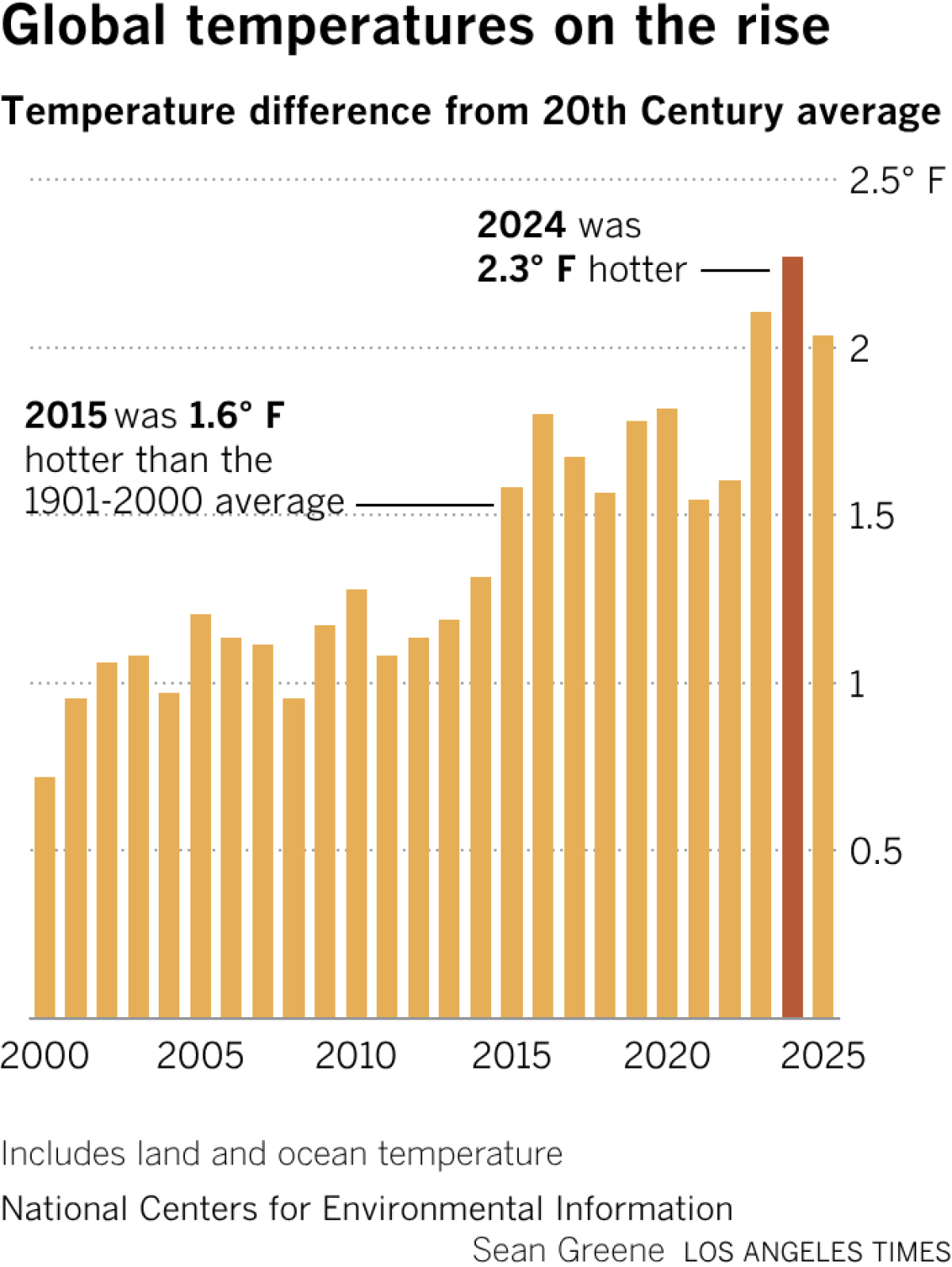
Meanwhile, that global temperature record that DiCaprio mentioned in his acceptance speech in 2016 seems almost trifling compared to what has happened since. It’s been surpassed six times. According to data from the National Centers for Environmental Information, the three hottest years on record are 2024, 2023 and 2025.

At the 98th Academy Awards, DiCaprio was nominated again for Best Actor — his sixth in that category — this time for “One Battle After Another.” The film, directed by Paul Thomas Anderson, won Best Picture. DiCaprio lost in his category to Michael B. Jordan, the lead of Ryan Coogler’s “Sinners,” so he didn’t have a chance to say anything about climate change.
But not a single one of the Oscar winners this year mentioned it.
Both “One Battle After Another” and “Sinners” were produced by Warner Brothers, which is about to be acquired by Paramount Skydance, which in turn is owned by David Ellison, the son of Larry Ellison, one the world’s wealthiest individuals and noted Trump supporter. Ellison the younger has already made decisions that have significantly defanged the climate coverage at CBS News — Paramount’s flagship news network — and it would not be shocking if CNN — part of the WB — is next.
Indeed, one of the defining characteristics of this show was its dearth of any language at the awards that could be considered political.
Instead of the fire we got from, say, Michael Moore in 2003, what we got was a sort of mea culpa from P.T. Anderson — who might be the definitional American Gen X director — in his acceptance speech for Best Adapted Screenplay:
“I wrote this movie for my kids to say sorry for the housekeeping mess that we left in this world we’re handing off to them. But also, with the encouragement that they will be the generation that hopefully brings us some common sense and decency.”
I harbor the same hopes, but it might require at least acknowledging the problems first.
One thing that does give me some optimism is that the feted films themselves did a pretty good job acknowledging climate change. According to Good Energy, a consultancy group, of the 16 scripted features that were nominated for an Oscar and met the eligibility criteria, five passed the “climate reality check.” That’s pretty good!
Relevant especially for those facing the heat wave right now in L.A. and the rest of the southwest: a study published earlier this week in Lancet attempted to quantify how rising global temperatures will impact physical inactivity in different parts of the world. Chloé Farand summed it up for the Guardian, noting the researchers’ projection of 500,000 additional annual deaths due to inactivity by 2050.
Meanwhile, Libby Rainey at LAist wrote about how the city is preparing for the inevitable heat challenges that will accompany the World Cup games this coming summer.
This isn’t brand new — in fact, it references the reporting of my former colleague Sammy Roth — but Alexandra Tey over at the Nation has a nice roundup of sports fans protesting their teams’ financial ties to fossil fuel companies. It focuses on one of the most visible of these partnerships: Citi Field, where the New York Mets play, is named for Citi group, the world’s biggest lender to oil and gas companies.
With gas prices skyrocketing due to the war in Iran, some Californians have been wondering why oil companies in the state can’t just start drilling more. My colleague Blanca Begert explains why it isn’t that simple.
The related big question is will the turmoil in the middle east push countries around the world to double down on renewable energy. In the New Yorker, Bill McKibben makes the case that this could be the moment that small clean tech — think solar panels, heat pumps, induction cooktops, etc — really takes off.
Finally, somehow, some 10 million tons of manure produced at California factory farms is unaccounted for. Seth Millstein, writing for Sentient, explains how lax regulation let farms dispose of 200 Titanics’ worth of animal waste without telling anyone where or how they did it.
This is the latest edition of Boiling Point, a newsletter about climate change and the environment in the American West. Sign up here to get it in your inbox. And listen to our Boiling Point podcast here.

MS NOW is making sweeping changes to its daytime programming, moving hosts Stephanie Ruhle and Alicia Menendez to new time slots.
The changes include the departure of Ana Cabrera, who told viewers about her plans Wednesday. Carbera joined MS NOW — formerly MSNBC — from CNN in 2023. Chris Jansing, the current 11 a.m. Eastern host, will become chief political correspondent.

Stephanie Ruhle is the new anchor for MSNBC’s “The 11th Hour.”
(MSNBC)
The moves announced by MS NOW President Rebecca Kutler are aimed at improving daytime ratings on the network, which changed its name from MSNBC after being spun off from Comcast into a new company called Versant.
MS NOW has seen improved ratings in prime time with opinion programming since the network was re-branded in November. The politically progressive-leaning network will have hosts with a point-of-view in the daytime hours as well once the programming changes take effect in June.
In a memo to staff obtained by The Times, Kutler said the daytime programming will “still be rooted in hard news.”

Ana Cabrera speaks at The Common Good Forum & American Spirit Awards 2018 at The Common Good Forum on May 21, 2018 in New York City.
(Sylvain Gaboury / Patrick McMullan via Getty Images)
Ruhle will move from her 11 p.m. Eastern program “The 11th Hour” to a daytime shift from 9 a.m. to 11 a.m. Eastern. Her program will focus on money and politics.
Menendez will host two hours in the afternoon starting at noon Eastern.
The schedule changes will take effect in June.

Alicia Menendez, Michael Steele and Symone Sanders Townsend of MSNBC’s “The Weekend.”
(MSNBC/Virginia Sherwood/MSNBC)
Once Ruhle’s new program debuts, “Morning Joe” will return to a three-hour format. The program co-hosted by Joe Scarborough and Mika Brzezinski expanded to four hours in 2022. Although the expansion improved ratings, the hosts have asked to scale back so they can pursue other projects at the network.
Menendez has been part of the trio on “The Weeknight,” with Michael Steele and Simone Sanders-Townsend. Luke Russert will take her seat on the program as he returns to an on-air role. Russert had been part of the daytime MSNBC show “The Cycle,” and recently served as creative director for MS NOW’s live event series.
Ruhle will be replaced on “The 11th Hour” by Ali Velshi, who recently served as a weekend anchor. Jacob Soboroff, the network’s national correspondent, will take over Velshi’s anchor duties from 10 a.m. to 1 p.m. Eastern.
Kutler said there will be no job reductions related to the schedule changes, saying she expects to have “more people working at MS NOW by the end of 2026 than we do today.”
MS NOW is the second most-watched cable news network behind Fox News while leading CNN.

TIMOTHÉE Chalamet’s painful Oscars experience was made worse by love rival Travis Scott cheering for Michael B. Jordan, a source close to the star told The U.S. Sun.
Chalamet endured a brutal Academy Awards, from being roasted by host Conan O’Brien to missing out on a career-defining award.
O’Brien targeted the Willy Wonka actor over his scathing remarks about opera and ballet, which had sparked global criticism and threatens to end his partnership with Cartier.
Chalamet said last month in a CNN town hall with Matthew McConaughey that “no one cares” about either artform, with one Academy insider labelling him as “arrogant.”
The night, however, reportedly worsened when controversial rapper Scott — girlfriend Kylie Jenner’s ex and father of her two children — openly supported Jordan, who beat Chalamet in the Best Actor category.
The insider said the 30-year-old was “shaken” after Marty Supreme failed to win any of its nine nominations.
While he was happy for Jordan, who impressed judges with his dual role in Sinners, Chalamet struggled to hide his disappointment, and his tension with Scott reportedly hit an “all-time low.”
“Travis’s support for Michael B. Jordan was seen as a direct snub, and it’s clear he has little respect for Timothée’s talent,” the source said. “While he isn’t confrontational, their relationship has grown colder than ever.”
Chalamet was, according to the insider, withdrawn throughout the evening, leaving the after-party earlier than usual.
Another source also told The U.S. Sun that the couple even walked out of the Oscars ceremony for an hour, leaving seat fillers in their spot.
People close to him said he leaned heavily on Jenner for comfort, appearing so reliant that she sometimes seemed overwhelmed.
It has been a dispiriting awards season for Chalamet.
Last month at the 2026 BAFTA Film Awards in London, he was nominated for Best Actor for Marty Supreme but lost to Robert Aramayo for his performance in I Swear.
Marty Supreme, which tells the true story of a table tennis player in the 1940s, went home empty-handed despite nine nominations.
Sources said Chalamet left the BAFTA ceremony visibly deflated, struggling to enjoy himself despite efforts from Jenner and his friends.
“Going home with nothing in London deeply bruised his ego, though he will certainly learn from the experiences of the last few months.
“He never truly settled into the vibe of the ceremony; his mood was tense and stressed, and he struggled to enjoy himself.”
It wasn’t just host O’Brien laughing at him, either.
Another roast came from Alexandre Singh, who accepted the award for Best Short Film (a tie between The Singers and Two People Exchanging Saliva) and addressed Chalamet’s ballet comments.
“Maybe it takes ten years’ time, but we can change people’s lives through art, through creativity — through theatre and ballet — and also cinema,” Singh said after collecting his award.
The insider said the energy throughout the night was tense, with Jenner’s behavior described as almost maternal.
“The atmosphere was strange for everyone involved. Kylie has become his primary safe space, to the point where those around him feel she is essentially babysitting him.

Timothée Chalamet has sparked a heated cultural debate following comments made at a CNN and Variety Town Hall on February 21, 2026.
Speaking alongside Matthew McConaughey about needing “draws” to pull in an audience to his movies, Chalamet made harsh comments about industries he claimed feel forced to stay afloat.
“I don’t want to be working in ballet or opera… where it’s like, ‘Hey, keep this thing alive, even though no one cares about this anymore,’” he said.
The remarks mirror sentiments Chalamet expressed as early as 2019 during a promotional event for The King, where he labeled the disciplines “dying art forms.”
The Royal Ballet and Opera issued a formal rebuttal, emphasizing that these art forms do not exist in isolation but rather “inform, inspire, and elevate” the broader cultural landscape, including the film industry itself.
“It is a bizarre dynamic; while she seems to embrace her influence over him, it often feels like she is acting as a maternal figure rather than a partner, which many find frustrating to witness.”
Sources said the Oscars provided Chalamet a reality check when he faced fellow nominees Jordan and Brazilian actor Wagner Moura.
Friends have advised him to adopt a more mature public persona, projecting confidence rather than appearing like a “young boy with a high school girlfriend.”
“The gap in maturity was obvious,” the insider said. “He’s been told multiple times he needs to project more maturity to be taken seriously as a leading man.”
Chalamet now plans to put the disappointment behind him by going on vacation, attending some NBA games, and “reconnecting with himself” before returning to work.

Athletes in T-shirts, fans applying suncream – have these been the Summer or Winter Paralympics?
If you were to listen to American Patrick Halgren, who called the conditions at the Milan-Cortina Games “tropical” and “like surfing”, you would think the former.
Until you were told he is a skier.
Since the 1992 Games, the Winter Paralympics have always been held in March, usually starting just shy of a fortnight after the conclusion of the Winter Olympics.
That means conditions during the Games have often been more spring-like than winter, with temperatures peaking at 26C four years ago in Beijing.
While such temperatures have not been felt in Cortina, it has been warm, and until a huge dump of snow fell the night before Sunday’s final day of competition, snow had only been seen on the groomed competition pistes.
A blazing sun on several days of competition, mixed with some rain, had caused snow on the courses to turn soft and slushy, which in turns sticks to athletes’ skis and snowboards.
Last weekend a third official training session for the Para-alpine skiing downhill events was cancelled in a bid to maintain the piste conditions.
While many athletes have praised the efforts of organisers to keep the tracks in as good a condition as possible, conditions on Friday during the men’s giant slalom events were far from ideal, with British visually impaired skier Fred Warburton describing it as a “bathtub of Slush Puppie”.
His guide, James Hannan, said: “The snow surface was changing every single gate, so we never knew how the ski was going to react.
“It was almost like survival of the fittest.”
It certainly proved that way during the sitting event, which followed the visually impaired and standing races: 18 athletes from a field of 37 failed to make it to the bottom of the course.
“The organisers need to look at scheduling with obvious changes of the climate that we’re experiencing,” said Warburton.
“Both the Olympics and Paralympics want to be top spectacles of skiing and allow athletes to put their best work down.
“We need to look at the schedule and move it forward in future. That’s way beyond my pay grade, but it seems pretty logical to me.”
Warburton’s words echoed those of retired American Paralympic snowboarder Amy Purdy, who this week said in a video on TikTok: “I don’t believe that the Paralympics should be happening right now.”
Her comments came after the snowboard cross course had to be adjusted following numerous crashes in training, partly because of its design but also the warm conditions.

In remarks that are likely to stoke concerns through the corridors of CNN, Secretary of Defense Pete Hegseth said Friday he is looking forward to Paramount’s ownership of the network.
“The sooner David Ellison takes over that network the better,” Hegseth said during a morning briefing.
Hegseth’s invoking the name of the Paramount Skydance chief executive — whose company will take control of CNN once its deal to merge with Warner Bros. Discovery is finalized — amplified the fear many have that the cable news channel will seek to appease the Trump administration.
The typically combative Hegseth made the remarks after blasting CNN’s reporting on the U.S. military action in Iran. CNN said the Trump administration underestimated the impact its attack would have on the Strait of Hormuz, echoing the claims of other media outlets. Oil tankers have been unable to get through the passage due to attacks by Iranian drones, escalating gas prices as a result.
“CNN doesn’t think we thought of that,” Hegseth said. “It’s a fundamentally unserious report.”
Paramount declined to comment on the remarks by Hegseth, a former Fox News host who has a lot of experience in bashing the mainstream media. A CNN representative said the network stands by its reporting.
Trump has a friendship with Ellison’s father, Larry, and the two have reportedly discussed changes to CNN once Paramount takes ownership. But it’s the rare time such expectations have been offered up publicly by a top member of the administration.
Trump, who has long expressed disdain for CNN, expressed his preference for Paramount to prevail over Netfilx in its pursuit of Warner Bros. Discovery so that CNN would be in the hands of the Ellisons.
In his last public statement about CNN, David Ellison said he wants to be in the “truth business” and insisted there would be no corporate interference in the network’s coverage.
“CNN is an incredible brand with an incredible team, and we absolutely believe in the independence that needs to be maintained, obviously, for those incredible journalists, and we want to support that going forward,” Ellison told CNBC on March 5.
Paramount has been forced to battle the perception of that its news organizations will tilt to the right under its stewardship. One of David Ellison’s first moves after his company Skydance Media took over CBS was installing Bari Weiss as editor in chief of the network’s news division despite having no experience in TV news. Ellison acquired Weiss’s the Free Press, a centrist digital news site that often targets excesses of the political left and is staunchly pro-Israel.
The acquisition and the appointment of Weiss were seen as a way to help smooth the regulatory approval of Skydance’s acquisition of Paramount last year. CBS News has been under intense scrutiny for signs that is shifting its coverage to please the administration.
A number of CBS News journalists unhappy over the division’s direction under Weiss have already departed. Scott MacFarlane, the Justice Department correspondent who announced his exit Monday, was said to be particularly unhappy over the network’s handling of the anniversary of the Jan. 6, 2021, attack on the U.S. Capitol by Trump supporters who wanted to overturn the 2020 election results.
Anderson Cooper also passed on signing a new deal with “60 Minutes,” where he has been a correspondent since 2007. But with the merger, the CNN anchor will still be a part of the company.
Weiss’ has had some early missteps. The Jan. 6 story was among several highly criticized segments during the first week of “CBS Evening News with Tony Dokoupil.” She delayed a “60 Minutes” segment on the government’s use of an El Salvador prison to detain undocumented migrants for more reporting, only to have it air with minor changes. The delay prompted charges that Weiss was trying to placate the White House, which CBS denied.
Notwithstanding the controversy, some insiders contend there has
not been a significant shift in how CBS News is covering most stories.
The network was among the first to report that the severity of injuries to U.S. service members from an Iranian drone attack in Kuwait were far more serious than the government initially said.
CBS News is also moving ahead with the hiring of Jeremy Adler, once a top advisor to former congresswoman and outspoken Trump nemesis Liz Cheney, to handle communications for Weiss, according to people familiar with the plan who were not authorized to speak publicly.
Axios — citing unnamed sources — reported that White House officials are angry about Adler joining the network, as Cheney was vice chairman of the committee that investigated the Jan. 6 insurrection.
Cheney, the daughter of former Vice President Dick Cheney and one of the most conservative members of Congress during her time, supported Trump’s opponent Kamala Harris in the 2020 election.
Adler was Cheney’s deputy chief of staff and senior communications advisor from 2019 to 2023. He also served as a regional press secretary on now-Secretary of State Marco Rubio’s 2016 presidential campaign.
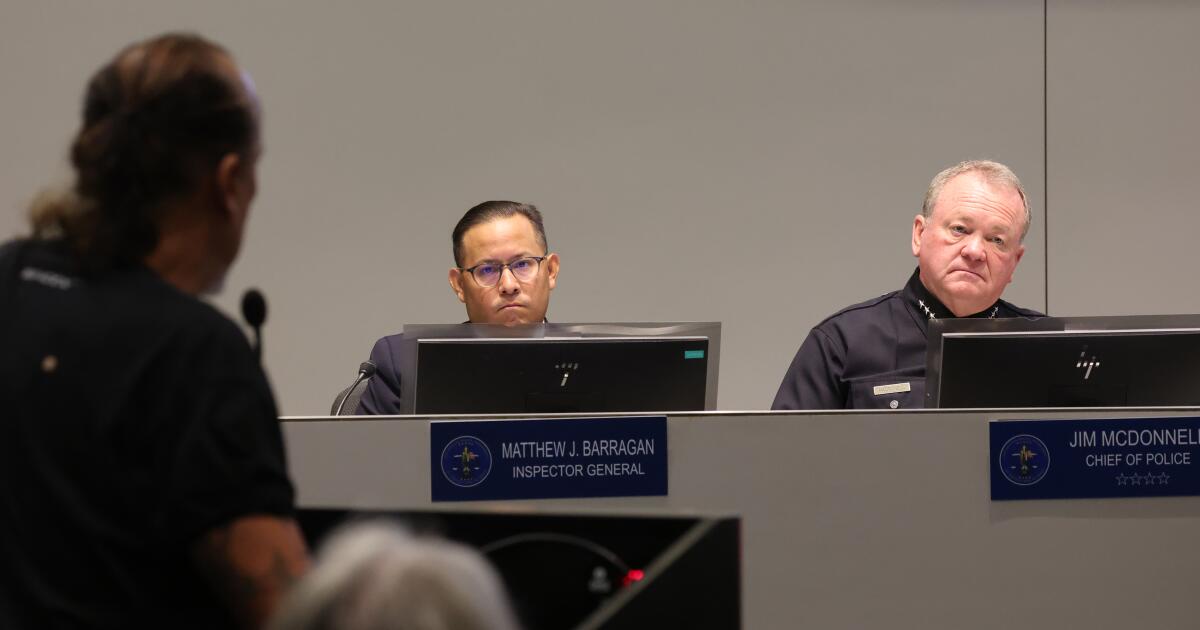
A series of proposed changes to the city’s charter — essentially its constitution — could give elected leaders in Los Angeles more oversight of the police department and enable the chief to fire problematic officers, reforms long sought by advocates that are likely to once again face fierce opposition.
Among the recommendations approved last week by the city’s Charter Reform Commission was a proposal that would require any LAPD accountability-related motion or ordinance passed by the City Council to automatically become law if not acted on by the Police Commission within 60 days.
Once the language is finalized, the proposals must clear the City Council and its committees before they can be put to voters on November’s ballot.
Another proposal would give city leaders the ability to override the policy decisions by the Police Commission, a board appointed by the mayor that sets the LAPD policies, oversees its budget and serves as a civilian watchdog.
With the police chief taking criticism for a recent rise in shootings by officers, several proposals sought to strengthen accountability for the use deadly force. One recommendation could require the LAPD to purchase “no less than” $1 million of liability insurance for its roughly 8,700 officers. The insurance would be used to cover legal fees if an officer is found liable for a wrongful injury or death, instead of tapping into the city’s General Fund budget.
Another potential change would “clarify and strengthen” the police chief’s ability to “to initiate and pursue the removal of officers with documented, repeated histories of harm or misconduct.”
Under city rules, the chief of police does not have the authority to fire an officer. Instead, they must send officers whose misconduct they deem severe to disciplinary panels, which occasionally lead to lighter penalties. The new proposal would give the City Council the power to override decisions not to fire, still leaving officers the right to appeal through the courts.
Mayor Karen Bass vetoed a similar bid to rework the disciplinary process in 2024.
The latest proposals drew cautious optimism from activists, many of whom claim the Police Commission is too cozy with the LAPD and have pushed for stronger independent oversight.
Godfrey Plata, deputy director of the nonprofit L.A. Forward, called the proposals a “huge victory” in the fight for police accountability.
“Months ago, police reform wasn’t even on the Charter Commission’s to-do list. Today, because community members came together to force conversations that likely never would have happened on their own, we have multiple reforms headed to City Council,” Plata said.
The Police Commission and LAPD issued nearly identical statements that said they are looking forward to working with the City Council on the charter reform process.
An LAPD spokesman declined to say how Chief Jim McDonnell felt about the proposal, saying it wasn’t “in his interests to give his opinion on something like this as long as it’s still with the full council.”
Samantha Stevens, a Los Angeles political consultant and former legislative staffer, said she is worried the proposed changes are a shortsighted solution to address police abuses that will create another layer of bureaucracy.
“If we don’t like how they’re running things, we should replace the commissioners.” she said. “I don’t know that this will be as effective when you’ve got 15 councilmembers now telling LAPD what to do in their own districts. Is that now too many cooks in the kitchen?”
The charter commission, which has been meeting since last July, must send all its recommended changes to the City Council by April 2.

Pointe-Noire and Brazzaville, Republic of Congo – In Pointe-Noire, the economic capital of the Republic of Congo, the aisles of the Grand Marche come alive in the early hours of the morning. Among the market stalls, street vendors, and shoppers pushing their way through the crowd, Romain Tchicaya is selling medicines on the sly.
As the price of basics – including pharmaceutical products – rises, and people turn to more affordable unregulated options, merchants like Tchicaya step in to fill the gap while trying to earn a living in a struggling economy.
list of 3 itemsend of list
However, the 37-year-old’s background is far from typical for a street vendor.
With a degree in management, he thought he would find a stable job after graduating from university. But like many young Congolese, he found himself facing a tight job market with few opportunities.
“We are told that the country is rich in oil. But I don’t see that wealth in my daily life,” he told Al Jazeera. “Look at Pointe-Noire, formerly nicknamed as Ponton la Belle [Beautiful Pointe-Noire]. Today, the city is unrecognisable.”
Around the Grand Marche, the main roads are potholed, and when it rains, the streets get flooded, making it almost impossible to drive.
Like Tchicaya, Brice Makaya, in his 40s, has never managed to find a stable job here despite having a degree in computer science.
With no stable employment, he is unable to rent a house and now lives outside the church where he prays.
“I am still underhoused at my age and have no prospects for the future,” he told Al Jazeera. “Without a job, I can’t plan ahead. I’m just trying to survive.”
For many young Congolese, daily life is a paradox: though they live in a resource-rich country – the third largest oil producer in sub-Saharan Africa and a producer of liquefied natural gas (LNG) – nearly half the population live below the poverty line.
This Sunday, Congo goes to the polls in which President Denis Sassou Nguesso, 82, is again seeking another term. For young voters, jobs and the economy are a big concern. But for the government, there appear to be limitations to what is possible.
During one of his speeches in the election campaign, Nguesso pointed out that the civil service could not absorb all job seekers, and urged young people to take charge of their own futures by encouraging self-employment.

According to the World Bank, oil accounts for about 70 percent of Congo’s exports and nearly 40 percent of its gross domestic product (GDP).
But this wealth does not automatically translate into an improvement in living standards for most of the populace.
The World Bank estimates that more than 40 percent of Congolese people live below the poverty line, despite the country’s significant natural resources.
For economist Charles Kombo, this can be explained in large part by the very structure of the Congolese economy, which is dependent on oil revenues.
“Oil dependency plays a structuring role in many African economies. In what some call a ‘rentier state’, a large part of public resources comes from the exploitation of natural resources rather than taxation,” he explained.
In a rentier state, the country generates substantial revenue from “renting out” natural resources, such as oil, to foreign companies. In exchange for the exploitation rights granted on these resources, the state receives royalties, taxes, or a share of production.
In this type of system, Kombo explains, the management of revenues becomes central to political power.
“Control of this revenue often reinforces institutional centralisation,” he said, explaining that dependence is no longer solely economic, but becomes institutional and sometimes psychological, as it influences budgetary priorities, political strategies, and even perceptions of development.
He points out that when the economy relies heavily on extractive revenues, economic and political resources tend to become intertwined, which can limit electoral competitiveness.
“Oil revenues can generate significant income, but they do not guarantee the structural transformation of the economy,” he said.
This oil dependence also exposes the country to fluctuations in oil prices on international markets.
After the fall in crude oil prices in 2014, the Congolese economy experienced a severe crisis. Public debt exceeded 90 percent of GDP, before being restructured under agreements with the International Monetary Fund and several international creditors.
Although this has helped stabilise the macroeconomic situation, the country remains heavily indebted. According to the World Bank, public debt fell from 103.6 percent of GDP in 2020 to about 93.6 percent in 2024, reflecting a gradual improvement, but also the continued vulnerability of Congo’s economy to fluctuations in global oil prices.
For political analyst Alphonse Ndongo, oil revenues also influence political life in Congo.
“Oil has become the fuel of the political system. It is used to finance parties, co-opt elites, and maintain social balance,” he said.
According to him, “oil money comes easily and quickly”, but this financial windfall has long delayed necessary structural reforms such as economic diversification.
In his view, the steady flow of money from the oil sector can create a sense of complacency within the system, reducing the pressure to pursue deeper structural reforms. As a result, debates around economic diversification tend to emerge mainly during periods of financial stress, when falling oil prices expose the limits of the model. But when revenues rise again, he argues, the urgency to diversify often fades, leaving the economy heavily dependent on the same resource.

As the country’s oil wealth fails to filter to the majority of the population, young people are particularly affected and many face unemployment.
According to data from the World Bank and the International Labour Organization, the youth unemployment rate in Congo is among the highest in Central Africa, while the informal sector absorbs the majority of new entrants to the labour market.
During a news conference on March 4 in Brazzaville, Prime Minister Anatole Collinet Makosso, who is also spokesperson for presidential candidate and incumbent leader Nguesso, said that young people were at the heart of the government’s policy.
“Youth has always been at the centre of Denis Sassou Nguesso’s policies and social projects,” he said, citing investments in education and the construction of universities.
He also claimed that the unemployment rate had fallen from 44 percent to 39 percent in recent years.
But on the ground, many young people remain sceptical.
Landry, 23, a student in the capital Brazzaville who did not want to give his last name, says he has lost faith in political promises.
“Promises of jobs come back every election. It’s become a cycle,” he said.
A months-long strike at Marien Ngouabi University, the country’s main institution of higher education, forced him to interrupt his studies.
“I went back to my parents’ house to wait and see what I could do. Today, I’m seriously thinking about going abroad.”
Another student in Brazzaville, a 26-year-old woman who did not want to give her name, expressed similar frustration.
“The only sector that is really recruiting today is the army. But not everyone can become a soldier. Becoming a civil servant is also an uphill battle,” she said.
Even sectors that are supposed to be structured are not immune to precariousness. Regine, a young journalist who also did not want to provide her last name, said she works without a stable employment contract.
“In the media, many young people live off ‘camora’, one-off payments for services. It’s not a real salary.”
She also lamented the difficulties of everyday life, including infrastructure issues, such as power cuts and inconsistent water supplies, despite repeated government investment plans.
“In the 21st century, people rejoice when the electricity comes back on. And when the water finally flows, everyone rushes to fill buckets,” she said.

Congo’s infrastructure problems are a reminder to Regine and many others that economic difficulties go beyond the issue of employment.
At the same time, the consequences of the country’s youth employment crisis also reverberate more widely and into the social sphere.
Analyst Ndongo sees this as a potentially explosive situation.
“When there are large numbers of young people who are unemployed and have no prospects, it can become a social time bomb,” he said.
This dynamic is already visible in the tensions that emerge when unemployment and inequality intersect, Ndongo explained: As large numbers of young people struggle to find work while wealth linked to the oil sector remains visible, frustration can build among those excluded from economic opportunities.
He says pressure can be contained for a time, but without meaningful job opportunities and stronger education systems, resentment may deepen. Over time, he warns, groups of unemployed and poorly trained youth can become more vulnerable to crime or gang activity.
The Congolese population is very young: more than 60 percent of people are under 25, according to United Nations data. This demographic reality represents both economic potential and a major challenge for the authorities.
For economist Kombo, the issue goes far beyond just unemployment.
“Demographics are a major political factor in many African countries. When the population is predominantly young, expectations for employment and social mobility are particularly high.”
According to him, long-term political stability will depend on the ability to create economic opportunities.
“Development is not distributed,” he said, “it is built.”
Despite the frustrations, political mobilisation remains limited, even as several candidates rally to compete against Nguesso in this weekend’s vote.
Chris Taty, a young student in Brazzaville, says he is not interested in the current election, as it is clear that the president who has already been in power for more than 40 years will once again reign supreme.
“Everyone already knows who is going to win. So why bother voting? I’d rather stay at home and do other things,” he said.
“Sometimes we joke that Sassou [Nguesso] is our grandfather,” the young journalist Regine said. “He has been ruling for so long that many of us have never known another president”
Nguesso has been a dominant figure in Congolese politics for decades, first ruling the country from 1979 to 1992 before returning to power in 1997 following a brief period out of office. His long tenure has enabled him to consolidate influence over key state institutions. Meanwhile, analysts say the country’s opposition remains fragmented and lacks the organisational capacity to pose a strong challenge.
For some potential voters, the perception of a largely predictable outcome has contributed to a degree of political disengagement, which Ndogo says is a “feeling of resignation”.
“Resignation is ingrained in everyone … Students, politicians, intellectuals … everyone is forced to scramble for a piece of the pie,” he said.
“We are all lulled into resignation because we tell ourselves that if we stand up against the established order, against those in power, we risk ending up in prison or even six feet under. It’s risky to oppose the system today.”
This combination of economic frustrations and limited political participation is a main challenge facing Congo, observers say. And the issue of youth unemployment risks becoming a major crisis in the coming years if nothing is done to fix it.
For many educated yet underemployed young people in the oil-rich country, the question is whether or not Congo can transform its natural wealth into concrete opportunities for its people.
“We are not asking for much,” said Regine. “Just the chance to work, to live in our own country with dignity and to believe that our future can be built here, without connections, with equal opportunities for young people, and without conditions.”

Bruce Johnston, a six-decade member of the Beach Boys’ live band, announced he will step away from the group.
The 82-year-old Johnston told Rolling Stone that “It’s time for part three of my lengthy musical career! I can write songs forever and wait until you hear what’s coming! As my major talent beyond singing is songwriting, now is the time to get serious again.”
The Beach Boys’ Mike Love also said in a statement that “Bruce Johnston is one of the greatest songwriters, vocalists, and keyboardists of our time. We’ve had the honor of his performance and participation for many many years with the Beach Boys. Change is always promised in life; today we find ourselves in a chapter of change, but not an end.”
Johnston originally joined the group in 1965, filling in as a live vocalist in place of frontman Brian Wilson, and earning a vocal credit on “California Girls.” He left the band in 1972 to pursue solo work, and penned Barry Manilow’s hit “I Write The Songs.”
Johnston returned to the Beach Boys in 1978, and continued to tour as the only member besides Love from the band’s original era. He also wrote several songs for the group, including “Disney Girls (1957),” “Deirdre” and “Tears in the Morning.” Johnston will be replaced by Chris Cron, vocalist for the Beach Boys tribute band Pet Sounds Live.
After Wilson’s death last year, Beach Boys fans still have several occasions to hear the catalog live. Love’s long-running edition of the Beach Boys will play three nights at the Hollywood Bowl over July 4 weekend (which Johnston said he’ll sit in on). Founding member Al Jardine is touring with Brian Wilson’s former backing ensemble, now called the Pet Sounds Band, with a set focused on the1977 LP “The Beach Boys Love You.”