

challenging

Trump lawsuit challenging L.A.’s sanctuary city law dismissed

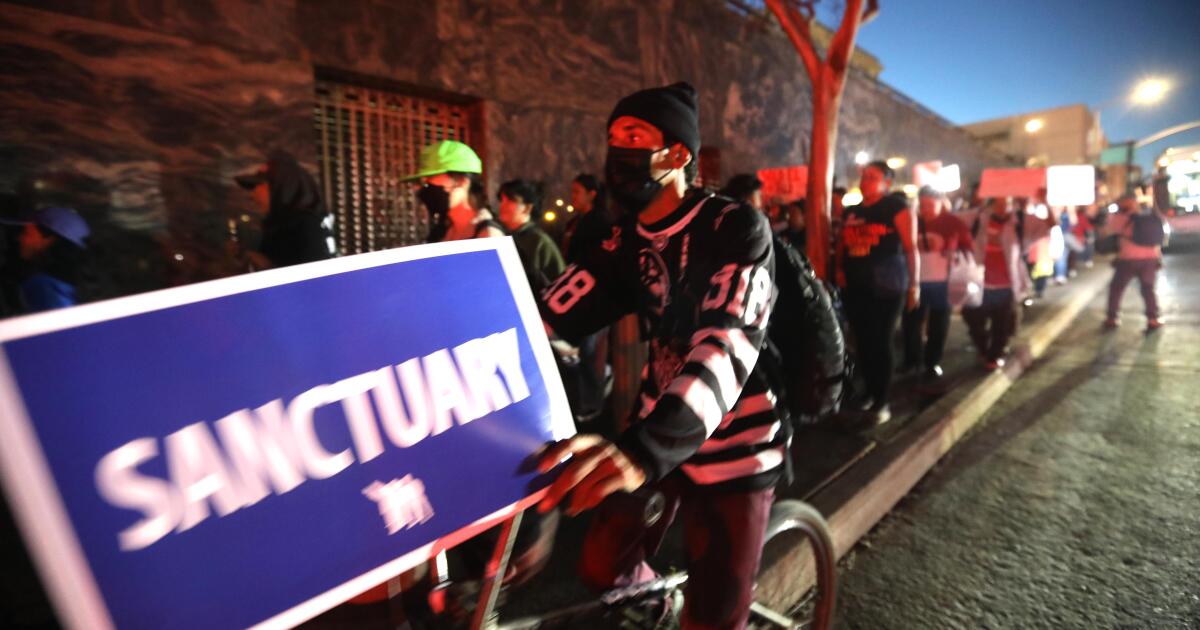
A federal judge has dismissed a lawsuit filed by the Trump administration that sought to block what it called L.A.’s “illegal” sanctuary city law.

In a weekend ruling, U.S. District Judge Fernando M. Olguin granted the city’s motion to dismiss the complaint, which alleged that the city ordinance violates the intergovernmental immunity doctrine by regulating and discriminating against the federal government.

Olguin ruled that the government’s allegations were “insufficient to establish that the Ordinance violates the intergovernmental immunity doctrine,” but granted the administration permission to file an amended complaint by July 3.

“The Ordinance does not directly regulate the federal government,” Olguin said in his ruling. “Rather, it ‘controls the actions of [the City’s] own agents and agencies.’”

The White House and the Department of Justice did not immediately respond to a request for comment.

Although the administration could refile its complaint, L.A.. City Atty. Hydee ‌Feldstein Soto celebrated the dismissal as a legal victory.

“This order reinforces the well-established principle that local governments have the authority to decide how to use their personnel and resources,” Feldstein Soto said in a statement.

The lawsuit, filed by the Trump administration in California’s Central District federal court last June, said the country is “facing a crisis of illegal immigration” and that its efforts to address it “are hindered by Sanctuary Cities such as the City of Los Angeles, which refuse to cooperate or share information, even when requested, with federal immigration authorities.”

The lawsuit came as immigration agents descended on Southern California, arresting thousands of immigrants and prompting protests across the region.

“The situation became so dire that the Federal Government deployed the California National Guard and United States Marines to quell the chaos,” the lawsuit states. “A direct confrontation with federal immigration authorities was the inevitable outcome of the Sanctuary City law.”

The law was proposed in early 2023, long before Trump’s election, but it was finalized in the wake of his victory in November 2024.

Under the ordinance, city employees and city property may not be used to “investigate, cite, arrest, hold, transfer or detain any person” for the purpose of immigration enforcement. An exception is made for law enforcement investigating serious offenses.

The ordinance bars city employees from seeking out information about an individual’s citizenship or immigration status unless it is needed to provide a city service. They also must treat data or information that can be used to trace a person’s citizenship or immigration status as confidential.

“The goal of this ordinance, and of LAPD’s immigration-related policies … is to encourage victims of and witnesses to crime to feel safe coming forward to seek help from LAPD regardless of their immigration status,” Feldstein Soto said in her statement. “It does not obstruct or impede lawful federal immigration enforcement operations.”

The government in its original filing said that Trump campaigned and won the 2024 presidential election on a platform of deporting “millions of illegal immigrants.” By enacting a sanctuary city ordinance, the City Council sought to “thwart the will of the American people regarding deportations,” the lawsuit states.

“The Supremacy Clause prohibits the City of Los Angeles and its officials from singling out the Federal Government for adverse treatment — as the challenged law and policies do — thereby discriminating against the Federal Government,” the lawsuit says.

Trump’s Department of Justice contends that L.A.’s sanctuary city ordinance goes much further than similar laws in other jurisdictions by “seeking to undermine the Federal Government’s immigration enforcement efforts.”

Source link

China, Egypt, and Iran: Challenging U.S. Military Presence in the Gulf

The Chinese strategy employs research and intelligence institutions working to foster closer ties between Iranian national security institutions and the Egyptian military, aiming to undermine the American presence in the Middle East. Prominent among these institutions are the Middle East Studies Institute at Shanghai International Studies University, the China Institute of International Studies, and the Center for West Asian and African Studies. These Chinese research centers, which shape China’s relations with countries in the region and the Gulf, include the Middle East Studies Institute at Shanghai International Studies University (SISU), which directs studies related to security and defense issues and facilitates direct dialogue between think tanks in Iran and research centers in Egypt. Another example is the China Institute of International Studies (CIIS), which reports directly to the Chinese Ministry of Foreign Affairs and works to engineer diplomatic plans that align Egypt’s strategic interests with the objectives of Tehran and resistance movements in the region. Chinese think tanks and intelligence agencies also rely on a number of People’s Liberation Army-backed space intelligence companies, such as MizarVision and EarthEye. These Chinese companies have provided high-resolution satellite imagery and intelligence data to support operations targeting US bases in the Gulf and the Middle East. These Chinese entities coordinate and plan operations through various mechanisms and initiatives officially launched by China, most notably the Global Security Initiative (GSI). Beijing also uses forums, such as the China-Arab Cooperation Forum, to pressure Middle Eastern and Gulf countries to withdraw foreign forces and end US hegemony in the Gulf and the Middle East. This is framed as ending direct interference in the internal affairs of countries in the region. Beijing is also seeking to establish permanent overseas bases, most prominently the Djibouti naval base in East Africa, to support its regional alliances and ensure the continuity of global supply lines for Chinese interests and investments within the framework of the Belt and Road Initiative.

The relationship between Chinese military and intelligence think tanks and the Egyptian army is highlighted by their shared goal of countering American hegemony and expelling US military bases from the Gulf and the Middle East. China is strengthening its strategic cooperation with the Egyptian army as part of the Djibouti-UAE-Egypt axis, with Beijing relying on Cairo as a key launching pad to secure maritime navigation and reduce American military influence. Beijing is utilizing its strategic institutions and think tanks to provide technological and logistical support to the Egyptian army, aiming to create a regional power capable of maintaining strategic balance in the region against American hegemony and interventions. This escalating security and strategic relationship between the Egyptian and Chinese armies rests on several key pillars, most notably intelligence and military partnership. China aims to train the Egyptian military elite through Egyptian military academies and coordinate threat assessments and mutual monitoring of the military movements of the United States and its allies in the Gulf and the wider region. With the implementation of several joint exercises between the two sides, the Chinese vision crystallized in the (Civilization Eagles maneuvers), which brought together the air forces of China and Egypt. This paves the way for the transfer of military technology and the integration of Chinese systems with Egyptian defenses independent of the West, along with the localization of Chinese military industries in the heart of Cairo. China is negotiating with the Egyptian Ministry of Defense to develop local manufacturing capabilities and transfer defense technology. There are also reports of integrating Chinese systems into Egyptian systems to reduce Egypt’s dependence on American-supplied weaponry. Beijing seeks to create a counterweight to American hegemony in the Middle East and the Gulf. China sees Egypt’s refusal to host any American military bases as a cornerstone of its strategy, relying on the Egyptian and Emirati armies to guarantee regional security as an alternative to the traditional American presence in the Gulf and the Middle East.

Chinese research, military, and intelligence think tanks are working to engineer an asymmetric strategic partnership to end American hegemony in the Middle East and the Gulf. Chinese think tanks, military research centers, and intelligence agencies are operating according to a clear strategic vision aimed at building asymmetrical partnerships in the Middle East and the Arabian Gulf to reduce American influence and establish a multipolar world order. Beijing provides Tehran with technical and intelligence support to deter Washington, while simultaneously seeking to strengthen military cooperation with Egypt as a pivotal regional power. This strategy aims to diminish American influence and secure China’s vital economic interests. The Chinese strategy in the region rests on several pillars, most notably its strategy toward Iran and its technical and intelligence support for the country. China has secretly supplied Iran with advanced satellite technology from its BeiDou satellite system, bypassing Western and American GPS systems, as well as sophisticated air defense systems. This has significantly enhanced the Iranian Revolutionary Guard’s ability to monitor and target American military bases in the region and the Gulf.

The objectives of Chinese think tanks, political, strategic, military, and intelligence research centers become apparent here, as they attempt to plan a path to link Iran to China’s Belt and Road Initiative and transform Iranian military pressure into a tool for destabilizing the US bases deployed in the region and the Gulf. The convergence between China and the Egyptian military is highlighted through the comprehensive strategic partnership between the two countries. Beijing is inclined to strengthen military cooperation with Egypt, capitalizing on its political stability and its geographic location controlling vital maritime trade routes, and to transfer advanced Chinese military technology to Egypt. Beijing has revealed its desire to be a major supplier of equipment to the Egyptian army, such as the J-10 aircraft. This aims to increase Egypt’s strategic maneuvering room and reduce the dominance of Western weaponry.

The stability achieved by the Egyptian leadership is a fundamental pillar supporting the comprehensive strategic partnership, as Beijing seeks to secure its economic and military interests with a stable and influential regional power. Therefore, China is investing in the Belt and Road Initiative, for which the Suez Canal is a vital artery in the Middle East. Cooperation extends to the exchange and transfer of military technology, joint military manufacturing, advanced air defense systems, and the evaluation of potential acquisitions of modern Chinese fighter jets. Furthermore, joint air exercises have been conducted, with the Egyptian Armed Forces carrying out their first-ever joint air exercise, dubbed Eagles of Civilization with China, involving multi-role fighter aircraft from both countries, underscoring the deepening defense partnership between them.

In this context, China relies on the Egyptian military within the framework of its strategic and African axis to counter American influence. For China, Egypt represents its strategic gateway to the African continent and a cornerstone in its maneuvers against the US Africa Command (USAFRICOM). In addition to joint military exercises, China and Egypt have conducted joint air force drills, a clear indication of an unprecedented military rapprochement that has drawn close American scrutiny. With China’s move to transfer technology and arms deals to Cairo, it is positioning itself to support the Egyptian army with advanced air defense systems, such as the HQ-9B. This enhances Egypt’s air deterrence capabilities and forms part of strategic military deals aimed at reducing dependence on the United States and its Western allies. On the other hand, China relies on Iran as a deterrent and direct driver, exerting pressure on American bases in the region. Iran represents the spearhead of China’s brinkmanship policy against American military bases in the Gulf, Iraq, and Syria, with Tehran threatening to strike them should any regional conflict erupt. In conjunction with the economic and diplomatic alliance between Beijing and Tehran, China uses emerging alliances, such as the BRICS group and the Shanghai Cooperation Organisation (SCO), to establish Iran’s political foothold. It sometimes resorts to mediation policies as a tool to reduce the likelihood of a direct confrontation with Iran, which could harm its commercial interests, such as China’s sponsorship of Pakistani mediation efforts between Iran and the United States to stop the war against Iran and allow the Strait of Hormuz to be opened to global trade and navigation.

China’s major objectives in the Middle East lie in a strategy of attrition against the United States. China uses Iranian actions as a clever pressure tactic to test and deplete American military technology without direct involvement in wars of attrition, while simultaneously attempting to create a new regional order. Here, Chinese intelligence agencies coordinate networks of overlapping interests to push countries toward understandings that transcend the American security umbrella, paving the way for the future withdrawal of foreign military bases. The pillars of China’s strategy for alternative hegemony are based on asymmetric partnerships. Beijing focuses on presenting itself as a reliable economic and technological partner without political conditions or interference in internal affairs, unlike the American model based on conditionality and direct military alliances. With China’s emphasis on the economy as a gateway to security, it utilizes the Belt and Road Initiative and its massive investments in infrastructure and ports, such as the Khalifa Port in the UAE and the Port of Duqm in Oman, to solidify its strategic presence and transform economic dependence into long-term geopolitical influence. With Beijing’s use of security diplomacy and mediation, Chinese decision-making centers have adopted a common security approach and offered political mediation, such as sponsoring the Saudi-Iranian agreement, to solidify Beijing’s role as an international peacemaker and portray the United States as a destabilizing force through the militarization of the region. This is coupled with China’s technological and intelligence penetration of the region and the Gulf, where Chinese partnerships focus on transferring 5G technologies, artificial intelligence, and space cooperation with Gulf states. This grants Beijing intelligence-gathering capabilities and allows it to connect the region’s vital systems to the Chinese technological infrastructure. Chinese think tanks and intelligence agencies are planning to cautiously fill the void, as China avoids direct military confrontation with Washington in the region and prefers to capitalize on the Gulf states’ desire to diversify their partnerships and hedge against the gradual decline of American interest in the Middle East.

Accordingly, we analyze that China’s military strategy in the Middle East and Africa relies on building defense partnerships with diverse objectives. It utilizes the Egyptian army as a pivotal regional power to bolster its influence and counterbalance the American presence through advanced training cooperation while simultaneously leveraging its relationship with Iran to exert pressure on American bases, particularly in the Gulf, and secure its oil interests all within a comprehensive policy aimed at dismantling American hegemony in the region.

Source link

Jennie Bond details ‘challenging’ Lady Diana in ‘momentous’ interview

Jennie Bond was BBC Royal Correspondent for 14 years and struck up a friendship with Lady Diana.

Jennie Bond’s illustrious journalism career stretches back over five decades, during which she has covered a vast array of remarkable stories.

In 1989, she took on the role of Royal Correspondent for the BBC, a position she held for 14 years before stepping down in 2003 to dedicate more time to her family and pursue freelance work.

During her time as a royal reporter, however, she forged a close friendship with Lady Diana, which she discussed with Raj Bisram during her appearance on Celebrity Antiques Road Trip. A repeat of that episode aired this evening (June 20) on BBC Two.

The BBC antiques expert quizzed her on just how close their relationship was, to which she responded: “I was a journalist that she got along with and shared confidences with.

“You know, ‘There were three of us in this marriage,’ all this sort of stuff.”

“Then, at the end, annoyingly, she’d say, ‘Of course, Jennie, this is just between you and me and these four walls.’ I’d think, ‘Ugh!’ So I kept it that way.”

Raj then asked which interview throughout Jennie’s career had left the greatest impression on her, reports Devon Live.

She answered: “I suppose, when I challenged her in Angola on the land mine mission, when she was trying to get an international ban on land mines.

“I said, ‘Ma’am, you’ve been accused of being a loose cannon,’ and she was very shocked and said, ‘I’m just trying to be a humanitarian. That’s it.'”.

“That was pretty momentous. It made an awful lot of news.”

At the time, Lady Diana was described as a ‘loose cannon’ by a junior government Cabinet minister who condemned her position on landmines.

The tense exchange, which took place in 1997, was captured in a documentary of the time, showing Lady Diana’s response to Jennie’s pointed question.

She said: “I’m only trying to highlight a problem that’s going on all around the world. That’s all.”

She was subsequently filmed climbing into a waiting car, visibly moved by Jennie’s remark, as she told the camera team: “I might really burst into tears now. Who said I’m a loose cannon?”

Celebrity Antiques Road Trip is available to watch on BBC iPlayer.

Source link

BBC The Repair Shop guest issues apology and holds back tears over ‘challenging’ fix

BBC expert Steve Fletcher was given the task of restoring a sentimental item on the latest episode of The Repair Shop.

Emotions were at an all-time high during The Repair Shop as BBC’s Steve Fletcher and Dominic Chinea welcomed Robin into the workshop.

The guest had a large globe with him, which he explained was a ‘world clock’ and was built by his great-grandfather.

He commented: “It’s based on a grandfather clock mechanism. The idea is that the clock makes the globe rotate once every 24 hours. Then, using the numbers on the ring around the equator, you can see what the time is anywhere in the world.”

The BBC stars were blown away as they both called it ‘amazing’ before Robin confessed that he’s never known it to work in his lifetime.

Curious, horologist Steve asked if his great-grandfather was a clock-maker, as the guest explained that he wasn’t, he had been a mechanical engineer, but made the item in his spare time in the 1930s after retirement.

He added: “There’s a little newspaper cutting in here, according to the newspaper it’s supposed to chime every half hour. It took him five years to perfect.”

Sadly, Robin shared that his great-grandfather died when he was one year old, but he has memories of the item in his grandad’s dining room.

When asked what he wanted them to do with the unusual clock, Robin stated the idea would be to get it working, which is something his own father had wanted to do but never was able to.

He added: “If he’d have seen it working, I think it would have really been special to him if I could get it working now, in his memory, but also, grandfather and great-grandfather before that. Just to keep the family legacy going, as it were.

In the end, after the item was worked on by both Steve and Jonathan Wright, it was time for Robin to return to see the final restoration.

When the globe was revealed, which the experts managed to get working once again, Robin was blown away. He commented: “Wow! Well, it looks gorgeous, it really does look gorgeous. I’m… I am stunned, I really am stunned. Thank you. That’s a lovely sound, isn’t it?”

When Steve turned the clock strike on, Robin laughed as he struggled to hold back his emotions. He added: “Wow, that is so sweet. Sorry. I’d have loved my dad to have seen it and heard it. He’d have been thrilled. It’s really, it is emotional.

“Extremely emotional, but it’s magical, fabulous. We shall treasure it until it’s time to hand it on to the next generation.”

Steve added: “It’s been a real great challenge, so thank you very much for bringing it in.

The Repair Shop is available to watch on BBC iPlayer.

Source link

The insurgencies challenging Mali’s military-led government

Mali’s government is facing difficulties in maintaining power following coordinated attacks by insurgents which killed the defense minister and targeted the main army base near the capital. These attacks involved collaboration between al Qaeda affiliates and a Tuareg rebel group, raising concerns about the government’s claim of restoring order.

The first main group involved is Jama’at Nusrat al-Islam wal-Muslimin (JNIM), which formed in 2017 from a merger of several militant groups after an ethnic Tuareg uprising began in 2012. JNIM is led by Iyad Ag Ghaly, who was previously the head of the Islamist group Ansar Dine. His deputy is Amadou Koufa from the Macina Liberation Front. JNIM has been active near Bamako for nearly a year and is focused on destabilizing the government more than capturing the city. The group had previously announced a fuel blockade as part of its strategy to encircle urban areas and has attacked Bamako before, including a significant assault in September 2024. JNIM is believed to have around 6,000 fighters and also operates in neighboring Burkina Faso and Niger.

The second group, the Azawad Liberation Front (FLA), arose from ongoing Tuareg rebellions that have plagued Mali since its independence in 1960. The Tuaregs seek an independent homeland called “Azawad. ” The National Movement for the Liberation of Azawad (MNLA) initially aimed for independence in 2012 but was overtaken by Islamist factions, prompting Mali to request French military support. In 2015, Mali and Tuareg separatists signed a peace agreement, but tensions reignited in 2024 when the military-led government withdrew from this agreement after expelling foreign forces. In July 2024, clashes resulted in numerous casualties among Malian and Russian troops, with suggestions of foreign involvement in the rebellion.

The third group, the Islamic State in the Sahel Province (ISSP), is an affiliate of the Islamic State that split from Al-Mourabitoun in 2015. ISSP is JNIM’s main rival, and since 2019, confrontations between the two have resulted in over 2,000 deaths. ISSP gained notoriety for the 2017 killing of four American soldiers and has recently escalated attacks in Niger, raising concerns over civilian safety. The group aspires to create an Islamic caliphate in the Sahel but is known to be less engaged with local populations compared to JNIM.

With information from Reuters

Source link