The “Hands Around the Kennedy Center” rally drew thousands after Trump-backed board votes to close the iconic arts venue.
Published On 19 Sep 202619 Sep 2026
Thousands of protesters formed a human chain around the Kennedy Center for the Performing Arts in Washington DC to contest its closure, amid fears that United States President Donald Trump could make good on his threat to demolish the venerated landmark.
The crowd filled streets in the Foggy Bottom neighbourhood of the capital on Friday evening, bringing traffic to a standstill as demonstrators made their way to the “Hands Around the Kennedy Center” protest. Many carried signs and some wore costumes, while boos rang out when Trump was mentioned during the programme.
At one point, some protesters linked hands around the building, whose marble facade remained partly concealed by scaffolding and tarpaulins.
Among the most iconic buildings on Washington’s Potomac waterfront, the Kennedy Center has become a battleground over Trump’s bid to assert control over the institution since he returned to office last year, replacing its board with his own appointees and installing himself as chairman.
Protesters in Washington, DC denounce the Kennedy Center board’s vote to close one of the nation’s premier performing arts venues, September 18, 2026 [Leah Millis/Reuters]
Chris Raleigh, co-founder of Hands Off the Arts, which organised the rally, said in an interview with The Associated Press news agency that he hoped the turnout would show that people were prepared to push back against Trump’s plans for the building.
The demonstration comes just days after the Trump-installed board voted to close the centre for repairs that are expected to last up to two years. That came hours after District Judge Christopher Cooper quashed the board’s latest attempt to restore Trump’s name to the building.
Last December, the new board added Trump’s name to the building’s facade after the Kennedy Center said its Board of Trustees had unanimously voted to rename the institution in his honour.
A federal judge blocked those efforts in May, ruling that the board had exceeded its statutory authority by unilaterally renaming the Kennedy Center and adding Trump’s name to its facade without congressional approval. Congress had designated the centre as a memorial to the late 35th US President John F Kennedy.
In August, the board tried again to inscribe Trump’s name on the building, this time with wording along the lines of “The John F. Kennedy Center for the Performing Arts Restored and Renovated By President Donald J. Trump”.
The federal judge scotched the move in September, ruling that it violated his May injunction.
Protesters outside the John F. Kennedy Memorial Center for the Performing Arts in Washington after its board voted to close the venue. September 18, 2026 [Leah Millis/Reuters]
Trump has since declined to rule out demolishing the building, while a federal judge on Thursday ordered the Kennedy Center to give 30 days’ notice before undertaking any major structural changes, including demolition.
Speaking to reporters in North Carolina on Wednesday, Trump argued that his administration deserved recognition for rescuing the Kennedy Center and that without the repairs, the building risked falling into disrepair and ultimately being forced to shut down.
Raleigh said he, like others, is concerned that Trump could move ahead without first notifying the court.
“Look at the East Wing,” he said. “We got up one morning and there was a giant hole there.”
The expansion will create nearly 700 additional rooms, with the hotels expected to begin welcoming guests between late 2026 and 2028
A popular hotel chain has announced plans to open 10 new locations across the UK. The expansion will create nearly 700 additional rooms, with the hotels expected to begin welcoming guests between late 2026 and 2028.
The properties will be positioned near major railway stations, motorways, stadiums, business centres and visitor attractions. Hilton confirmed the hotels will operate under Spark by Hilton, its value-focused “premium economy” brand.
The company says Spark offers reliable and comfortable accommodation at an accessible price, although room rates and individual opening dates have not yet been announced. A total of 672 rooms will be added across nine locations in England and one in Wales.
The new hotels will open in Cardiff, Coventry, Derby, Doncaster, Hull, Peterborough, Runcorn, Sunderland, Wakefield and Washington. The 10 properties have been signed through an agreement between Hilton and UK hotel owner and operator AG Hotels Group.
Paul Blackmore, vice-president of development for the UK and Ireland at Hilton, said: “With nearly 700 rooms in the pipeline, including the brand’s first hotel in Wales, Spark continues to gain momentum.”
The full list of new hotels is:
Spark by Hilton Cardiff North – 51 rooms
Spark by Hilton Coventry Walsgrave – 48 rooms
Spark by Hilton Derby Station – 100 rooms
Spark by Hilton Doncaster East – 51 rooms
Spark by Hilton Hull Central – 51 rooms
Spark by Hilton Peterborough Norman Cross – 99 rooms
Spark by Hilton Runcorn – 53 rooms
Spark by Hilton Sunderland Northern Spire Bridge – 63 rooms
Spark by Hilton Wakefield South – 77 rooms
Spark by Hilton Washington Newcastle South – 79 room
Spark by Hilton Dunfermline – 53 rooms
The Dunfermline property is separate from the 10 hotels included in the latest agreement. Spark by Hilton launched in 2023 and now has more than 275 hotels operating worldwide, with over 200 additional properties in development.
Daisy Chain Fields arrived on a sweltering summer Saturday, plopped in the middle of Irvine’s suede hills, inside Orange County lines. The festival, hosted by Olivia Rodrigo at the Great Park, was a spiritual successor to Sarah McLachlan’s Lilith Fair of the late ‘90s, born out of frustration with promoters and radio stations that refused to play two female artists in a row.
Like McLachlan’s event, Daisy Chain Fields boasted an all-female lineup, featuring some of the most coveted names in the contemporary music scene. The festival also gave a nod to some of the industry’s women pioneers, such as Bikini Kill and Garbage.
Anticipation for the festival was high after Rodrigo unveiled it in late June, with tickets selling out just 30 minutes after release. This translated directly onto the grounds, which were swarmed by 45,000 attendees, comprising teenage girls, moms, dads and everyone in between.
The event raised $10 million to benefit 10 girl- and women-focused nonprofit organizations, all of which made an appearance on stage before each artist’s set. Each musician on the lineup performed for free.
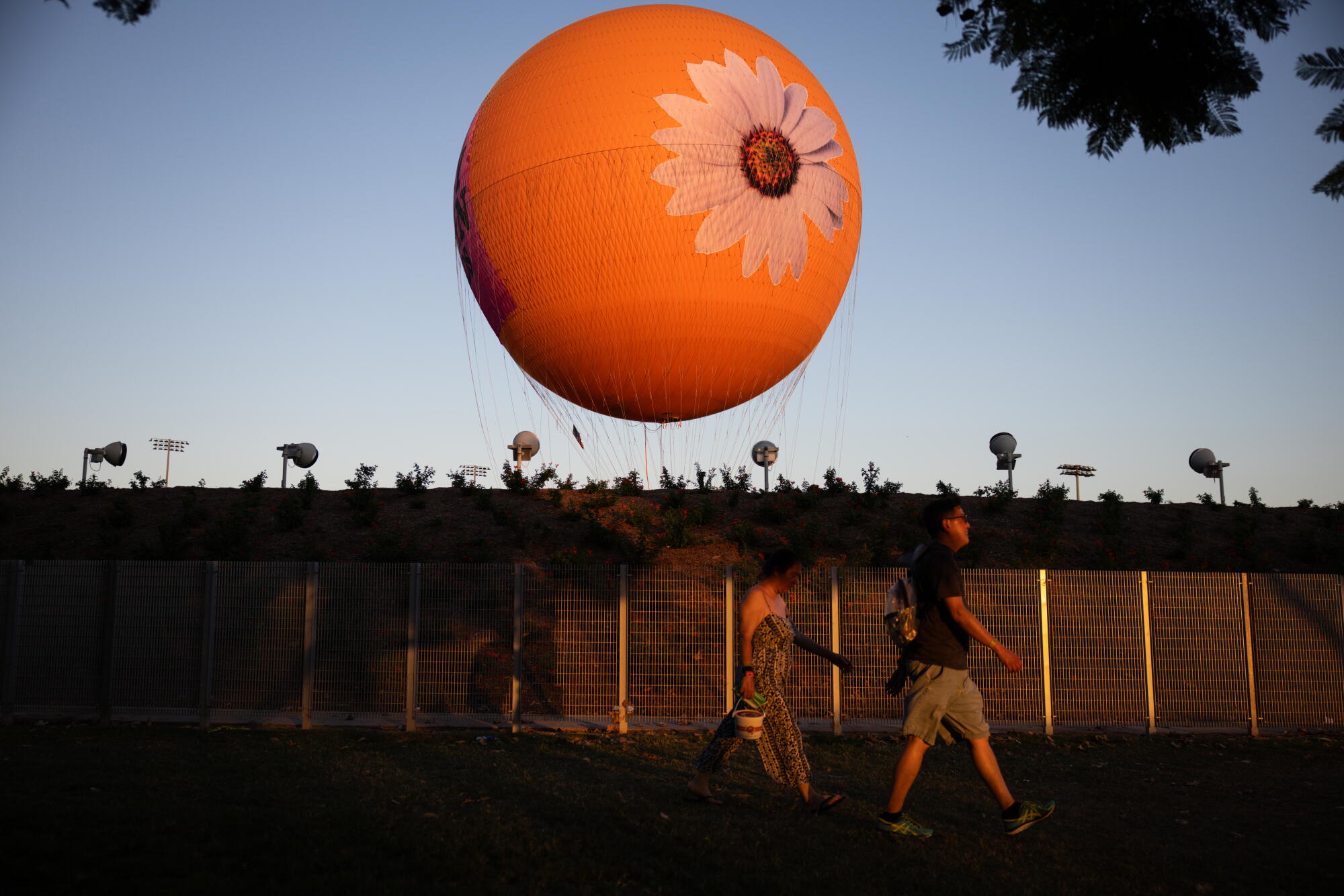
Festivalgoers walk past the Great Park Balloon.
1
2
1.Festival goers pose for pictures in front of a daisy backdrop.2.Nara Brown from Costa Mesa ties together a flower headpiece.
As the sun went down and Rodrigo took the stage, she announced that proceeds had been 100% matched by billionaire and philanthropist Melinda French Gates, bringing total donations to $20 million.
The Times was on site to witness the festival in all its glory, amid astounding 94 degree heat and an unwavering, tangible electricity among fans. Here is our recap of the best moments from the festival. —Julius Miller
Livies get loud on the Metrolink The 2 p.m. Metrolink train from Union Station in L.A. to Orange County was absolutely mobbed with Livies (a.k.a. Olivia Rodrigo fans) on Saturday. For such a car-brained region, it was sweet to see public transit packed with young fans in festival regalia, making the grind to Irvine more sane and green. Let’s have this vibe for every major SoCal festival (including the car-free Ocean Way next month). Yet, for new train fans, a gentle reminder: one spirited round of singing “Get Him Back!” as you’re climbing onboard? Endearing, a delight for all. Keeping it up for an hour, next to civilian commuters who looked ready to climb onto the tracks themselves by Buena Park? Maybe save that for the pit. —August Brown
Festivalgoers sing as Olivia Rodrigo performs during Daisy Chain Fields.
Devon Again performs during Daisy Chain Fields.
Devon Again felt so lucky that she gets to know you
25-year-old alt-pop princess Devon Again was a last-minute addition to the Daisy Chain Fields bill, replacing global girl group Katseye, who pulled out of the festival on Thursday due to a member’s ankle injury. Luckily, Devon Again, a personal friend of Rodrigo who will open for her tour starting in November, was there to answer Rodrigo’s call with a resounding “Duh, b—! Obviously I want to do it!” as she relayed to the Saturday afternoon crowd. Though Katseye’s presence was felt — members Lara Raj, Megan Skiendiel and Yoonchae Jeong took the stage to introduce nonprofit partner Baby2Baby before the set, and Devon Again’s drummer wore a Katseye shirt in tribute — Devon Again’s self-confessed impostor syndrome was misplaced. With a rollicking mix of high-energy country twang, twisty ballads and production-heavy pop hits bolstered by her crisp belt, she made the stage her own. —Eloise Rollins-Fife
Die Spitz dives into a great early set
The set began with a five-minute delay due to technical issues, during which bassist Kate Halter — impressively — performed several handstands to pass the time. By 1:45 p.m., the band was ready to go, with frontwoman Ellie Livingston kicking off the performance. Draped in a torn white skirt and black fishnet gloves to complement, she wailed “I hate when girls die.”
Die Spitz’s set felt like the epitome of what Daisy Chain was all about. The band members took turns strutting around stage and acknowledging, “I know it’s f— hot!” But that didn’t stop the crowd from forming mosh pits on the left and right side of the yellow Marigold stage. At one point, Livingston even jumped in herself, to the despair of security and the delight of fans. —JM
Eleanor “Ellie” Livingston of Die Spitz performs during Daisy Chain Fields.
Santigold’s set was worth fighting for
Santigold’s eclectic, genre-defying sound may be a hallmark of the “indie sleaze” era, but her standout midday Daisy Chain set proved she has plenty of staying power in 2026. Dressed in all white and flanked by a pair of straight-faced dancers in futuristic sunglasses, the 49-year-old artist performed back-to-back hits like “Run the Road” and “L.E.S. Artistes” to a crowd ready to dance the pain away. She even brought a handful of fans onstage — mostly, adorably, children — for a follow-along dance contest during “Unstoppable,” with a winner determined by cheers. Wrapping up the set with “Disparate Youth,” Santigold reminded the audience to keep believing in “a life worth fighting for.” –ERF
Santigold transports the crowd to the early aughts era of indie sleaze during Daisy Chain Fields.
Bikini Kill double dares Daisy Chain crowd to keep fighting the power
“This government hates us and wants us dead,” proclaimed punk icon and Bikini Kill frontwoman Kathleen Hanna: a critical guiding light for Olivia Rodrigo’s feminist consciousness, as well as that of thousands of Daisy Chain attendees on Saturday. Since the band’s inception in 1990, the OG riot grrrls of Bikini Kill made social justice the centripetal force of their furor — long before Daisy Chain Fields, and even its late ‘90s predecessor Lilith Fair. Powered by Tobi Vail on drums (and occasional vocals), Kathy Wilcox on bass and Sara Landeau on guitar, the electric Hanna buffered classic songs like “Double Dare Ya” and “Feels Blind” with parables from her own revolutionary life — much of which she spent fighting back against objectification from men. Dudes in Saturday’s crowd got a special directive: “You guys gotta talk to your friends [about misogyny],” said Hanna. “[Women] are not gonna stop this on our own!” Sealed with a kiss and delivered with a snarl, the band closed its rip-roaring set with the anthemic battle cry of “Rebel Girl,” and were flanked onstage by a few lucky young fans. —Suzy Exposito
Bikini Kill’s Kathleen Hanna preaches a message of anti-misogyny to the crowd during Daisy Chain Fields.
Mitski brought melodrama and musical magic
Whether you’ve been rocking with Mitski since the “Lush” days or discovered her music via pandemic-era Tik Tok, when industrial ballads like “Washing Machine Heart” unexpectedly popped off, there’s no denying her captivating stage presence — not to mention her stunning vocals. Longtime fans may have wished for a few more of the hits (no “Your Best American Girl” after the recent “Puberty 2” 10th anniversary re-release was a surprise), but indie music’s favorite sad-woman still brought her A-game to the Dandelion Stage, incorporating her signature “Butoh” performance style — a form of avant-garde Japanese dance-theatre — underscored by a backdrop of 1940s melodramas. During her set she implored Rodrigo to make the festival an annual tradition. “When do you get to be the first anything anymore?” she said. “For the rest of our lives, we could be like, ‘I’m OG DCF.” – ERF
Mitski performs during Daisy Chain Fields.
The Breeders deliver ‘Last Splash’ classics
Hand it to Kim Deal: As one of the OGs on the bill at Daisy Chain Fields, the Breeders frontwoman used her band’s performance to shout out an even earlier pathbreaker by wearing an old Shirley Chisholm campaign T-shirt featuring the first Black congresswoman’s slogan of “Unbought and unbossed.” Deal and her bandmates (including her twin sister Kelley) drew deeply from their classic 1993 “Last Splash” LP, loping through the country-ish “Drivin’ on 9,” chugging on a fuzzed-out “Saints” and pricking up Gen Z ears with the perennially TikTok’d “Cannonball.” — Mikael Wood
The Breeders play songs from their 1993 classic album “Last Splash” during Daisy Chain Fields.
Doechii does it for the girls
Under the hot afternoon sun, Grammy award-winning rapper Doechii celebrated all things girls in her typical over-the-top fashion. She and her dancers arrived onstage painted in hot pink, the swamp princess’ hair fashioned into high pigtails. A dance breakdown to a hardcore take on Beyoncé’s “Run the World (Girls)” introduced the set, and though she fed fans by performing some of her most popular singles — a version of “Anxiety” that morphed into a cover of the original sample “Somebody I Used to Know” by Goyte, “Alter Ego” and tracks like “Nissan Altima” and “Boiled Peanuts” from her 2024 album “Alligator Bites Never Heal” — she also reminded festivalgoers of the influential Black women artists who came before her — Lauryn Hill, Queen Latifah, Beyoncé — by mixing their iconic songs into hers. Glowing magenta, she twirled above what looked to be a rising river, a physical representation of the swirling, engulfing thoughts that anxiety can provoke as she performed the song by the same name. And just to ensure there was zero confusion, the Florida rapper ended her set by simply stating: “We do this for the girls, we do this for the gays and we do this for trans women.” —Danielle Dorsey
Doechii performs during Daisy Chain Fields.
Doechii
Garbage gives grunge power to Gen Z
With its blend of serrated alt-rock guitars and sleek machine rhythms, Garbage always sounded a little ahead of its time when the band broke out in the post-grunge mid-’90s. But as frontwoman Shirley Manson evoked an age of digital surveillance and pharmacological dependence in “I Think I’m Paranoid” — one of the era’s great snarling pop singles — what you realized is that history had finally caught up with the band. — MW
Shirley Manson, lead singer of Garbage, performs during Daisy Chain Fields.
Chappell Roan reigns with a hit-heavy set
It’s funny to think that Chappell Roan has only really been in the American music scene for the past six years, with just one studio album to her name.
Roan appeared from the back of stage, revealing her leather, periwinkle stewardess outfit and red mod bob — an apparent nod to Luc Besson’s 1997 film “The Fifth Element.” Naturally, the crowd roared as she dove bob-first into “Super Graphic Ultra Modern Girl.” She’d occasionally crouch down to take a sip from her water bottle, which matched her ensemble.
Roan looked especially happy to be there, happily performing for free and her set did not disappoint.
“Only the hits today,” she said, smiling. “Only the hits.” —JM
Festivalgoers dance in the “MicroRave.”
Not for Radio crank up the volume
Just after sundown, the Marías’ enigmatic leading lady, María Zardoya, emerged to perform songs from her nocturne solo project, Not for Radio. Circled by a verdant reproduction of an enchanted forest, and dressed in a black swan-like two-piece by Ann Demeulemeester, Zardoya held the audience captive with her purring soprano and vampy stare. But make no mistake: by dialing up their otherwise elegant chamber pop with a little extra crunch and distortion, the players of Not for Radio came ready to rock out with the Daisy Chain crowd. It was during a performance of the new track “Comet,” which has only been recorded live thus far, that Zardoya bewitched fans into head-banging along with her. —SE
Olivia Rodrigo does duets with her idols
Sarah McLachlan, left, and Olivia Rodrigo perform during Daisy Chain Fields.
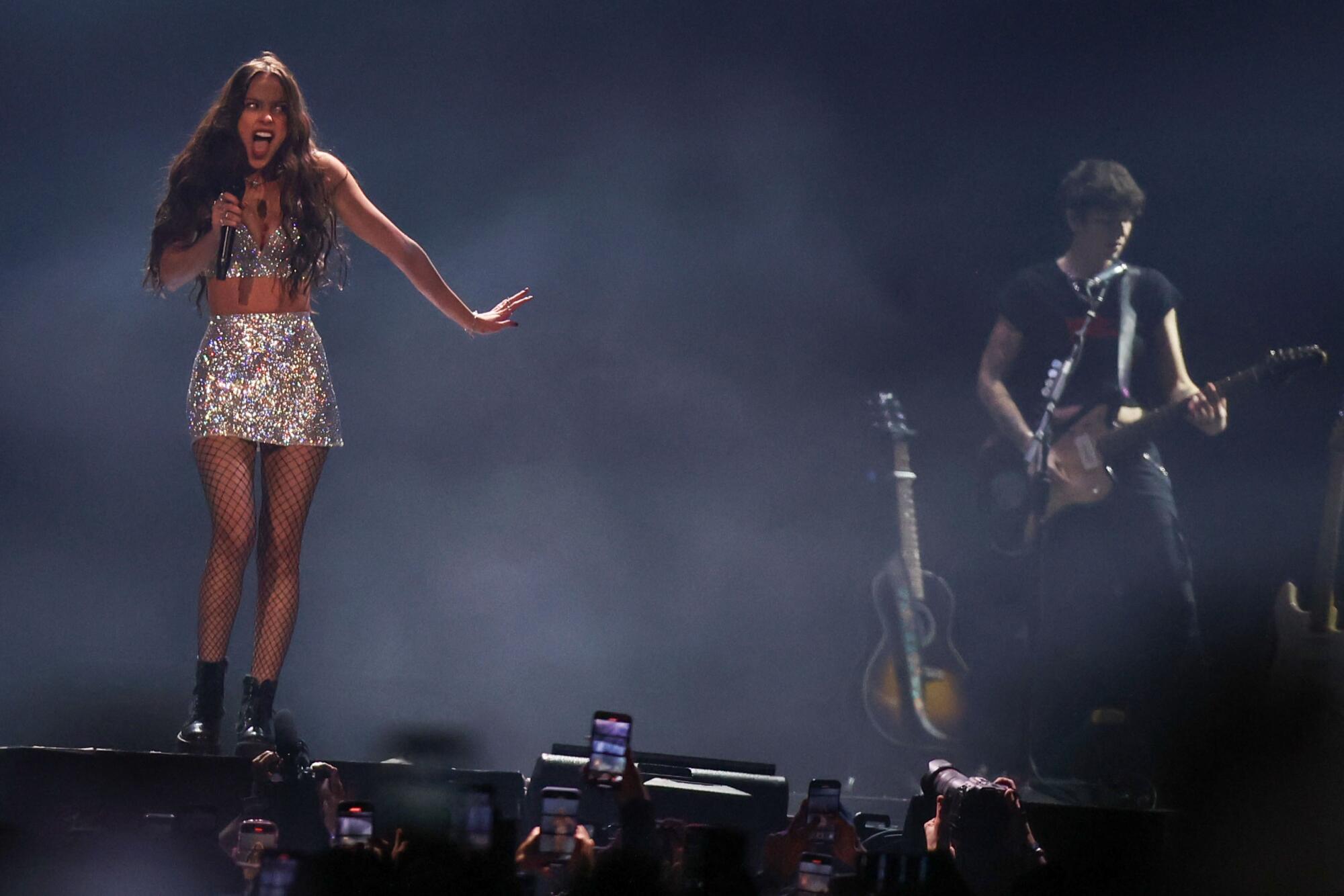
Rodrigo’s enduring virtue as a pop star is being a great fan first. The job requires commanding attention and devotion for yourself, but she’s never been shy about situating herself in the long arc of women who came before (and after) her, or just being moon-eyed to live inside her favorite songs with her heroes onstage. For her Daisy Chain Fields closing set, she dueted with generations of women that shaped her sense of what’s possible in music — Stevie Nicks for a gorgeous “Landslide,” and a surprise Alanis Morissette cameo for “Ironic” that felt like girl-gang karaoke night at its finest. She joined Lilith Fair founder Sarah McLachlan — a specific inspiration for this festival — for “Building a Mystery” and a deeply tender “Angel.” Even Rodrigo’s backing band, full of absolutely shredding women instrumentalists, played beside her on equal footing for exquisitely tasteful, post-punky revisions of songs across her three albums. The boys in the crowd got a brief chance to growl in the lead on “Expectations,” but here they were just allies — the headline act was Rodrigo’s talent framed as a gift received from other women, and given again to the young fans on the field. —AB
IRVINE — Olivia Rodrigo bridged generations Saturday night as the headlining act at her Daisy Chain Fields festival, where the 23-year-old pop star brought Stevie Nicks, Sarah McLachlan and Alanis Morissette to the stage for duets that demonstrated the enduring value of sharp, smart songwriting about women’s emotional lives.
Share via
With McLachlan, Rodrigo sang “Building a Mystery” and “Angel,” which the two dedicated to Dolly Parton, who died Tuesday at age 80; with Morissette (who filled in for a missing Karen O), Rodrigo did the former’s iconic mid-’90s hit “Ironic.” Later, Nicks came out to close the show with a duet of Fleetwood Mac’s “Landslide,” inspiring a mass singalong in the audience of approximately 45,000 at Great Park Live. After the song, Nicks stuck around to deliver an apparently extemporaneous tribute to Rodrigo’s artistry and activism that seemed to push the younger singer close to tears.
Irvine, CA – August 29, 2026: Olivia Rodrigo performs during Daisy Chain Fields at The Great Park on Saturday, Aug. 29, 2026 in Irvine, CA.
(Kayla Bartkowski/Los Angeles Times)
Held a few months after the release of Rodrigo’s third studio album, “You Seem Pretty Sad for a Girl So in Love,” Daisy Chain Fields offered 10 hours of music by all women acts, including Chappell Roan, Doechii, Bikini Kill, Garbage, Not for Radio, the Breeders and Mitski, among others. On Friday, Rodrigo announced that the festival would donate $10 million to an array of organizations working for women’s rights and reproductive justice.
The singer’s headlining set mixed new songs from “You Seem Pretty Sad” — one highlight was “Maggots for Brains,” a euphoric pop-punk jam about going crazy in a lover’s absence — with oldies from her first two LPs, 2021’s Grammy-winning “Sour” and 2023’s triple-platinum “Guts.” Rodrigo also debuted a just-released tune called “Serena Joy,” which she titled after a character in Margaret Atwood’s “The Handmaid’s Tale.”
THE new Ali G film is facing a cinema boycott as a major UK chain “have no plans” to show the sequel.
The movie mockumentary revivesSacha Baron Cohen‘s famous character after the original movie was unveiled 24 years ago.
A major cinema chain is refusing to show the new Ali G filmCredit: YouTubePicturehouse Cinemas have confirmed they ‘have no plans’ to screen the movieCredit: Alamy
The brand new film, Ali G: Who Iz I?, sees Sacha play the character once more in a ‘real-life’ setting.
But in a surprise move, Picturehouse Cinemas, which has 25 cinemas across the UK, will not show the upcoming film after its release in October.
Sign up for the Showbiz newsletter
Thank you!
Media watchdog NewsCord demanded cinemas to refuse to screen the film due to “satire using a cover for enforcing racist stereotypes”.
The platform claimed Baron Cohen had “enforced harmful stereotypes across marginalised communities through his characters”.
NewsCord demanded the film not be show due to ‘enforcing racist stereotypes’Credit: Sony PicturesThe sequel is set to be released in OctoberCredit: YouTube
So far they have sent around 27, 000 emails from supporters to cinemas nationwide to stress their concerns.
In a statement, Picturehouse confirmed to Metro: “We currently do not have any plans to screen this film on its release.”
NewsCord also claimed that the film’s studio Amazon MGM had “revived a racist caricature”.
She filmed the role alongside Sacha in secret over the course of a year and replaces EastEnders star Kellie Bright in the part.
In the movie, she will be revealed to be eight months pregnant – something that the characters struggle to get their head around.
In one of the clips from the film’s preview, they can be seen at a doctor’s office with Ali G begging the doctor to simply say that Julie is “bloated” and not actually pregnant – despite her visible baby bump.
He later puts her positive pregnancy test in his mouth and pretends to use it as a vape.
Elsewhere, the trailer sees Ali G poking fun at Ed Sheeran as he remarks on what the world has ‘survived’ since the original movie’s release in 2002 and insisted things had “turned to c**p”.
Speaking in the trailer, he said: “I’ve been gone for 20 years, chilling.
He continued: “I’m going to get back on top with a brand new thing called a ‘documentary.’
“For the first time ever, this is with real people not actors. For more than a year we let the cameras follow me everywhere.
“Nothing was off limits.”
The film is expected to be released in cinemas on October 23 with the movie being distributed by Amazon MGM.
The character was first introduced by Sacha on Channel 4‘s The 11 O’Clock Show in 1998 before the character became even more widely known for the 2000 sketch comedy series, Da Ali G Show.
Just after the U.S. Supreme Court overturned Roe vs. Wade in 2022, ending the nationwide right to legal abortion, Olivia Rodrigo walked onstage at the Glastonbury festival in the United Kingdom, sad and furious but also galvanized. “I’m heartbroken over what happened in America yesterday,” Rodrigo said onstage then. “I’m devastated and terrified that so many women and so many girls are going to die because of this.”
Four years later, Rodrigo has a new festival of her own this weekend, Daisy Chain Fields in Irvine’s Great Park, that’s entirely in service to those causes of women’s rights and reproductive autonomy.
“I remember being at Glastonbury that day with the most exciting opportunity to perform on that stage, but at the same time, being shaken to my core knowing that women’s rights were being stripped away,” Rodrigo told the Times via e-mail just before the festival. “I want people to walk away from here feeling hopeful and feeling like they can effect change. That was the entire thesis of this festival. I do think we can. We’ve seen it happen before, and we’re seeing some change now.”
Daisy Chain Fields is an ambitious escalation of Rodrigo’s activism in this sphere, which has paralleled her chart-topping success after debuting as a teenager with her LP “Sour” in 2021. The festival — with similarly-aligned acts including Chappell Roan, Doechii, Bikini Kill, Katseye and others — will be a globally-prominent cultural event, underlining the urgency for reproductive and women’s rights work amid the current right-wing backlash. It raises funds to benefit 10 like-minded advocacy groups, and intertwines her music career and women’s rights advocacy in ways few pop artists at her scale are attempting.
“We are ecstatic to have Olivia supporting our work, not only financially, but using her voice and reach to shine a light on these urgent issues,” said Nancy Northup, president and chief executive of the Center for Reproductive Rights, which challenged abortion bans in 11 states, and filed the first lawsuit on behalf of women denied abortions in 50 years. “Women are continuing to suffer under these bans, and that won’t stop until abortion is federally protected once again. Her support will help us continue filing lawsuits and advocating for laws that expand reproductive rights, both in the U.S. and globally.”
Olivia Rodrigo performs during the opening night of her Guts tour at Acrisure Arena on Feb. 23, 2024, in Palm Desert, Calif.
(Michael Blackshire / Los Angeles Times)
Rodrigo’s public work in activism began in earnest on the tour for “Guts” in February 2024. That tour coincided with the launch of Rodrigo’s Fund 4 Good, a nonprofit (under the fiscal sponsorship of the 501(c)(3) group Entertainment Industry Foundation) that steered $2.5 million in profits and donations from that tour to a range of global groups working in women’s rights, health and reproductive care. These included Jhpiego — a Johns Hopkins-affiliated global women’s health NGO — along with Women’s Shelters Canada, Women Against Violence Europe, and the Korea Foundation for Women.
“She did something. She could have played it safe, but she acknowledged that she has the power to make stuff happen, and she’s going to use it for good,” said Kathleen Hanna, founder of the legendarily activist punk group Bikini Kill, who will play Daisy Chain Fields on Saturday. While Hanna recalled feeling initially skeptical about the all-women Lilith Fair in the ’90s, she respects how Rodrigo learned about that fest’s communal, radical goals from a recent documentary, and sought to update it for her fans’ generation.
“What’s awesome about that is that it’s not that rare” for artists to be outspoken on these issues now, Hanna said. “Look at Megan Thee Stallion, Hayley Williams — all I see is women who are like ‘This is bull—.’ In a fascist era, we need to be meeting each other and opening friendship circles instead of isolating ourselves.”
Rodrigo’s advocacy hasn’t always gone smoothly. While on tour for “Guts” in 2024, Rodrigo brought abortion rights groups under the National Network of Abortion Funds to canvass at shows, and some groups handed out free condoms and emergency contraceptives to fans. Those efforts upset conservatives in states like Missouri, which had enacted a near-total abortion ban, and where state legislators sought to ban the morning-after pill. Fearing political backlash, Rodrigo’s management team at the time reportedly asked the groups to refrain from passing out contraceptives, but still encouraged them to canvass on-site.
“I don’t think demanding that women and girls be safe and have ownership over their own bodies is a radical idea,” Rodrigo said. “I was raised by parents who encouraged that belief in me.”
At Daisy Chain Fields, Rodrigo will likely face little resistance — but the show arrives in an ever more challenging time for women’s health and rights.
The return of President Trump to office has resulted in legislation like the One Big Beautiful Bill Act that slashed funding for healthcare; decimated funding for groups like USAID; and saw controversial, conspiracy-pushing figures like Health and Human Services Secretary Robert F. Kennedy Jr. brought into government. Crucial issues in women’s health risked being ignored or exacerbated.
“It is a fraught moment” said Angela Aina, co-founder and executive director of the Black Mamas Matter Alliance, one of the groups supported by Daisy Chain Fields. Aina said that American Black women die in childbirth at three times the rate for white women, and 87% of these deaths were preventable.
“What matters most to us is that the festival is showing people the organizations that are doing this work and pushing solutions,” Aina added. “Black maternal health has too often been treated as a niche concern, something discussed among public health professionals and then set aside.” But when these topics underpin a massive, sold-out festival of music with an audience of young women, it becomes “part of ordinary civic life,” she said.
These organizations said Rodrigo made a real effort to connect personally with their teams and more closely learn about their issues and strategies. Some, like the National Institute for Reproductive Health and Planned Parenthood, focus on reproductive justice. Baby2Baby supports mothers in poverty while Johns Hopkins Center for Indigenous Health focuses on Native and First Nations community healthcare; FreeFrom responds to the epidemic of gender-based violence, while the National Domestic Workers Alliance advocates for care workers, the vast majority of whom are women.
“It’s really extraordinary,” said National Domestic Workers Alliance President Ai-Jen Poo. “[She’s] making the time to come to meetings and learn about each organization directly from us, offering to think through different ways that she can lift up our work even beyond the festival.”
Part of NDWA’s mission is to change the cultural conversation around domestic labor — “We as a culture often refer to it as ‘help,’ as opposed to the profession that it is for millions of workers,” Poo said — an undertaking Poo said Rodrigo understands well.
“I think that she is a great storyteller herself through her music, and she knows that great storytelling is at the heart of what moves people and what creates change for people,” she said.
Olivia Rodrigo speaks at the beginning of the July 14, 2021, daily briefing at the White House in Washington, where she was filming a video to promote vaccines.
(Susan Walsh / Associated Press)
The National Women’s Law Center works across virtually every issue affecting women and girls in the United States. “One of the things I like to say is that our fingerprints are on the lives of women in this country in ways that they’re probably not even aware of,” said Uma Iyer, NWLC’s chief external affairs officer.
Iyer said that the “constant conversation” between law, policy and culture change is at the heart of the NWLC’s work, and Rodrigo’s advocacy keeps that conversation urgent.
“We’ve seen that in how #MeToo played out. That spawned litigation, but it was also a big global cultural moment,” Iyer said. “You’re talking about it at kitchen tables and movie theaters and on talk shows, and that discourse really matters when you’re trying to effect change.”
Each of the nonprofits will have a physical presence at the festival in Irvine’s Great Park. For their station, Poo said the NDWA will set up a space for visitors to learn about care work and pay tribute to the caregivers in their own lives through artwork, which will all knit together “in a big chain of care” by the festival’s end.
“We’re really excited about all the people who will come to our tent and have a conversation with us and stay involved in our movement long afterwards,” she said. “We feel like Daisy Chain is almost like a catalyst for really growing this movement for care in our country.”
Several organizers said the recognition and opportunities for connection that the festival brings are just as meaningful as whatever financial support it generates.
While the festival’s total donation pool is yet unclear, Rodrigo has said that all artists on the lineup are performing for free, though production and staffing costs for a fest this size will be substantial.
What money the nonprofit groups do receive will go right back into “continuing the work,” Iyer said. “The work of gender justice in whatever form it shows up for any of these 10 organizations is really the work of protecting our democracy.”
Money generated by Daisy Chain Fields will be “flexible dollars,” Iyer explained, usable for anything an organization needs to fill in the gaps. “Those are critical dollars for nonprofits to be able to survive and do the work,” she said. Beyond the impact for populations the organization serves, Iyer said the promise of Daisy Chain Fields has boosted morale among NWLC staff during an extremely difficult time in America.
“When you have this big festival with people you love to hear, who bring you joy and bring you comfort and peace and entertainment and laughs and love, and they’re all banding together because this one incredible person asked them to, because she believes it’s the right thing to do — it makes the work a little less hard.”
The work seems to be catching on. Roan, long outspoken on LGBTQ+ rights issues, will throw the Super Graphic Spectacular concert at the Shrine in Los Angeles on Oct. 21-22, benefiting trans youth through Roan’s Midwest Princess Project. Last year, Doechii told the audience at the GLAAD Media Awards in L.A. that as ”hard-won cultural change and rights for transgender people and the LGBTQ+ community have been threatened,” the superstar rapper was “disgusted” by the revanchism.
“Olivia’s involvement is such a gift, because she is reaching and educating young people who may feel checked out or hopeless on these issues,” Northup said. “Olivia is giving us a chance to meet young people where they’re at, and she’s approaching it with positivity. Her message is not about what we’ve lost, it’s about what we can accomplish if we channel our collective power as women and girls.”
Rodrigo just followed up her acclaimed LP “You Seem Pretty Sad for a Girl So in Love” with a new single, “Serena Joy,” titled after a character in Margaret Atwood’s “The Handmaid’s Tale” who complies with an oppressive theocracy.
“If they do it to them, they’re gonna do it to you,” Rodrigo sang, with a fury that brooks no room for despair.
“There’s a growing sentiment among young people and women that we have to create change, and hopefully people are inspired, whether it’s by engaging with some of our NPO partners or simply finding whatever way feels right to them,” Rodrigo said. “There is no doubt in my mind that protecting women and girls, and ensuring they have ownership over their own bodies, has to be a priority for all of us.”