The exterior of the hotel doesn’t betray the maze of the building which saw me go down stairs, up stairs and through courtyards to find my tucked away room.
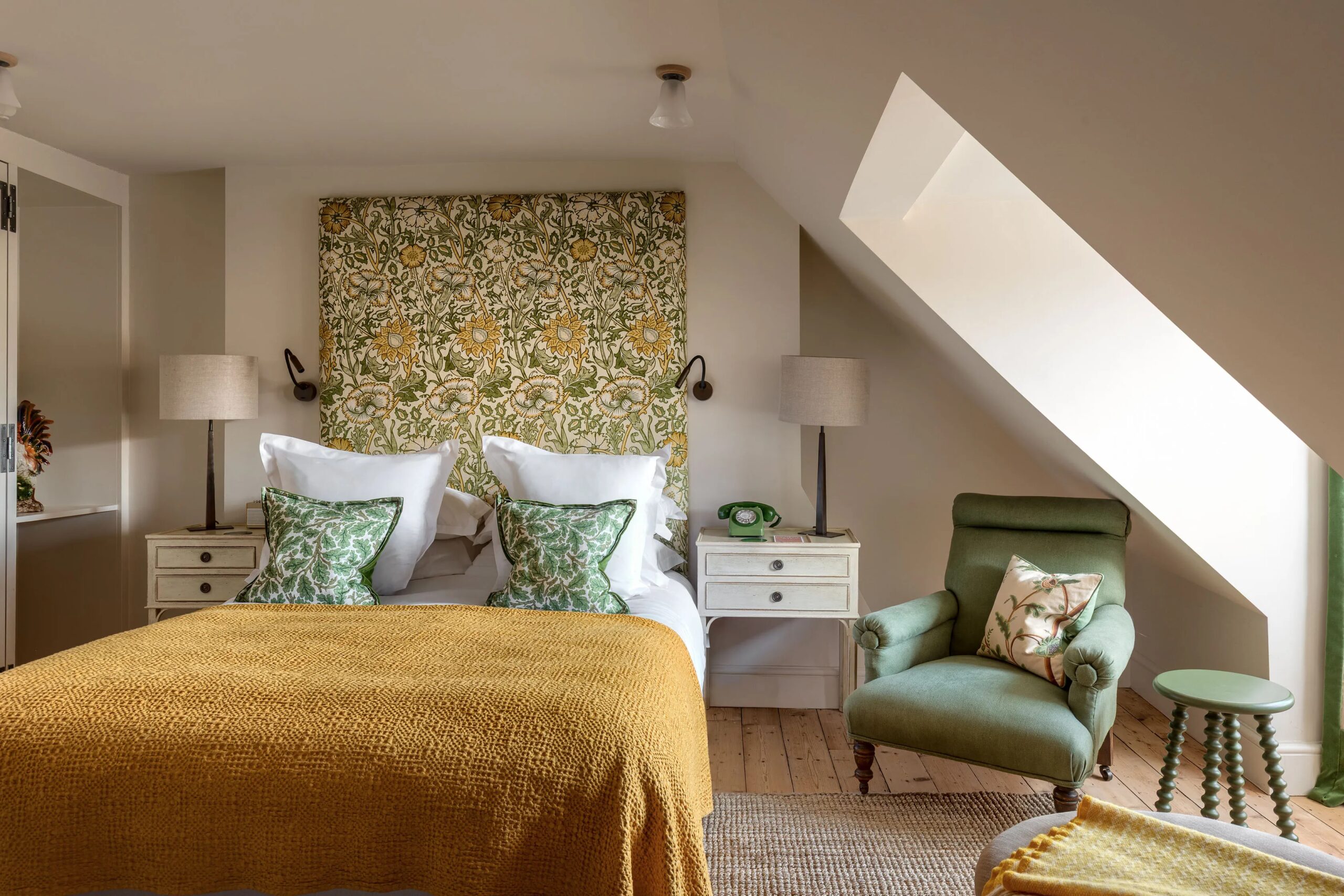
Bold pattern wallpapers and vintage furniture were offset by brushed brass lights and DAB radios.
My king-size bed was deliciously sink-into-able, while the lounge area was the best spot for a cup of tea and a biscuit, all complimentary.
The larger rooms – I was staying in their Junior Suite – have roll top baths, so you better believe I hopped straight in, making the most of the free Verbon toiletries.
It even has a tiny outdoor patio and table and chairs for you to have a coffee in the warmer months.
If you’re on a budget, opt for their Cosy Rooms which are more compact but just as gorgeous. Rooms start from £125 a night. See thegeorgeinrye.com.
The rooms are beautifully designed, with floral accents throughoutThe restaurant’s deep red walls made it a cosy place to spend an evening
What is there to eat and drink?
The restaurant is a must, even if you aren’t a guest at the hotel.
The Grill is the epitome of cosiness with deep red walls, low lighting and the perfect level of lo-do music.
And it has a delightfully concise menu – I hate having too many options.
My smoked salmon salsa to start was refreshingly zingy and fresh, and just light enough to line my stomach before devouring their rib eye steak.
My dessert was the star of the show, with super sweet macerated strawberries offset by kalamata ice cream and marshmallow.
If you want to swap the pudding for a cocktail, The Dragon Bar has a great menu which also includes wines and beers.
Try the drink of the season – a Sarti Spritz – or my favourite, the aptly named Dragon Mojito.
(Come back for breakfast too – my Mimosa and Hastings Kipper went down a treat).
Why not grab a drink in the lobby by the fire?Or try a cocktail or two at Dragon Bar
What else is there?
As tempting as it is to stay at the hotel, the town of Rye needs to be explored.
Grab a decadent hot chocolate from Knoops, before walking the cobbles paths of Mermaid Lane, which look straight out of a fairytale.
Beach days aren’t far away either, with Camber Sands beach just down the road too.
Is it family friendly?
The hotel has some rooms that are perfect for kids, with the Luxury Rooms and Junior Suites able to fit kids beds
Is it accessible?
There is an accessible room which can be accessed by the ground floor lift, which can also take you to the ballroom.
However being such an old building, there may be some issues with getting around the rest of the hotel.
Hong Kong listing reforms and surging deposits show regional markets funding Asia’s future.
This article appears in the October issue of Global Finance Magazine.
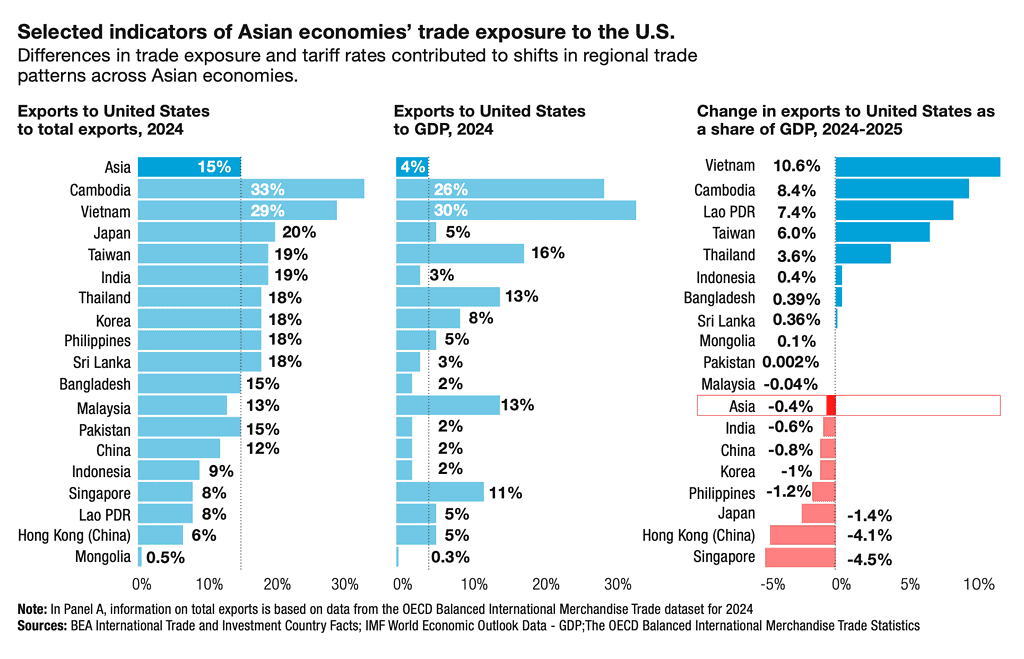
When the International Monetary Fund and World Bank convene their annual meetings in Bangkok this October, it will be the first time the joint gathering has returned to the city in 35 years. IMF officials have taken to calling Asia the “driving force” of the global economy — shorthand for a region that accounts for one-third of global gross domestic product, 29% of global public equity market capitalization, 56% of listed companies and 52% of global venture capital activity, according to the Organization for Economic Cooperation and Development’s Asia Capital Markets Report
The question for chief financial officers isn’t whether Asia is growing — it’s whether the region can finance that growth on its own terms, or whether it still depends on capital, listings, and liquidity from the West. The answer, based on bank data, exchange records, and conversations with practitioners and economists on the ground, turns out to be both.
Alex Ibrahim, until recently corporate CFO of Yanolja, the Seoul-headquartered travel technology company, said Asia is a picture of change. Its financial sector has matured in the decades since the 1960s to 1990s, when headlines proclaimed the rise of the Asian Tigers and countries became synonymous with rapid, export-driven industrialization funded largely from abroad.
“Back then, the economies were growing very fast, and a lot of the money was coming from the U.S. to invest,” said Ibrahim, who before joining Yanolja spent nearly a decade running international capital markets at the New York Stock Exchange. “If you look now, capital has developed locally and the financial infrastructure in Asia is much more robust.”
Marc Iyeki, a board advisor who formerly led the NYSE’s Asia-Pacific listing sector and shepherded about 100 companies to market, said the shift reflects a change in decision-making. “Decades ago, the money was in New York. Decisions were made in New York,” he said. Since then, regional private equity and venture firms have placed people on the ground in Asia who understand the home market and make the calls themselves, often after training at global firms and bringing that experience back. The region has also produced homegrown standouts such as PAG, Hillhouse Investment, MBK Partners, and Peak XV Partners.
That evolution is seen in how Asia’s own exchanges are performing. Over the past ten years, Hong Kong’s equity market has moved through cycles in liquidity and new issuance, but 2025 marked a rebound from the post-pandemic slowdown. Average daily turnover on the Hong Kong stock exchange rose from HK$66 billion in 2016 to HK$248 billion in 2025, nearly 3.7 times the level a decade earlier. Initial public offering proceeds were more volatile: HK$194 billion was raised in 2016, followed by several weak years before rebounding to HK$285 billion in 2025.
Japan’s exchange has risen more steadily. On the Tokyo Stock Exchange’s Prime Market, average daily trading value for domestic common stocks rose from 3.2 trillion yen in fiscal year 2022 to 4.3 trillion yen in fiscal year 2023, and 6.7 trillion yen in fiscal year 2025.
Iyeki recalled that when Alibaba first wanted to list in Hong Kong in 2013, the exchange turned it away over governance requirements — and New York landed the IPO. Losing a flagship company forced a reckoning. Some in Hong Kong worried that loosening listing rules would weaken protections for retail investors; others warned the market would be “hollowed out,” as local companies sought listings in New York and London. Hong Kong changed its rules, and years later Alibaba came back for a dual listing. The infrastructure now absorbing record IPO volumes and Alibaba-scale capital was built, in part, out of that earlier loss.
One of the people behind that financial infrastructure is Larry Li, a Hong Kong-based fintech founder who worked on Stock Connect, a market access program that links the stock markets of mainland China and Hong Kong. It has become a major cross-border equity trading tie between China and international investors. Its northbound turnover more than doubled to 345 billion yuan in the first half of 2026; southbound turnover hit a new high of $123 billion yuan. “It’s a closed loop, so capital cannot fly out of the system,” Li said.
Li, a director of Digital Asset Clearing Center, which aims to develop a financial settlement and clearing infrastructure that can integrate digital and tokenized assets into mainstream capital markets, argued that areas like Hong Kong, Singapore, and Shanghai have pockets of innovation in financial AI. Li said the region’s token economy “drives market infrastructure upgrades, attracts capital globally, and enjoys support from governments as a strategic force of growth.”
Fintech, Banking, and Innovation
Li pointed out that the region’s tokenized economy fosters “co-opetition” between the banking industry and fintech enterprises. Consumers across the region have largely turned to fintech-developed super apps like Alipay and WeChat Pay, while banks have doubled down on the regulated back end: cross-border settlement, know your customer, and other compliance rules.
Some of the same banks figuring out Asia’s patchwork of KYC and settlement rules are also among the world’s fastest-growing lenders. Banking data makes the same point in numbers. S&P Global Market Intelligence’s 2026 ranking of Asia-Pacific’s 50 largest lenders by assets found China’s big four — Industrial and Commercial Bank of China, Agricultural Bank of China, China Construction Bank, and Bank of China — grew assets about 16% year over year in US-dollar terms as of December 31, 2025. S&P also singled out Singapore’s three largest banks — DBS, Oversea-Chinese Banking Corp., and United Overseas Bank — for strong double-digit asset growth, driven by regional deposit inflows rather than capital raised abroad.
China’s financial system is bank-led and primarily state-directed, according to Standard & Poor’s. The country’s household savings, pensions, and corporate liquidity flow into banks rather than capital markets, giving lenders a large, stable funding base that the government then channels toward priority sectors. Beijing has supported that base with a 520 billion yuan capital injection into four state-owned banks in 2025, followed by plans announced in March 2026 to issue another 300 billion yuan in special bonds to recapitalize ICBC and Agricultural Bank of China.
“As the primary liquidity conduit for fiscal stimulus, state-owned banks increased their financial investments by 19% in 2025,” Iris Tan, a senior equity analyst at Morningstar, said in the S&P report. These financial investments were “fueled by a record 28% surge in government bond issuance,” according to Tan.
Vietnam as a Case Study
None of this means that Asia’s approximately 48 countries are growing equally. Sam Van, managing partner of SRO Partners and an advisor on Vietnamese capital markets, said the region is still layered by tier. Blue-chip regional companies can borrow cheaply from local banks at rates set by well-capitalized central banks — sometimes so cheaply, he said, that “it’s better to borrow money from the bank than actually issue a bond.” Midsize companies, those earning under $50 million in revenue, are a harder sell to credit officers weighing thin margins against career risk, which pushes some smaller businesses toward informal lenders. Van sees this gap as a reality in a still-maturing system rather than evidence that the system isn’t working.
Van, who recently co-authored a book that chronicles Vietnam’s economic rise, said the country illustrates how quickly a market can mature once the incentives align. Vietnam’s IMF-linked compliance upgrades — the product of what Van calls the government “consistently wanting to meet that standard” since joining the IMF in the 1990s — helped it earn an upgrade to FTSE Russell’s emerging-market status in September.
Critical Economic Views
Two economists watching from outside the deal room caution against overstating the region’s financial self-sufficiency. Bala Ramasamy, professor of economics at the China Europe International Business School in Shanghai, argued that “the driver in Asia, for Asia and by Asia is definitely China” — its outbound foreign direct investment to the Association of Southeast Asian Nations alone can match what comes from the EU or the US, and the reconfiguration of trade around geopolitical frictions is relocating supply chains in ways that are boosting growth across Southeast and South Asia. Japanese and Taiwanese capital, he noted, is increasingly heading toward the US to secure market access and stay aligned with Trump-era industrial policy, even as flows from Europe and the US slow elsewhere. “I don’t think Asia can do without it,” he said.
Prema-chandra Athukorala, emeritus professor of economics at the Australian National University, said Asia’s growth is substantial, but its export-driven economy still relies heavily on the rest of the world. Domestic savings rates across the region dwarf the emerging-market average of roughly 25% — Singapore’s is near 58%, China’s near 49.5%, India’s around 30% — and in most Asian economies, investment rates run below those savings rates, meaning the region is, on balance, a net exporter of capital rather than an importer of it. Intraregional FDI from China, Korea, Taiwan, and Singapore has grown substantially over the past two decades. However, Athukorala said that extra-regional FDI still accounts for the larger share of investment in Vietnam, Malaysia, Thailand, and Cambodia, where Western multinationals remain central to “China+1” supply-chain strategies, and even domestically financed activity depends heavily on global demand. “Over two-thirds of the regional exports are still destined to extra-regional markets,” he said.
Taken together, the practitioners and the professors describe a region that finances far more of its own growth than it used to, yet remains clearly reliant on the rest of the world.
Weld Royal is a contributing writer based in the U.S.
When it comes to scary movies, the motion picture academy has historically been a bit squeamish. Horror has been a cornerstone of the industry since the beginning, but Oscar voters have rarely embraced it. Only one horror film has ever won best picture: 1991’s “The Silence of the Lambs.” Even “Sinners,” which made history this year with a record 16 nominations, couldn’t close the deal.
Now, though, horror has gotten inside the house.
Opening Saturday and running through July 25, 2027, the Academy Museum of Motion Pictures’ new exhibition, “The Horror Show,” explores more than a century of horror, from silent-era landmarks “The Cabinet of Dr. Caligari” (1920) and “Nosferatu” (1922) through “Psycho” (1960) and “The Exorcist” (1973) to “Midsommar” (2019) and “Weapons” (2025). Drawn from the academy’s collection and 62 private lenders around the world, it brings together costumes, props, prosthetics, creatures and production art.
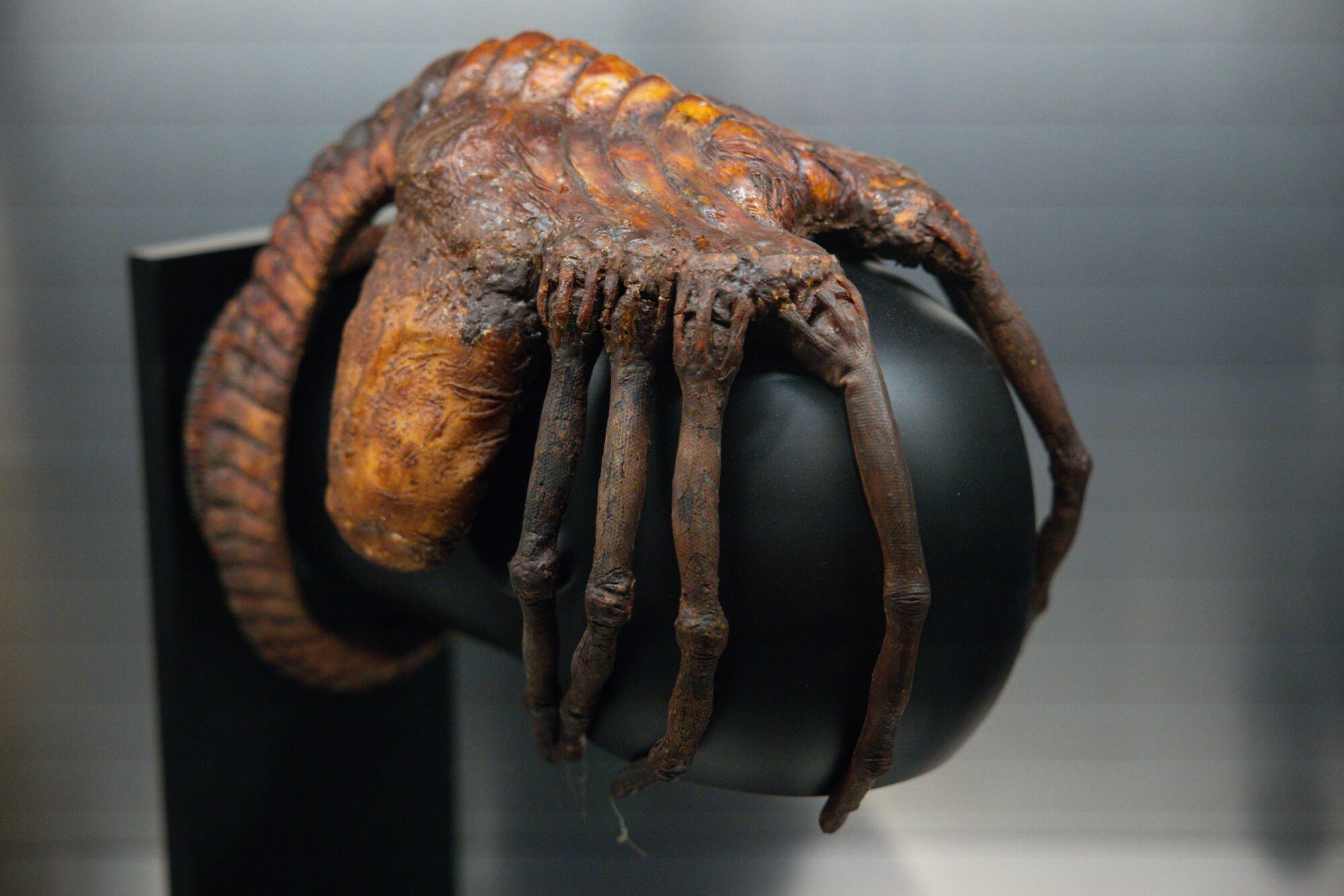
An original facehugger from Ridley Scott’s “Alien” (1979), part of the exhibition’s collection of creatures and production materials from the sci-fi series.
(Kayla Bartkowski / Los Angeles Times)
Introducing the exhibition at Thursday’s press preview, Robert Englund, who played the razor-fingered Freddy Krueger in the “Nightmare on Elm Street” films, recalled how the genre was once regarded in Hollywood. “Back when I started, we would sort of get the lousy table in the commissary by the kitchen door,” he said. Now, with the academy mounting an exhibition devoted to horror and the genre continuing to thrive at the box office, Englund added, “I think we’re getting some respect.”
Rather than a simple chronological tour through the genre’s history, the exhibition is organized into six themed “chambers” devoted to Gothic horror, psychological horror, science, slashers, religion and ghosts, with settings ranging from a shadowy crypt to a killer’s house and a haunted living room.
Storyboards from 1973’s “The Exorcist,” a clapperboard from 1976’s “The Omen” and the original Necronomicon from 1987’s “Evil Dead II” are among the artifacts in the exhibition’s religion-themed chamber.
(Kayla Bartkowski / Los Angeles Times)
Senior exhibitions curator Jessica Niebel says the idea was to walk a line between a traditional museum exhibition and a haunted-house experience.
“Horror films are about evoking an emotional response and we’re hoping the exhibition will do the same,” she says. “These are all original objects and they tell a story. We wanted to place them in an environment that brings them to life and activates them.” (The museum advises parental guidance; a smaller, family-friendly “Zombies!” exhibition is next door.)
So what’s lurking inside? Here are 10 sights worth braving. Read on, if you dare.
See Bela Lugosi’s original Dracula cape
Bela Lugosi’s original cape from 1931’s “Dracula,” on public display for the first time after undergoing an extensive restoration.
(Kayla Bartkowski / Los Angeles Times)
Nearly a century after Bela Lugosi first swept it around his shoulders, Dracula’s cape doesn’t need much introduction. Worn by Lugosi in Universal’s 1931 “Dracula,” the simple black cape became as inseparable from the character as his hypnotic stare and Hungarian accent, establishing the visual language of the screen vampire for generations to come. Lugosi, who had first played the Count onstage in 1927, kept the cape after filming and continued wearing it for stage and public appearances until his death in 1956. Now part of the Academy Museum’s collection, the nearly century-old garment underwent an extensive restoration before “The Horror Show.” Remarkably, this is the first time it has ever been put on public display.
Come face-to-face with Hannibal Lecter
Anthony Hopkins’ Hannibal Lecter costume and restraints from 1991’s “The Silence of the Lambs” are on display, including the serial killer’s unmistakable mask.
(Kayla Bartkowski / Los Angeles Times)
Anthony Hopkins’ Hannibal Lecter, the brilliant psychiatrist and cannibalistic serial killer at the center of Jonathan Demme’s “The Silence of the Lambs,” is unsettling enough standing perfectly still. When he has to be moved, the precautions are extreme. Hopkins wore this orange prison uniform, straitjacket and muzzle when Lecter is transported under heavy security, strapped upright to a hand truck. Costume designer Colleen Atwood devised the ensemble, while Ed Cubberly created the famous fiberglass muzzle, deliberately leaving it uncoated to evoke the look of dried, taut skin. Seeing the outfit up close is a reminder of just how little Hopkins needed to work with: Even with virtually his entire body immobilized and much of his face obscured, Lecter somehow became more frightening.
Trace the evolution of the Xenomorph
A towering Xenomorph created by Legacy Effects for 2024’s “Alien: Romulus” offers an up-close look at one of horror’s most enduring monsters.
(Kayla Bartkowski / Los Angeles Times)
Nearly half a century after Ridley Scott’s “Alien” introduced H.R. Giger’s nightmarish vision to moviegoers, the creature still looks like nothing else in science fiction. The exhibition brings together original Giger artwork depicting the alien egg and an original facehugger from the 1979 film, the spidery parasite whose method of reproduction helped make “Alien” a landmark of body horror. There’s also an original drawing by James Cameron, who took over the franchise with 1986’s “Aliens.” But the hardest thing to miss is a towering Xenomorph created by Legacy Effects for 2024’s “Alien: Romulus.” Up close, its elongated head, skeletal body and glistening double set of jaws reveal just how much unsettling detail goes into a creature often glimpsed onscreen in darkness.
See Dracula’s armor go from page to screen
Eiko Ishioka’s blood-red armor for Gary Oldman’s Count Dracula in Francis Ford Coppola’s 1992 “Bram Stoker’s Dracula.”
(Kayla Bartkowski / Los Angeles Times)
Before Gary Oldman’s Dracula became a pale, bewigged count, he was Vlad the Impaler, encased in one of the most striking costumes in Francis Ford Coppola’s 1992 “Bram Stoker’s Dracula.” Eiko Ishioka designed the blood-red battle armor with a ribbed surface evoking both exposed human musculature and an armadillo’s shell, while the pointed helmet foreshadows the wolf Dracula later becomes. Displayed alongside several of Ishioka’s original design drawings, the armor offers a fascinating look at how her ideas evolved from pencil on paper into something almost anatomical. Ishioka, a celebrated Japanese graphic designer making her first foray into Hollywood costume design, won an Oscar for her work on the film.
Log on to the original ‘Blair Witch’ website
Visitors can explore the groundbreaking viral promotional website for 1999’s “The Blair Witch Project,” which blurred the line between the film’s fictional story and reality.
(Kayla Bartkowski / Los Angeles Times)
Long before viral marketing had a name, 1999’s “The Blair Witch Project” was using the still-young internet to convince moviegoers that three student filmmakers might actually be missing in the woods. Directors Daniel Myrick and Eduardo Sánchez created the film’s promotional website in 1998, filling it with fake police reports, evidence photographs and an elaborate mythology while carefully avoiding any suggestion that their story was fictional. They posted on message boards and continually updated the site before the film’s release, helping turn a tiny found-footage horror movie into a grassroots phenomenon. Here, you can sit down at a chunky late-’90s computer and explore the original site yourself. Nearby is one of the movie’s crudely constructed stick figures — a reminder that sometimes a few twigs and some twine are all it takes to lodge an image permanently in the culture.
Meet the slashers
Costumes and props from some of horror’s most notorious killers fill the exhibition’s slasher chamber, including Candyman, Ghostface, Michael Myers, Freddy Krueger and Art the Clown.
(Kayla Bartkowski / Los Angeles Times)
Slasher movies have always depended on a memorable killer, and the genre has produced some of horror’s most instantly recognizable figures. Freddy Krueger, Michael Myers, Ghostface and Art the Clown are gathered here in full costume, looking less like museum pieces than a welcoming committee you’d rather not encounter. Nearby cases turn slasher movies’ grisly tools of the trade into artifacts, with masks and weapons from “Saw,” “Us,” “M3GAN,” “The Black Phone” and other films. It’s a reminder of how little a slasher movie really needs to get under your skin.
Open the Babadook’s book
The handmade “Mister Babadook” pop-up book created by illustrator Alex Juhasz for Jennifer Kent’s 2014 “The Babadook.”
(Kayla Bartkowski / Los Angeles Times)
Sometimes the scariest special effect is a pop-up book. In Jennifer Kent’s 2014 “The Babadook,” the sinister children’s book “Mister Babadook” heralds the arrival of the top-hatted creature that terrorizes a widowed mother and her young son, while giving physical form to the grief consuming them. Kent turned to illustrator Alex Juhasz to create the handmade book, drawing inspiration from the eerie silhouetted animation of German filmmaker Lotte Reiniger from the 1920s. Opened to one of its more elaborate spreads, the original prop is both beautifully crafted and deeply unsettling, its seemingly innocent children’s-book mechanics revealing a grinning black figure and the ominous command: “LET ME IN.”
Take a selfie with Norma Bates
A re-creation of the mummified Mrs. Bates from Alfred Hitchcock’s immortal “Psycho” gives visitors a chance to pose with Norman Bates’ dearly departed mother.
(Kayla Bartkowski / Los Angeles Times)
The Academy Museum wanted the original mummified Mrs. Bates head from Alfred Hitchcock’s “Psycho,” but there was one problem: She was too fragile to travel. The Cinémathèque Française, which owns the 1960 prop, declined the museum’s loan request. “I was really disappointed about that, but it’s totally understandable,” Niebel says. “We probably wouldn’t have lent her if she were in our collection.” So the museum commissioned Oscar-winning makeup artist and sculptor Mike Hill, fresh off his work on Guillermo del Toro’s “Frankenstein,” to research and create a full-body Mrs. Bates instead. Unlike the many delicate original artifacts elsewhere in the exhibition, this one was made to let visitors get close and take home their own slightly unsettling family portrait. Just don’t get too close. As a nearby sign warns, “Mother isn’t quite herself today — do not touch, she needs her space.”
Get grossed out by Monstro Elisasue
The spectacularly gross Monstro Elisasue bust, created by makeup and special-effects artist Pierre-Olivier Persin for Coralie Fargeat’s 2024 “The Substance.”
(Kayla Bartkowski / Los Angeles Times)
By the time Coralie Fargeat’s 2024 “The Substance” reaches its gloriously grotesque climax, Demi Moore’s Elisabeth Sparkle and Margaret Qualley’s Sue have effectively fused into the spectacularly deformed creature known as Monstro Elisasue. The exhibition puts designer Pierre-Olivier Persin’s bust of the creature alongside the syringes, vials and other medical paraphernalia from the mysterious Substance kit that sets the movie’s nightmare in motion. Fargeat has described body horror as a “weapon of expression” for confronting the pressures placed on women’s bodies, particularly as they age. As Fargeat puts it in the exhibition’s wall text, she wanted audiences to see that women’s “pearly smiles are made of so many horrendous things that we have to keep within ourselves.”
Make your escape through the Blood Room
The Blood Room, streaked and splattered with cinematic gore, provides the only way out of “The Horror Show.”
(Kayla Bartkowski / Los Angeles Times)
Fittingly, there is no clean getaway from “The Horror Show.” Every visitor must exit through the Blood Room, a gruesomely immersive space whose walls are streaked, smeared, splattered and practically dripping with the red stuff. To get the gore just right, Niebel turned to Oscar-winning special makeup effects artist Howard Berger, a veteran of such splatterific films as “Evil Dead II” and “Kill Bill.” Berger worked with the museum and its fabricators to create the room’s layers of fake blood, varying the colors and consistencies to suggest everything from dark, dried stains to fresh blood still running down the walls. Just when you think you’ve made it through, the exhibition has one last gruesome touch: To escape, you have to push your way through a set of bloody butcher curtains.
Kusal Mendis produces a captain’s innings at Headingley as he scores 121 off 100 balls to put Sri Lanka on course for a big score as they bat first against England in the second One Day International.
Born into an African American family with a grim history of enslavement, Marian Anderson was determined from an early age to master the art of singing for the concert hall. A contralto of great range and warmth, Anderson’s abundant gifts as a performer of spirituals, arias and German Leider brought her global fame even as she endured the indignities of racial discrimination at home. Her Easter Sunday performance at the Lincoln Memorial in 1939 in front of 75,000 spectators remains a touchstone of defiance in an age of racial violence.
Anthony Tommasini’s excellent biography of Anderson, “Voice of A Century,” reclaims the singer as a great artist who only embraced her power as a symbol of racial equality much later in life. I spoke with Tommasini about Anderson, Franz Schubert and Albert Einstein.
You’re reading Book Club
An exclusive look at what we’re reading, book club events and our latest author interviews.
By continuing, you agree to our Terms of Service, which include arbitration and a class action waiver. You agree that we and our third-party vendors may collect and use your information, including through cookies, pixels and similar technologies, for the purposes set forth in our Privacy Policy such as personalizing your experience and ads.
✍️ Author Chat
Anthony Tommasini’s biography reclaims Anderson as a great artist who embraced her power as a symbol of racial equality later in life.
(Ahna Tessler Photography)
I feel like people know Marian Anderson in the abstract, but they regard her as a symbol rather than an artist. And among the virtues of your book is that you reestablish Anderson’s legacy as a great singer and performer.
She was a contralto, which is the lowest female vocal register. But that register had such resonance, and she had complete control over it. She also had enormous range; the uncanny, beautiful thing about Anderson’s voice is that when she started ascending even into the soprano sphere, she held those notes so beautifully. They were emanating from below, grounded in that low voice. It made for a mesmerizing sound. I’ve made a playlist to accompany the book.
She embodied this kind of fierce dignity and grace in the face of racial discrimination. But as you point out, she was reluctant to make herself a symbol of the civil rights movement, preferring to let audiences focus on her artistry.
In 1939, she was banned from performing in Washington’s Constitution Hall because of her race, and her manager, with help from Eleanor Roosevelt, arranged a performance in front of the Lincoln Memorial on Easter Sunday. Yet, the night before the performance, she was trying to get out of it. She felt the whole affair had turned into a civil rights demonstration. When it came time to write her memoirs in 1956, she wanted to excise the event from the book. She felt that what she could do is be an example of excellence and possibility for aspiring black artists.
She did play to segregated audiences, even long after she had become a national star.
[This type of segregated performance featured what] was called vertical seating. But she refused to forsake her career, which she had worked so hard to attain, and so she played these segregated shows. Eventually, there was a performance in Virginia which was boycotted, and that sort of broke the trend. She then performed in front of an integrated audience in Florida.
There is an encounter with Albert Einstein, of all people, who counsels her to take a stand against these racist booking policies.
In 1937, she showed up for a concert in Princeton, New Jersey, only to discover she was being refused a room at the Nassau Inn. As it turns out, she had a friend in Princeton who had seen her at Carnegie Hall and had meekly gone backstage to meet her. This was Albert Einstein, who was teaching at Princeton University at the time, and who offered to put Anderson up for the night at his house. He really pressed her on being more outspoken on racial equality.
Anderson played Europe multiple times in the 1930s, right before the rise of Hitler and the Third Reich. As you write, German audiences were blown away by Anderson’s mastery of their music, specifically Franz Schubert’s Lieder, or art songs, which were among Anderson’s most beloved repertoire.
So extraordinary, right? She also made two tours of the Soviet Union during that time. They went crazy for her in the Scandinavian countries, as well. But for the German audiences who are so nationalistic about their Leider, it was confusing. They couldn’t imagine how a Black American woman could sing their music so beautifully.
Anderson was the first Black soloist to perform at the Metropolitan Opera in New York, in Verdi’s opera Un ballo in maschera.
That was really a huge risk and a huge leap for her. She wasn’t a trained opera singer, and she had to dig deep into that material. She was already 58 by that time. There is a radio recording of the performance. There’s this dignity, like she’s calling upon this power. It’s exhausting and it’s draining, but it’s also exhilarating.
This Q&A was edited for length and clarity.
📰 The Week(s) in Books
Book jacket for “Body Language” by Meg Howrey
(Los Angeles Times illustration; jacket from Doubleday)
Marlon James has published his highly anticipated new novel “The Disappearers,” a sprawling story about gay culture in ’80s Jamaica, and Mark Athitakis is quite taken with it. “James is … determined to unwind the cliches of gay fiction: the tragic victim, the heartwarming gestures of solidarity, the blunt porniness,” he writes. “Mere survival will have to be enough for most of these characters; the sense of fear is pervasive, but so is a determination to work through it.”
What’s it like to be the primary dissenting liberal voice on Fox News? Stephen Battaglio found out when he talked to Jesssica Tarlov about her hybrid memoir and self-help book “I Disagree.” “I have a good amount of shyness to me,” she tells Battaglio. “I have a lot of imposter syndrome. I’m constantly in wonder that I ended up getting to do this and that hopefully, am the right person to do it.”
Finally, Emily Wilson, the classicist who has been a lightning rod of controversy over her disparaging remarks in regard to the film version of “The Odyssey,” is going to translate Homer’s epic for a second time, reports Emily St. Martin.
📖 Bookstore Faves
The Hammer Museum’s gift shop is one of the best art book shops in L.A.
(Eric Petschek)
Sure, the Hammer Museum’s gift shop stocks the requisite art-themed mugs, tea towels and tchotchkes, but it’s also one of the best art book shops in L.A. Inside the sleekly designed Hammer Store is a vast inventory of monographs, children’s books and critical texts about modern and contemporary art. In an email exchange, store managers Sara Beattie and Brooke Berlin tell us what museumgoers are buying right now.
Hammer’s store is really the best museum bookshop in L.A. How do you decide what to put on the shelves?
We’re an eclectic bunch of book nerds and love the written word. We start by looking at upcoming programming, exhibitions and the season, and we buy accordingly. And we have a great team that gives us suggestions. We’ve learned to trust our instincts. The Hammer is an experimental institution, and we approach our buying in that spirit.
Do you have patrons that are not necessarily there to check out museum exhibits?
Of course! We’re not only a museum, but a cultural center, which means there’s always something happening — like mindful meditation on Thursdays, or family programming on weekends, or people coming in just to enjoy a meal at Lulu.
What kinds of books tend to do well for you?
Art monographs, especially on contemporary or Los Angeles artists; books about living more conscientiously; and everyone loves a children’s book (even if it’s just to heal your inner child). We love finding unique books that can’t be found elsewhere. Whenever we can, we work with small presses and book distributors. They often make books that can only fully be enjoyed or understood by seeing them in person.
Is there any particular title that is presently selling well?
Why do we still enjoy art books, when we can look at millions of paintings and sculptures on the internet?
Why go outside if you can look through a window? There is a lot of talk of people returning to the analog or physical media, and that includes renewed interest in physical books. BookTok is huge. People love talking about books and showing off their special deluxe book editions on TikTok. Art books by their very nature are deluxe, image filled and thoughtfully designed. A well-produced book is an art object in itself. Nothing beats the experience of paging through a beautiful book. That experience can’t be replicated on a screen.
The Hammer Museum store is located at 10899 Wilshire Blvd., Los Angeles.
Leopardus tilcayo is the first new living cat species named and described in more than a century.
Published On 18 Sep 202618 Sep 2026
A tiny wild cat that lives in Bolivia’s lush cloud forests has been identified as a previously unknown species, marking the first time in more than a century that a new living feline species has been formally named and described.
Called “tilcayo” by local communities, the cat is part of a group called tiger cats, which are found across much of South America.
Recommended Stories
list of 2 itemsend of list
It was discovered in the Yungas forest, a mountainous region where forests are often covered by clouds and surrounded by high humidity, according to the researchers.
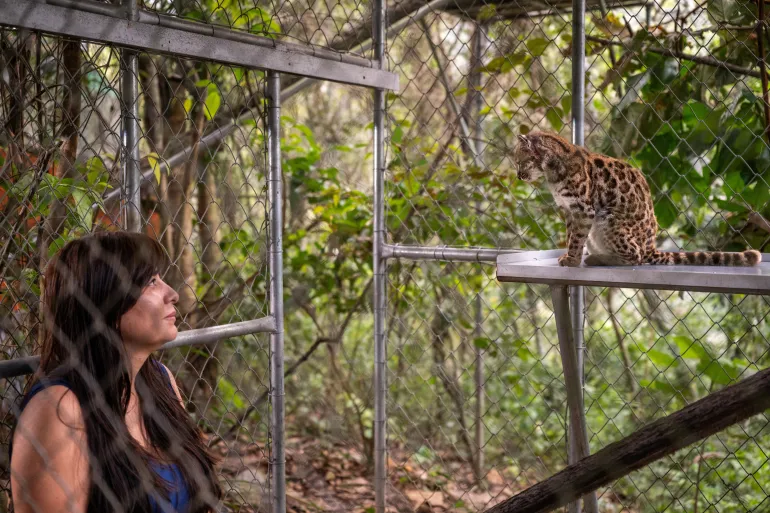
Given the scientific name Leopardus tilcayo, the cat measures 46cm (18 inches) long and weighs about 1.4kg (3 pounds), making it smaller than an average domestic cat.
“Its fur is light brown … with irregularly shaped rosettes across its body,” according to Paola Nogales-Ascarrunz, a National Geographic Explorer and one of the authors of the study describing the newly identified species published on Thursday in the journal Current Biology.
Little is known about the cat’s biology and lifestyle. Remains of small rodents in scat samples suggest they may form part of its diet, while camera-trap evidence indicates it could be more active at night, Nogales-Ascarrunz said.
Tiger cats are so-called cryptic species, meaning they cannot easily be distinguished merely by appearance, evolutionary biologist and study co-lead author Jonas Lescroart of the University of Antwerp in Belgium said.
National Geographic Explorer Paola Nogales Ascarrunz, who led the research that identified Leopardus tilcayo as a new species, observes the cat at the Senda Verde animal refuge in the Yungas region, in Bolivia, September 1, 2026 [Handout/Fernando Faciole/Reuters]
Observing the Bolivian cat drew interest because “its characteristics did not match the descriptions, most of them based on Brazilian cats”, Nogales-Ascarrunz said. “This made us wonder, what tiger cat do we actually have in Bolivia?”
The team analysed DNA from 38 cats sampled across several South American countries, including eight museum specimens. The study found that tiger cats are in fact five genetically distinct species.
“We never expected this Bolivian tiger cat to be a separate species, and no one had ever proposed it as a different animal, subspecies or otherwise,” Jonas Lescroart said.
Genetic analysis suggested that the tilcayo lineage separated from other tiger cats about 1.4 million years ago.
The research team also described a new tiger cat subspecies in Peru’s Yungas, naming it Leopardus tigrinus antisuyo, after Antisuyu, the region of the old Inca Empire that included the area it inhabits.








![National Geographic Explorer Paola Nogales Ascarrunz, who led the research that identified Leopardus tilcayo as a new species, observes the cat at the Senda Verde animal refuge in the Yungas region, in Bolivia, September 1, 2026 [Fernando Faciole/Handout via Reuters]](https://i0.wp.com/occasionaldigest.com/wp-content/uploads/2026/09/2026-09-17T154150Z_381273466_RC2N9NAU7NUJ_RTRMADP_3_SCIENCE-CAT-1789702964.jpg?w=640&ssl=1)