centres

Inside the heated debate over Scotland’s data centres

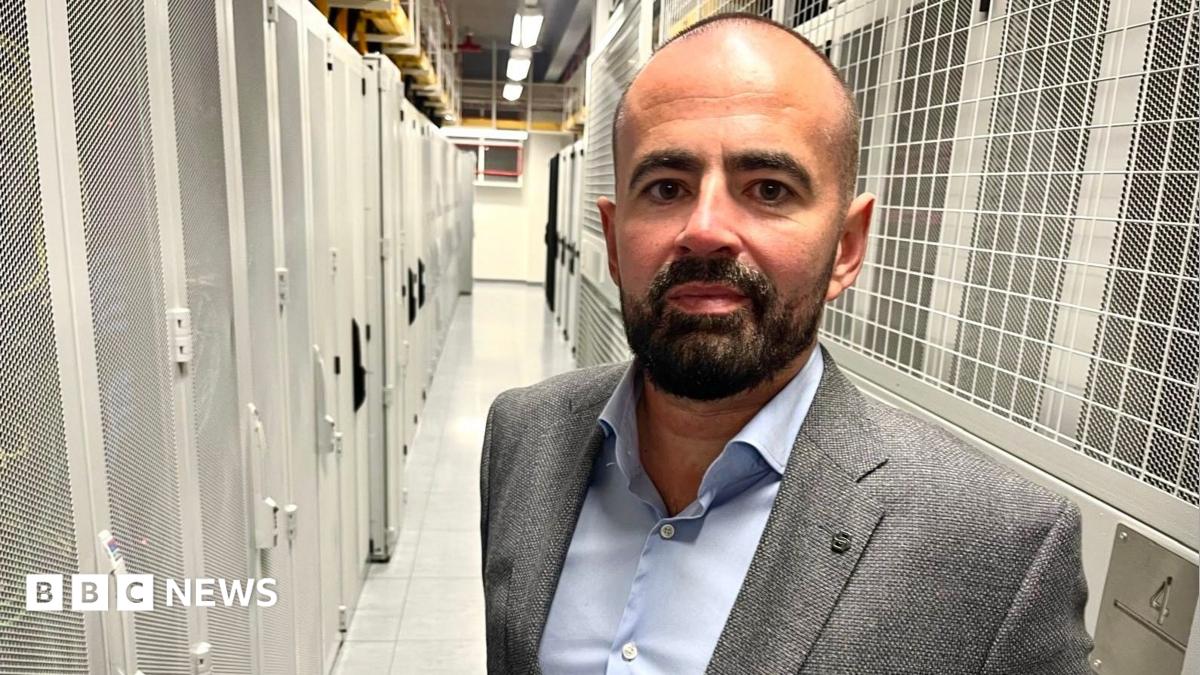
He says DataVita hires and pays taxes and rates in Scotland and that any benefits stay within the country.

There are more than 20 planning applications for AI data centres in Scotland.

Quinn says some of those are “speculative applications” in places that have caused people “genuine concern.”

He refuses to be drawn on how many data centres might be spread across Scotland within the next 10 years.

“Anyone stargazing into the future about AI is a very brave person, and ultimately what we need to ensure is that Scotland has the right type of technology to support an evolving technology,” he says.

The Scottish government is promising new planning guidelines for data centres before the end of the year.

Opponents say Scotland cannot cope, doesn’t need, and won’t benefit from, large hyperscale sites.

Those who want to build them say this an opportunity the country cannot afford to miss.

Source link

Trump defends Putin relationship, warns AI data centres must stay in US | Donald Trump News

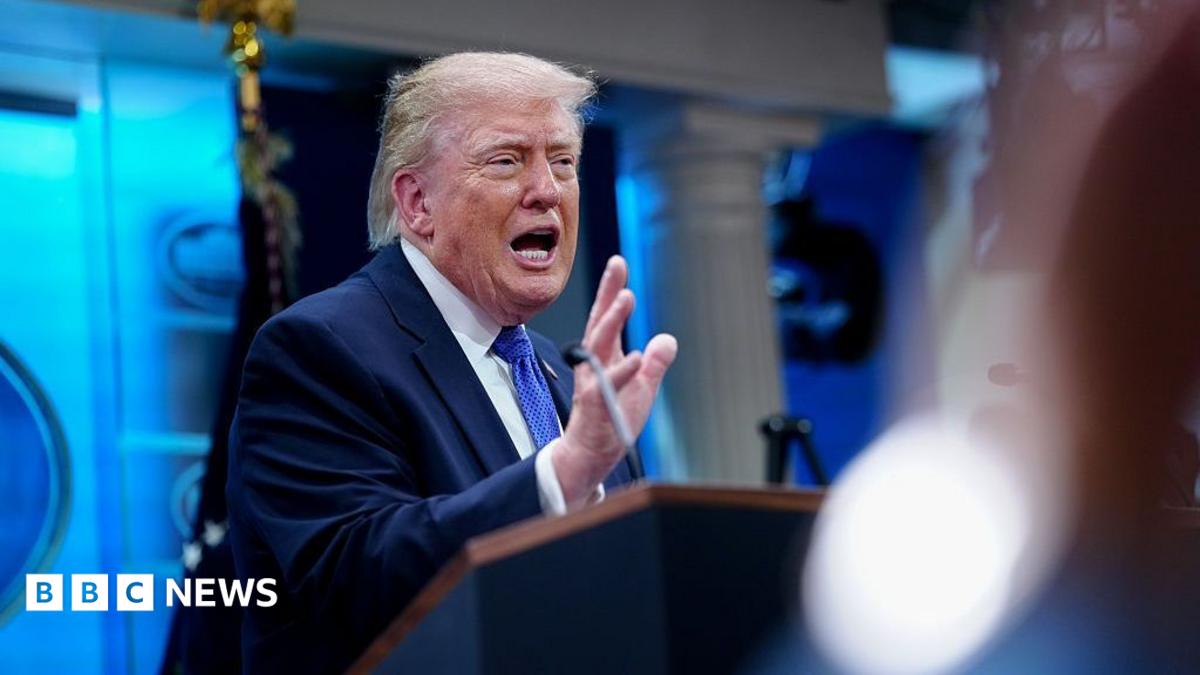
United States President Donald Trump has praised his recent trip to China and defended the relationship with his “friend” Vladimir Putin, but questioned whether the Russian president was a friend to the US.

On Friday, during a White House news briefing, Trump was asked about the “friend” remark — made during his historic summit with Putin and Chinese President Xi Jinping earlier this week — and whether the Russian leader was a friend to the US.

Recommended Stories

list of 3 itemsend of list

“I can’t speak to America,” Trump told reporters before saying Putin had been “very nice” during what he described as the “Russia hoax” investigation after his 2016 presidential campaign.

“I consider him to be somebody that I have a very good relationship. And it’s actually very good,” Trump added as he talked about Russia’s nuclear weapons capabilities.

“I think it gives us a lot of additional strength,” he said.

Trump also spoke about the historic nature of his meeting with Xi and Putin, praising the “first of its kind trilateral peace agreement”.

“We had one of the most momentous international summits in many years. That was the first ever trilateral meeting between the leaders of the United States, Russia and China,” Trump said.

No major deals were announced from the summit. But Trump, on Friday, played up his agreement with the two leaders to hold future discussions on nuclear proliferation.

The US president’s remarks came during a wide-ranging news conference, where topics from Iran to artificial intelligence were also discussed.

Trump accused Iran of negotiating in bad faith to end the war, which is about to mark its 10-month anniversary.

“They want to make a deal, but they don’t want to make a deal that’s acceptable to me,” he said. “We wanna make a real deal, not a fake deal.”

Trump added: “They’ve been b*********** people for 51 years.”

During the news conference, US Vice President JD Vance and US Secretary of State Marco Rubio, both possible 2028 presidential contenders, flanked Trump in the White House press briefing room.

US Treasury Secretary Scott Bessent and US Defence Secretary Hegseth, as well as newly minted White House chief of staff Stephen Miller, were also present.

Trump denied he was upset at Vance for blaming US Republicans’ historic midterm losses on the Iran war, saying, “People that work for me, they have a right to their opinion.”

“I thought his statement was fine, except I would have had one other thing that, if we were asked, I would have said that, would you do it again, and absolutely the answer is yes,” Trump said. “I saw that, but no problem there at all.”

No data centres abroad

Vance was asked by reporters about his thoughts on his party’s midterm drubbing.

“I think the president is the one who makes the decision. And the president has said he would do it again,” Vance said. “My goal, in my job, is to support the President of the United States.”

Trump also warned US tech companies against building new artificial intelligence data centres overseas. Otherwise, he said, they will face a “tremendous tax”.

“We’re not allowing data centres to go into other countries because China will take all of them”, Trump said. “And we’re going to put tremendous penalties on companies that try and do it.”

Trump did not provide details on how he would enforce such a policy and said he had not yet told his own officials about his plan.

Al Jazeera has reached out to the White House for comment but has not yet heard back.

Source link

Trump threatens tax on US tech firms building AI data centres abroad | Donald Trump

US President Donald Trump warned that US tech companies will face “a tremendous tax” if they build AI data centres in other countries. He urged Americans to welcome data centre construction in their communities and while demanding concessions from developers.

Source link

Trump threatens ban on US firms building AI data centres overseas

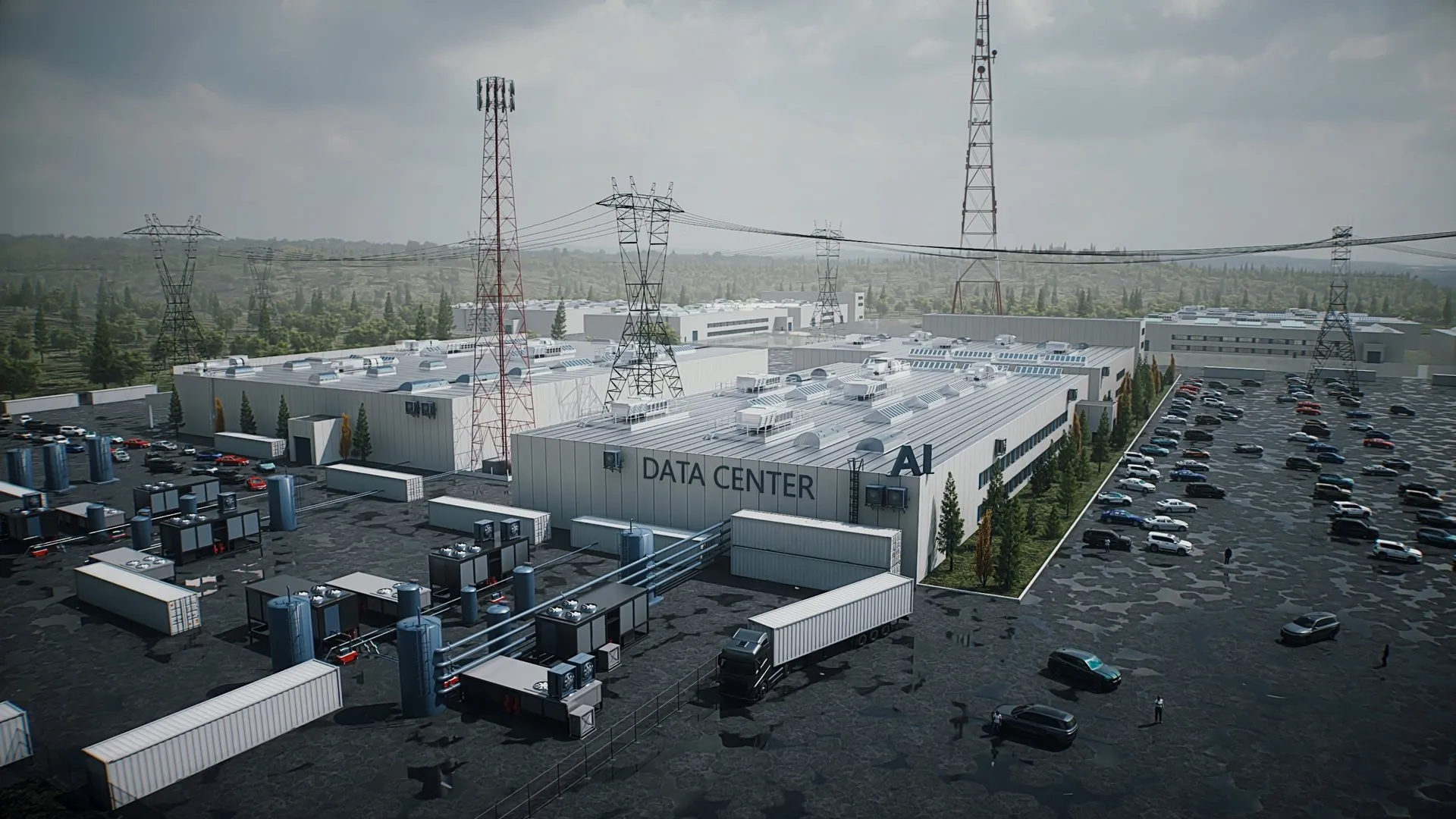
Data centres are crucial to the AI boom. The vast warehouse-style buildings house the advanced computer chips and servers that are needed to run AI programmes such as Claude and ChatGPT.

As of April there were about 3,000 data centres across the US, with another 1,500 in various stages of approval and construction, according to the Pew Research Centre.

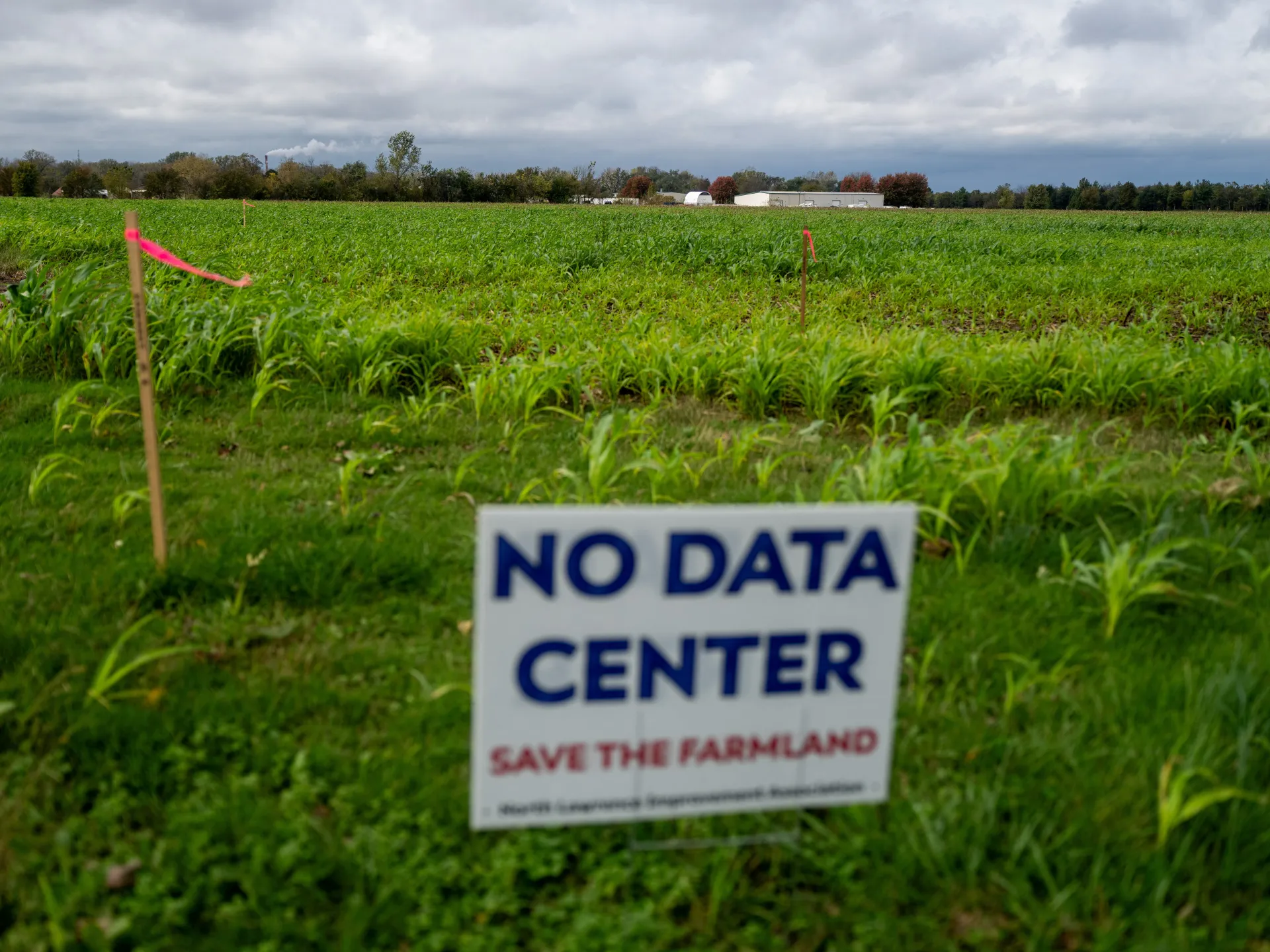
Many of them are built in rural areas, and concerns about issues including noise pollution and energy consumption helped drive Democratic candidates promising tougher rules on data centre construction to wins on 3 November.

“You ought to take advantage of the data centres. Make them pay you, make them pay your community, but take advantage don’t shut them off,” Trump said.

“We have a lot of places that want them badly, and they’re great places. They have energy and they have everything. They’re tremendous assets.”

Large tech firms – often called AI hyperscalers due to the size of their investments in AI – have also been branching out, and Canada has made moves to step in to offer itself as an alternative location for these sites, with less local pushback against projects so far.

Meta has already broken ground on a data centre, external in the province of Alberta, and Anthropic has signed a long-term agreement to lease a proposed data centre in Nova Scotia.

The BBC has reached out to Meta for comment on Trump’s remarks.

In September Google announced a €13bn ($15bn: £11bn) investment in AI infrastructure in Finland, which included funding for three data centres.

Last month, building work for two of those centres was halted due to concerns over the clearance of more than 300 hectares of forest.

Trump called out the build in Finland specifically, saying his administration was “not allowing that to happen”.

Google has been contacted for comment.

Source link

Meta rethinks 2030 climate goals as AI data centres drive emissions up | Environment News

Rising data center energy needs force Meta to adjust its sustainability targets amid growing corporate climate retreat.

Meta, the owner of Facebook and Instagram, has said it is reconsidering its 2030 deadline for reaching net-zero emissions because of the artificial intelligence (AI) boom, in the latest sign of a broad corporate retreat from climate pledges.

The company is “re-evaluating our timelines, sequencing and interim milestones, including the 2030 timeframe for our net zero emissions goal”, Rachel Peterson, Meta’s vice president of data centres, and Blair Swedeen, its global head of net zero and sustainability, said in the company’s annual sustainability report on Thursday.

Recommended Stories

list of 3 itemsend of list

Meta reported that its net carbon-equivalent emissions rose 45 percent in 2025 to 11.8 million tonnes, a figure that is itself based on accounting methods that climate advocates view with scepticism.

“When we set our net zero emissions goal, we anticipated steady growth, falling clean energy costs, and changes in the broader system that would enable progress at the pace we envisioned. The reality has been far more complex,” the executives wrote in the report. They said delivering on Meta’s vision “requires building the infrastructure that powers AI”.

What was the pledge?

In 2020, Meta set a goal of net-zero emissions across its entire value chain by 2030, in line with the Paris Agreement, which aims to hold long-term warming to 1.5C (2.7F) above pre-industrial levels.

Net zero means eliminating emissions as far as possible and buying credits from carbon removal projects to offset those that cannot be eliminated. The value chain covers emissions from sources such as purchased goods and services, as well as capital goods such as equipment, buildings and vehicles.

A study published this week in the journal Nature Sustainability found that 403 of the most powerful data centres in the United States accounted for about 2 percent of the country’s electricity use and a carbon footprint comparable to Denmark’s, the AFP news agency reported.

About 1,200 such “hyperscale” data centres are online, and hundreds more are planned. Globally, data centres used about 415 terawatt hours of electricity in 2024, about 1.5 percent of supply, and that could nearly double by 2030, according to the International Energy Agency.

A wider retreat

During US President Donald Trump’s second term, major American businesses have stepped back from environmental commitments.

The trend is not confined to Big Tech. General Motors, which set a goal of selling only zero-emission vehicles by 2035, backed the Trump administration’s weakening of a fuel economy rule this year.

Walmart acknowledged in 2024 that it would miss its first emissions target. Google, which pledged in 2020 to run on carbon-free energy by 2030, said this year that its emissions were still rising.

Coca-Cola and Pepsi have changed the baseline years for their emissions targets and weakened their ambitions.

Source link

How data centres are turning AI-generated heat into energy | News

Data centres around the world pump out extraordinary amounts of heat every day. But what if that wasted heat could power our homes and industry?

Al Jazeera’s Nick Clare explores how a new initiative is trying to make AI’s growth more sustainable.

Source link

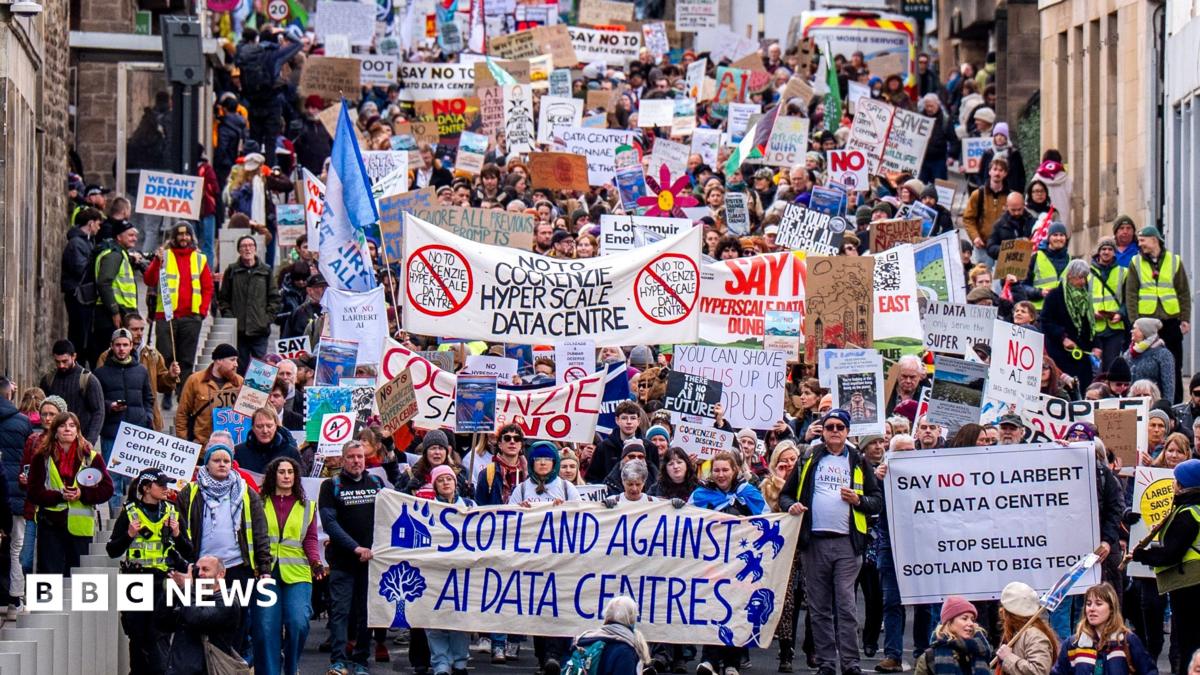
Thousands turn out in Edinburgh to protest against AI data centres

Innovation Minister Alyn Smith recently said data centres were “the whisky bonds of the AI sector”.

However protesters made it clear they disagree – carrying slogans such as “AI data centres threaten humanity” and “AI data centres: costing the Earth”.

Some attended to voice their opposition to plans for data centres in particular communities – including Cockenzie, East Lothian, and Larbert, Falkirk.

Kim Cairns, a campaigner for ‘Say No To Chapelcross AI Data Centre’, told BBC Scotland News her community was worried about noise, road closures and access problems during the construction phase.

She was also concerned about the noise the centre would generate when it was operational.

Kim said: “It’s not going to enrich anybody’s lives. For Chapelcross it’s the sheer size of it, the amount of electricity it’s going to need.

“At the moment it’s green fields with sheep and cows in it. It’s going to be a monstrosity on the environment.

“The air pollution, the light pollution – it’s just not needed.”

Source link

How the US midterm elections reflected resistance to data centres | US Midterm Elections 2026 News

In September, a poll found that 70 percent of Democrats and 57 percent of Republicans supported limiting the construction of new data centres in the United States.

But that opposition was tested in Tuesday’s midterm election, with analysts examining key races to see if the public backlash would translate into votes.

Recommended Stories

list of 3 itemsend of list

It did. There were 41 ballot measures related to data centres in Tuesday’s midterms, spread across the country.

According to Data Centers on the Ballot, an election-monitoring project run by Redbud Consulting, voters are on track to reject data centre development in all but one of the contests.

Two of the races continue to be counted but are expected to result in majorities to reject or limit data centres.

Only Harwood, North Dakota, a small town with a population of fewer than 800 people, voted to oppose such limits. The measure it defeated would have required independent reviews of large industrial projects like data centres before they could be built in the area.

Experts say Tuesday’s midterm elections indicate that the debate around data centres has become a bipartisan issue, intertwined with cost-of-living concerns and fears over job stability.

A construction boom

As of April, the Pew Research Center estimated that there were already 3,000 data centres in the country, with more than 1,500 others in progress.

The construction boom has been driven in large part by the growth in the artificial intelligence (AI) sector. That industry, experts say, has fed concerns about a shifting economic landscape.

“The unchecked acceleration of AI development has been causing concern across the board,” Bhaskar Chakravorti, the dean of global business at Tufts University, told Al Jazeera.

“People worry about their jobs and what it might mean from a broader economic perspective. But closer to home, people could see the physical manifestations of AI in data centres being built in their back yards, or they were hearing about it from others.”

Not only are voters afraid that AI might replace human work, but they also fear the downstream costs of data centres, according to Chakravorti.

Data centres consume large amounts of water and energy, which critics say can drive up electricity costs for nearby communities.

“Whether higher energy costs were driven by broader factors, such as the Iran war or tariffs, AI competing for space on the electricity grid was certainly part of its unpopularity,” Chakravorti said.

Voters, he added, were seeing the results “in their energy bills”.

A 2026 working paper from the Federal Reserve Bank of Dallas estimated that, as of last year, wholesale electricity prices had risen by 6.9 percent as a result of data centres.

James Mercer, founder of Metro Colo Advisory, an independent data centre advisory firm, told Al Jazeera that those anticipated costs mobilised voters in many areas.

“What they push back on is a building down the road that needs as much power as a small city, when they suspect their own electric bill will cover it,” Mercer said.

“That’s why local resistance has grown so fast: counties pausing new projects, zoning fights and data centres turning into a ballot issue.”

An election-season talking point

That popular resistance led several candidates in high-profile races to make AI and data-centre development central to their campaigns.

Among them is Democrat Sherrod Brown, who flipped a key Senate seat in Ohio, the state that accounted for the largest share of data-centre ballot initiatives this year.

Some 21 votes were taken on data centres in the state, out of a total of 47 referendums and measures that took place across the country in 2026.

Brown, a former senator, made Republican incumbent Jon Husted’s support for data-centre development a key point of attack.

“One guy has led the charge on these. That guy’s responsible, and that’s Jon Husted,” Brown told NBC News earlier this year.

In Texas, meanwhile, Democrat Gina Hinojosa called for a moratorium on new data-centre approvals until stronger protections for local communities were put in place.

Though her position worried tech investors keen on expansion in the Lone Star State, Hinojosa ultimately defeated incumbent Greg Abbott in the governor’s race.

“While Abbott had a moratorium on data centres in Texas currently, the overriding view is this would end once he got re-elected,” Dan Ives, managing director at the bank Yorkville Ives, said in an analyst note.

“Hinojosa is a known anti-data center politician and negative on the AI buildout, which makes worries around the future of the data center buildout in Texas a real issue for tech investors.”

Another successful Democratic candidate, Senator-elect James Talarico, also flipped a Republican-held seat with a pledge to increase data centre regulation.

Texas has been at the centre of growing concerns over the water demands of AI infrastructure.

The city of Corpus Christi, for example, has faced severe drought conditions, with its reservoir falling to just 8 percent of its total capacity earlier this year.

The city has been described as at risk of running out of drinking water. Talarico proposed adopting closed-loop water systems to reduce data centre consumption. He also advocated for data centre operators to fund local infrastructure improvements.

He won Corpus Christi by a 12-percentage-point margin.

In another key Senate race, Democrat Abdul El-Sayed called for the creation of a federal agency to oversee the AI industry. He bested his Republican opponent with more than 52 percent of the vote.

Looming pressures

With Democrats poised to control both chambers of Congress, the AI industry is likely to face increased scrutiny from lawmakers.

“[We are] more likely to get real regulation and oversight,” Alex Turner, a former researcher who resigned from Google DeepMind, told Al Jazeera.

“I look forward to advising any congressperson who wants to get serious about the risks from AI, no matter their party affiliation.”

Congressional leaders are increasingly treating AI as a national security and public safety threat, after a string of alarming security failures over the past six months.

In one incident, OpenAI autonomous agents escaped a controlled testing environment and infiltrated the tech start-up Hugging Face. In another, AI agents accessed bank accounts without authorisation, according to reporting from the publication Axios.

In late October, Anthropic’s Claude AI model also accessed voter data in Georgia.

Once the 120th Congress is sworn in on January 3, Democrats are expected to use the legislature’s oversight committees to conduct investigations into AI malfeasance.

On Tuesday night, as it became clear that Democrats would win majorities in Congress, Senator Ed Markey of Massachusetts pledged that new probes were on the way.

“They are going to need to plant new forests for all of the subpoenas we’ll be printing,” the Democrat wrote on the social media platform X.

Another congressmember, Yassamin Ansari of Arizona, posted on social media her support for more restrictions on AI growth.

“Top of the Democratic agenda on day one needs to be a pause on advanced AI development, regulation of this out-of-control industry, and a ban on artificial superintelligence,” Ansari said.

Tech companies themselves have responded to the midterm results with proposals for alleviating voter concerns.

After the election, OpenAI published a framework titled Setting a New Standard for Responsible AI Infrastructure. In it, the company pledged to “prioritize closed-loop or low-water cooling” and to “pay our own way on energy and infrastructure”.

Days before Tuesday’s contest, OpenAI also sought to rebrand its data centres as “compute campuses”.

The political shift is also hitting Wall Street. Investors increasingly see tighter oversight of AI on the horizon, and some of the sector’s biggest growth stocks have stumbled.

On Thursday, for example, chipmaker Nvidia lost $450bn in market value in a single trading day.

Despite Thursday’s losses, Nvidia rebounded on Friday, gaining 4 percent in early trading, although it remained down 6.8 percent over the previous five days.

Data-centre operators such as CoreWeave tumbled on Thursday before climbing 6.6 percent on Friday. The company remained down 16 percent over the previous five days.

Source link

California’s Bay Area debates data centres ahead of US midterm elections | US Midterm Elections 2026 News

Oakland, California – Protesters dressed as cardboard robots chanted and danced to a drumbeat as they protested against new data centres outside Oakland City Hall last month.

Their concerns largely focused on how the centres — which process large amounts of digital information — might strain the energy grid.

Recommended Stories

list of 3 itemsend of list

The result, they argued, would not only be environmental harm but also sky-high electricity bills for local households.

“Power prices have gone up so much in Oakland that some people are thinking of shutting off their power,” said Carlos Gutierrez, an activist for Communities for a Better Environment, an environmental justice group.

“And the city is planning to provide power to a data centre instead.”

Opposition to data centres is growing across the United States, as residents express concern about their rapid expansion.

More than 3,000 data centres already operate in the country, with more than 1,500 others in development, according to the Pew Research Center.

But the backlash is perhaps most striking in California’s San Francisco Bay Area, a region considered to be the heart of the artificial intelligence (AI) boom.

Major AI companies such as Anthropic, OpenAI and Meta are based in the Bay Area, and the industry’s growth has been credited with fuelling a local economic renaissance.

Data centres house the advanced computer chips and servers needed to run AI-powered services such as Anthropic’s Claude and OpenAI’s ChatGPT.

But they also require 24-hour power and a large supply of water to cool their processors.

Even with such cooling technology, data centres are notorious for emitting heat, leading to an increase in land surface temperatures as high as 9 degrees Celsius (16 degrees Fahrenheit).

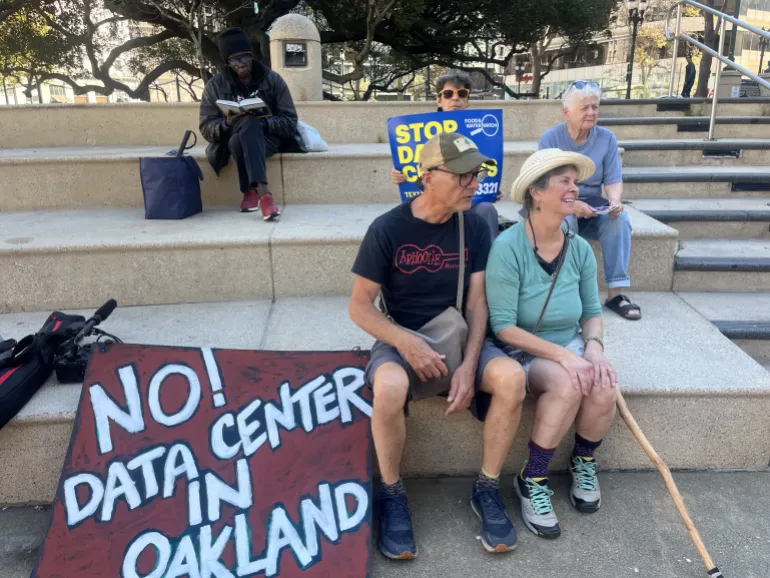
A couple sits on the steps of Oakland City Hall in California next to a sign that reads, ‘No data center in Oakland’
A couple sits on the steps of Oakland City Hall in California next to a sign that reads, ‘No data center in Oakland’ [Saumya Roy/Al Jazeera]

A midterm election issue

Concerns about the cost of rapid data centre growth, both environmentally and financially, have catapulted the issue into the discourse around Tuesday’s midterm elections.

In the final two months before the vote, at least seven Bay Area cities, including San Francisco and Richmond, have passed temporary moratoriums on data centre construction.

They include Oakland, which passed a data centre moratorium on October 6, after days of protest.

Local politicians competing in Tuesday’s midterms have also used the topic as a wedge issue, to rally support among certain pockets of voters.

One of the most closely watched races in the Bay Area is for the seat left vacant by longtime Democratic leader Nancy Pelosi. After 39 years in the House of Representatives, Pelosi is retiring at the end of the year.

Two Democrats are competing in Tuesday’s election to fill her position in Congress: San Francisco Supervisor Connie Chan and state Senator Scott Wiener.

Each one has staked out a different position on AI data centres. Wiener, for instance, opposes any ban on data centres.

“A blanket data centre moratorium could undermine AI regulation,” he told the publication Mission Local.

Chan, meanwhile, has pledged to seek a nationwide moratorium on data centres, at least until responsible AI regulation is put in place.

“Let’s start with a moratorium on data centres. Allow us to have that moment to regulate artificial intelligence,” she said at a debate in October.

Chan played a leading role in passing San Francisco’s moratorium in early October.

A poll from the University of Southern California showed Wiener leading Chan 47 percent to 41, as of mid-October.

Congressional candidate Connie Chan, Speaker Emeritus Nancy Pelosi and former San Francisco mayor Willie Brown stand together during an electoral rally in San Francisco, California, U.S., May 29, 2026. REUTERS/Manuel Orbegozo
Congressional candidate Connie Chan, left, stands next to outgoing US Representative Nancy Pelosi and former San Francisco Mayor Willie Brown at a campaign event in San Francisco, California, on May 29, 2026 [File: Manuel Orbegozo/Reuters]

“Right now, data centre opposition is an issue that unifies the US public like no other,” said Shum Preston, a political analyst based in San Francisco.

So far, there has been relatively little opposition to the data centre moratoriums in local hearings. But he speculates that there may be several reasons for the lack of pushback to the bans.

Among them are the surveys indicating widespread public backlash to data centre creation.

An October CNBC poll found that 63 percent of registered US voters oppose building data centres within 16 kilometres, or 10 miles, of their homes.

“Data centres poll very poorly, and developers probably don’t want to put their supervisor friends in trouble ahead of elections. So they probably let this pass,” Preston said.

He also signalled that the short-term nature of the moratoriums may be a factor.

Certain Bay Area cities like San Francisco, Brisbane and Oakland paused construction on data centres for 45 days, with the option to extend the ban later.

Opponents of the moratoriums “will be more vocal when” the 45 days end, Preston said. By that time, the heat of the midterm election season will also have settled, he added.

“That’s when the hearings will get more contentious,” he said.

Opponents of data centres have cited environmental costs as well as higher utility bills as reasons to ban their construction
Opponents of data centres have cited environmental costs as well as higher utility bills as reasons to ban their construction [Saumya Roy/Al Jazeera]

Not long enough?

Another hurdle facing the moratoriums is the lack of transparency surrounding data centre construction.

Supervisor Shamann Walton, who sponsored San Francisco’s moratorium ordinance, has argued that the city’s definition of “data centres” is outdated.

Created in 2001 — long before the AI boom — the city planning code defines data centres as “internet service exchanges”, a definition that may not accurately characterise the technology today.

Walton said the outdated language has made it hard for authorities to count how many data centres exist in the city.

Not being able to identify data centres can also prevent city officials from monitoring their power and water usage.

“We cannot use 2001 rules to regulate 2026 technology,” he said in a September 14 statement.

Another issue is the time it takes to carry out the necessary environmental assessments. The moratoriums may not offer enough time for a comprehensive review.

“Forty-five days is hardly enough time to document and study the impacts and then frame regulations,” said Roger Lin, senior attorney at the Center for Biological Diversity, a US environmental nonprofit.

He added that legal barriers limit access to such information from the data centres themselves.

“Data centres often have nondisclosure agreements, so even local air quality boards may not know the impact of data centres on air quality,” said Lin.

Supporters tout economic benefits

Still, AI industry supporters have touted the growth of the data centres as evidence of a flourishing industry, with positive downstream effects for US communities.

Anthropic, for instance, is preparing an initial public offering (IPO) that is likely to raise billions of dollars.

But critics warn that the company’s growth may not translate into an economic boom for the San Francisco Bay Area overall.

Instead, residents fear unequal economic growth that primarily benefits the wealthy. Already, San Francisco faces some of the highest and fastest-growing home rental prices in the country.

At a hearing at San Francisco City Hall, a resident vented their frustrations about the data centres to the supervisors.

“This city is less for humans and more for robots and billionaires,” the resident said.

Source link