Caucus

Edith and Carolyn, the women who stole CNN’s Iowa caucus show

It was early Wednesday morning when Edith Pfeffer and Carolyn Tallet became late-night TV stars, charming CNN hosts, producers and viewers alike with their earnest attempt to make sense of a mathematical snafu that had left the outcome of the Iowa caucuses hanging in the balance.

Pfeffer, who is chairwoman of the Clinton County Republican Central Committee, and Tallet, president of the Clinton County Republican Women’s Club, talked by phone with CNN hosts Wolf Blitzer and John King as the network tried to locate the final 3% of precinct tallies that would decide the winner of Iowa’s GOP presidential nominating contest.

The call resulted in eight minutes of hilarious, heartwarming television as the women tried to unscramble the math while King drew numbers on his special television screen and Blitzer pressed on for precision. (Watch the video below.)

Turns out Pfeffer had the missing tallies all night – they were phoned in less than an hour after the caucuses began, she said, but somehow weren’t counted by Republican Party officials.

Tallet told CNN that she learned just after midnight that the party was searching for the tallies, but couldn’t reach Pfeffer by phone.

“I knew they needed the information, and so I came to Edith’s home and pounded on the door and woke her up and got her up,” Tallet said.

“Do you know who carried this precinct?” King asked, referring to the precinct for which the state party said it had no votes. “…Who won?”

“Mitt Romney won with 51 votes,” Pfeffer said. “Rick Santorum and Ron Paul tied with 33 votes each.”

Double-checking, Blitzer asked Tallett and Pfeffer to give the totals for all precincts in Clinton County.

“Oh God, I added them up,” Pfeffer said, sparking giggles from the CNN crew offstage. “I added them up a couple times. I – oh, man.”

After they got the math all sorted out, Blitzer wanted to be sure he had the record straight.

“Just to be precise, we didn’t wake you up – the state chairs in Des Moines, they called you, they woke you up, is that right?”

“No!” Tallet said. “I woke her up…I was staying home watching CNN, waiting for the results, when I was told by the party. And so I came to wake up Edith, who didn’t answer her phone.”

The duo was such a hit that CNN called them back later in the night, once the results were official.

“I am just overwhelmed with all of this,” Pfeffer said. “I am just amazed because really and truly, my people did call this in tonight, and I don’t know where the glitch was…”

Pfeffer said she gave her county’s tallies to Romney campaign staff at the end of the night.

“And then I went to bed, and it’s been kind of interesting to wake up,“ she said.

kim.geiger@latimes.com

Source link

After Iowa caucus, WMUR is a TV player in New Hampshire

The unsuccessful 1996 and 2000 presidential campaigns of publishing scion Steve Forbes may have faded from memory. But he will always have a special place at Manchester, N.H.-based WMUR, the only commercial TV station in the state that holds the first presidential primary.

The candidate spent nearly $6 million to buy time on the station — including half-hour blocks during which he took phone calls from viewers. The cash deluge led politically minded locals to refer to WMUR’s 68,000-square-foot headquarters adjacent to the city’s historic Amoskeag Mills as “the house that Steve Forbes built.”

The television business went through a major period of disruption in the two decades that followed, with the proliferation of cable channels and later streaming services. But WMUR’s status as the most influential local TV outlet in the country every four years has remained intact. Presidential aspirants descending on the state in the early pivotal contest fill hours of time on its local newscasts and public affairs programs — and spend millions on political ads.

Leading up to the Feb. 11 primary, candidates can regularly be seen in WMUR’s newsroom. Former Vice President Joe Biden and his entourage came through on a recent afternoon. He posed for selfies with staff members and stopped at the sports desk to lament over the playoff fate of his Philadelphia Eagles before being interviewed by WMUR political director Adam Sexton.

“They cover, pound for pound, probably more politics than any station in the country,” said Rick Klein, political director for ABC News. “There really isn’t anything else like it. They get access to candidates that frankly a lot of networks would dream of. The candidates make themselves available to WMUR because they know that people watch.”

The primary campaign also means national exposure for the station’s journalists. On Friday, Sexton, 39, and WMUR anchor Monica Hernandez, 34, joined ABC News anchors George Stephanopoulos and David Muir and correspondent Linsey Davis in questioning the candidates at the network’s Democratic primary debate. It was watched by 7.86 million viewers, according to Nielsen.

Political advertising dollars for TV have grown in recent years even as more money goes into digital media. Research firm Advertising Analytics projects political ad spending on broadcast TV for the 2020 election cycle will hit $3.26 billion, up from $1.73 billion in 2016.

Most spending occurs closer to the general election in November. But WMUR, owned by the privately held New York media conglomerate Hearst, gets an early piece of the pie thanks to the political calendar and geography — big advantages when TV outlets are struggling to retain viewers and profits.

Manchester — a city of 111,000 people — is counted by Nielsen as part of the Boston TV market, but WMUR is the only station that reaches the entire state of New Hampshire. In a typical week, 56.2% of 468,730 television households watch the station at least once, according to Nielsen.

WMUR’s morning newscast from 6 to 7 often gets a 50% share of the TV audience in the six New Hampshire counties that also receive Boston stations, a staggering number in today’s fragmented market.

“They are insulated from some of the other trends in the TV business,” said Bill Hague, executive vice president for Magid, a media consulting firm that has worked with Hearst. “They’ve maximized the value of being a dominant TV station in the market. Coupled with increased political spending, they are on fire.”

WMUR also benefits from New Hampshire’s pride in having the first primary in the nation, which is looking even better in light of chaotic Democratic caucuses held in Iowa on Monday. A New Hampshire state law allows the primary date to be moved in order to keep it ahead of other states in the presidential cycle.

The distinction of having the influential primary has embedded WMUR in the nation’s political culture. Microphone flags with the station’s logo have turned up on fictional White House series such as “Veep” and “The West Wing.”

Candidates spend early and often on the station. WMUR took in nearly $40 million in presidential political ad revenue during the 2016 primary campaign, when both the Republican and Democratic parties were choosing nominees and 18 candidates were in the race.

The total revenue from the 2020 primary will be less, as President Trump does not have a formidable opponent from his party and only Democrats are buying ad time. Most candidates are not using money from political action committees, which spent heavily previously.

Nonetheless, in the weeks leading up to the primary, WMUR’s sales department frequently huddled to find ways to accommodate the intense demand for ad time. The station’s highest-priced ads of the primary season were on Friday’s debate and Sunday’s telecast of the Oscars, on which campaigns paid WMUR $10,000 per 30-second commercial, several times the rate it receives for many of the ABC network programs it runs in prime time.

Most of WMUR’s political ad time is sold on its local newscasts. The station has 4 1/2 hours of news a day, 10 hours on weekends and a long-running daily half-hour magazine show called “Chronicle,” which over 10 years on the air has done feature stories in all 221 towns and 13 cities in New Hampshire.

The station even has a local historian — 83-year-old Fritz Wetherbee — whose segments on the newscasts are assigned as homework for local schoolchildren.

“Local television news is still one of the most desired time periods to be in for any political candidate and any political action committee,” said Gerry McGavick, director of sales for WMUR, who also oversees political advertising for all of Hearst.

McGavick deals mostly with media-buying agencies based in Washington, D.C., but the campaigns also try to establish their own relationships with the station. Bags of Hawaiian macadamia nuts given out by Democratic candidate Rep. Tulsi Gabbard’s staffers during a recent visit were still circulating on the sales department’s floor.

While political ad dollars have long flowed into WMUR, Hearst invested in improving the local news after acquiring the station in 2001 for $185 million from Imes Corp., a family-owned outfit that lacked the resources of a large TV station ownership group.

Hearst owns 33 stations with annual revenues of $1.2 billion, making it the 11th-largest station group in the country, according to research firm BIA Advisory Services. Boosted by ad spending for congressional races, the stations had record revenue and profits in 2018, Hearst said. In a strong political year, WMUR ranks among its top 10 performers.

“The previous owners had a lot of shows that were filled with candle-making and stuff like that because they couldn’t afford to buy programming,” said Jeff Bartlett, a veteran TV news executive and general manager of WMUR.

Hearst acquired strong syndicated daytime shows for WMUR such as “Ellen,” which helps drive viewers into its afternoon and evening newscasts. The station beefed up its news coverage to serve highly politically engaged viewers who expect to see the candidates several times before they go to the polls.

Democratic presidential candidate Pete Buttigieg meets with New Hampshire voters on WMUR's "Candidate Cafe."

Democratic presidential candidate Pete Buttigieg meets with New Hampshire voters on WMUR’s “Candidate Cafe.”

(Jim Stankiewicz)

The station has deep ties to the community. Many employees have worked there for decades, able to play on a big-time media stage while living in a bucolic state with no income or sales taxes. News director Alisha McDevitt is a 25-year veteran who joined the station when she was still a college senior. She now oversees a news department with more than 60 employees.

While New Hampshire residents can watch news on Boston stations, WMUR is where they will see reports on government meetings, snowstorms, fires, accidents and local charity events. During high school football season, there is a WMUR photographer at every game.

“The viewers see us every day,” said Hernandez, a San Diego native who joined the station in 2018. “We’re out there covering baseball games and ice pond hockey tournaments.”

Presidential campaigns recognize the connection WMUR’s journalists have with the viewers and gravitate to them in order to reach New Hampshire voters, who savor their role in the candidate selection process. Hernandez said she came to WMUR from a much larger station — WFAA in Dallas — because the primary offered an opportunity to cover national politics close up.

WMUR political director Adam Sexton and anchor Monica Hernandez prepare for the Democratic primary debate airing Friday on ABC.

WMUR political director Adam Sexton and anchor Monica Hernandez prepare for the Democratic primary debate airing Friday on ABC.

(WMUR)

“We get advantages that other stations and the networks don’t get,” Bartlett said. “Sometimes you’ll be standing in a line with a bunch of other reporters and the candidate comes over to one of our guys and says, ‘Come on over for a sit-down.’ The other guys are not getting a sit-down. So that creates a little bit of tension, but it’s just a fact of life.”

The heated partisan rhetoric that saturates cable news does not show up in WMUR’s political coverage. There is no editorializing, commentary or even polling, which has largely been inaccurate in the state in recent primary campaigns as New Hampshire voters are last-minute deciders.

The station produced 25 hourlong town hall programs (Andrew Yang appeared on the first one back in February 2019), where studio audience members asked questions of the candidates. Fourteen hours of less formal exchanges between the candidates and voters for a series of segments called “Candidate Cafe” were shown on WMUR newscasts and social media platforms.

“We are presenting the facts, and people can draw their own conclusions from them,” McDevitt said. “We are very serious about that.”

WMUR was one of the earliest stations to expand online. The station’s website offers an extended version of its “Conversations With the Candidates” series for viewers who want to go deeper. The website has also become the base for New Hampshire political columnist John DiStaso, formerly of the New Hampshire Union Leader, who has covered the state for 35 years.

Dante Scala, a professor of political science at the University of New Hampshire, said WMUR understands that it has a symbiotic relationship with the primary — which he refers to as “the franchise.”

“WMUR benefits from the primary enormously, but they do go out of their way to provide a large amount of information,” he said. “Part of their job is to try to make sure that New Hampshire voters maintain their reputation as being well-educated active participants.”

Source link

Congressional Black Caucus presses companies in the US to oppose Republican redistricting push

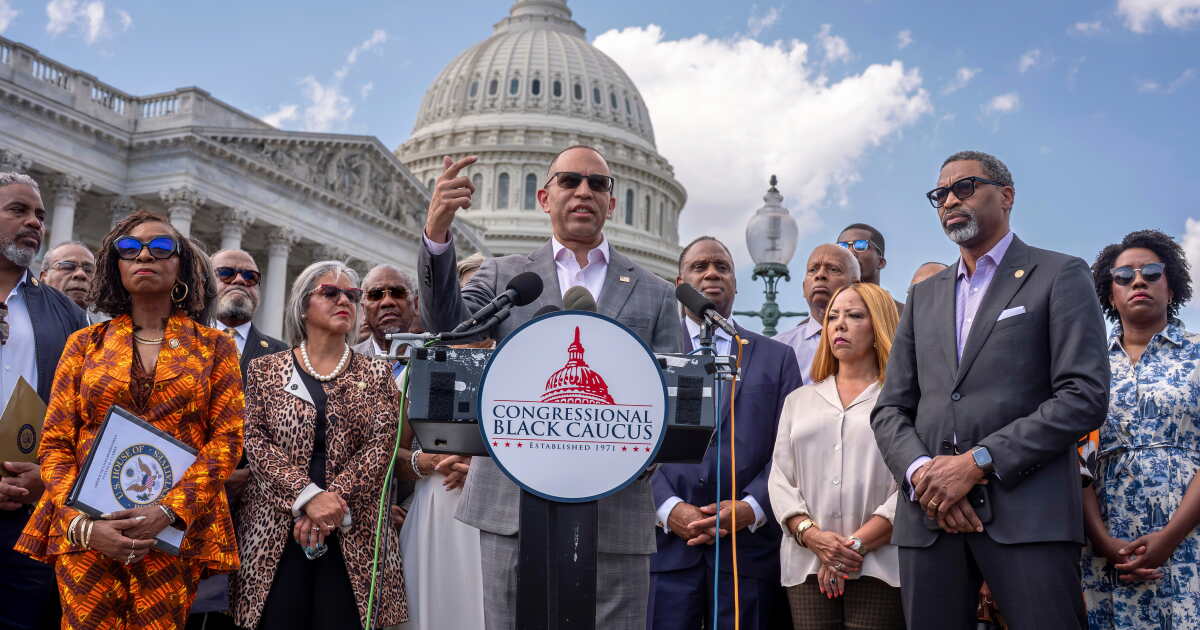
The Congressional Black Caucus on Tuesday called on major corporations across the U.S., including those that previously expressed support for voting rights and racial justice, to oppose redistricting efforts by Republican-led states that seek to eliminate majority-Black U.S. House districts.

In a letter sent to more than 250 companies, members of the Black Caucus urge them to condemn the redistricting efforts, which the lawmakers describe as “coordinated efforts to silence Black voices at the ballot box.” Some of the companies had co-signed their own message to Congress five years ago urging lawmakers to pass the John Lewis Voting Rights Act, a Democratic proposal to restore and update the Voting Rights Act.

That 2021 coalition, Business for Voting Rights, was backed by many of the country’s most valuable and influential companies, including Apple, Amazon, Google, Meta, Microsoft, Tesla, Salesforce, Target, PayPal, Intel and Starbucks.

Tuesday’s letter is the latest effort by the Congressional Black Caucus and its allies to gather support for preventing more Republican-led states from redrawing their legislative maps in ways that would dilute Black political representation. Several states have moved to eliminate congressional districts represented by Black Democratic lawmakers after a U.S. Supreme Court ruling last month that severely weakened a key provision of the Voting Rights Act.

“Corporations that have profited from Black consumers, relied on Black workers, and amassed wealth in part from Black communities cannot look away while Black political power is dismantled in plain sight,” Rep. Yvette Clarke, chair of the Black Caucus, said in an interview.

Clarke described the letter as “putting corporate America on notice,” but she said the caucus was not seeking an adversarial relationship with corporations. Among those receiving Tuesday’s letter were companies based overseas that have a significant presence in the U.S.

The caucus last week called for Black athletes to boycott public universities in states that are gerrymandering their congressional maps to eliminate districts held by Black lawmakers. The 59-member Congressional Black Caucus consists entirely of Democrats, including more than a third from Southern states.

Some lawmakers have said mass protests and federal legislation might be necessary to undo the efforts underway in Republican-led states. Any new federal voting rights law would almost certainly require Democrats to secure majorities in both chambers of Congress and win the presidency.

It is unclear how companies will respond to the demands. The Associated Press was making efforts to contact them.

“Many companies that previously issued statements after the murder of George Floyd, pledged billions toward racial equity initiatives, and spoke forcefully in defense of democracy following January 6 now face a defining test of whether those commitments were rooted in principle or convenience,” the caucus’ letter states.

It also represents the latest instance of the caucus expressing frustrations with corporate America. A 2024 Black Caucus report noted that lawmakers were “troubled that some corporations that made pledges in 2020 have taken several steps in the opposite direction,” such as rolling back or failing to follow through on pledges to diversify their workforces.

“We understand who the occupant in the White House is and the reality of Republicans being in charge,” Democratic Rep. Steven Horsford of Nevada said of the caucus’ message. “But what corporate America also understands is that there will be a shift at some point.”

The letter calls on companies to publicly condemn the redistricting plans, meet with Black Caucus members to discuss corporate America’s role in protecting voting rights and disclose their political donations to Republican politicians in states that are redistricting their congressional maps.

President Trump last year kicked off the unusual mid-decade round of congressional redistricting when he pushed Texas lawmakers to redraw their maps in a way that would add Republican seats. Democratic-led California responded, but it has been mostly Republican states redrawing their lines since as the party tries to maintain its majority in the U.S. House during this year’s midterm elections.

The effort was supercharged by the Supreme Court decision, which allowed even more Republican states to redraw congressional maps that previously had protected minority communities.

Horsford, who chaired the Black Caucus during President Biden’s Democratic administration, said the caucus is demanding that companies “stand on the side of democracy, fairness and equal representation.”

“This is about power, who holds it and what it’s used for,” he said. “And when you’re diluting Black economic and political power, we need to know where these companies stand in this moment, and what side of history they’re on.”

Brown writes for the Associated Press.

Source link

The GOP’s YOLO caucus is small but growing. That may spell trouble for Trump’s congressional agenda

The YOLO caucus is in session.

In a Republican-led Congress defined by deference to President Trump, there’s a small but steadily growing cohort who have found themselves more willing to break with the White House. Although the president maintains a firm grip on Republican voters, the expanding club could hinder his agenda on everything from the Iran war to immigration funding at a moment when his party holds a tenuous majority on Capitol Hill.

Sen. Bill Cassidy of Louisiana is the newest member of the club. Just days after losing his primary to a Trump-backed challenger, Cassidy on Tuesday reversed himself on legislation involving the war in Iran and voted with Democrats to rein in U.S. military action.

“The way our Constitution is set up, Congress should hold the executive branch accountable,” he told reporters the day before.

Sen. John Cornyn of Texas could be next after Trump endorsed Ken Paxton, Cornyn’s rival for the Republican nomination in next week’s runoff.

Rep. Thomas Massie of Kentucky is perhaps a founding member of the YOLO caucus — slang for “you only live once,” used to punctuate unbothered or even foolhardy behavior. He frustrated Trump since the president’s first term, and his status was solidified after losing his primary on Tuesday to a Trump-backed challenger. Massie has enraged Trump by voting against his signature tax and spending bill and by pushing for the release of the Jeffrey Epstein files.

He hinted there’s more to come before he leaves office.

“I got seven months left in Congress,” Massie said with a grin during his concession speech as the crowd erupted.

More Republicans feel free to shrug off Trump

Other similarly situated Republicans include Sen. Thom Tillis, who was a fierce critic of former Homeland Security Secretary Kristi Noem and has more recently turned his attention to Defense Secretary Pete Hegseth. There’s also Sen. Lisa Murkowski of Alaska, who joined Democrats last week in a bid to curb Trump’s war powers in Iran. Sens. Susan Collins of Maine and Mitch McConnell of Kentucky have voted against some of Trump’s Cabinet picks. And in the House, Rep. Don Bacon of Nebraska has pushed to reclaim congressional power over tariffs.

“If the legislative branch always votes with the president, we do have a king,” Massie said in his concession speech Tuesday.

This hardly amounts to a revival of the Never Trump movement that some Republicans unsuccessfully hoped would curb the president’s excesses during his first term or block him from returning to office. Many in the party, including Trump’s occasional detractors, have either stood by or been unable to block the president as he launched the war in Iran and presided over an aggressive immigration enforcement operation and the dismantling of the federal workforce.

Today’s unencumbered Republicans don’t fit into an ideological box. But they are united by a sense of emboldening that can only be attained in a few ways in Trump’s Washington.

Many, like Tillis, McConnell and Bacon, have decided to retire and can cast votes knowing they’ll never again have to face Republican primary voters. Others like Collins and Murkowski have more leeway because they represent states that tend to reward political independence. And some like Massie banked on the idea that voters could support both Trump and someone who occasionally crossed him.

It’s a paradox for Trump. As he demands total loyalty and pushes out Republican dissenters, he’s left with a growing cohort who, for one reason or another, owe Trump nothing.

Democrats look to capitalize

That could be a problem for Senate Majority Leader John Thune and House Speaker Mike Johnson, who are already governing with threadbare majorities. Shifting loyalties of even a few Republican lawmakers could dramatically complicate the ability for either chamber to pass substantial legislation ahead of the November midterm elections.

Thune called Cornyn a “principled conservative” and “very effective senator” on Tuesday.

“None of us control what the president does,” he said.

The next tests could come later this week as Thune pushes a funding package for Immigration and Customs Enforcement and Customs and Border Protection designed to pass on a party line basis.

Democrats are eager to pounce.

Speaking at an event in Washington on Tuesday sponsored by the Center for American Progress, House Democratic leader Hakeem Jeffries said he would aim to drive a wedge between Republicans by using a so-called discharge petition to bring issues directly to the floor for a vote.

That tactic has been successful in securing House passage on issues including the Epstein files and temporary protection of Haitian immigrants.

“When we’re disciplined and when we’re focused and when we put pressure in particular on the so-called swing seat Republicans, they have been breaking with us,” Jeffries said.

California Gov. Gavin Newsom told reporters on Tuesday that Trump’s endorsement of Cornyn’s rival was a sign that his political power lies within the Republican base — not the American public at large.

“He’s showed the only influence he has, and that’s an outsize influence within the base of the party,” the potential 2028 Democratic presidential contender said. “Otherwise he’s shown little to no influence with the American people.”

Counting the votes

That leaves Republicans gaming out how they might cobble together the votes needed to pass legislation.

Sen. John Hoeven of North Dakota called Cassidy a “good friend” and said the loss was “tough for him.” He said Cassidy “will always vote in line with what he thinks is best” but doubted he will become a less reliable Republican vote.

His fellow Louisianan, Sen. John Kennedy, said Cassidy deploys power “rationally and maturely” and “will continue to do the same thing.”

Cassidy repeatedly rejected the notion that he will spend his final months in Washington as a troublemaker for Trump, saying he’s going to do “what’s good for my country and my state.”

Yet the independent streak that ended his political career quickly resurfaced. A week after Trump visited China, Cassidy spoke of a Western alliance that’s “totally falling apart” and will be unable to “push back on the threat China represents.” He seemed stunned that the administration would create a nearly $1.8-billion fund to compensate Trump allies who they believe have been unjustly investigated and prosecuted.

“I just came off the campaign trail,” he said. “People are concerned about making their own ends meet, not about putting a slush fund together without a legal precedent.”

Sloan and Cappelletti write for the Associated Press. AP writer Stephen Groves in Washington contributed to this report.

Source link