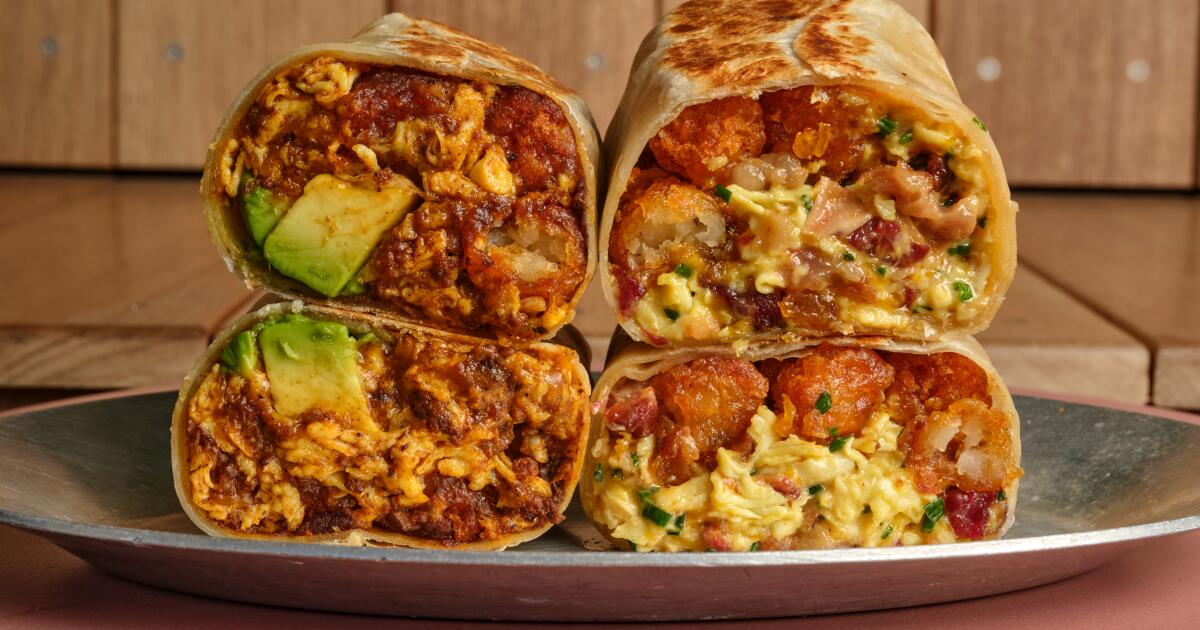
Morning meals in Southern California restaurants link us to so many cultures and flavors: Taiwanese sticky rice fan tuan, Salvadoran huevos picados con loroco, fatteh hummus in Van Nuys, catfish and grits in Inglewood, blueberry pancakes with extra butter in Hollywood.
But to narrow L.A.’s essential daybreak dishes down to one icon? It is, without question, the breakfast burrito.
The origins of burritos, meals wrapped in flour tortillas for breakfast or otherwise, trace most reliably to Sonora, Mexico’s northwestern state where wheat has been cultivated since the 1500s. California’s Mexican foundations made the burrito’s presence in L.A. inevitable, though its omnipresence was surely sped along by California entrepreneur Duane Roberts, who introduced the frozen burrito for fast-food chains to heat and sell in 1956 — after he’d already found success supplying the original McDonald’s in San Bernardino with burger patties.
Discussions of the mid-20th-century industrial food complex are relevant here. If any one ingredient, beyond the all-important egg, defines our modern tastes in breakfast burritos, it is the inclusion of the Tater Tot, capitalized after Ore-Ida (now owned by Kraft Heinz) engineered the fried puffs from potato scraps in 1953 and trademarked the term.
Our tastes for breakfast burritos have only increased since the pandemic. Many newer businesses spun out of 2020-era pop-ups or at-home tinkering — and nearly all of them crunch with a telltale fluffy-crispness. Tater tots are now to the L.A. breakfast burrito what rice is to the Bay Area Mission-style burrito.
Still, many styles express themselves in our foil-wrapped torpedoes: Some are canvases for individual creative expression, some innovations that graft global cuisines, some basic energy bombs to fuel the day.
And yes, rising prices led to a viral argument about a $20 burrito in the summer 2026 political discourse. Among the following suggestions, you can find a $3.99 egg, potato and cheese burrito served from a takeout window in Atwater Village and a $26 knife-and-fork burrito stuffed with short-rib meat in Hancock Park; a majority is in the mid-range between $12 and $17.
To build your own best-of breakfast burrito list, you can always start with stalwarts like Cottage Corner in Burbank and Lucky Boy in Pasadena. These 16 favorites span businesses that have been open for six months to several decades. The regional options are overwhelming, and the mix is always fluctuating. (A Pasadena standout, BBAD, recently changed ownership and the quality plummeted, hopefully temporarily.) It’s hard to consider this roundup anything more than a continual work in progress.
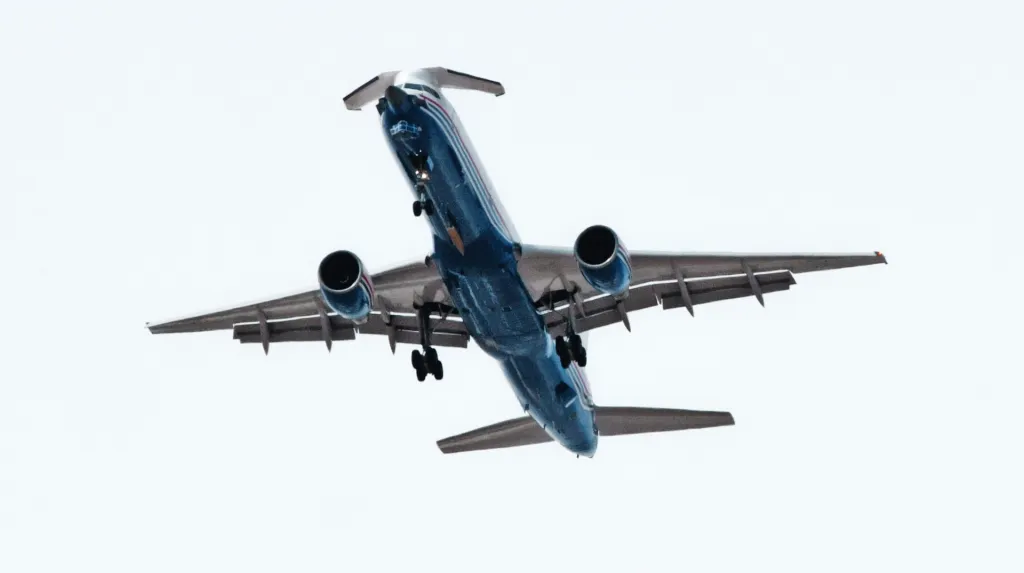
Jerod Harris caught Catfish with the pod under its belly as it came in to land at Edwards Air Force Base in California on Monday. Edwards is the main hub for U.S. Air Force test and evaluation activities, and Catfish has been seen there many times over the years as part of its work. The aircraft, which carries the U.S. civil registration code N757A, also happens to be the first 757 ever built, and took to the skies for the first time back in 1982.
Catfish with the pod under its fuselage seen on approach to Edwards Air Force Base in California. Jerod Harris
As already noted, Catfish has already played a central role in the story of F-22. The aircraft’s heavily modified nose is designed to directly replicate that of the Raptor, and contains the same AN/APG-77 active electronically scanned array (AESA) radar as the fighter. The swept wings on top of the cockpit were also designed to support testing of the conformal antennas for the Raptor’s AN/ALR-94 electronic support measures system and other components of its ‘fused’ sensor suite. The aircraft has supported the development of a wide array of other systems for the F-22, and is packed inside with additional equipment to support those needs in particular, including a replica of the Raptor’s cockpit. You can read more about Catfish and its general history here.
So it is not surprising then that the heavily modified 757 would also be used now to help with continued testing of the new underwing infrared sensor pods for the Raptor. Carrying the pod under the forward end of the fuselage would offer the sensors inside a good open field of view to the front, as well as to the left, right, and down.
Another view of Catfish carrying the stealthy infrared sensor pod. Jerod Harris
The stealthy pods have been test-flown on actual F-22s for years now. At the same time, there are only a limited number of Raptors available, in total, and they are notoriously fuel-hungry, maintenance-intensive, and otherwise expensive to operate. If the particular test plan calls just for level flight, and over extended periods of time, a platform like Catfish could be an attractive alternative. With space for dozens of engineers and technicians in its main cabin, and workstations for them, the aircraft would also offer very different options for testing and evaluating the pod while in-flight. A North American Sabreliner business jet has also been used to test these pods in the past.
N33TR, a Rockwell Sabreliner 65 for Airborne Imaging returns to KJWY/Mid-Way regional Airport as ” AIRBORNE33 ” carrying one of the future F-22 pods.
It was at Nellis AFB testing the pod alongside RATT55/NT-43A, a radar test bed that regularly flies alongside B-2s. pic.twitter.com/kNADnga7H0
The capability, in general, for Catfish to carry stores under its fuselage might open up additional possibilities for utilizing the aircraft in support of other testing efforts, if it hasn’t already.
Catfish continues on with its approach to Edwards. Jerod Harris
Catfish would also be well suited to supporting testing of other elements of the Raptor 2.0 package. Under the current plan, the Air Force’s F-22s are also set to get a new integrated distributed infrared search and track (IRST) system called the Infrared Defensive System (IRDS).
IRST systems have seen a renaissance across the U.S. military in recent years, as well as elsewhere globally. IRSTs detect and track targets via their infrared emissions, making them particularly valuable for helping spot stealthy targets with features designed to reduce their radar cross-sections. The sensors are also immune to radio frequency electronic warfare jamming and operate passively, meaning they do not emit signals that could alert a target to the fact they are being tracked. IRSTs can also be used to cue or otherwise be linked to other sensors, including AESA radars. This data fusion can provide higher fidelity tracks of multiple targets, as well as improved situational awareness overall.
Increased demand for IRSTs has led to a commensurate increase in demand for testing using multiple platforms. This, in turn, has been a major component of a general uptick in U.S. military flight testing in recent years to support a variety of new, advanced programs.
An F-22 with the stealthy underwing infrared sensor pods and drop tanks seen on a test flight over the Mojave Desert in March 2026. Jarod Hamilton
Other elements of the Raptor 2.0 upgrade plan include new stealthy drop tanks, improvements to the jet’s stealthy features, radar capabilities, electronic warfare suite, and more, as you can read about in detail here.
The F-22 upgrade work is reflective of current Air Force plans to keep the Raptors in service for decades to come. In 2024, the Air Force said it no longer had a firm retirement schedule for the fighters.
Catfish seen flying together with a pair of F-22s near Edwards in 2024. Courtesy photo/Kyle Larson via USAF Chase Kohler
At the same time, Catfish is now 44 years old. Boeing 757s, in general, are increasingly disappearing from service globally as they become more complicated and cost-intensive to sustain. Especially with the work ongoing now on the F-47, it seems likely Boeing will start looking toward a new highly specialized testbed aircraft modified to reflect the particular physical geometry, unique avionics, and other features of the new fighter.
Similarly, the F-35 family also has a dedicated test jet, the Boeing 737-300-based Cooperative Avionics Testbed, nicknamed the CATbird. There are several other airliner and business jet-based testbeds flying globally today, though Catfish is certainly one of the largest and most visually distinctive. Improving digital simulation and modeling tools could allow for less reliance on surrogate testbed aircraft in the future, but they will in no way be eliminated.
China’s Tu-204C-based ‘Catfish’ testbed jet. Chinese internet via X
In the meantime, Boeing Catfish remains a very important part of continued work to improve and expand the capabilities of the F-22. This now extends to testing of specialized underwing pods for the Raptor.
Special thanks again to Jerod Harris for sharing his pictures of Catfish carrying the stealthy sensor pod with us.