Will Smith is in a slump, but benching him isn’t an option for Dodgers
MILWAUKEE — The Dodgers have a big hole in the middle of their batting order, and it’s not Shohei Ohtani.
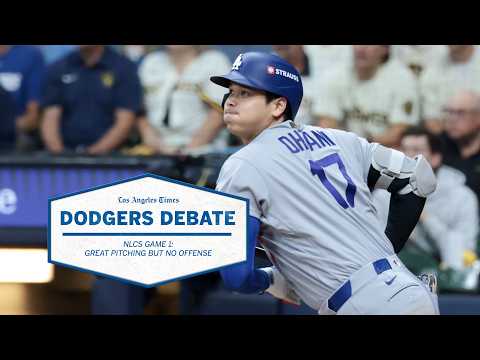
If anything, Ohtani has reemerged as an offensive force in the cleanup spot, singling, walking and scoring the Dodgers’ only run Sunday in a 2-1 loss to the Milwaukee Brewers in Game 1 of the National League Championship Series.
The problem is with the guy hitting in front of Ohtani.
Will Smith walked in four plate appearances, marking just the second time he’s reached base in the postseason. In the four division series games against the Atlanta Braves, he had a single in 16 at-bats, striking out seven times. He’s hitting .053 in the playoffs — only Cleveland’s Ángel Martínez has a lower average among players with at least nine at-bats.
But there’s not much the Dodgers can do about it. They are built to win with pitching and Smith, the catcher, is the guy they rely on to guide those pitchers through games.
Dalton Rushing, who started just five fewer games behind the plate than Smith this season, is injured and not on the roster. Hunter Feduccia, who did make the team, caught just 15 complete games this season and isn’t an option to start in the playoffs.
“I’m not going to put Feduccia in place of Will Smith,” Dodgers manager Dave Roberts said. “That’s just not going to happen.”
So Roberts and the Dodgers are left to muddle on with Smith regardless of how much he struggles offensively. That’s because he’s far more valuable crouching behind the plate than standing next to it.
“I don’t even know how he’s performing offensively,” said Tarik Skubal, who took the loss Sunday. “Catchers, I think it’s the most important position on the field. They’re the ones calling pitches, dictating game flow, rhythm, all that type of stuff. I’m going to trust those guys always.”
Smith appears to be executing his catching duties very well, since opponents have scored just 10 runs and are hitting .160 against the Dodgers this postseason. Only Tampa Bay, which has played two fewer games, has done better.

As for what Smith thinks, that’s unknown because the Dodgers did not make him available to the media Sunday. But since he’s not coming out of the lineup, the next-best solution might be moving him to another spot in the order.
That worked with Ohtani, who had as many strikeouts as hits in the first two games of the division series, when he batted second. Since being dropped in the order, he has reached base four times in three games, stolen a base and scored twice.
“There’s always lineup construction. I can think it through. He’s not swinging the bat well,” Roberts said of Smith. “It’s hard because of the body of work, he just has that knack to get a hit, to get a big hit.”
That’s exactly what happened last fall when Smith’s two-out, 11th-inning home run in Game 7 of the World Series helped the Dodgers win a second straight title.
Smith was on the injured list for 86 days this summer because of neck disk inflammation, returning for the final month when he slashed .290/.400/.548. He has cooled off considerably in October, just as he did last year, when he returned from a right hand contusion three games into the playoffs and got just two hits in his first 14 at-bats.
He recovered to bat .400 in last year’s NLCS win over Milwaukee, then broke a 4-4 tie with his winning homer against the Toronto Blue Jays. Just as important, though, Smith caught all but 11 innings in the Dodgers’ final 15 postseason games — including two 11-inning games and another that lasted 18 innings.
Smith rarely has hit well in the postseason, batting just .206 in 18 series, which may explain Roberts’ lack of panic. Plus, Roberts knows his All-Star catcher has helped him win three World Series rings, and if the Dodgers are to get another, it will be on the strength of their pitching, not their hitting.
And that side of Smith’s game is as strong as ever.
“To be honest, that’s not where my focus is with Will,” Skubal said of his catcher’s hitting. “My focus is what he’s doing behind the dish and he’s very important. He’s very important to the entire pitching staff.”