catch

Expert shares ‘vital’ £3,000 holiday saving trick — but there’s a catch

A TikTok money expert has revealed how a travel credit card could save you thousands on holiday — but there’s a catch you need to know before you go abroad

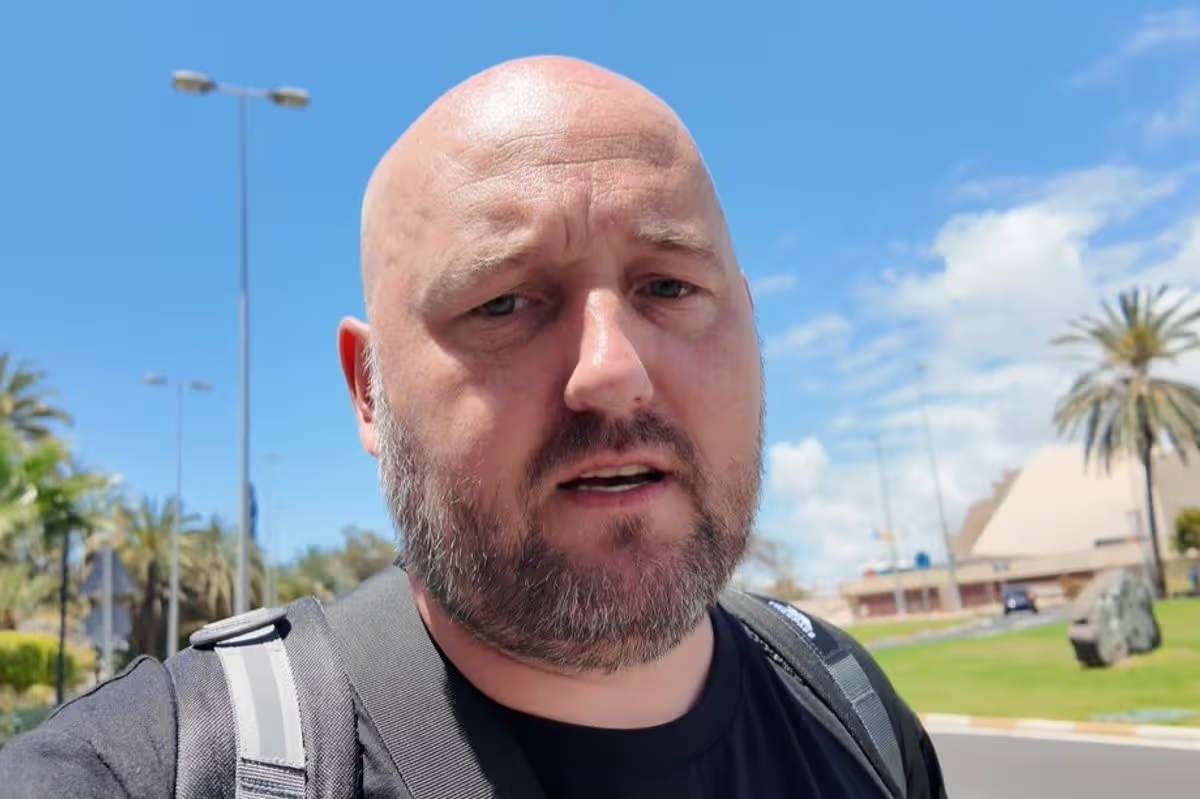
Many holidaymakers think they’ve got their trip finances sorted but one money expert says a simple tool could save you thousands and protect you from scams. Mat The Money Man, known as @thequidsquid on TikTok, revealed the £3,000 holiday hack that many people completely overlook.

“If you go on holiday and don’t bring one of these, you could be in serious trouble,” he warns in the viral video. Over 9.4 million tourists have fallen victim to holiday scams over the past five years, making financial protection a must.

Mat explains that travel credit cards are often safer than using a debit card because they offer Section 75 protection under UK law. Any purchase between £100 and £30,000 is covered, meaning you can claim your money back if something goes wrong — a safety net debit cards rarely provide.

READ MORE: Aviation expert Alex Macheras predicts when Emirates, BA, and Qatar Airways flights might resumeREAD MORE: Travel expert Simon Calder explains when Dubai, Emirates and Qatar flights could resume

He also points to other perks, such as better exchange rates and cashback on overseas spending. “So if you get scammed, you can claim that money straight back,” he says, highlighting how the average person spends around £1,320 on two long holidays each year.

According to Compare the Market, a typical European holiday costs £1,000 to £2,000 per person, while longer-haul trips can exceed £2,000 per person depending on flights and accommodation. For many, the combination of fraud protection, exchange rate benefits, and potential cashback makes travel credit cards a valuable tool. Mat claims the total holiday savings could reach £3,633.

Content cannot be displayed without consent

Experts, however, stress that not all travel credit cards are created equal. MoneyHelper notes that while these cards often provide no foreign transaction fees and built-in insurance, consumers should compare annual fees, interest rates, and exchange rate policies before signing up.

The “catch” is simple but critical: you must have the right card and actually use it during your trip to unlock the savings and protections. Without it, you risk missing out on thousands of pounds and the extra security a travel credit card can provide.

For holidaymakers who want peace of mind and the chance to save big, a travel credit card could make all the difference — but only if you bring it along and use it correctly.

Ensure our latest headlines always appear at the top of your Google Search by making us a Preferred Source. Click here to activate or add us as your Preferred Source in your Google search settings


Source link

Greek island where you can get free breakfast and accommodation – but there’s a catch

The historic island of Syros in the Cyclades is home to a cat sanctuary where volunteers from around the world can stay for free in exchange for caring for animals – and it’s been described as a quieter alternative to Santorini and Mykonos

Holidaymakers can seize the opportunity to live on a stunning Greek island with free accommodation, breakfast, and utilities in return for volunteering at a cat sanctuary and assisting with animal care. The position is based on the historic island of Syros, situated in the Cyclades within the Aegean Sea, where the Syros Cats sanctuary operates.

Since the 1990s, the sanctuary has led the way in feline welfare, implementing trap, neuter and return (TNR) schemes, overseeing animal health, and facilitating the safe integration of stray cats within the local community.

The sanctuary welcomes volunteers from across the globe to join its team and embrace animal care while discovering life on a Greek island. They are seeking volunteers who are physically capable, responsible, healthy, and self-sufficient, able to commit to staying for at least one month.

Applicants must be prepared to dedicate five hours daily, five days a week, to vital duties. These include cleaning living areas, preparing and serving meals, socialising kittens, and providing a secure, nurturing environment for the cats.

Those with veterinary expertise or experience handling feral cats are especially encouraged to apply, though the programme welcomes anyone prepared to roll up their sleeves, demonstrate reliability, and genuinely interact with the animals. In exchange, volunteers are provided with free lodgings, breakfast, and access to amenities, enabling them to fully concentrate on their tasks while basking in the Mediterranean sun, reports the Express.

The sanctuary’s efforts have revolutionised the dynamic between the island’s inhabitants and its cat population. Richard Bowell, co-founder of God’s Little People Cat Rescue, which works in partnership with Syros Cats, stated: “We want to show the world that we really care about animals. The way we treat them reflects something of our own humanity.”

As a result of these endeavours, the local community now regards cats with respect and pride, marking a significant departure from the apathy or animosity previously displayed.

Syros is often touted as a quieter, less touristy alternative to more renowned Greek islands such as Santorini and Mykonos. YouTubers Katie and George from Intersection Voyage highlighted the island’s allure during a recent trip: “Every year, millions of people travel to Greece’s most famous islands, Santorini and Mykonos. However, after travelling to both Santorini and Mykonos, I have come to realise that there are some other, way less commercialised islands, which are amazingly rich in history and scenery.”

They added: “We will be spending the next three days on one of Greece’s most historic and beautiful Greek islands, exploring hidden cave churches, local beaches, unique cuisine and the island’s famous tourist attractions.”

Reflecting on their experience, they said: “Looking back on this island, there was something just magical about it. It was unique and authentic and it had something for everyone. I found the locals were extremely kind and generous and were always willing to help if you needed it. We didn’t even scratch the surface of how many hidden places there are to see.”

Applications for the 2026 volunteer season are now closed, but those keen to participate in 2027 can apply when registration reopens in September 2026 via the official Syros Cats website or sign up to their newsletter for updates.

Source link

Newcastle: More questions than answers as Eddie Howe’s men yet to catch fire this season

There have certainly been glimpses of what this team could be in recent weeks.

There was a devastating first-half display against Chelsea, a spirited hour away to Paris St-Germain and a fine opening half an hour or so at Anfield.

But games are not won in snatches.

It has been a frustration of the coaching staff that they have lacked the training time during an unrelenting run of fixtures to really work on things and piece it all together like they have during previous sticky spells.

Instead the players have come to rely on meeting rooms, analysis sessions and walk-throughs.

This is the reality of life at clubs who aspire to fight on multiple fronts, of course, but competing in four competitions was an unprecedented feat for Newcastle going into February.

The relentless nature of the schedule has had a knock-on effect on the squad – Bruno Guimaraes, Joelinton, Tino Livramento and Fabian Schar are all currently sidelined, while Anthony Gordon hobbled off with a hamstring issue on Wednesday night.

It has also had an impact on the adaptation of Newcastle‘s summer signings who, aside from defender Malick Thiaw, are still finding their feet at the club.

Thiaw, Jacob Ramsey, Nick Woltemade and Yoane Wissa all joined in the final fortnight or so of a turbulent window, in which the club operated without a sporting director and missed out on a host of top targets.

Newcastle, remarkably, are still searching for a settled combination in the final third despite spending £179m on forwards.

Elanga enjoyed a lively second-half cameo at the Etihad, but Woltemade was substituted at half-time – having failed to score since December – while the rusty Wissa missed a host of good chances in both legs.

It leaves Newcastle with more questions than answers as they embark on a crunch run of fixtures.

“Where does that leave our season?” Howe asked. “We’re still fighting on several fronts.

“The games are coming thick and fast. There’s no let-up for us. We need to get back to winning ways as quickly as possible. It’s the only thing that gives you new energy.”

Source link

Meteor Long-Range Air-To-Air Missile In The Works For Ukraine, But There’s A Catch

Good news for Ukraine: it looks increasingly likely that it will get its hands on European-made Meteor beyond-visual-range air-to-air missiles, a class of weapon that it badly needs to redress the balance against Russian fighter jets. Bad news: the Meteors would likely only be made available once Kyiv acquires Saab Gripen fighters, a plan that remains questionable, especially in terms of the timelines for when they might materialize.

Earlier this week, the Ukrainian Ministry of Defense confirmed that the Meteor was one of the weapons being lined up for the next Swedish security aid package for Ukraine. Also on the agenda were the Gripen E and undisclosed air defense systems, Saab radars, electronic warfare systems, and drones, including long-range one-way attack drones. The announcement came after talks between the Ukrainian Minister of Defense Mykhailo Fedorov and his Swedish counterpart, Paul Jonsson.

A Gripen E loaded with seven MBDA Meteor missiles. Saab

At the Singapore Airshow this week, a Saab official told Defense News that transfer of the Meteor was under discussion and that it would be “natural” for it to be included in any Gripen package.

“The Meteor missile would be a natural content in a weapon package for any Gripen user […] discussions are taking place with several export nations, including Ukraine,” said Jussi Halmetoja, operations advisor in the air domain at Saab.

The Ukrainian Air Force’s need for a weapon in the Meteor class has long been apparent.

As we have discussed in the past, the Meteor is one of the most capable air-to-air missiles in operational service anywhere in the world.

Its key feature is its unique ramjet propulsion system, which can be throttled during different phases of flight. This ensures the missile still has considerable energy reserves during the terminal attack — it’s at this point that more conventional air-to-air missile motors lose energy, leading to a decrease in agility.

Meteor


Propelled by its ramjet motor, the Meteor’s all-important ‘no-escape zone’ is therefore far greater than for comparable weapons. This means the target has a much-reduced chance of evading the missile at the endgame of the engagement, something that would otherwise be far more realistic, using high-energy maneuvering. Another advantage of being able to throttle the motor is that the missile’s autopilot can calculate the most efficient route to the target for very long-range shots.

Highly significant for Ukraine is the fact that the Meteor is among the longest ranged of any Western air-to-air missile, generally considered to be able to engage certain types of targets out to around 130 miles.

A Meteor is fired during testing. Dassault

The Meteor has an active radar seeker for the terminal phase and a two-way datalink. The datalink feeds the missile with in-flight updates as it flies out to its target and provides the pilot in the launch aircraft with information on the Meteor’s fuel, energy, and tracking state. That data can help determine if and when to fire another, disengage, or even assign a different target of opportunity.

Currently, the Ukrainian Air Force’s most capable air-to-air missile is the AIM-120 Advanced Medium-Range Air-to-Air Missile (AMRAAM), which arms its F-16 fighters.

A Ukrainian Air Force F-16 with wingtip-mounted AMRAAMs. Ukrainian Air Force

Ukraine’s AMRAAMs include the AIM-120C version, which, as we’ve discussed in the past, offers some significant advantages over the earlier AIM-120A/B models. Most importantly, the AMRAAM is Ukraine’s first active-radar-guided air-to-air missile. This is a class of weapons that was long sought after by Ukraine. Early on in the conflict, one of its fighter pilots, the late Andrii Pilshchykov, better known by his callsign “Juice,” told TWZ: “The lack of fire and forget missiles is the greatest problem for us.”

According to data from one of its operators, the AIM-120C-5 subvariant provides a maximum range of around 46 miles, although the actual range of the missile is tightly controlled information and based on many engagement factors.

For all its capabilities, the AMRAAM’s reach is far outstripped by Russia’s long-range R-37M air-to-air missile, known to NATO as AA-13 Axehead. Typical Russian tactics involve firing the R-37M from outside the range of the missiles carried by Ukrainian fighters.

A Russian Su-35S launches an R-37M air-to-air missile. Russian Ministry of Defense screencap

Mainly used by Su-35S Flanker multirole fighters and MiG-31BM Foxhound interceptors, the R-37M is a missile we have examined in detail in the past.

Last week, we discussed a video showing the shootdown of a Ukrainian Air Force Su-25 Frogfoot close air support jet, apparently by an R-37M.

The loss of a Ukrainian Su-25. The aircraft was hit by an R-37 missile; the responsibility likely lies with either a MiG-31BM or a Su-35S fighter, as these are the types that typically patrol with such long-range missiles. The pilot lost his life during the action. Blue skies to… pic.twitter.com/lNXZPuzHXS

— Zsiguli🇭🇺 (@GZsgallos2007) January 27, 2026

With a reported range of 124 miles against certain types of targets, the R-37M flies to its target on a lofted trajectory, controlled by an inertial navigation system with mid-course radio correction, and uses an active radar seeker for its terminal phase attack.

Speaking to TWZ back in 2022, Ukrainian MiG-29 Fulcrum pilot Pilshchykov said that the R-37M, typically fired from within Russian airspace, was “limiting our capabilities to conduct our missions. Of course, if you’re maneuvering, we are not able to provide an airstrike or something else, so the game is still very, very, very tough in the air and very, very risky. If you’re not aware of the launch of a missile, you’re dead.”

As it stands, the Meteor is the best candidate for Ukraine to try and redress the balance in the air war when faced by the far-reaching R-37M, and would finally put Russian aircraft at risk within their own missile ranges.

The Meteor is a product of the European MBDA missile house, with manufacture undertaken by its U.K. branch. Other partners in the Meteor program are France, Germany, Italy, Spain, and Sweden, which placed an order for more of the missiles last year. All of these nations are firm supporters of Ukraine, but whether they approve a transfer of the missiles to Kyiv will also depend on how they judge the intelligence risk. After all, the wreckage of such a long-range weapon is very likely to end up on Russian territory, which would expose its technologies to analysis and exploitation.

The then U.K. Secretary of State for Defense, Gavin Williamson (center), is shown a Meteor missile by MBDA staff at their factory in England. Crown Copyright

However, Ukraine will only be able to use the Meteor once it starts to receive Gripens (or, alternatively, Dassault Rafales offered by France).

As it stands, Ukraine has signed letters of intent to acquire as many as 150 Gripen E fighters from Sweden and up to 100 Rafales from France over the next 10 years.

Ukrainian President Volodymyr Zelensky and Swedish Prime Minister Ulf Kristersson announced the signature of the letter of intent in front of a Gripen E at Linköping, Sweden, in October 2025. Swedish Ministry of Defense

For Ukraine, the Gripen and Meteor could be used in a very powerful combination with the two Saab 340 airborne early warning and control (AEW&C) aircraft equipped with Erieye radar that have been donated by Sweden.

The Saab 340 AEW&C will be able to work as a fighter control asset, detecting targets, prioritizing them, and then assigning them to the fighters for interception. Using its datalink, the radar plane can also directly provide the missile with mid-course guidance updates. In fact, the fighter pilot may never have to use their own radar to engage a target. Instead, the missile is assigned a target, is fired, and then gets continuous updates from the AEW&C platform.

Erieye explained


As we have discussed in the past, either the Rafale or Gripen E would become the most advanced combat aircraft in Ukraine’s inventory, but there remain glaring questions about whether the acquisition of one of these aircraft types, let alone two, is actually feasible, especially in such numbers.

A Dassault Rafale bristling with weapons, including the Meteor. Dassault

The letters of intent underscore Ukraine’s political commitment to buy these fighters, but don’t constitute a purchase deal. For Ukraine, there’s nothing to lose here, and it can cement its relationships with the nations that support it by showing interest in huge arms buys without any liability.

The same applies to the Meteor.

However, official discussions about the missile, together with the Gripen and Rafale, once again signal the scope of Kyiv’s ambitious re-equipment plans, especially when it comes to its air force.

A faster route to getting Meteor operational in Ukraine might involve Sweden providing secondhand Gripen C/Ds, something that has been proposed in the past.

A Swedish Air Force Gripen C at a remote base. Saab

Swedish officials have said it would take around three years for new-build Gripen Es to arrive in Ukraine. With an urgent need for fighters, Ukraine has said in the past that it wants to get its first Gripens delivered by 2026. The earlier Gripen C/D is also compatible with the Meteor.

While we wait for any final Gripen or Rafale deals to be concluded, Ukraine has at least made a first step toward acquiring an air-to-air missile that would finally allow its pilots to engage Russian aircraft at extended ranges, which would offer a powerful challenge to Russia’s current freedom of movement in the air war.

Contact the author: thomas@thewarzone.com

Thomas is a defense writer and editor with over 20 years of experience covering military aerospace topics and conflicts. He’s written a number of books, edited many more, and has contributed to many of the world’s leading aviation publications. Before joining The War Zone in 2020, he was the editor of AirForces Monthly.


Source link