He’s wine country’s reluctant casino mogul. His new novel is rich with Native history
On the Shelf
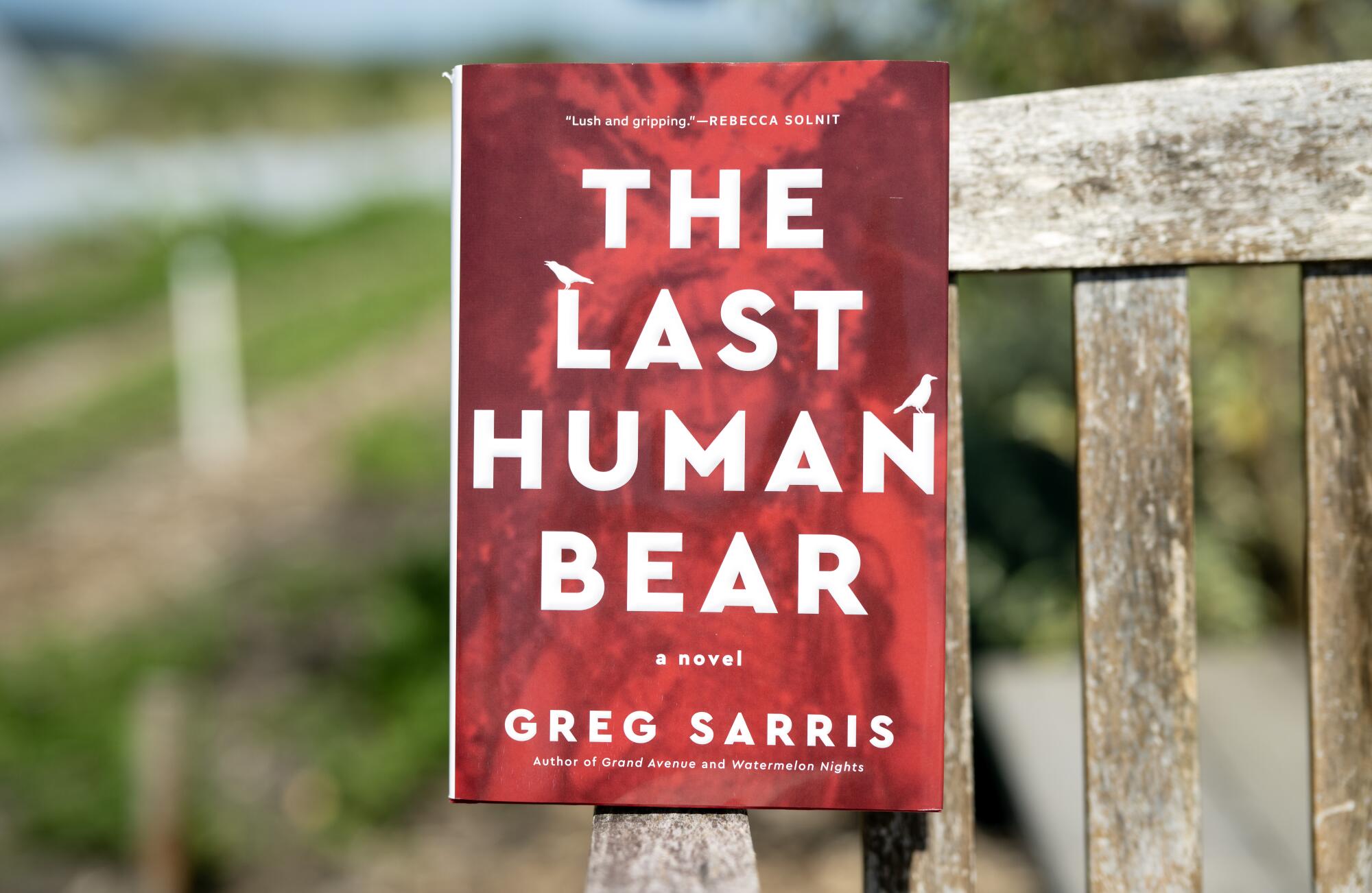
The Last Human Bear
By Greg Sarris
Heyday Books: 384 pages, $30
If you buy books linked on our site, The Times may earn a commission from Bookshop.org, whose fees support independent bookstores.
Before her death in 1993, Mabel McKay — one of the last living dreamers of the Pomo Indian people — shared a prophecy while driving through the Sonoma hills. One day, this paradise would burn.
“Everything is going to go dry. Everything will burn. That’s my latest vision,” she said, gesturing to the idyllic landscape.
Startled, writer Greg Sarris asked what could be done to stop it.
“You live the best way you know how,” McKay replied.
Since her passing, Sonoma County experienced the most destructive wildfires in California history in 2017, only for another, more destructive fire to surpass it a year later. “She always used to say, ‘Whether you believe it or not, it’s true,’” Sarris recalls.
McKay and her visions are the inspiration behind Sarris’ latest work. His first novel in 28 years, “The Last Human Bear,” is loosely based on the spiritual leader McKay, whose wisdom and companionship served as a refuge to Sarris during a tumultuous childhood in Sonoma County.
A reluctant casino mogul
On a Monday morning in California, Sarris sits in his sleek office at the Federated Indians of Graton Rancheria in Rohnert Park. Sarris, 74, has served as chairman of the Federated Indians of Graton Rancheria for more than 30 years. In his office, diplomas and academic certificates crowd the walls. A framed poster for the 2023 film “Joan Baez: I Am a Noise” hangs nearby — she’s a close friend. Behind him, an American flag ripples in the distance outside the window, blurred by the summer heat.
Just up the road sits a multibillion-dollar tribe-owned casino, Graton Resort & Casino — a project the writer oversees. “I had never been in a casino. I have a PhD in modern thought and literature from Stanford,” says Sarris.
How does an accomplished author find himself at the helm of a multibillion-dollar casino enterprise? It’s a question that still puzzles Sarris. “I told them if we can raise our people and become a platform for social justice and environmental stewardship to benefit Indian and non-Indian alike, I’ll do it.”
Before his stint as a reluctant casino mogul, Sarris was a prolific author and university professor at UCLA and Sonoma State. In 2023, he was appointed a regent of the University of California by Gavin Newsom. Over the course of his career, he published six books, and his novel “Grand Avenue” became an HBO original film in 1996.
California’s Native history: revisited
From early in his career, Sarris wanted to depict Indians as he knew them, rather than as Hollywood depicted them. “We’ve been erased by Hollywood, because the idea of Indians has always been Plains Indians or Southwest,” Sarris explains. “It’s easier for Americans to access Buffalo Bill.”

Greg Sarris’ new novel “The Last Human Bear.”
(Josh Edelson / For The Times)
“California Indians have always been left out of the picture,” says Sarris.
“The Last Human Bear” is Sarris’ latest attempt to revive the legacy of California’s Native history. The novel follows Mary Hatcher, a Pomo Indian in Sonoma County, from Prohibition through the 21st century. It’s told in the first person through Hatcher’s compelling voice as she narrates the horror and heartbreak of her lifetime over the course of a century, echoing William Faulkner’s literary style, which influenced Sarris.
‘California Indians have always been left out of the picture,’ says Sarris.
“I’m curious why you want to know about me,” reads the first line. The novel unfolds like an oral storytelling tradition, driven by a voice that Sarris painstakingly crafted, evoking his conversation with McKay. “The voice comes. I have to call it, almost like a spirit,” says Sarris. “I wanted it to feel like an oral story.”
Hatcher — a Pomo shape-shifter who dodges prejudice by passing as Mexican in the novel — is a thorny protagonist, often cunning, scheming and unforgiving. “An American Indian woman is as richly complicated as anybody else. I wanted to show this rich and complicated character who’s negotiated a history that she’s showing you,” says Sarris.
Acclaimed Northern California writer and activist Rebecca Solnit, who has authored 17 books and is a friend of Sarris’, says that she was fascinated by his ability to evoke so many aspects of female life in “The Last Human Bear.” Solnit was especially moved by Sarris’ rendering of California’s tragic history. “It’s shocking, given how rich California’s Indigenous cultures were — 99 different language groups, mythologies, belief systems and linguistic traditions. Every North American Indigenous language family is represented in California. It’s weird how this history has been erased, and how horrific what happened was.”
Climate change and ongoing ecological disasters have made Indigenous perspectives more vital than ever, the author argues. “I think Indigenous people have been hugely influential in giving us a point of view in which we were never separate from nature,” she says. According to Solnit, Sarris’ novels are part of a broader resurgence of interest in Native culture.
In the early chapters of the “The Last Human Bear,” the protagonist gets a job on a ranch by posing as Mexican, since Indians were forbidden from working as housekeepers. What follows is a tale of tension, deception and a forbidden love that sours, reminiscent of Brontë novels.
Sarris hopes that the novel illuminates an uncomfortable history of Sonoma County that remains largely invisible, looming beneath the soil of wine country. The novel offers “a history of this county that a lot of people haven’t seen,” says Sarris.
“There were more Indian people right where we’re sitting per capita than anywhere else in the entire New World outside Mexico City, which was the Aztec capital,” says Sarris. “The genocide was so horrendous.”
Identity, revenge and a search for home are themes that arise throughout the novel — subjects Sarris knows well in his own life.

Greg Sarris feeds chickens at an organic farm across the street from Graton Resort & Casino, which he heads, in Rhonert Park.
(Josh Edelson / For The Times)
Uncovering a hidden Native heritage
In 1952, Sarris’ teenage mother gave him up for adoption, her family hoping to evade the embarrassment of their Jewish daughter becoming pregnant by a Native American Filipino man. Sarris grew up in a white family in Santa Rosa alongside three siblings. His adopted father, George Sarris, became abusive, causing Greg to flee the house with his adopted mother’s blessing. “God bless her. She let me go out and live on ranches and run with other people to get away from him.”
It was in these formative years that Greg became acquainted with Native American people in Santa Rosa, always feeling a mysterious pull toward them. It was these years that also shaped his sensibility as a writer. “I was a lost kid on the streets, so I was always paying attention to everyone, listening, and people would tell me stories.”
Native Americans lived on the fringe of town, often practicing healing ceremonies that were frowned upon by white Catholic families in the suburbs Sarris explains. “When I was 15, I met Mabel McKay, who I wrote the book about. I knew she did some of those strange things that I heard about, but I liked her,” he says. “I had no idea that I was related to these people. I thought I was a mixed-blood Mexican or Spanish.”
At age 30, Sarris uncovered the identities of his birth parents and learned of his Native heritage. He learned his birth mother was buried in a pauper’s grave at the Calvary Catholic Cemetery in Santa Rosa, with “nothing to mark her grave but an upside-down horseshoe that has her name in it.” In the opening pages of the novel, a dedication to her: Bunny Hartman.
Excitedly, Sarris presented proof of his Indian heritage to McKay, his trusted confidant. “I thought it was a big deal that I had Indian blood,” says Sarris. He showed McKay a photo of his father, which she met with indifference. Naturally, Sarris was disappointed. “She told me something later: ‘You’re never any more Indian than your experience.’”
A lifelong outsider
Questions surrounding the legitimacy of Sarris’ heritage haunted him for decades and ultimately informed the novel. Being adopted by a white family, only to be shunned by the Native community, perpetuated his lifelong feeling of being an outsider. “I keep thinking maybe I just got in with this group of people and my Indian relatives so that I would feel rejected again,” he says. “We gravitate towards what we know as home emotionally.”
“I didn’t grow up on a reservation. I’m fair-skinned,” he says. “Being adopted, it feeds into that feeling of not being good enough,” he says, adding: “Illegitimacy is a medicine in the end.”
In the Native American literary community, Sarris has often felt excluded from discourse. When in doubt, he reminds himself of his involvement with the tribe. “Who among them have done this much for their people?” he asks. “Who among them has given this much time and sacrificed a writing career for their people?”
Jane Fonda, the two-time Academy Award-winning actress and activist, struck up a friendship with Sarris through a shared cause. “We met during the campaign to secure health and safety setbacks that would finally prevent oil wells from being drilled within 3,200 feet of a community. Greg and the federated tribes helped us win that fight against Big Oil,” Fonda explained in an email.
“I can tell from his books and my time with him that he embodies indigenous wisdom and beliefs,” Fonda says. “I see Greg Sarris as a man who embodies the best of two worlds — the mercantile culture of Western civilization and the indigenous world that knows we are part of nature and interdependent with it. It’s a rare and valuable combination.”

Greg Sarris, who holds a PhD in literature from Stanford, inside the casino he works for to help fund his tribe’s future.
(Josh Edelson / For The Times)
Inside the polarizing casino kingdom
The Graton Resort & Casino, launched by Sarris over 12 years ago, now plays a vital role in supporting the Pomo Indian community. “I promised early on: roof over everyone’s head, an insurance policy in every pocket and a college degree paid for,” he says. “We give $2.5 million a year in perpetuity to the University of California, so that all California Indians can go to the University of California tuition-free.” The casino has funded theater programs, youth writing intensives and revenue sharing with neighboring tribes.
On the car ride to the casino, Sarris is riffing on his friendship with Grateful Dead member Mickey Hart, who bought Sarris a quarter horse as a gift. In the casino, Sarris eagerly greets his employees with a friendliness that betrays his repeated insistence that he’s a reclusive writer. He points out blown-glass flower sculptures, an embellishment he once saw at the Four Seasons in Paris. He walks past the baccarat room, where he hosts high rollers from Beijing, whom he boasts, “play $100,000 in a hand.”
Early on, news of the casino’s construction caused waves of controversy across Sonoma County — some of which resulted in death threats against Sarris’ life. Concerns that a casino would invite debauchery into the county circulated, which Sarris points out is ironic for a community predicated on wine: “Beyond whether gambling is right or wrong, what is implicit is their privilege and elitism,” says Sarris. “People were getting scared because these brown people, who were the poorest in Sonoma County, are suddenly going to have power.”
Admittedly, Sarris says their newfound wealth has not been without repercussions in the tribe. “People who have been traumatized with generational poverty are the most vulnerable to the lure of materialism,” he says.
When time catches up
In the final chapters of “The Human Bear,” the protagonist, at the end of her life, recalls: “Human Bears often like to even the score before they die.” Revenge is futile, she concludes. “If I was going to avenge our people, I would have to poison nearabout all of history.”
Sarris recalls a similar epiphany he had speaking with McKay. He explains Pomo Indians believed that each action had a consequence. “Ethnographers always said we’re a culture predicated on black magic and fear. No, we were cultures predicated on profound respect for the complexity of all life,” says Sarris.
Then, white men came and seemingly bent the laws of natural order. “The Kashaya Pomo word for white people was ‘miracles’, because they came in and killed everything and did all these things. Nothing could come back to them,” says Sarris.
He explained to McKay that he thought of the white man’s fate differently. “Look, there’s no water. There’s no air. Everything’s poison,” he says, gesturing around him to this vast, broken world. “It’s all come back. It just took time.”
Connors is a culture journalist from Sonoma County. She covers books, food, entertainment and offbeat Los Angeles. She’s currently at work on a book of essays about tourism in all its forms.