ST. PAUL, Minn. — Nearly a year after the assassination of a Minnesota legislative leader, lawmakers across the U.S. have worked to fortify security in state capitols and improve safeguards when officials are in their communities.
The changes have followed a rise in political violence nationwide that included the stunning assassination last June of Rep. Melissa Hortman, the top Democratic leader in the Minnesota House, and the September killing of conservative activist Charlie Kirk, who was speaking at a college in Utah.
In Minnesota, most doors at the state Capitol are now locked, and people entering must go through weapons detectors. People entering the visitors’ galleries to watch floor debates must go through a second set of detectors.
“It’s important for us to be able to not have our government fall apart if our legislators are under threat,” said Minnesota Rep. Julie Green, a Democrat who sits directly across the aisle from Hortman’s old desk, which remains empty except for fresh roses, her portrait and a speaker’s gavel. “It’s a complicated, complex, very emotional issue, as you can imagine.”
High-profile attacks have stoked lawmakers’ fears
In addition to the killings of Hortman and Kirk, violence targeting political figures in the U.S. in the last few years has included an arson attack last year at the home of Democratic Pennsylvania Gov. Josh Shapiro; an assassination attempt on then-candidate Donald Trump at a Pennsylvania rally in 2024; and a hammer attack on the husband of Democratic then-House Speaker Nancy Pelosi at their California home in 2022.
Twenty-five states, including Minnesota, now formally allow candidates to use campaign funds for personal security. Most made the change after the killings of Kirk and Hortman. Eleven states have laws permitting it, while others have approved it through rules or other mechanisms, according to the National Conference of State Legislatures and the VoteMama Foundation.
This year alone, Alabama, Oregon, Nebraska and Utah enacted laws allowing campaign funds for security. Bills to legalize it are pending in about a dozen other states.
It’s not just happening at the state level. Security spending for congressional and presidential campaigns has jumped fivefold over the past decade. Federal political committees spent more than $40 million on expenses labeled as security during the 2023-24 campaign cycle, according to an April report from the nonpartisan Public Service Alliance.
Weapons detectors are just one response
Metal detectors — one of the most visible signs of concerns about political violence — were installed at Alaska’s Capitol last year. Democratic Rep. Sara Hannan said the change was due to “increased risk of violence in our public institutions.” Lawmakers approved them before Hortman was killed.
But some states have balked at making it harder to access the halls of power. Wisconsin Assembly Speaker Robin Vos, a Republican who knew Hortman, resisted efforts to install metal detectors in his state, saying he didn’t want to “fortify” the Capitol. Wisconsin’s is one of 11 state capitols that don’t have metal detectors, a state audit found.
Minnesota lawmakers are also considering creating a special unit within the State Patrol, which oversees Capitol security, that would provide protection for legislators, the state attorney general, secretary of state, state auditor, and Supreme Court justices.
One lead author is Democratic Sen. John Hoffman, who survived being shot nine times the night Hortman was killed. Prosecutors say the gunman, disguised as a police officer, began his rampage by shooting Hoffman and his wife, then stopped at the residences of two other lawmakers who weren’t home. He then went to Hortman’s home, where he killed the representative and her husband, and wounded their dog so severely that he had to be euthanized.
At a hearing Tuesday, Hoffman called his measure “a necessary response” that would “keep elected officials and Supreme Court justices safe and dedicate the resources necessary and hopefully stop future tragedies from happening.”
Numerous states have also taken action to protect lawmakers’ personal information. North Dakota lawmakers on Wednesday discussed a bill draft for next year that would make confidential the home addresses of candidates and public officials upon request.
The NCSL in February created a $1.5-million fund to reimburse legislatures for expenses related to lawmakers’ personal safety and security while they’re away from their statehouses. More than 30 states have applied or are preparing to, NCSL spokesperson Katie Ziegler said.
Karnowski and Bauer write for the Associated Press. Bauer reported from Madison, Wis. AP writers Becky Bohrer in Juneau, Alaska, and Jack Dura in Bismarck, N.D., contributed to this report.
The advent of autonomous treasury has ignited a competitive push, complete with aggressive industry targets. Not all companies will want to proceed at the same speed.
The shift to an autonomous treasury is reshaping the world of corporate finance, driven by new strategies and technologies—from self-healing cash forecasts to AI-driven liquidity engines—that are replacing legacy systems and maximizing yield.
To fully realize the potential, corporate finance leaders are strategically investing in the key areas that will accelerate the transition. The next phase of autonomous treasury will be defined by three investment-focus areas, says Sayantan Chakraborty, head of Digital Payments at Fiserv. “Treasurers don’t lack visibility anymore; they lack widgets that can act on that visibility in real time,” he says. “The gap isn’t analytics. It’s execution.”
Although agentic AI can forecast cash positions and draft funding instructions, Chakraborty notes, current corporate infrastructure often runs in batch mode. The first essential missing link is comprehensive, real-time cash positioning, second, it’s combined with rule-based, just-in-time money movement across multiple payment rails—including instant and traditional—and third, integration of new features like tokenized deposits and programmable payments.
The technological journey still requires human expertise, however. And Chakraborty advises building around legacy ERP systems rather than waiting for a complete modernization.
“Think of it as an AI-powered autopilot added to an older cockpit,” he says. “Policies are enforced, actions are executed, and audit trails are preserved without forcing a full-core replacement on day one, under the watchful eyes of a trained cockpit and cabin crew.”
The era of multi-year, big-bang upgrades is over, Chakraborty argues. Instead, the best course is to implement a lightweight, 24/7 automation layer to handle real-time balances, rules, and payments.
As instant payment rails and real-time reporting become more widespread, Chakraborty predicts the current practice of pre-funding accounts before cut-offs will become obsolete. Instead, “agentic AI will push treasury from once-a-day instructions to continuous, just-in-time funding: as soon as execution matches intent across all rails.”
This shift will impact float, causing idle-balance float to decrease and driving banks to focus their earnings on 24/7 clearing services, intraday credit, and real-time liquidity.
Siemens, a leader in autonomous treasury, adopted J.P. Morgan’s programmable payment feature (formerly Onyx, now Kinexys) in late 2023. Siemens shifted to advanced programmable payments using the blockchain-based ledger, JPM Coin. This allows their bank accounts to autonomously manage cash and execute transactions based on pre-defined rules. Addressing the inefficiency of idle pre-funded balances, Siemens implemented a just-in-time mechanism. Funds are only moved into a specific account the moment a payment is due. If a balance drops below a set threshold, the system autonomously sweeps funds from a central cash pool, enabling Siemens to operate with near-zero balances in local accounts.
“In my experience, the biggest challenge is not technology, but the mindset shift in finance and treasury,” states Heiko Nix, global head of Cash Management and Payments, Siemens. “For almost every technical problem, there is a solution. But simplifying entrenched processes and changing how people think about treasury and its role takes significantly more time and effort. In practice, you do not need to convince everyone at once, what matters is building sufficient momentum across the organization to enable real transformation.”
John Stevens, Kyriba
A ‘Forward-Looking Control Tower’
AI creates a strategic opportunity, argues John Stevens, senior vice president, global head of Capital Markets, Financial Institutions & Working Capital at Kyriba.
“AI can transform working capital management from a retrospective reporting function into a forward-looking control tower,” he says. “Instead of focusing on past events, you can optimize for the future in real time. This is because tasks that previously required manual, analog effort, or demanded analysts to spend long hours consolidating reports, can now occur instantaneously. This real-time capability allows for significantly more sensible and timely decision-making.”
Companies still need to work closely with vendors to build AI safely, he cautions: “We don’t see a single out-of-the-box ‘autonomous’ product replacing the diversity of treasury needs.” The future will be “composable,” he predicts, although it is important to be precise about what this means.
While Kyriba App Studio serves as an extensibility layer for building bespoke integrations and workflows on the Kyriba platform, Stevens stresses that it is not an agent-building toolkit. The agentic AI layer is TAI, which provides Kyriba-developed agents with “a clear human in the loop posture.”
Using a third-party model doesn’t automatically make an AI tool less intelligent and using only in house-models doesn’t automatically make it more intelligent, he argues.
“In treasury, the deciding factor is whether the AI can be used safely and consistently in a regulated environment,” Stevens says. TAI isn’t positioned to avoid external LLMs. “We use a leading external model [Anthropic’s Claude] within a controlled, governed deployment. The difference is the wrapper around the model: strict limits on what data it can access, clear rules on what it’s allowed to do, and a full audit trail of activity.”
Practically, that means the AI can help generate insights—summaries, explanations, flag anomalies, scenario narratives—while anything that could affect payments, liquidity, or risk stays under platform controls, approvals, and policy-driven workflows.
“So it’s not a binary choice between open and sovereign,” he notes. “Some organizations will require sovereign options for policy or jurisdiction reasons, but most regulated treasuries are looking for governed AI: strong models, used in a way that is secure, auditable, and designed for real operational control.”
Redefining Corporate Finance
The potential benefits to treasury have ignited a competitive push for autonomy, complete with aggressive industry targets and a race for “fully autonomous” platforms.
HighRadius recently updated its agentic AI platform with the goal of achieving over 90% automation for the Office of the CFO by 2027. The initiative involves deploying AI agents across six product suites and 20 products within accounts receivable, payables, treasury, close, and consolidation. The release of 186 agentic AI agents, announced last February, moves HighRadius closer to the “fully autonomous platform vision” it first announced in 2019, with cash application and cash forecasting already demonstrating 90% touchless automation.
HighRadius prioritizes “measurable value creation,” which it validates with clients through mutually agreed success criteria (MASC). This value is delivered via automated agents, aiming for 90%-plus automation, and assisted agents, designed to triple user effectiveness.
CEO Sashi Narahari views agentic AI as an interim step toward HighRadius’s goal of ensuring that all its products are “fully autonomous”—defined as 90%-plus touchless end-to-end process—by 2027. Narahari stresses the critical nature of this goal, to the point that failing to achieve it would lead to the company’s demise.
What about mid-tier banks that may not want to jump to a comprehensive transformation? For them, Chakraborty advises that a single, reliable orchestration endpoint is better than many disparate APIs.
“Essential to this is a real time balance plus payment execution API,” he says “exposing positions, limits, and instant movement through a single, resilient interface. That’s what lets AI driven treasury systems act as agents, not just analysts.” Integrating such a process with tokenized deposit movement is also beneficial where possible, he adds.
That said, the journey toward the autonomous treasury, spearheaded by pioneering companies like Siemens and driven by the rapid evolution of agentic AI, is fundamentally redefining corporate finance.
The shift is not merely about incremental efficiency gains but is coming to be seen as a strategic imperative for maximizing yield, securing real-time liquidity, and moving beyond the constraints of legacy systems. Corporate treasurers who are embracing the transition are attracted by a promised tactical roadmap to a future-proofed role. For the financial institutions that serve them, autonomous treasury is an urgent call to align their offerings with a new era of continuous, intelligent, and just-in-time financial control.
An AI-generated image illustrates rising consumer debt and credit card borrowing in South Korea. Graphic by Asia Today and translated by UPI
April 21 (Asia Today) — Credit card loans and cash advances in South Korea surged more than 50% in March, signaling growing financial strain among households and raising concerns about rising credit risk in the card industry.
According to data from the Credit Finance Association, card loan usage at nine major credit card companies rose to 11.44 trillion won ($8.4 billion) in March from 7.42 trillion won ($5.4 billion) in February, an increase of about 54%.
Outstanding card loan balances reached 42.99 trillion won ($31.5 billion), up slightly from the previous month and marking a third straight month of increases.
The sharp rise reflects growing demand for short-term, high-interest borrowing as households face persistent inflation and a slowing economy, while tighter bank lending standards push lower-credit borrowers toward credit cards as a last resort.
Industry officials warned the trend could signal deteriorating asset quality, as card loans typically carry higher default risks.
Delinquencies are already rising. Data from the Bank of Korea showed the delinquency rate on credit card loans at commercial banks reached 4.1% at the end of January, the highest level since May 2005.
Loans overdue for more than six months – widely considered difficult to recover – also surged, rising 84% last year to 470.8 billion won ($345 million).
While higher loan volumes can boost interest income, industry officials said the increasing share of low-credit borrowers and longer delinquency periods could weigh on profitability due to higher provisions for bad loans.
Among card issuers, Samsung Card recorded the largest loan volume in March at 2.22 trillion won ($1.6 billion), while Hyundai Card posted the biggest monthly increase.
Cash advance usage also climbed sharply, rising 56% month-over-month to 12.48 trillion won ($9.1 billion), with outstanding balances increasing 4.5% to 6.29 trillion won ($4.6 billion).
A credit card industry official said the combined rise in new borrowing and outstanding balances could become a burden if delinquency rates continue to worsen.
Mukalla, Yemen – The Yemeni government’s measures to curb the devaluation of the Yemeni riyal have finally borne fruit, but they have created another problem: A severe liquidity crunch.
The government’s central bank, based in the southern city of Aden, has shut down unauthorised exchange firms it says were involved in currency speculation, centralised internal remittances under a controlled system, and formed a committee to oversee imports and provide traders with hard currency.
Recommended Stories
list of 3 itemsend of list
These measures have helped curb the riyal’s freefall, from about 2,900 to the United States dollar months ago to about 1,500 today, a move that was initially welcomed. But the gains have been short-lived, as public frustration has grown over a worsening shortage of cash in riyals.
People across government-controlled cities such as Aden, Taiz, Mukalla and others have said they are facing an unprecedented shortage of Yemeni riyals in the market. Many, particularly those holding US dollars or Saudi riyals, said local banks and exchange firms are refusing to convert foreign currency, or are limiting daily exchanges to as little as 50 Saudi riyals per person, citing a shortage of local cash.
This has left many Yemenis unable to access cash or use their savings in hard currency at a time of mounting economic pressure, paralysing businesses and giving rise to a black market where traders exchange foreign currency at more unfavourable rates to the customer.
Businesses grind to a halt
Mohammed Omer, who runs a small grocery shop in Mukalla, said he has spent hours crisscrossing the city’s exchange firms trying to convert a few hundred Saudi riyals he received from customers. “I’ve gone from one exchange to another, and they refuse to exchange more than 50 riyals,” said Omer, a man in his early 50s with a salt-and-pepper goatee. “It’s a waste of time and effort – I’ve had to close my shop.”
Yemen has endured an economic meltdown for more than a decade, stemming from a war between the Saudi-backed government and the Iran-aligned Houthis that has killed thousands and displaced millions.
Alongside the fighting on the battlefield, the warring sides have targeted each other’s main sources of revenue, leaving both the Houthis and the government strapped for cash, struggling to pay public-sector salaries and fund basic services in areas under their control.
At a board meeting in March, the Central Bank in Aden said it was aware of the cash shortage and had approved several unspecified “short- and long-term” measures to address the problem, noting that it is pursuing “conservative precautionary policies” to stabilise the riyal and curb inflationary pressures.
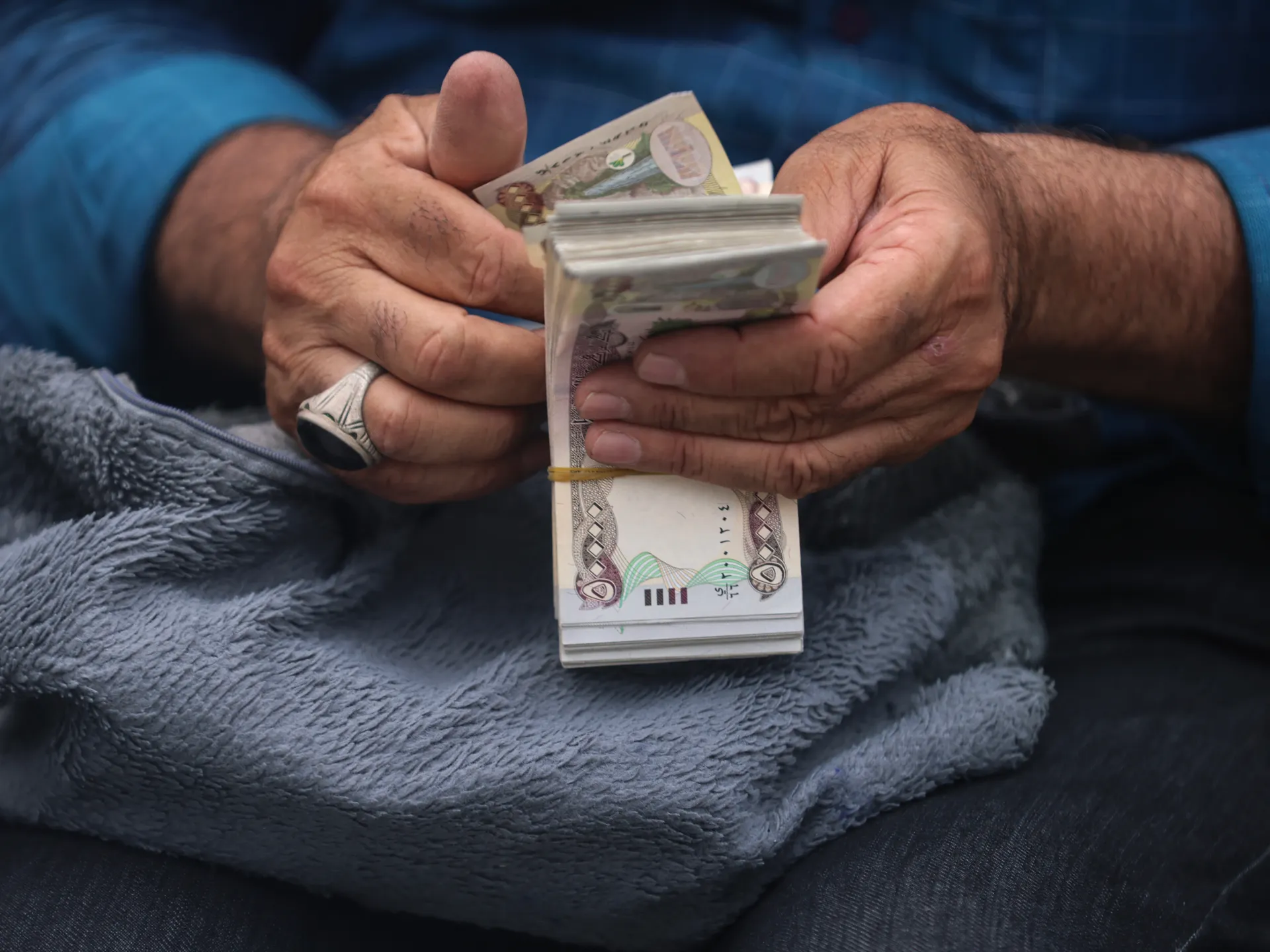
Government employees have also complained that the cash-strapped Yemeni government is paying salaries in low-denomination banknotes – mainly 100 riyals – forcing them to carry their wages in bags.
Munif Ali, a government employee in Lahj, took to Facebook to express his frustration, posting a video of himself sitting beside large, tightly packed bundles of 100- and 200-riyal notes that he said he received from the central bank. Munif, like many Yemenis on social media, said traders are refusing to accept large quantities of low-value notes. “Merchants are refusing to recognise this,” Munif said, referring to the stacks of 100- and 200-riyal notes in front of him. “Legal action should be taken against them.”
People who have kept their savings in Saudi riyals, the de facto currency in parts of Yemen, as well as Yemeni expatriates who send remittances in hard currency to their families, and soldiers paid in Saudi riyals, are among those most affected by the cash shortage.
Finding workarounds
To cope with cash shortages and the refusal of exchange firms to convert hard currency, Yemenis have adopted a range of workarounds. Some rely on trusted shopkeepers who allow delayed payments, while others exchange foreign currency at local groceries or supermarkets, often at lower, unfavourable rates. Banks and exchange firms have also introduced online money transfers, which have helped ease the crisis for some.
In rural areas, where internet access is limited and exchange shops are scarce, the problem is even more acute.
Saleh Omer, a resident of the Dawan district in Hadramout, told Al Jazeera that he received a remittance of 1,300 Saudi riyals sent from Saudi Arabia. But the exchange firm that handed him the money refused to convert it into Yemeni riyals, citing a lack of cash, and advised him to try nearby shops.
With the official exchange rate at about 410 riyals to the Saudi riyal, a shopkeeper agreed – after repeated appeals – to exchange only 500 riyals, and at a lower rate of 400. “I nearly begged the shopkeeper to exchange 500 riyals,” Saleh said. To convert the remaining 800 riyals, he added, he would have to return another day and go from one shop to another. “We are suffering greatly just to convert Saudi riyals into Yemeni riyals.”
Connections matter
Well-connected individuals are often better positioned than others to navigate the cash shortage, with some relying on personal contacts at banks and exchange firms to access cash. Khaled Omer, who runs a travel agency in Mukalla, said most of his business transactions are conducted in Saudi riyals or US dollars. But when he needs Yemeni riyals to pay employees or cover utilities, he turns to a trusted contact at a local exchange firm. “We work with a money exchange trader when we need riyals to pay salaries or meet basic expenses,” Khaled told Al Jazeera. “Exchange companies say they are facing a liquidity crunch.”
On social media, Yemenis say some patients have been denied medication as health facilities refuse to accept payment in Saudi riyals, while exchange firms decline to convert the currency into Yemeni riyals.
In Taiz, Hesham al-Samaan said a local hospital refused to accept Saudi riyals from a relative of a patient, forcing him to roam the city in search of someone to exchange the money to pay for treatment. “Is there any justice for the people, oh government? Will anyone hold accountable those who refuse to exchange currency and exploit people’s needs?” al-Samaan wrote in a Facebook post that drew dozens of comments from others reporting similar experiences, including being denied medical services because they did not have local currency.
For traders who import goods from Saudi Arabia, the cash crisis has become something of a blessing in disguise, as Saudi riyals are increasingly available at discounted rates. A clothing trader in Mukalla told Al Jazeera that he accepts payments in both Yemeni riyals and Saudi riyals, partly to attract customers and partly to secure the foreign currency he needs for his business. “As a businessman who sells goods in Yemeni riyals, I benefit from the cash shortage,” he said on condition of anonymity. “Exchange companies that need local currency I hold sell me Saudi riyals at lower rates.”
WASHINGTON — U.S. Immigration and Customs Enforcement acting director Todd Lyons, a key executor of President Trump’s mass deportations agenda, will resign at the end of May, federal officials announced Thursday.
Homeland Security Secretary Markwayne Mullin announced Lyons’ departure, calling him a great leader of ICE who helped to make American communities safer. Mullin said Lyons’ last day will be May 31.
“We wish him luck on his next opportunity in the private sector,” Mullin said in a statement. The Department of Homeland Security did not immediately respond to an email from the Associated Press asking why he is resigning.
Lyons, who was named acting director in March 2025, led the agency at the center of President Trump’s plans to reshape immigration to the U.S.
Under his leadership, the agency was granted a massive infusion of cash through Congress, which it used to expand hiring and detention capabilities, and it ramped up arrests to meet demand from the administration.
ICE was also central to a series of high-profile immigration enforcement operations in American cities, including Chicago and Minneapolis, a deployment that ended after backlash erupted over the deaths of two American protesters at the hands of federal immigration officers.
Stephen Miller, the president’s deputy chief of staff and the main architect of his immigration policy, called Lyons a “dedicated leader.”
“His courageous work at ICE has saved countless thousands of American lives and helped deliver safety and tranquility to millions of Americans,” Miller said in a statement.
White House spokesperson Abigail Jackson described Lyons in a post on X as “an American patriot who made our country safer.”
It’s not clear who might replace Lyons. But whoever does will take over an agency flush with cash while still a flashpoint for controversy. ICE is at the center of a battle in Congress, with Democratic lawmakers demanding restraints on immigration officers before agreeing to restore routine funding for DHS.
On Thursday, Lyons, along with two other top immigration officials, appeared before a House subcommittee to argue for his agency’s budget and faced continued scrutiny from lawmakers of ICE’s actions.
Lyons’ departure also comes as DHS is under new leadership after Trump fired former Secretary Kristi Noem, who led the department through the administration’s major immigration policy changes.
Mullin, who took over as secretary last month, is likely to continue to advance the president’s agenda but has struck a softer tone on some of the administration’s most contentious policies.
Public perceptions of ICE during Lyons’ tenure were low. In a February AP-NORC poll, most U.S. adults, including independents, said they have an unfavorable view of the agency.
Lyons faced questions in Congress over the shooting deaths of Renee Good and Alex Pretti and was asked if he would apologize for the way some Trump administration officials characterized Good as an agitator. He declined to do so.
“I welcome the opportunity to speak to the family in private. But I’m not going to comment on any active investigation,” Lyons said.
Lyons said he had seen video that captured Pretti’s shooting but said he could not comment, citing an active investigation.
Lyons, who joined ICE in 2007 as an immigration enforcement agent in Texas, signed off on a memo, first obtained by the Associated Press, that granted federal immigration officers sweeping powers to forcibly enter homes and make arrests without a judge’s warrant.
Trump’s border advisor Tom Homan described Lyons as serving selflessly and “a highly respected and effective acting Director of ICE.”
Goldenberg and Golden write for the Associated Press. Golden reported from Seattle.
WASHINGTON — Democrats who once saw retaking the U.S. Senate as a long shot in 2026 have newfound hope thanks to an unpopular president and a California donor machine that has snapped into action.
Californians provided the most out-of-state cash to Democrats in nearly every hotly contested race, and in several cases gave more than in-state donors, according to a Times analysis of campaign finance filings covering the first three months of 2026.
Sen. Jon Ossoff of Georgia, who took in more than $14 million overall, received nearly as much from California backers as from supporters in his home state among donors who contributed at least $200 and whose identities were disclosed.
James Talarico, a Democratic Senate candidate in Texas, has raised a staggering $27 million so far this year, with California donors contributing just under $1.2 million to back his campaign — second only to Texas supporters among those donors whose names were disclosed.
Donors who give less than $200 are not required to be identified in campaign finance reports and made up a significant share of the donors to Ossoff’s and Talarico’s campaigns.
Republicans currently have control of the Senate with 53 of the chamber’s 100 seats. This year 35 seats are at play, including special elections in Florida and Ohio.
GOP still winning a key cash race
While more of the seats up for grabs are in Republican hands, polling showing the potential for tight races in several of them has given Democrats hope that they might be able to shrink or reverse their deficit in November.
Top Democratic candidates have out-raised their GOP rivals in the most competitive Senate races, but Republicans are winning the cash race among big-money committees that can accept checks far larger than the $7,000 cap on donations to candidate committees.
Those Democratic candidates have continued a tradition of relying on donors in the country’s most populous state to bankroll their campaigns.
“California has been a rich gold mine for many a candidate and continues to be that,” said Michael Beckel, director of money in politics reform at Issue One, a bipartisan advocacy group.
Democratic Senate candidates in a few races raised more from California donors than from donors in their home states, according to campaign finance reports filed Wednesday.
Democratic former Rep. Mary Peltola of Alaska, who is challenging incumbent Republican Sen. Dan Sullivan, brought in nearly $900,000 from California donors who had contributed at least $200. Alaska donors contributed just over $520,000 to Peltola in the same time period.
Two of the three leading Democratic hopefuls in Michigan’s open Senate race, Rep. Haley Stevens and physician Abdul El-Sayed, reported taking in more from California donors than from donors in Michigan. California was the second biggest bank of support for the other top Democratic contender, state Sen. Mallory McMorrow.
And in Nebraska, independent Dan Osborn, who is challenging incumbent Republican Sen. Pete Ricketts, took in $80,000 more from disclosed California donors than from Nebraskans.
Dozens of California donors gave to at least five Senate candidates across the country, according to The Times’ analysis of the filing data.
Burbank playwright and screenwriter Winnie Holzman has donated to Democratic candidates in nine key races and said she has been inspired to give to them — and other candidates and political groups — because of concerns about the policies of President Trump’s administration and what she sees as its violation of the law.
“This isn’t just about who is in the Senate,” said Holzman, who wrote the script for the play “Wicked” and co-wrote its movie adaptations. “But if enough Democrats were in the Senate right now, there would be a lot more ability to push back on this.”
The impressive fundraising hauls by Democrats come with a significant caveat.
The two most prominent political committees that support Republican Senate candidates — the party-affiliated National Republican Senatorial Committee and the Senate Leadership Fund super PAC, have both outraised rival Democratic groups by a significant margin this cycle.
For the NRSC, an $11.5-million fundraising advantage since the start of 2025 has translated to a modest $2-million advantage in cash in the bank through the end of February compared with the Democratic Senatorial Campaign Committee.
But the Senate Leadership Fund, which can accept unlimited amounts of cash from donors, had $91.6 million more to spend at the end of March than the Democratic rival Senate Majority PAC.
And the pro-Trump super PAC MAGA Inc. had a stunning $312 million in the bank at the end of February.
Money raised by candidate campaign committees does, however, bring some advantages over money raised by other committees. Most significantly, candidates are able to buy advertising at cheaper rates than other political committees.
That is an important distinction in a year when advertising spending in Senate races is expected to top $2.8 billion.
The Senate map
While political analysts expect that Democrats will likely perform well in congressional races — with early signs pointing to a strong possibility that the party regains control of the House — winning control of the Senate would be a much taller order.
“The Senate is going to be won or lost in red states,” said Kyle Kondik, managing editor of Sabato’s Crystal Ball at the University of Virginia’s Center for Politics.
Even in the best-case scenario for Democrats, to retake control of the chamber they would probably need to win in at least two states such as Iowa, Alaska, Ohio or Texas, all of which went to Trump in the 2024 presidential election by double-digit margins.
With the vast sums likely to be raised — and spent — by both sides, Kondik said that fundraising can reach a point of diminishing returns.
“You’d rather have more than less, obviously, but the actual effect is pretty debatable,” he said.
And history shows that fundraising prowess doesn’t necessarily translate to electoral success in November.
Take the example of Texas Democrat Beto O’Rourke.
In his 2018 challenge of incumbent Republican Ted Cruz, O’Rourke brought in more than $80 million, more than double Cruz’s fundraising haul of $35 million.
But it wasn’t enough to put the then-congressman from El Paso over the top.
O’Rourke lost the race by about 2.5 percentage points.
SINGER Rochelle Humes made jaws drop as she confessed she made more cash from being in S Club Juniors than she did in The Saturdays alongside stars Frankie Bridge and Una Healy.
The businesswoman launched her career as a singer in 2001 when she joined S Club Juniors after being selected for the band on the reality TV show S Club Search.
Sign up for the Showbiz newsletter
Thank you!
Rochelle Humes confessed she made more money from S Club Juniors than in The SaturdaysCredit: Great Company with Jamie Laing / YoutubeThe Saturdays – Una Foden, Vanessa White, Frankie Bridge, Rochelle Humes and Molly King performing at Wembley Arena in 2014Credit: GettyRochelle joined S Club Juniors after auditioning on a reality showCredit: Getty
The juniors, who released their first single One Step Closer in 2002, accompanied S Club 7 on their huge tour as the supporting act.
After just three years in the girl band, Rochelle joined The Saturdays in 2008 and despite their chart topping success, the star revealed she made more money at the beginning of her career.
Speaking on the Great Company with Jamie Lang podcast, Rochelle said: “When I look back on it I made more money from S Club Juniors than I did in The Saturdays.”
Made In Chelsea star Jamie was so baffled by Rochelle’s revelation that she jokingly asked him to call Frankie Bridge, who was also in both bands, to confirm their experience.
Explaining why she thought she made more money from S Club Juniors, Rochelle said: “The music industry… the money just went out of it.
“It wasn’t the same space to be in anymore.”
The star added: “At the time your the chosen one, you never want to rock the boat because your like do you know how many girls would be whipping these extensions out ready to put them in their hair.
Rochelle joined S Club Juniors in the early noughties, when she was just 12-years-old, alongside Frankie Bridge, Aaron Renfree, Jay Asforis, Stacey Franks, Calvin Goldspink, Daisy Shelvey and Hannah Richings.
While the girl band was successful, The Saturdays were huge with 11 top 10 singles including All Fired Up and What About Us.
The 37-year-old explained that when she was part of The Saturdays she was paid a “salary” and was expected to live a certain type of lifestyle.
The singer told how when she was part of The Saturdays she was scared to ‘rock the boat’Credit: Great Company with Jamie Laing / YoutubeThe star told how most of her money came from brand deals before record labels started taking cuts of their profitCredit: Great Company with Jamie Laing / Youtube
But, most of her money actually came from brand deals and touring rather than the group’s singles.
“When someone says your record deal is X amount of money, that doesn’t mean that’s what we’re making. That means they’ll put this money into the album, pay these producers, the marketing budget,” she said.
Rochelle continued: “The tours and the brand deals was where you would make your money. The records weren’t for us. So we’d be the face of a shampoo and all have our own scent – that’s where we’d make our money.
“But then record labels changed their whole strategy…they would then also take a cut of the brand [deals], and then take a cut of the live performances. You’ve got to remember everything you earn, split that in half, basically with tax and an agent. And then there’s five of you. You’re expected to live a lifestyle that you can’t always prop up.”
During her candid interview with Jamie, Rochelle also revealed her uncle is an England footie legend.
Her uncle is none other than Paul Ince, who had 53 caps for England and played most notably for Premier League teams West Ham and Man United.
Paul was the first black player to ever captain the England team and later the first black British manager to coach in the highest tier of English football.
Stunning Rochelle has since pivoted from the music industry and has set up multiple businessesCredit: GettyPaul Ince (right) is Rochelle Humes’s famous England footie legend uncleCredit: Alamy
WASHINGTON — Democrats are struggling to come up for air after outside groups flooded their first round of midterm primaries with campaign cash.
As the Democratic Party fights to regain control of Congress, organizations affiliated with the American Israel Public Affairs Committee, cryptocurrency and artificial intelligence have dominated the airwaves, sometimes leaving candidates on the sidelines of their own campaigns.
Democratic pollster Zac McCrary said the primaries have “become proxy wars, and the candidates are almost afterthoughts in larger skirmishes.”
Now the Democratic National Committee is advancing a resolution at its New Orleans spring meeting to condemn the surge of spending that has scrambled its primaries and exacerbated tensions within the party.
Candidates who lost have pointed their fingers at special interests, blaming them for derailing their campaigns. Others who are still in the running are courting voters by denouncing deep-pocketed outside groups. Even those who have benefited from the spending have expressed concern.
“It’s definitely a brave new world,” McCrary said.
“We’re not talking about doubling of campaign expenditures,” he added. “We’re talking about 10 times or 20 times more.”
Dan Sena, a former executive director at the Democratic Congressional Campaign Committee, said party organizations are no longer the ones with the clout to push favored candidates.
“All that’s been completely smashed now,” Sena said. Even if Democrats regain control of the U.S. House, he warned that outside spending could damage the party in the long run.
Referring to House Minority Leader Hakeem Jeffries, he said, “You’re going to hand Jeffries a caucus that is divided.”
Democrats bear the brunt of big spending
So far this cycle, outside money in U.S. House races has largely targeted districts particularly friendly to Democrats, meaning the primaries will likely determine who will win the general election in November. After a record number of House members retired this year, many of those seats opened up for the first time in years, drawing dozens of Democratic hopefuls.
In Illinois, for example, there was more than $125 million in outside spending across five open Democratic primaries. In all but one of those congressional races, the outside spending exceeded candidate spending.
While it’s still early in the calendar, there are indicators that many more races could see big spending. Almost 40 seats have already seen more than $1 million in outside spending, according to Federal Election Commission filings.
In Illinois, the top three spenders in U.S. House races were groups affiliated with American Israel Public Affairs Committee, or AIPAC, according to AdImpact, which tracks ad buys in political races, followed by the cryptocurrency-affiliated Fairshake.
AIPAC was founded to support strong ties between the U.S. and Israel, a particularly controversial issue as Democratic hostility toward Israel rises over the war in Gaza. Some Democratic National Committee, or DNC, members wanted to call out AIPAC’s role in primaries, but the final resolution did not.
“We had various resolutions that focused on different industries and groups, and instead of going one-by-one, we passed a blanket repudiation,” DNC Chair Ken Martin said in a statement.
Campaign spending has divided Democrats
The latest DNC meeting marks another chapter in longstanding disputes between progressives and the party establishment.
Progressives want the party to adopt official language that all Democratic presidential contenders oppose money from dark-money groups, or super PACs that aren’t required to disclose their donors.
“It’s necessary that we actually have the party do something on this issue, not just say something,” said Larry Cohen, co-chair of Our Revolution, a progressive group founded by independent Sen. Bernie Sanders of Vermont, who caucuses with Democrats.
The resolution being advanced at the DNC meeting in New Orleans is viewed by progressives as a step toward that goal. However, some Democrats warn against weakening their candidates when facing a Republican Party that’s flush with cash.
“Provided that we don’t handcuff ourselves in the general elections — because if the Republicans are going to use dark money in general elections, we should be using our money in general elections, too — if you provide an even playing field, I think then that’s fine,” said Sen. Ruben Gallego, an Arizona Democrat. “But we just can’t be handcuffing ourselves in the general to lose races.”
Any DNC resolutions would not stop outside groups from surging funds into primary contests or general elections. But some Democrats believe the issue is core to the party’s values.
“We should eliminate any super PAC in a Democratic primary. And I think every presidential candidate in 2028 should pledge that they will not have any super PAC spending in a Democratic primary,” said Rep. Ro Khanna, a progressive and possible Democratic presidential contender who co-chaired Sanders’ 2020 presidential campaign.
“That should be a litmus test,” Khanna argued. “If you’re not willing to take that pledge, then you’re part of the problem.”
Askarinam, Brown and Sweedler write for the Associated Press. Brown reported from New York.
Residents in Indian-administered Kashmir are donating their gold possessions and cash to support Iranians impacted by the US-Israeli war. Iran’s embassy in India has acknowledged the gesture, saying their kindness ‘will never be forgotten’.
Emma Chawner, a legendary contestant on The X Factor, shared her impressive 16 stone weight loss journey amid the tragic loss of both her mum and dad as well as her dog
Emma Chawner first captured public attention aged just 17(Image: Manchester Evening News Syndication)
One of The X Factor’s most unforgettable contestants left fans stunned after revealing an astonishing 16-stone weight loss. Emma Chawner first captured public attention aged just 17 when she and her family had a memorable encounter with judges Simon Cowell, Dannii Minogue, Sharon Osbourne, and Louis Walsh after being turned away from the competition in 2007.
Now in her late 30s, Emma has achieved a stunning transformation, emphasising that her dramatic weight loss was accomplished entirely without surgery, as she revealed during a 2019 appearance on ITV’s Lorraine. Taking to Instagram at the time, Emma also shared striking before-and-after photographs, captioning one: “5years down and 16st 4 lost im still losing it but very slow now.”
Admirers were swift to praise her achievement, with messages including: “Fantastic, you look amazing,” and “You look so beautiful and pretty! Please remember weight can not be defined by age, weight, or gender. Your beauty has always shined through! I’m glad to see you! Bless you love!”
Speaking candidly to Lorraine, who had previously extended support to help her family tackle their weight struggles, Emma revealed that her motivation stemmed from the heartbreaking loss of her beloved pet dog and the emotional turmoil surrounding her parents’ separation. Tragically, Emma’s mother died aged 73 in January 2024, with her father passing away in December that same year.
Sadly, Emma was forced to start a GoFundMe in an attempt to raise £2,200 for her dad’s funeral, but only appeared to raise £820 through the website. At the time, she posted her appeal, saying: “I would appreciate any help towards he funeral because at time it’s really hard for me and to pay for it and I really want my dad to have a good send off any amount of money would be greatly appreciated.” Heartbreakingly, she continued: “I don’t have any family left people that know me I hate asking for help put this time i have no choice.”
In a candid conversation with Lorraine, Emma emphasised her weight loss resolve, stating: “No one’s pushed me to do it, I’ve done it all myself. I was always out of breath and diabetic.”
She refuted suggestions from doubters that she had undergone weight loss surgery and voiced her intention to shed a few more pounds, affirming: “I’m happy with how I am and it’s not far to go.”
Emma initially took a shot at fame on The X Factor in 2007 but was met with a firm rejection. Undeterred, she returned to the stage in 2009 alongside her sister Samantha, who married in XXX.
However, Emma faced another setback as she was handed four no’s from the judges, with Cheryl observing, “Emma, I have to say, you’re definitely more confident when you’ve got your sister with you. But nothing else has really improved unfortunately.”
With her singing aspirations momentarily put on hold, Emma participated in Lorraine Kelly’s Big Fat Challenge, a weight loss initiative. She continued her slimming journey after the show, attributing her success to a 30-day detox and healthy habits such as eliminating snacks and staying hydrated.
Prior to joining Lorraine’s programme and seeking advice from diet experts, Emma believed her size was due to genetics, asserting, “It’s not because of what I’ve eaten. It’s because of the genes in my family. Mum’s big, dad’s big, my sister’s big. No-one’s thin in our house.” She had previously been forced to live in a car after her family was reportedly booted out of their home.
There are few greater muses than one’s own childhood. In recent months, this idea has taken visual form across fashion runways, with brands from Chanel to Acne Studios showcasing childlike sketches, often referred to as ‘naive design’. The aesthetic favors deliberate roughness and mistakes over a sterile, polished sheen.
Book covers are the latest medium to embrace the trend. Scribbles, doodles, crayon marks and stickers — evoking Lisa Frank and anime cartoons — have begun appearing on prominent Gen Z contemporary fiction covers. The more childish and unrefined, the better.
The covers, which often accompany literary fiction written by women, signal a particular emotional register of naive, sticky chaos that youth promises. The visual language recalls a simpler time — a reclamation of an innocence lost. For millennials and Gen Z readers who worship collectibles like Labubus, friendship bracelets and butterfly hair clips, it’s natural that art direction would follow suit — sometimes with an ironic twist. Often, the design’s playfulness obscures the protagonist’s malaise.
The book cover trend, imbued with nostalgia for childhood, promises fiction that grapples with the pangs of adulthood in an age of precarity. In her Substack, cultural critic and novelist Natasha Stagg commented on the trend, noting, “Reverse-image searching these images turn up books on early childhood education, dealing with anxiety or migraines, or teaching a kid to color outside the lines as an artistic parent.” The book trend cover suggests collective angst about adulthood, highlighted by a cultural fixation on “girlhood” that sparked a spate of online think pieces in recent years.
It’s fitting, then, that the aesthetic has been adopted by Gen Z fiction writers like Honor Levy, whose paperback edition of “My First Book” includes girlish heart stickers on a hot pink background. The Y2K aesthetic elicits a young girl’s diary. Meanwhile, the 2025 novel “Unfit” by Ariana Harwicz, about a mother losing her children in a custody battle, uses erratic crayon scribbles on its cover. In the fall, McSweeney’s Quarterly Concern was contained in a binder with a Lisa Frank-style aquatic wonderland on the cover. This month, Cazzie David released a book of essays about early adulthood titled “Delusions: Of Grandeur, of Romance, of Process” with a cover resembling a child’s birthday cake.
(New Directions Publishing, Penguin Books)
Writer and culture critic Drew Zeiba noted the trend in his June 2025 Substack post. “I wonder if it represents a fed-up-ness with prior or concurrent trends in book design,” writes Zeiba over email. “A move away from the layered, the blobby, the clean — to something with more illusion of or allusion to an id.”
“Not for nothing, I assume adult coloring books sell better than literary fiction,” says Zeiba. “I’m struck by that in a way the crayon or marker drawing is provisional — there’s no final form to it.”
This January, novelist and Forever Magazine co-founder Madeline Cash released her highly anticipated debut novel, “Lost Lambs.” The story follows a family unraveling amid open marriages, conspiracy and emotional turmoil. Designed by Na Song, the cover features drooping blue crayon text and a small illustration of a girl.
The cover was heavily influenced by Henry Darger’s Vivian Girls. “I was attached to this Henry Darger painting when I was writing the book. I felt like that was a really accurate visual representation of little girls running away from utter chaos,” says Cash.
“The childish scribbling handwriting is also a red herring for some of the more serious and sinister themes in the book, “ says Cash.
“Having read Cash’s, I’m struck by the fact that the children in the book — and children are central to the book — are really insightful and transformative, and ‘lost lambs’ actually refers in the text to a specific group of adults,” adds Zeiba.
A similar artistic logic underpins Sophie Kemp’s breakout 2025 novel, “Paradise Logic,” which gained attention for its unsettling cover. The book cover is an existing painting by Brooklyn-based artist Naruki Kukita, selected by veteran art director Martha Kennedy with Kemp’s input. Kennedy had come across “Virtual Temptation in Eden” in a weekly art newsletter called “It’s Nice That.” The image invokes a children’s coloring book with darker undertones, blending various cartoon and drawing styles to depict Adam and Eve in paradise. A cartoon snake lurks behind them.
The design mirrors the memorable prose. “This novel showcased one of the most original voices I’ve ever read. I would describe it as a psychosexual fever dream,” says Kennedy. “I recall the editor calling it ‘the first true Gen Z novel.’”
Kemp recalls sending a lengthy email about the book cover inspiration. “I want something super maximalist. I want it to be a preexisting image. And I wanted to do something that is shocking or crazy,” says Kemp. Kennedy presented Kukita’s painting, and it was love at first sight for Kemp.
(New Directions Publishing, Simon & Schuster)
“Kukita’s combination of finely crafted painterly portraiture and flat graphic anime (often in very intense sexual combination) seemed like a perfect match for the tone of this novel,” says Martha Kennedy, who served as the art director at Simon & Schuster.
Then, enter Comic Sans typeface — a perfect dash of irony. “Let’s use a typeface that feels kind of wrong,” Kemp recalls prescribing. “I used Comic Sans for the first time in my 35-year career for the rest of the type. I felt that was some sort of weird pinnacle in itself,” Kennedy explains over email.
Kemp sees a thematic alignment between her and Cash’s book designs. “Mine and Madeline’s books are about naive female characters,” Kemp says. “It makes a lot of sense with the protagonist of my novel, who’s an extremely naive young woman, for the book cover to match that tone that I created.”
While working in marketing, Cash recalls another book cover trend she calls “book blob.” The blob was earth-toned and splashed bestselling covers for years. “With any kind of viral aesthetic: one of those books did well, so they engineered every cover to emulate that, because people were drawn to them,” says Cash. “It looks like all the content was the same and ubiquitous. It is a disservice to a lot of those books.”
“I really wanted it to stand out,” says Cash about her own cover.
Connors is a writer living in Los Angeles. She hosts the literary reading event Unreliable Narrators at Nico’s Wines in Atwater Village every month.