carves

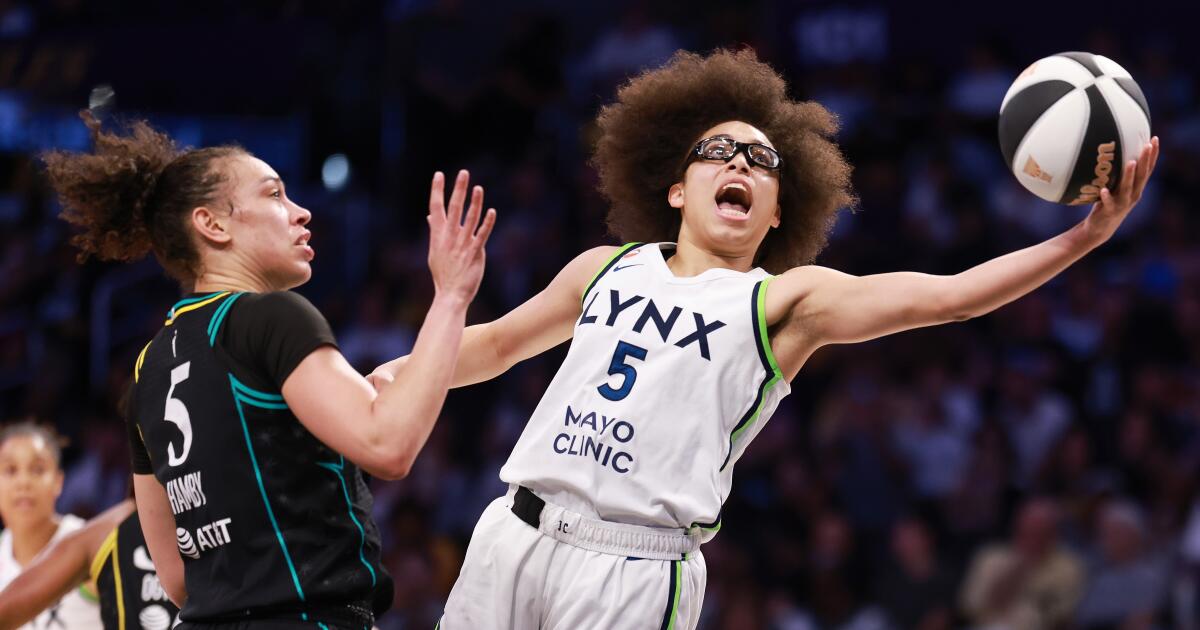
Olivia Miles carves up shorthanded Sparks, leads Lynx to a win

The Sparks’ defensive struggles continued on Wednesday during a 99-83 loss to the first-place Minnesota Lynx at Crypto.com Arena.

The Sparks (7-7) had trouble containing Lynx rookie Olivia Miles, who set a WNBA rookie record with 24 first-half points and finished with a career-high 31. Miles helped the Lynx (11-3) make a strong push for a spot in the Commissioner’s Cup championship, but the Las Vegas Aces snatched the final spot against the New York Liberty with a victory over Phoenix on Wednesday night.

Sparks guard Kelsey Plum, the WNBA’s leading scorer, missed the game with a lower leg injury. The team also played without forward Cameron Brink, who sprained her ankle on Monday.

Rae Burrell led the Sparks in scoring with 19 points, while Jihyun Park added 13 off the bench. Dearica Hamby was limited to 12 points and nine rebounds, while Nneka Ogwumike added 10 points and eight boards.

“I thought [Jihyun] was a bright spot. She is really smart out there and knows what she is doing,” Sparks coach Lynne Roberts said. “That’s what you need to do when you get those moments — you take advantage of it, and that’s what she did.”

With Plum and Brink out, Roberts said pregame that it would take a team effort to beat Minnesota, but it was a tough climb for four quarters.

The Sparks were nearly perfect in the first quarter before committing their first turnover with under five minutes to play. The turnover swung the momentum in Minnesota’s favor.

The Lynx erased the Sparks’ 7-3 lead — fueled by quick starts from Burrell and Hamby. Burrell scored 10 points by being aggressive in all areas and Hamby scored 10 of her 12 points in the first half.

Miles took a few minutes to get her feet wet. Once her shots started to fall, the Sparks struggled to contain her.

“She is good,” Roberts said about Miles’ performance. “She is talented. Like I said pregame, she is super skilled, and we were trying to mix things up. We didn’t execute exactly how we’d hoped to all the time, but you just have to tip your cap to her. She is a great player with a lot of skill.”

Lynx took their first lead with a jumper from Natasha Howard with 5:04 left in the first quarter. The lead changed frequently early, but the Lynx opened the second quarter with a 27-21 advantage.

The Sparks’ scoring trouble flared up in the second quarter just as Miles got hot. The Sparks were outscored 29-18 during the quarter and entered halftime down 52-37.

After trailing by as many as 20 points in the third quarter, the Sparks cut the margin to 10. Erica Wheeler sank two free throws to cut the deficit to 61-51 with 4:32 remaining in the third quarter.

The Sparks held Miles to five points during the third quarter, but the Lynx got 20 points from Nia Coffey and 15 points from Howard.

Fouls and turnovers crushed the Sparks’ rally. After Minnesota built a big lead, both teams cleared their benches late in the fourth quarter.

The Sparks haven’t beaten the Lynx at home since Aug. 21, 2018. L.A. is riding a two-game losing streak and will face Eastern Conference leader New York Liberty on Sunday at Crypto.com Arena. The game will feature a celebration of the WNBA’s 30th anniversary.

“We are going through adversity right now,” Roberts said. “We just got to get healthy.”

Source link

Tennessee lawmakers to vote on new U.S. House map sought by Trump that carves up Memphis

Republican lawmakers in Tennessee forged ahead with a plan Thursday that could carve up a majority-Black congressional district, reshaping it to the GOP’s advantage as part of President Trump’s strategy to try to hold on to a slim House majority in the November midterm elections.

Protesters shouted “No Jim Crow” outside the House and Senate chambers as lawmakers convened to consider the legislation. As the Republican-led House later voted for the new map, Democratic lawmakers locked arms at the front of the chamber while protesters yelled and made noise. A final vote in the Senate would sent the map to Republican Gov. Bill Lee, who called lawmakers into special session.

The redistricting effort in Tennessee is one of several rapidly advancing plans in Southern states as Republicans try to leverage a U.S. Supreme Court ruling that weakened the federal Voting Rights Act.

The court ruled that Louisiana relied too heavily on race when creating a second Black-majority House district as it attempted to comply with the federal law. The high court’s decision altered a decades-old understanding of the law, giving Republicans grounds to try to eliminate majority-Black districts that have elected Democrats.

Louisiana has postponed its congressional primary to give time for state lawmakers to craft a new House map. Legislation awaiting a final vote in Alabama also would upend the state’s congressional primaries if courts allow the state to change its U.S. House districts. In South Carolina, meanwhile, Republican lawmakers urged on by Trump have taken initial steps to add congressional redistricting to their agenda.

The states are the latest to join an already fierce national redistricting battle. Since Trump prodded Texas to redraw its U.S. House districts last year, eight states have adopted new congressional districts. From that, Republicans think they could gain as many as 13 seats while Democrats think they could gain up to 10. But some competitive races mean the parties may not get everything they sought in the November elections.

Tennessee Republicans act despite protests

As a first step to adopting new House districts, Tennessee lawmakers gave final approval Thursday to legislation that would repeal a state law prohibiting mid-decade redistricting. They then passed a bill that would reopen a candidate qualifying until May 15 to allow time for new people to enter the U.S. House primaries and existing candidates to switch districts or drop out.

The proposed House map would break up Tennessee’s lone Democratic-held district, centered on the majority-Black city of Memphis, creating a ripple effect of alterations to districts throughout the western and central parts of the state.

Republican House Speaker Cameron Sexton said the proposed districts were drawn based on population and politics, not racial data.

But Democrats dismissed such assertions.

“These maps are racist tools of white supremacy at the behest of the most powerful white supremacist in the United States of America, Donald J. Trump,” said state Rep. Justin Pearson, a Black Democrat from Memphis who is running for the U.S. House.

State Rep. Torrey Harris, another Black Democrat from Memphis, said he would lose part of his voting power as a result of the congressional districts.

“You cannot celebrate democracy while carving out Black communities,” he said. “We all know it, whether we say it or not, that this map impacts Black people negatively.”

Democrats noted that the state Supreme Court in April 2022 rejected a challenge to the current congressional map, finding it was too close to the election to make changes. This year, there’s even less time before the Aug. 6 primary, raising the potential of confusion for both candidates and voters, Democrats said.

A plan for a new primary advances in Alabama

Protesters watching an Alabama legislative committee Thursday erupted in shouts of “shame” as Republican lawmakers advanced legislation to authorize special congressional primaries if the state can put a new congressional map in place for the November midterms.

In the wake of the Supreme Court decision arising from Louisiana, Alabama is seeking to overturn a court injunction that created a second U.S. House district with a substantial percentage of Black voters. That map led to the 2024 election of Rep. Shomari Figures, a Black Democrat. Republicans want instead to use a 2023 map drawn by state lawmakers that would give the GOP an opportunity to reclaim Figures’ district.

If a court grants Alabama’s request, the legislation under consideration would ignore the May 19 primary results for congressional seats and direct the governor to schedule a new primary under the revised districts.

The House passed the legislation on a party-line vote Thursday after four hours of fiery debate. A final vote in the Senate is expected Friday.

South Carolina may add redistricting to its agenda

The South Carolina Senate could take up a resolution Thursday giving lawmakers permission to return later, after their regular work ends, to redraw congressional districts that could eliminate the state’s only Democratic-held district. The proposal, which passed the House on Wednesday, needs a two-thirds vote in both chambers.

Republican House leaders said after the vote that they plan to introduce a new map Thursday and hold committee meetings on Friday. But during debate Wednesday, Republicans fended off specific questions from Democrats, including why they were willing to stop the June 9 U.S. House primary elections well after candidates filed and how much a rescheduled primary could cost.

Democratic Rep. Justin Bamberg said he felt sorry for Republicans who, he said, were giving up their principles to follow the whims of Trump.

“The president of the United States is a very powerful man. Wields a heavy, heavy thumb — Truth Social, X, Meta, Instagram. To be honest I don’t envy our Republican colleagues,” Bamberg said.

Loller, Chandler, Collins and Lieb write for the Associated Press. Chandler reported from Montgomery, Ala.; Collins from Columbia, S.C.; and Lieb from Jefferson City, Mo. AP reporter Kristin M. Hall contributed to this report.

Source link