A federal judge on Tuesday seemed skeptical of a Trump administration request to immediately block California officials from counting about 20,000 ballots from voters whose citizenship the administration questions, but said he would not issue a ruling until Wednesday.
U.S. District Judge David O. Carter questioned how the administration had derived its list of suspect voters, worried about disenfranchising eligible voters, said the demands would represent a “monumental change” to California elections and suggested federal prosecutors bringing the case had other means of holding illegal voters accountable.
But just one day after a federal appeals court rejected the same request, Carter said at the conclusion of a 3½-hour hearing in Los Angeles that he needed more time to rule — except on one related issue.
“This court believes it would be wise — that it would be wise — that any threats to state and county elected employees cease immediately,” he said — a clear reference to federal authorities threatening elections officials with criminal penalties if they count any of the flagged ballots.
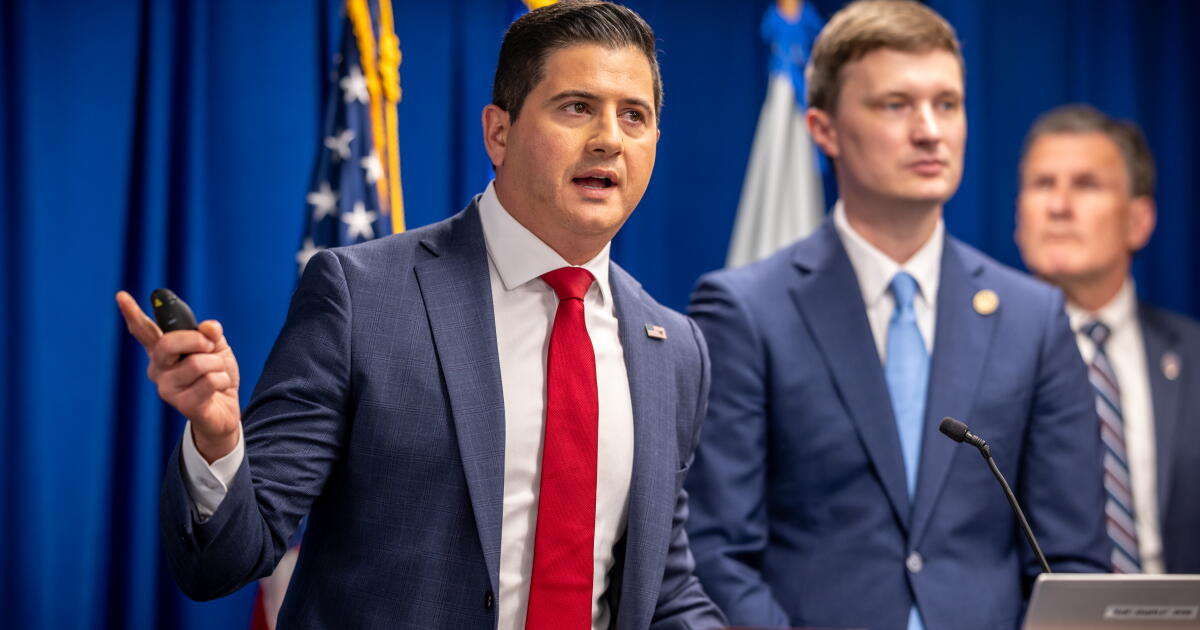
After the hearing, First Assistant U.S. Atty. Bill Essayli, the top federal prosecutor in Los Angeles who argued on behalf of the Trump administration, said he had made it “abundantly clear that American voters are being disenfranchised in real time,” and that the administration will wait to see what Carter says Wednesday but was likely to appeal the matter back up to the appellate court.
He also denied threatening state officials, despite the Justice Department having sent formal letters to election officials statewide last week warning them of criminal punishments, and Essayli reiterated that position Tuesday.
Carter’s hearing came after Monday’s decision from the U.S. 9th Circuit Court of Appeals — the reverse of what’s normal — because Justice Department attorneys had tried to go over Carter’s head after he didn’t acquiesce to a deadline they’d set for him to rule on their request for a temporary restraining order against the state last week.
However, when the three-judge appellate panel — composed of two appointees of President Trump and one of President Biden — ruled 2-1 Monday that it had no jurisdiction to hear the case given Carter hadn’t yet had the chance, the case returned to Carter’s courtroom.
And there, Carter — an appointee of President Clinton — seemed loath to rush to judgment, despite the Trump administration’s claims of urgency. He said the administration’s method for arriving at its list of potential noncitizen voters was unclear and that he would like to develop the record further, including by bringing in an expert for the court.
“What are these systems? What are the algorithms? How was this derived?” he said.
He also seemed unmoved by the Justice Department’s argument that the ballots must be segregated immediately to prevent noncitizen votes from being counted, and more focused on whether noncitizens who illegally vote can be identified and held accountable while avoiding disenfranchising legitimate voters in the process.
For those who do vote illegally, “you’ve got a remedy, for goodness sakes,” he told Essayli. “Go out and indict.”
The Justice Department sued California, Secretary of State Shirley Weber and Los Angeles County Registrar-Recorder/County Clerk Dean Logan on Oct. 15, two days after Acting Deputy Atty. Gen. Trent McCotter gave Weber and Logan 48 hours to set aside the ballots for the 20,000 flagged voters, whom McCotter described as “likely noncitizens.”
During the hearing, Essayli argued on behalf of the Trump administration that its demands on California and L.A. County were not onerous, could be complied with easily and did not call for ballots to go uncounted. Essayli said the federal government was in court “on a very narrow request for an injunction to separate ballots of those suspected of being noncitizens” only until the state can prove their citizenship.
He argued that the “reliability and credibility” of the federal government process for flagging the 20,000 voters is unquestionable — while also telling Carter, “We’re never going to stand here and tell you that everything is 100%.” He said every vote counts, as some elections “are decided by a handful of votes,” and that the federal government is simply asking California not to break existing federal law barring noncitizens from voting.
“We’re not telling California what they have to do. We’re telling them what they can’t do, which is just count these ballots without doing more to ensure whether they’re citizens or not,” Essayli said.
Essayli — who has aggressively sparred with California officials on social media for weeks — also argued to the court that the federal government has maintained a collaborative “tone” since first asking the state to segregate the ballots, and that he was surprised at how “adversarial” state elections officials have been on the issue.
Attorneys for Weber and the state said the Trump administration’s demand on the state “distorts several legal doctrines beyond recognition” and is clearly illegal, particularly during an ongoing election. They said the administration has provided no evidence that the 20,000 voters aren’t citizens, and has used “data and methods known to be unreliable.”
Michael Cohen, a deputy attorney general for the state, said the Trump administration questions California law that allows voters to attest to their citizenship under penalty of perjury, while ignoring the fact that standard was set not by the state but by Congress.
Anne Bellows, another deputy attorney general, said California has an established framework for running elections, and the Trump administration is trying to “sweep it off the table and replace it with a new, unclear procedure in which the federal government can issue a list and require California to change the way a subset of its voters’ ballots are received, and whether or not they are tabulated,” which she said was illegal and a “recipe for disenfranchisement” of thousands of legitimate voters.
“The stakes here are enormous,” she said.
Attorneys for Logan said the Trump administration has made its demands “without any credible argument” as to how it is legal, that the “proposed remedy” it is demanding from the state is “vague and unworkable,” and that if it wants to question California’s existing processes, “the proper audience for that argument” is Congress — not the federal court.
Several attorneys for voting and civil rights groups also argued against the Trump administration during the hearing, including by arguing that its reliance on third-party data sets — including from Lexis Nexis — was not a trustworthy way of identifying whether voters are citizens.
The litigation is just one part of a much wider battle by the Trump administration to intervene in state-run elections nationwide, and particularly in California, including on the notion that state elections have insufficient guardrails to prevent noncitizens from voting. Elections experts say such fraud occurs, but is exceedingly rare.
While the 9th Circuit panel’s unsigned ruling Monday rejected the Trump administration’s appeal for lack of jurisdiction, both judges in the majority — Mark J. Bennett, a Trump appointee, and Gabriel P. Sanchez, the Biden appointee — wrote independently to make clear that they would have rejected the case on its merits too.
They said it ran afoul of federal law barring interventions in voting in the immediate lead-up to elections, and the U.S. Constitution, which reserves control of elections for the states and oversight for Congress, not the executive branch.
Judge Patrick J. Bumatay, the other Trump appointee on the panel, also wrote independently in dissent — arguing the federal government must “have the power to stop this potential attack on the integrity of our elections.”
Carter previously rejected an administration lawsuit demanding California’s unredacted voter rolls as “unprecedented and illegal” — a decision similar to those made by dozens of other federal judges in other states. Federal prosecutors recently charged 28 lawful permanent residents in California with election-related crimes, including illegally registering to vote. Some of those charged expressed confusion, said they had no recollection of registering or had never voted.
There are more than 23 million registered voters in California.
Last week, Justice Department officials sent letters to election officials in counties across California demanding they sequester any flagged ballots in their jurisdictions, and warning them that they could face criminal penalties if they don’t. State officials denounced the letters as a legally baseless intimidation tactic.
Federal judges also have slapped back executive orders in which President Trump demanded new nationwide voter ID and citizenship requirements, and blocked a Trump administration plan to empower the U.S. Postal Service to vet mail ballots for the first time.
Beyond the courts, Democrats and voting rights groups have been strategizing for months on how to prevent the Trump administration from interfering in the midterm elections, which will determine control of Congress. The Trump administration has said it is merely trying to enforce the law and ensure that noncitizens do not illegally vote and negate the ballots of U.S. citizen voters.